Hosea and Israel’s Fall
What happened to Israel?
The majority of preachers and teachers today, unfortunately, don’t know the Biblical answer to this simple question. Yet when the Biblical name of Israel is making headlines almost every day, it’s unwise to be ignorant about what’s happened to the nation God created.
Many people believe that God’s given up on Israel and replaced the nation with the church today, but that’s far from Biblical, and it makes a mockery of God’s promise to them, which directly challenges the veracity of God’s Word.
“Speed Slider”
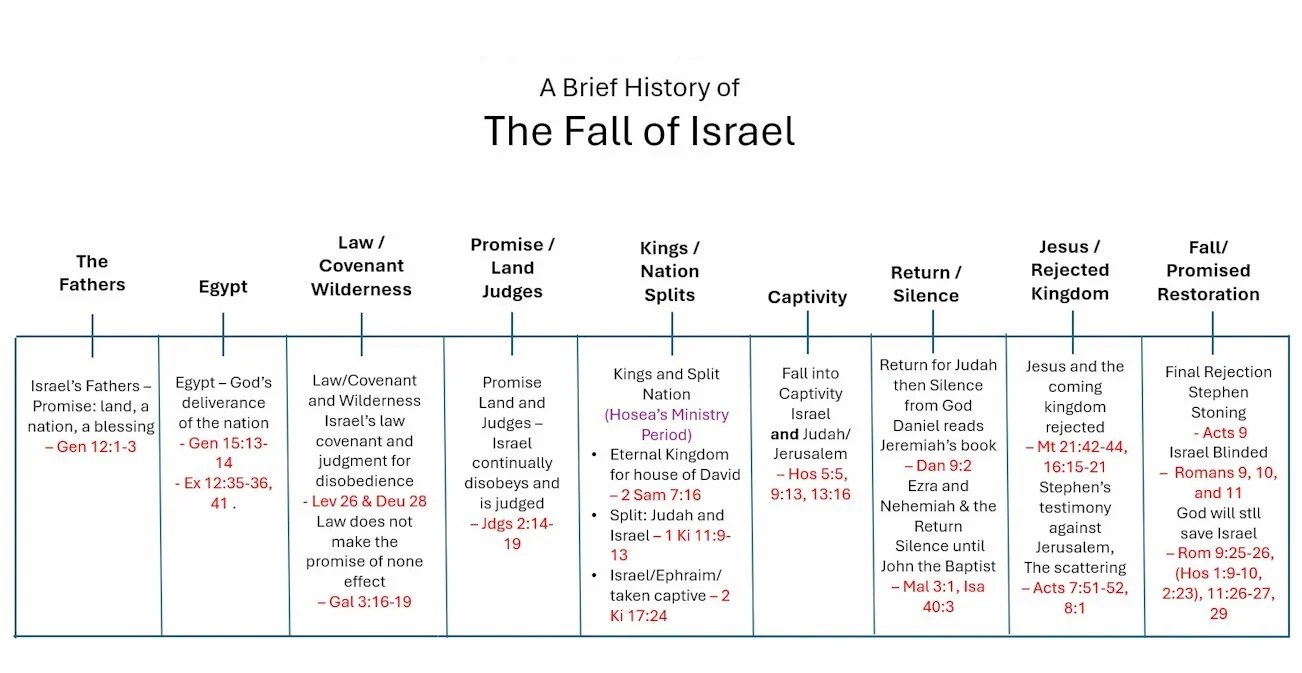
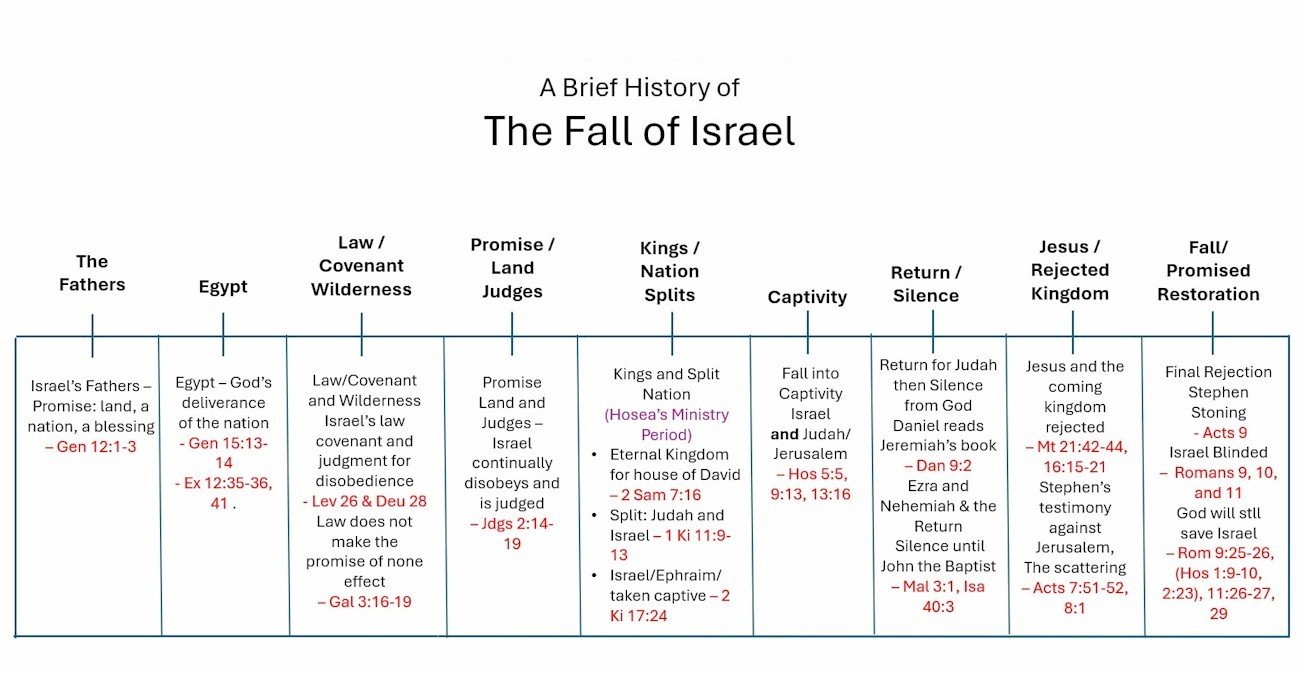
Press or tap the image to open large version
Hosea and Israel’s Fall – Transcript
What happened to Israel?
The majority of preachers and teachers today, unfortunately, don’t know the Biblical answer to this simple question. Yet when the Biblical name of Israel is making headlines almost every day, it’s unwise to be ignorant about what’s happened to the nation God created.
Many people believe that God’s given up on Israel and replaced the nation with the church today, but that’s far from Biblical, and it makes a mockery of God’s promise to them, which directly challenges the veracity of God’s Word.
Many other people believe that the name Israel is a figure of speech for the church today. They say Israel’s not been given up on by God because we ARE Israel. However, this requires these folk to have an extremely loose and allegorical view of most of the Bible. But if we can’t accept the words of God in plain speech, then the gospel is hid from all of us, and who can interpret such an impossible riddle?
If the church, the body of Christ today, is not the Israel of the Bible, and God is able to keep his promises, then we need to answer the question of ‘what has happened to the nation Israel’?
Over many hundreds of years of prophecy, it was prophesied that Christ would come to the lost sheep of the house of Israel and that they would reject him. In fulfilment of that prophecy, Christ came to preach the coming and the offering of the kingdom to Israel, as God had promised them way back in Genesis chapter 15 through Abraham.
Israel rejected his message of faith and repentance to the point of crucifying him on a cross.
In this act, prophecy was also fulfilled, as Romans 9:33 says, which quotes prophecy from Isaiah 8:14-15:
Behold, I lay in Sion a stumblingstone and rock of offence: and whosoever believeth on him shall not be ashamed
The crucifying of the Messiah, and the stumbling of Israel at the cross, wasn’t a secret. Peter preached it in his first letter, 1 Peter 2:8:
And a stone of stumbling, and a rock of offence, even to them which stumble at the word, being disobedient: whereunto also they were appointed.
Peter continued to proclaim repentance and forgiveness of sins to the nation Israel, as we see in Acts 2:38. According to prophecy, a remnant of this nation would suffer through the coming tribulation of those latter days under the protection of the Holy Spirit. The result would be a refined Israel where only the righteous remained, and we see this clearly in prophecy through Isaiah 4:3-5. This righteous remnant of the nation would enter the kingdom and fulfil the promise of the rise of Israel among the Gentiles as further prophesied in Isaiah 62:1-2.
But the tribulation did not occur, and Israel is not dominant and greatest among all nations.
So, if we, the church, aren’t the Israel of the Bible, and God does keep his promises, then what has happened to the nation of Israel?
The answer lies in the knowledge of the revelation of the mystery given to the apostle Paul, as we see in Romans 16:25 and Ephesians 3:1 and many other places.
This secret information’s not found anywhere among the prophetic writings because, as Ephesians 3:9 explains, it was hid in God from the beginning of the world.
The subject of this mystery information involved at least six distinct changes in God’s dealings with man, and one of them is the temporary fall of Israel.
In Romans 11:11 Paul writes this, speaking of Israel,
I say then, Have they [Israel] stumbled that they should fall? God forbid: but rather through their fall salvation is come unto the Gentiles, for to provoke them to jealousy.
Prophetic writings given to Israel continually prophesied Israel’s rise to superiority over the Gentile nations. It was the Gentile nations that would eventually come to Israel and seek the God who created the universe, as passages like Zechariah 8:22-23 tell us.
And yet, it was kept secret that also through the fall of Israel salvation would come to all men. This information was not known in the prophetic scriptures, as we learn in Romans 11:25,
For I would not, brethren, that ye should be ignorant of this mystery, lest ye should be wise in your own conceits; that blindness in part is happened to Israel, until the fulness of the Gentiles be come in.
In this age, God has counted Israel in unbelief among the Gentiles so that he could have mercy upon all men freely, as Romans 11:32 and Romans 3:24 say. Now there’s neither Jew nor Greek, and we ‘know no man after the flesh’ Galatians 3:28 and 2 Corinthians 5:16. We all are able to obtain the peace of God through Jesus Christ.
Israel will not always be blinded, and their prophecies won’t go unanswered.
Scripture very specifically addresses the issue of Israel’s return. In the same statement that we’re told of Israel’s fall, we are told of their future return: Romans 11:12,
Now if the fall of them be the riches of the world, and the diminishing of them the riches of the Gentiles; how much more their fulness?
And Romans 11:26,
And so all Israel shall be saved: as it is written, There shall come out of Sion the Deliverer, and shall turn away ungodliness from Jacob:
It’s clear that at some time in the future, God will restore Israel and fulfil the prophecies concerning their rise and their earthly dominion under God, but it won’t occur until this age of grace, where there’s no national separation before God, is complete.
However, in this age, where the whole world has become guilty before God, Israel is counted among the Gentiles in unbelief. As a result, we can all freely receive God’s mercy through Jesus Christ by faith apart from any special national standing before God. The lack of recognition of this dispensational change regarding Israel has led to so many false ideas concerning politics and foreign affairs with that nation.
What we can learn from the revelation of the mystery is that during this age, this dispensation of grace, God has counted Israel in unbelief and in need of the grace of God just as the other nations, as Romans 11:32 points out,
For God hath concluded them all in unbelief, that he might have mercy upon all.
Over ninety per cent of the Bible speaks about God’s prophetic purpose for Israel as the ‘praise in the earth’, as per Isaiah 62:7. Then all of a sudden, they seem to just drop away. Nothing seems to happen concerning Israel for nearly two thousand years!
This has led many students of the Bible to believe that God has given up on Israel. Certainly, according to human logic, if God had intended that the physical nation Israel would go into a physical prophesied kingdom, it would’ve happened by now.
This view seems to have a ring of truth to it, since Jesus said the kingdom of heaven is ‘at hand’ and ‘nigh’.
What about the fulfilled prophecy in Acts 2 concerning the last days? Surely those couldn’t have been the final days of the universe because we’ve obviously survived another two thousand years since then.
For those who are unaware of the current age of unprophesied grace, the only intelligent answer is that God’s given up on Israel and turned his grace towards the church.
Many teach that the early Jewish church was taught by God through Cornelius and Paul; that he has given up his national dealings with Israel in exchange for something that affects everybody on earth, not just one nation, Israel.
As a result, Israel’s promises become spiritualised, and the church becomes an allegory, a symbol of the Old Testament promises.
But this viewpoint is laden with error, and it ignores the plain reading of Scripture.
There’s an immovable truth about God. He cannot lie!
Numbers 23:19 says,
God is not a man, that he should lie; neither the son of man, that he should repent: hath he said, and shall he not do it? or hath he spoken, and shall he not make it good?
Titus 1:2 says,
In hope of eternal life, which God, that cannot lie, promised before the world began;
However, the Devil, the opposer of God, is the father of lies (John 8:44). But when God speaks, we can be sure it’s truth and that He’s perfectly able to do what He says.
And, speaking to Israel, God says in Isaiah 46:10-11,
Declaring the end from the beginning, and from the ancient times the things that are not yet done, saying, My counsel shall stand, and I will do all my pleasure.
I have purposed it; I will do it.
It was this same God who promised Israel that they’d be the glory of God forever and a crown of glory in the hand of God, as in Isaiah 46:13
I will place salvation in Zion for Israel my glory.
And Isaiah 62:3.
Thou shalt also be a crown of glory in the hand of the LORD, and a royal diadem in the hand of thy God.
It was in the middle of Israel’s rebellious blasphemy towards God that he made these promises to dwell among them forever, as in Ezekiel 43:4, which reads,
…Son of man, the place of my throne, and the place of the soles of my feet, where I will dwell in the midst of the children of Israel for ever, and my holy name, shall the house of Israel no more defile…
And Jeremiah 31:36,
If those ordinances depart from before me, saith the LORD, then the seed of Israel also shall cease from being a nation before me for ever.
Surely, when God said he would dwell in the midst of Israel, he didn’t mean Australia or America or Europe or China. The plain reading of these prophecies proves the presence of Israel as a nation with a position before God.
In Romans, Paul describes the fall of Israel from its prophesied position before God after they stumbled at ‘that stumbling stone’ mentioned in Romans 9:33. The result of that stumbling is Romans 11:32
For God hath concluded them all in unbelief, that he might have mercy upon all. God has counted Israel in unbelief as the other nations.
Even so, God has not given up on the nation of Israel or their prophecies. Even today, Israel can be saved according to grace in the same manner as all men, as Titus 2:11 says, but not according to prophecy. Today, Jews according to the flesh, those of natural Jewish heritage, don’t receive a special status because of that heritage. Instead, if they trust the gospel of Christ today, they’re saved apart from their promises in prophecy.
Paul labels himself as a Jew saved ‘out of due time’ in 1 Corinthians 15:8 because he was saved purely by the grace of God and not into a kingdom through his law-keeping.
Paul stops talking about the Israel of prophecy when he begins to talk about Israel according to the revelation of the mystery concerning their blindness. We see that in Romans 11:25,
For I would not, brethren, that ye should be ignorant of this mystery, lest ye should be wise in your own conceits; that blindness in part is happened to Israel, until the fulness of the Gentiles be come in.
Directly following the statement concerning this unprophesied period, Paul explains the continuing of prophecy, and its fulfilment in Romans 11: 26.
And so all Israel shall be saved: as it is written, There shall come out of Sion the Deliverer, and shall turn away ungodliness from Jacob:
When Paul says that all Israel will be saved, he means all believing Israel. The unbelieving portion of the nation will be destroyed at the Second Coming of Christ, as Zechariah 13:8-9 states. Only those who call on His name will be spared to enter the kingdom.
In due time, the salvation of Israel according to age-old prophecy will be fulfilled, but not in this age of the dispensation of grace we live in today.
The only way to understand why God gave special prophecies to Israel, but then was silent for such a long time, is to see that God intervened in His own timeline, making an interlude, an interruption of that timeline to introduce a new period of grace. God showed this to Paul as we see in Galatians 1:11–12 and Titus 1:3 and many other places.
Understanding this dispensation of grace, the mystery revealed, is essential for the salvation of all men. It’s the only explanation and instruction God gives, through Paul, by which all men can be saved.
According to prophecy, salvation was to be found flowing from Israel, the nation to whom salvation was given (John 4:22, Isaiah 46:13).
Today, our salvation is offered to all men through Jesus Christ directly.
God has not given up Israel, but He has counted them in unbelief so that He could have mercy upon all, Jew and Gentile, offering free justification in the Lord Jesus Christ (Romans 3:24).
In the future, God will reestablish his prophetic purpose with Israel, fulfilling the prophecies concerning the nation He created, but not until His purpose in the mystery church, the Body of Christ, is complete.
So what does this all have to do with Romans and Hosea?
Well, we’ve just seen how Paul explains in Romans chapters 9–11 that Israel has fallen. But we can’t fully understand this without seeing the beginning and the unfolding of it through the Old Testament, and Hosea unfolds this relationship between God and Israel in one of the most powerful depictions of all the Old Testament prophets.
Israel pursued righteousness by the law, not by faith, and stumbled at Christ, the “stumbling stone”.
When we come to the prophecy of Hosea, we’re coming to one of the great books of the Bible and to a man who was a remarkable prophet.
Hosea prophesied in the northern kingdom at the same time as Isaiah, Micah, and Amos. Hosea and Amos were prophets in the northern kingdom, Isaiah and Micah in the southern kingdom.
Hosea compares in many respects to Jeremiah. Jeremiah was the last prophet before the southern kingdom went into captivity; but more than a hundred years before that, Hosea was a prophet in the northern kingdom. He, like Jeremiah, warned the nation of its impending captivity.
Both men spoke out of heartbreaking personal experience. Hosea’s experience was in the home, while Jeremiah’s was in the nation. Jeremiah loved his nation, and it broke his heart to give them such a harsh message as he did, but God chose a very tenderhearted man for the job.
Hosea was probably not as tenderhearted as Jeremiah. He came from a broken home with a broken heart.
Hosea was married to Gomer.
His wife was unfaithful to him and was a harlot, but He loved her so much that he went back and took her again. And again she played the harlot. Coming from this experience, this man walked out before the nation of Israel and said, “I want to tell you how God feels about you, because I feel the same way. I have had this personal experience in my own home.” Because this man’s heart had been broken, he could speak God’s message to his nation with great power and meaning.
The first three chapters of Hosea are personal: the story of the prophet and his faithless wife, Gomer. They were the scandal of his home and the gossip of the town.
From then on in Hosea, we don’t see much about his private and personal life.
The emphasis shifts to the Lord and the faithless nation of Israel, which has been playing the harlot.
Out of the heartbreaking experience in his own home, Hosea speaks to the nation—and he knows how God feels about them. God has said, “They have sinned. They have played the harlot and been unfaithful to Me.”
God spells out certain charges against them and proves those charges. The message of Hosea is that Israel is guilty of lawlessness, immorality, ignorance of God’s Word, and idolatry.
We can compare this chapter with the first chapter of Isaiah, in which Isaiah speaks to the southern kingdom, spelling out God’s charge against that nation.
Israel was God’s chosen people, yet, like Hosea’s Gomer, they broke His heart.
In Romans 10:3, Paul says Israel tried to establish its own righteousness instead of submitting to God’s, causing God to describe them as “a disobedient and gainsaying people” in Romans 10:21.
But, as we’ve also seen, God had a secret, a mystery, which he revealed to the apostle Paul, that Israel’s fall brings salvation to the Gentiles (Romans 11:11–12).
Their blindness is temporary, lasting only “until the fullness of the Gentiles be come in” (Romans 11:11:25).
In Romans 9:25–26, Paul quotes Hosea to show that God will again call Israel “my people”. Paul’s using prophecy from Hosea 1:9–10 and Hosea 2:23. He declares, “all Israel shall be saved”, all believing Israel, in Romans 11:26–29. God’s promises to Israel—a land, a kingdom, a nation—are irrevocable; nothing can change them, even God Himself, because He promised it and He cannot violate His Word.
Prophecy describes Israel’s future rise through the New Covenant. Jeremiah 31 says God will make a new covenant “with the house of Israel and the house of Judah,” writing His law in their hearts and forgiving their sins. Hebrews 8:8 quotes this same passage, confirming it’s Israel’s covenant, not the Gentiles’.
Ezekiel 36 expands this promise: God will gather Israel from all nations, cleanse them, give them a new heart and spirit, and cause them to walk in His statutes. They will dwell in the land given to their fathers, and God will be their God.
Jeremiah 23:6-7 promises Israel’s future king—the “righteous Branch” of David—who will reign in justice. In this King’s days, “Judah shall be saved, and Israel shall dwell safely.”
So while Israel is fallen now, their fall brings Gentile salvation. Yet prophecy guarantees Israel’s future restoration, their New Covenant, their land, and their King, Jesus Christ the Lord, who’ll be to them the Lord our righteousness.
Isaiah 61:1–4 describes the future restoration of Israel.
The Spirit of the Lord anoints the Messiah to preach good news, heal the brokenhearted, proclaim liberty, and announce “the acceptable year of the Lord.” And remember that when Jesus was reading this Scripture in the synagogue in Luke 4:17-20, he stopped reading at that point even though the sentence doesn’t finish there. There’s a comma after that, and the next line reads, “and the day of vengeance of our God”. That section of the verse belongs to His future return.
Isaiah continues saying that God will comfort Zion, give beauty for ashes, raise up desolations, and rebuild waste cities. This is Israel’s promised restoration.
Hosea 6:1–3 echoes the same hope:
He hath torn, and he will heal us… after two days will he revive us; in the third day he will raise us up.
Hosea shows that although God judged Israel, He will revive and restore them.
The book of Revelation shows the fulfilment.
In Revelation chapter 19, Christ returns, depicted riding on a white horse, conquers the nations, and establishes Israel’s kingdom. Revelation 20:4 describes saints reigning with Christ for a thousand years. After the millennium comes the great white throne judgment, and then the eternal kingdom. Revelation 21:1–3 shows the new heaven and new earth, and the New Jerusalem descending where God dwells with His people, fulfilling His promises.
To understand how Israel reached this fallen state, we look back to their history.
God began with a promise to Abraham (Gen. 12:1–3): a land, a nation, and blessing. The promise passed to Isaac and Jacob, whose twelve sons became the nation of Israel.
Genesis 15 foretold Israel’s time in Egypt—four hundred years of affliction—followed by deliverance. Exodus 12 records their departure with great spoil, exactly as God promised.
After leaving Egypt, Israel received the law, but immediately fell into idolatry with the golden calf incident.
Their unbelief continued when they refused to enter the promised land, leading to forty years of wandering in the wilderness.
Israel’s fall began early in the life of the nation and continued throughout their history, and is declared by Paul in Romans 9–11. Yet prophecy assures their future restoration, their kingdom, and their King—Jesus Christ, the Lord our righteousness.
After Israel left Egypt, God gave them the law through Moses to teach them how to live in the promised land. Leviticus 26 and Deuteronomy 28 warned that if Israel disobeyed, God would judge them in stages. There were five stages of punishment, with each stage harsher than the previous one.
Israel did disobey, and God carried out exactly what He said. Yet Paul teaches in Galatians 3:16–17 that the law, given 430 years after the promise God made with Abraham, can’t cancel that covenant promise. Israel’s failures can’t undo God’s promise; He will still raise them in the future.
When Israel finally entered the land under the leadership of Joshua, they quickly fell again.
They failed to remove the nations God told them to remove, and those nations became a snare. After Joshua died, Israel repeatedly turned to idols. Judges 2 describes the cycle: Israel sinned, God delivered them to enemies, God raised judges to save them, and when each judge died, Israel became even more corrupt. Their fall was long and continual.
Eventually Israel demanded a king, rejecting God as their true King. God allowed it and gave them Saul, then David, then Solomon. God promised David an everlasting throne in 2 Samual 7:15–16, guaranteeing Israel’s future kingdom. But Solomon’s idolatry brought judgment. In 1 Kings 11, God declared He would tear the kingdom from Solomon’s son, Jeroboam.
The nation split through civil war: Judah in the south, and the ten northern tribes—called Israel, Ephraim, or Samaria—in the north.
This split created the background for Hosea.
The northern tribes became deeply corrupted. Later, when Israel was taken captive, foreign peoples were brought into Samaria and lived in the houses Israel had built, as we see in 2 Kings 17:24. These mixed peoples became known as Samaritans.
Hosea prophesied during this period of division and decline, before the northern kingdom fell to Assyria.
Israel’s fall didn’t begin in Romans 9–11; it began early in the nation’s history and continued throughout that history. Paul simply declares the final result: Israel is fallen, yet God’s promises stand.
Prophecy guarantees their future restoration, kingdom, and King—Jesus Christ.
Israel’s continued disobedience brought exactly what God warned in the law: He walked contrary to them, removed them from the land, and sent them into captivity. Hosea prophesies this judgment—Israel’s kingdom would end, they would be carried captive to Assyria, and their land would become desolate.
Hosea 5:5 declares,
Israel and Ephraim shall fall… Judah also shall fall with them.
Hosea 9:13-16 describes the severe judgment on the northern tribes—Ephraim and Samaria—because they persisted in rebellion. Their kings continued in Jeroboam’s sin, maintaining false temples and golden calves so the people would not return to Jerusalem. This idolatry defined the northern kingdom’s history until God removed them entirely.
Unlike Jeremiah, Hosea doesn’t give a timetable for Israel’s return. He promises restoration but doesn’t say when.
Jeremiah, however, gives a clear prophecy of seventy years for Judah’s captivity.
Daniel understood this by reading Jeremiah, which we see in Daniel 9:2. Jeremiah 29:10 and 25:11–12 state that after seventy years in Babylon, God would bring Judah back.
Cyrus later issued the decree allowing their return, and the people rebuilt the temple and the city wall, which is recorded in the books of the prophets Ezra and Nehemiah.
After this restoration, God is silent until John the Baptist – the period known as the silent years between Malachi and Matthew. This silent period, where God would not speak to Israel, was foretold in prophecy.
John the Baptist was the messenger foretold in Malachi 3:1 and Isaiah 40:3. Mark chapter 1 quotes both prophets.
John prepares the way for the Lord, and then God Himself comes to Israel in Jesus Christ. But Israel repeats its history: they reject God, reject His kingdom, and crucify the Messiah, the Christ. Jesus warns in Matthew 21:42–44 that the stone the builders rejected becomes the head of the corner, and the kingdom will be taken from unbelieving Israel.
Thus Israel’s fall in Romans chapters 9–11 is the culmination of a long history of disobedience—from the law, through the judges, through the kings, through the split kingdom, through captivity and through their rejection of Christ. Yet God’s promises remain, and prophecy guarantees Israel’s future restoration.
Paul calls Jesus the stumbling stone in Romans chapters 8 to 11—the One over whom Israel fell.
Israel rejected their King even after centuries of correction, then exile, partial restoration, prophetic silence, and finally the arrival of John the Baptist and Christ the King Himself.
In Matthew 16, Peter confesses Jesus as “the Christ, the Son of the living God.” Jesus explains that the “rock” is who He is, the cornerstone Israel rejected, not Peter. Israel stumbled because they sought righteousness by the law rather than faith. Like most people today, they rejected God, believing they were actually righteous in themselves.
This rejection is highlighted by God’s dealings with the Samaritans, a people the Jews despised. Their presence becomes a testimony against Judah’s unbelief. In Luke 17, ten lepers are healed, but only one returns to glorify God—and he is a Samaritan. In Luke 10, the “Good Samaritan” shows compassion while Israel’s religious leaders fail. In John 4, Jesus offers living water to a Samaritan woman, revealing Himself as the Messiah while His own nation remains blind.
These accounts show God working among those whom Israel considered unworthy, exposing Judah’s spiritual failure. Jesus warns in Matthew 21:42–44 that the stone the builders rejected becomes the head of the corner, and the kingdom will be taken from unbelieving Israel and given to a nation producing its fruit.
Israel’s final national rejection occurs in Acts chapter 7.
Stephen, a devout man of God, rebukes them, saying, “that they do always resist the Holy Ghost. They reject the prophets, the Son, and now the Spirit.” Their reaction is that they stone Stephen to death, and persecution scatters the believers into Judea and Samaria, as we see in Acts 8:1.
Philip preaches in a Samaritan city, and many believe—another testimony against Judah’s unbelief.
This scattering marks Israel’s third strike in their five courses of punishment and their final fall results.
Paul—formerly Saul, present at Stephen’s death—later declares in Romans 9–11 that Israel is fallen, yet God will one day raise them again. Prophecy guarantees Israel’s future restoration, kingdom, and King, Jesus Christ.
So, there’s a brief history of Israel throughout the Bible, and that’s going to set the context for our study of Hosea.
God Bless you all.