

Hosea 4:1-19 – No Knowledge in the Land
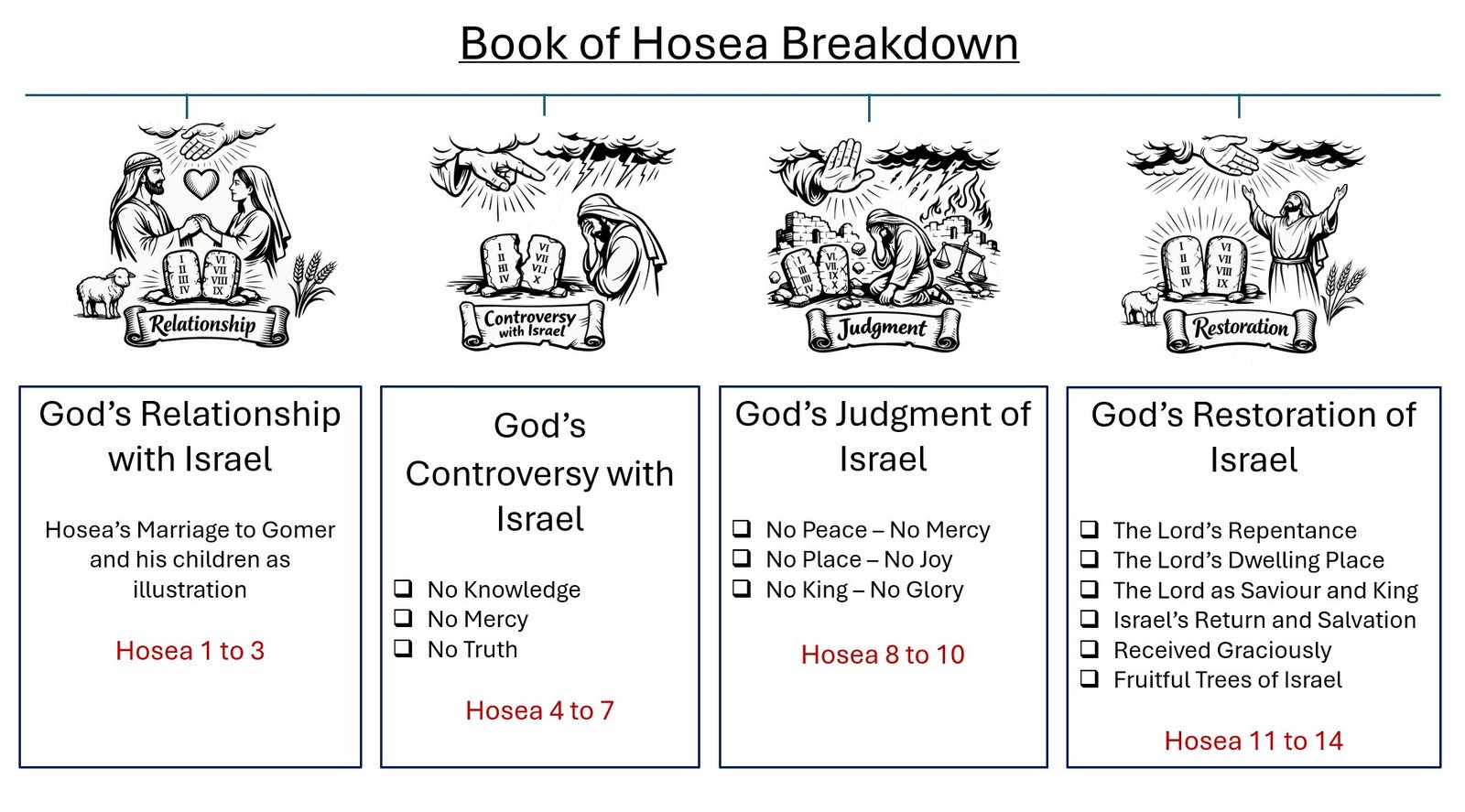
Now we’re in Hosea chapter 4, and from chapter 4 onwards, the focus shifts away from Hosea’s family.
This shows us that the book’s not mainly about Hosea, Gomer, or their children. Gomer and the marriage were only the opening illustration to show how God is moved by Israel’s rejection of Him.
The marriage illustration is the most powerful picture there could be to show God’s heart, and it makes it easy to imagine that hurt and pain, and yet, I suppose, the people who understand it best are those who have experienced the same thing.
“Speed Slider”

Press or Click to Open Larger Image
Modern Israel Versus Prophetic Israel
Hosea 4:1-19 – No Knowledge in the Land – Transcript
The real subject of the book of Hosea is Israel, her rejection of the Lord, the controversy God has with her, the judgment that follows, and the promise that, in the end, He Himself will cause her to return and be His people again.
Hosea 4:1 opens the chapter with,
HEAR the word of the LORD, ye children of Israel: for the LORD hath a controversy with the inhabitants of the land, because there is no truth, nor mercy, nor knowledge of God in the land.
This makes the true audience clear: it’s not Hosea’s household, but the nation of Israel.
The phrase “the word of the Lord” appears here for the first time since chapter 1 and reminds us that these are God’s own words, not Hosea’s opinions. Scripture repeatedly claims divine authority, and Hosea 4 is one of those claims. This is one of the many proofs that the Bible is the Word of God because, to even be considered the Word of God, the text has to claim it, and the Bible claims to be God speaking all through it. This is the word of the Lord God.
Notice that the “Lord” who’s speaking here is the capital L-O-R-D, l o r d. This is Jehovah, Yahweh, the Almighty God Himself. It’s God’s word!
God declares that He has a controversy with the inhabitants of the land.
Throughout the prophets, a “controversy” isn’t a casual dispute as we’d most commonly use that word today; it’s a formal legal charge. Webster’s dictionary describes its connection to written legal contention. It says that a dispute is commonly oral, and a controversy is in writing. A dispute is generally a debate of short duration, a temporary debate; a controversy is often oral but sometimes continued in books or in law for months or years.
In the Bible, a controversy is similar to a lawsuit. God’s bringing covenant charges against Israel, not random complaints or a petty pouting because of something that was said.
Deuteronomy explains the covenant terms Israel is breaking, so this controversy becomes a key background for understanding Hosea’s message. In fact, it’s key to understanding all the prophets, knowing that Israel and God are in a covenant that’s the greatest, most powerful covenant that’s ever been in existence on earth and breaking even a word of it attracts the most serious of consequences.
Deuteronomy 17:8 describes how controversies were handled when a matter was too difficult for ordinary judgment.
If a matter arose that was too difficult to handle “between blood and blood, about violence, plea and plea, accusations, or stroke and stroke, injuries” and the local judges couldn’t settle the case because the disputes were too serious, the matter had to be taken to the priests and Levites, who acted as judges. They were required to judge according to the law (Moses’ law), then teach the law, and declare the sentence.
Their authority came through the judges from God, and refusing their judgment was a serious offence in itself. This shows that proper judgment requires knowledge, and the priests were responsible for knowing and applying God’s law.
When God Himself brings a controversy, He always does it based on the covenant, those all-important promises that were made between Himself and Israel in an eternally binding agreement.
Throughout Hosea chapters 4–7, God lists specific violations, proving His charges just as a plaintiff has to provide evidence to a court.
Hosea 4:1–2 summarises the issue, the controversy, that God has with Israel: “There is no truth, nor mercy, nor knowledge of God in the land.” Then Hosea 4:2 says,
By swearing, and lying, and killing, and stealing, and committing adultery, they break out, and blood toucheth blood.
There is swearing, lying, killing, stealing, and adultery—each of which is a commandment from the law that’s been broken.
Swearing doesn’t mean using profanity. It’s using false oaths, or perjury, calling God as witness to something untrue and using God’s name to manipulate or deceive. It means taking oaths in God’s name falsely, making promises you don’t keep, or invoking God to support a lie. Saying, “God told me to do this or that” falls into the same category. It’s a direct violation of the Third Commandment: “Thou shalt not take the name of the LORD thy God in vain.”
Lying, killing, stealing, and committing adultery all break the commandments. Five of the Ten Commandments are summarised here.
So, Hosea 4 introduces God’s formal covenant case, His controversy against Israel and why this controversy’s legitimate. If you bring a lawsuit to court, you have to prove that what you’re bringing has valid evidence, and this’s exactly what God does. Chapters 4 to 7 reveal the evidence, the consequences, and ultimately the promise that God will restore His people after judgment.
God charges that there’s “no truth, no mercy, and no knowledge of God in the land”.
These three themes unfold through chapters 4–7: “no knowledge” in chapter 4, “no mercy” in chapter 5, and “no truth” in chapters 6–7. So here in chapter 4, we’re going to find out about no knowledge.
Jesus later brings a similar charge in Matthew 23:23, rebuking Israel for omitting “judgment, mercy, and faith,” which mirrors Hosea’s accusations because faith is the knowledge of God, so Christ’s controversy matches the earlier one Hosea describes.
Hosea 4:2 shows the results of lacking truth, mercy, and knowledge, which are swearing, lying, killing, stealing, and adultery. These are not small failings but direct and constant violations of the commandments. Their sins multiply—“blood touches blood”—meaning one sin leads to another without restraint, leading to nonstop violence, one killing flowing into another, all showing how deeply Israel’s sin has corrupted the land.
Jesus describes the same pattern in Matthew 23:34–35, where Israel kills the prophets sent to correct them. Stephen says the same in Acts 7, and Paul repeats it in 1 Thessalonians 2:15: Israel killed the Lord, killed their prophets, and persecuted the apostles. God sends truth, but they reject it, and the violence continues.
Because of this, Hosea 4:3 says,
Therefore shall the land mourn, and every one that dwelleth therein shall languish, with the beasts of the field, and with the fowls of heaven; yea, the fishes of the sea also shall be taken away.
The punishment affects everything: people, beasts, birds, and even fish. The land will become desolate, not the peaceful inheritance God intended.
Later chapters expand this punishment: in chapter 8 the people languish, in chapter 9 they lose the land, in chapter 10 they lose their king. Hosea 11–14 will eventually describe how God Himself will restore them, but first the controversy and sentence must be declared.
In Hosea 4:4, God says,
Yet let no man strive, nor reprove another: for thy people are as they that strive with the priest.
According to Deuteronomy 17:9-10, the priest was the judge.
To strive with the priest was to reject God’s judgment, and the penalty was death.
Israel argues with the judge because they lack knowledge and fear of God.
Hosea 4:6 says, “My people are destroyed for lack of knowledge.” See, they can’t judge rightly, yet they challenge God’s verdict, much like people today who accuse God of injustice while either ignoring or having no knowledge of their own sin and the need for judgment and punishment for it.
Hosea 4:5 declares the outcome,
Therefore shalt thou fall in the day, and the prophet also shall fall with thee in the night, and I will destroy thy mother.
Israel will fall.
Their fall will be public —“in the day”—and even the prophets will fall “in the night,” because they walk in darkness. True prophets like Isaiah saw God’s light and glory, but these false prophets that are operating at this time have no revelation and no understanding, so their fall will be unseen and spiritually dark. This is Hosea describing the way things will be as the time of judgment approaches.
God also says, “I will destroy thy mother,” meaning He’ll remove the corrupt kingdom of Israel, the nation that raised its people in idolatry and spiritual whoredom. Remember this is the northern kingdom. Hosea 1 already said the kingdom would end and the king would be removed. Israel, the “mother,” has led her children into sin, so God will take away the nation itself.
God’s controversy is based on the covenant, His charges are proven, and the sentence will be carried out. The chapters ahead explain this fall in detail before turning to the hope of the restoration that God promises.
In Hosea 4:6, God begins addressing the first major charge: Israel has no knowledge of God. It reads,
My people are destroyed for lack of knowledge: because thou hast rejected knowledge, I will also reject thee, that thou shalt be no priest to me: seeing thou hast forgotten the law of thy God, I will also forget thy children.
“My people are destroyed for lack of knowledge.” This is not general ignorance, a lack of general knowledge, but the rejection of God’s Word and God’s will.
When this popular verse is preached today, the slant is towards, “You should know more things, get more education”. But God’s talking specifically about the knowledge of the Lord here. It’s not just, “I know who God is, or just knowing He exists, even though that’s good knowledge to have. But here, they don’t care to know what He said or what His will is. They don’t care to know Him.
The “knowledge of God” means knowing His commandments, His covenant, and His revealed will. That’s why Hosea begins with “Hear the word of the Lord”—because they’ve stopped listening.
If Hosea 4 were preached today, most people would reject it, because people prefer messages about personal blessing rather than God exposing sin. Israel did the same.
Israel knew the laws of the Lord. They were being taught by the priests, and if they did those laws, there wouldn’t be the destruction. There wouldn’t be the judgment.
They didn’t want to know the Lord, and so destruction came from God Himself. We today can sympathise with Israel to a certain extent, because in the flesh none of us wants to know the Lord.
Romans 8:7 says.
The carnal mind is enmity against God.
Paul’s making the point that the flesh, meaning our fallen nature, is not neutral. It’s hostile to God. It resists Him, opposes His will, and cannot submit to His law.
Proverbs 9:10 says,
The fear of the LORD is the beginning of wisdom: and the knowledge of the holy is understanding.
God gave Israel His law so they could know Him, but either the priests weren’t teaching it, or the people weren’t listening, and we’ll see here both were true.
Proverbs teaches that the wise seek knowledge, but fools feed on foolishness.
Israel fed on idolatry and worldly thinking instead of God’s truth. Proverbs 18:15 says,
The heart of the prudent getteth knowledge; and the ear of the wise seeketh knowledge.
Israel rejected it. Rejecting knowledge is rejecting God, because wisdom and knowledge come from Him, as Proverbs 1:7 says,
The fear of the LORD is the beginning of knowledge: but fools despise wisdom and instruction.
Therefore God says in Hosea 4:6, “I will also reject thee.”
Israel was meant to be a nation of priests, and the priests were supposed to teach the law.
Malachi 2:7 says the priest’s lips should keep knowledge, but in Hosea’s day they did not. When priests fail to teach truth, the people can’t know truth. The same principle applies today: when teachers neglect God’s Word, congregations become ignorant.
God established clear vehicles for instruction in Israel: priests to teach the law, parents to teach their children, and leaders who understood doctrine. This entire system collapsed because the nation rejected the knowledge of God.
Hosea 4:6 says, “Thou hast forgotten the law of thy God,” so God declares, “There shall be no priest to me.”
Israel’s leaders did not know the law, and the people followed them into ignorance. So God says, “Thou shalt be no priest to me.” They can’t represent Him because they don’t know Him.
In judgment, God says He’ll forget thy children, Israel’s, the mother’s children, Israel’s people. He’s not forgetting His covenant promises, but refusing to hear their cries during the period of punishment.
Deuteronomy warns that if Israel turns aside to other gods, God will shut up the heavens, the land will fail, and they’ll perish from the land. Hosea 4:3 reflects this exactly when it says the land mourns, the people languish, and judgment falls because they forgot the covenant.
God told them to bind His words on their hands and foreheads, teach them constantly to their children, and write them on their doorposts.
If they obeyed, He’d multiply their days in the land and drive out their enemies. Every place they walked would be theirs, and no man could stand before them. But He also set before them a blessing and a curse. Hosea 4 shows they chose the curse.
Israel didn’t merely “forget” the law; they rejected it. As a result, God must keep His covenant by bringing judgment. He’d shown patience, but faithfulness to His own Word requires Him to act.
Hosea 4:7-11 is God’s case against the priests, saying,
As they [the priests] were increased, so they sinned against me: therefore will I change their glory into shame.
They eat up the sin of my people, and they set their heart on their iniquity.
And there shall be, like people, like priest: and I will punish them for their ways, and reward them their doings.
For they shall eat, and not have enough: they shall commit whoredom, and shall not increase: because they have left off to take heed to the LORD.
Whoredom and wine and new wine take away the heart.
The more the people sinned, the more sin offerings the priests greedily received. They actually enjoyed the benefits of the people’s sins, such as taking bribes and eating the sin offerings, and they relished Israel’s wickedness.
There’s no doubt that the priesthood of Israel was corrupt.
According to 1Kings 12:31 and 1Kings 13:33, Jeroboam, the first king of the northern kingdom, had made priests from the lowest of the people who weren’t even the sons of Levi.
Jeroboam didn’t pass a written statute saying “worshipping Yahweh in Jerusalem is illegal,” but his actions in 1 Kings 12 made obedience impossible and made disobedience mandatory.
In response to this state-sponsored idolatry, we see what happened in 2 Chronicles 11:13-16.
Large numbers of true priests, true prophets, and, quote, such as set their hearts to seek the LORD God of Israel, left the northern kingdom.
They refused to live in a kingdom where worshipping God as He commanded was against the law.
This meant that since the days of Jeroboam, the southern kingdom of Judah was made up not only of the tribes of Judah and Benjamin, but also of a godly remnant from all the ten northern tribes.
Spiritually speaking, Israel was struck twice – by the ungodly religion of Jeroboam and by the departure of the godly and faithful. There were few godly people left in the northern kingdom.
These priests may have thought they’d be immune from the judgment coming upon Israel. After all, they were priests! But God promises that when it comes to judgment, like people, like priest.
So, like people, like priest, they were both corrupt.
Their punishment would be their enslavement to harlotry, wine, and new wine, indulging and never becoming satisfied.
God says He’ll “change their glory into shame.”
Israel gloried in wealth, in their own religion, and in their kingly dynasty—yet God would remove their king, their peace, their prosperity, and finally their land.
Even the things God Himself gave them to glory in—land, law, salvation, hope—would be taken away. Without a kingdom, without deliverance, without future hope, Israel would become no different from any other nation. Their glory would become their shame because they rejected the knowledge of God.
Everything good Israel possessed came from God—land, prosperity, multiplication and blessing. Yet in Hosea 4 they turn against Him, rejecting truth, mercy, and knowledge. Because they refuse what He gave, He’ll punish them. But Hosea’s final chapters promise that God Himself will one day bring them back, restore the land, be their salvation, and be their King.
Their future hope depends entirely on Him.
Just to explain what Hosea 4:8 means when he says,
They eat up the sin of my people, and they set their heart on their iniquity.
Under the law, priests were required to eat certain offerings, including the sin offering of Leviticus 6. Eating the offering symbolised the priest receiving the sin and mediating before God. It was part of their holy duty and also their livelihood. But Hosea exposes the corruption: while performing the ritual, their hearts were set on sin. They were mediators in outward appearance but hypocrites in reality. People instinctively know this is wrong—how can a priest handle sin offerings while living in iniquity? It makes the sacrifice meaningless.
So Hosea 4:9 declares, “Like people, like priests,” meaning the priests are no better than the sinners bringing the offerings, and when the judges of Israel become corrupt, God Himself becomes the Judge: “I will punish them for their ways and reward them for their doings.”
Malachi 2 gives the same condemnation. God tells the priests that if they will not give glory to His name, He will curse their blessings, corrupt their seed, and even spread the dung of their feasts upon their faces. Sacred things become defiled because the priests themselves are defiled. God reminds them that His covenant with Levi required truth, knowledge, and holiness—yet they rejected it.
Hosea 4:10 continues the punishment: “They shall eat, and not have enough; they shall commit whoredom, and shall not increase.”
Their sin offerings once fed them, but now God will remove satisfaction. Their immorality will not produce increase.
Micah 6:14 echoes this judgment: “Thou shalt eat, but not be satisfied.” Hosea already said the land will mourn and the people will languish. God will remove abundance and peace.
Leviticus 26 explains these curses. Israel is now experiencing the fourth stage of covenant punishment: if they refuse earlier corrections, God says, “I will walk contrary unto you.”
We explain the 5 courses of punishment in our two introductory episodes on Hosea.
This matches Hosea’s message: “You reject knowledge, I will reject you.” Earlier punishments were lighter, but now God Himself becomes their adversary. They’ll not be His priests, and they’ll not be His people. Judgment is the covenant consequence for rejecting His Word.
When God says throughout Hosea, “You are not my people,” this is more than a warning. It’s covenant language announcing the loss of all the benefits of being God’s nation. In Leviticus 26, God had already said that if Israel rejected His law, He would “walk contrary” to them and punish them “seven times” for their sins. Hosea is declaring that this stage of judgment has arrived.
Leviticus 26:25–26 describes the punishment: God will bring a sword, send pestilence, deliver them into the hand of their enemies, break the staff of their bread, and make them eat without satisfaction. Hosea repeats these same consequences, showing he is applying the covenant curses exactly as written. The prophets never speak randomly; they declare what God already revealed in the law.
Jesus did the same—nothing He taught contradicted what had already been foretold in the Old Testament through the prophets.
Hosea 4:11 says, “Whoredom and wine and new wine take away the heart.”
Their sin and drunkenness remove their heart from God. Instead of finding joy in the Lord, they seek pleasure in immorality and drink. Isaiah 28 gives the same picture: Ephraim’s “glorious beauty” becomes a fading flower because they’re “overcome with wine.” Even the priests and prophets “err through strong drink.”
The leaders who should have taught truth are drunk and corrupt. This mirrors modern situations where judges or leaders lack discernment because they lack knowledge. Israel’s judges were no different.
Proverbs repeatedly warns about these same dangers.
Proverbs 23 says a whore is a deep ditch and wine leads to perverse speech, foolishness, and self‑destruction. Hosea’s statement that wine and whoredom take away the heart is simply applying the wisdom God had already given. Proverbs teaches that wisdom begins with fearing the Lord, but Israel rejected His knowledge, so their behaviour followed their corrupted understanding.
Evil communications corrupt good manners, and corrupt doctrine produces corrupt living.
Paul echoes this in Romans 13:14: “Make not provision for the flesh.” Israel was doing the opposite—feeding the flesh instead of seeking God. Ephesians 5:18 says, “Be not drunk with wine, but be filled with the Spirit.” Israel was filled with wine and idolatry, not with God’s truth. Their lack of knowledge led to moral collapse, and their moral collapse confirmed their lack of knowledge.
Philippians 4:4–7 teaches believers to rejoice in the Lord, pray with thanksgiving, and guard their hearts and minds through Christ. The heart and mind are where faith, truth, and the knowledge of God reside. Hosea 4 shows Israel’s destruction came from a lack of knowledge, and the result is that they’ll lose their land, livelihood, and blessings because they broke the covenant God made with them.
Let’s go to Hosea 4:12, which says,
My people ask counsel at their stocks, and their staff declareth unto them: for the spirit of whoredoms hath caused them to err, and they have gone a whoring from under their God.
Israel seeks guidance from idols made of wood and carved staffs. These “stocks” refer to tree trunks used to form idols and groves. Instead of seeking the Creator, God’s people seek counsel from objects they made with their own hands. God forbade graven images, yet Israel worships nature and man‑made gods.
Habakkuk 2:19 condemns this same idolatry: “Woe unto him that saith to the wood, Awake; to the dumb stone, Arise.”
People carve wood, overlay stone with gold, and then treat it as if it’s alive. Habakkuk says plainly, “There is no breath in them.” Do we today in our highly technical world indulge in these seemingly ancient practices? Of course! People sell crystals and hang feathered “dream catchers” in their cars and houses, maintaining that they carry spiritual or energetic power that can influence their lives. There’s a huge range of wooden objects today that people treat as sacred, such as carved idols, spirit trees, charms, statues, crucifixes and ritual tools, believing the wood carries spiritual power or divine presence. People lap it up just as they’ve done for centuries.
Modern technology shows similar patterns where people take elements from the earth, shape them, overlay them with metals, and then speak of artificial “life.” Scripture reminds us that only God gives breath.
Isaiah 44:16-18 sharply exposes the foolishness of idolatry. A man cuts down a tree, burns part of it to cook his meal, and uses the rest to make a god. He bows to the leftover wood and says, “Deliver me, for thou art my god.” Isaiah says they “have not known nor understood.” Their eyes and hearts are shut, and they can’t see the contradiction: the same wood that roasted their dinner cannot save them. They lack knowledge and understanding.
Jeremiah 10 gives another warning: “Learn not the way of the heathen.”
The nations fear signs in the heavens and worship carved trees decorated with silver and gold. These idols must be nailed upright because they can’t move. Jeremiah says, “Be not afraid of them; they cannot do evil, neither also is it in them to do good.” Idols have no power. Only the Lord is great and mighty. Jeremiah calls idol‑makers “brutish”—lacking knowledge and wisdom.
Jeremiah 10:14 says, “Every man is brutish in his knowledge… his molten image is falsehood, and there is no breath in them.” People become foolish because they don’t know God. Scripture answers the deep questions of human nature—life, consciousness, wisdom—because God created these things.
Without His knowledge, people fall into superstition and idolatry.
Jeremiah 10:21 says, “The pastors are become brutish,” meaning they lack knowledge.
This is a serious problem because pastors and priests are supposed to know God’s will and teach it. When leaders are ignorant, the blind lead the blind—just as in Jesus’ day. If a pastor says he doesn’t know God’s will, he certainly can’t help anyone else know it.
Jeremiah says such leaders “have not sought the Lord; therefore they shall not prosper, and all their flocks shall be scattered.”
Deuteronomy 6 commanded Israel to love the Lord with all their heart, soul, and might. They were married to the Lord by covenant, yet they turned aside to other gods. God warned them repeatedly: “Take heed… that your heart be not deceived, and ye turn aside and serve other gods” (Deuteronomy 11:16). But they did exactly what He said not to do, proving the sinfulness of the human heart.
To Hosea 4:13 now, which reads,
They sacrifice upon the tops of the mountains, and burn incense upon the hills, under oaks and poplars and elms, because the shadow thereof is good: therefore your daughters shall commit whoredom, and your spouses shall commit adultery.
They sacrifice on mountains and burn incense under oaks and poplars because they’re religious, but they worship the wrong god. Many people today do things “in the name of God” without knowing the true God. That’s why correct doctrine matters—worship without knowledge is vain.
Deuteronomy 12 commanded Israel to destroy pagan worship sites and not imitate the other nations.
Yet Israel turned sacred places like Bethel and Gilgal into centres of false worship.
In Deuteronomy 16:21, God even forbade planting groves near His altar because He hates idolatry. “Groves” refers to clusters of trees set up as sacred places where people performed idolatrous worship.
They worship under trees “because the shadow thereof is good.” They choose worship based on convenience and personal comfort, not obedience.
Jeroboam encouraged idolatry by offering “easier” worship locations so people wouldn’t need to travel to Jerusalem. The shadow was pleasant, the trip shorter—but God had forbidden it. What they didn’t know, or chose not to know, destroyed them.
Romans 1 says people worship the creature rather than the Creator. Israel did this by worshipping nature and man‑made idols.
God wanted worship in the open, in the light, at the place He chose—not hidden in groves. Their lack of knowledge led them to serve other gods, and their hearts were deceived.
Worship is simply serving what you consider most important. Israel served idols; Do we, as believers today, consider Christ, who is God manifest, as the most important part of life?
Hosea 4:13 warns that Israel’s idolatry will lead directly to literal whoredom: “Therefore your daughters shall commit whoredom.” The connection is simple but sobering. When Israel chooses worship based on convenience—“because the shadow thereof is good”—they teach their children that pleasure, material goods and personal preference override God’s commands.
If the parents serve false gods for comfort, thinking they’re doing good, their children will follow the same pattern in their own choices. Idolatry produces moral collapse. The Bible shows this repeatedly: spiritual adultery leads to physical adultery. People commit fornication because they don’t serve the true God and have invented a god who approves their feelings and desires. Without the knowledge of God and His law, they create their own morality.
Hosea makes this cause‑and‑effect clear.
Wrong worship leads to wrong living. A culture filled with adultery, fornication, and sexual confusion is a culture without knowledge of God. Worship requires knowing God’s will. If people don’t know His will, they won’t serve Him, and their choices will reflect that ignorance.
Hosea 4:14 says
I will not punish your daughters when they commit whoredom, nor your spouses when they commit adultery:
When God says He’ll “not punish your daughters when they commit whoredom,” He doesn’t mean they escape judgment, but that the deeper blame lies with the priests and leaders who taught false worship. The daughters learned their behaviour from the religious system itself.
God’s real accusation is against the priests and the people who corrupted worship. They sacrificed with harlots; they learned immorality at the place of worship.
This principle applies universally, through the ages, right down to today.
People focus on the symptoms of society that cause —abortion, homosexuality, adultery and all manner of crime—but Hosea points to the root cause: lack of knowledge of God.
If church assemblies today twist God’s Word, preach a false gospel, or teach that God simply wants people happy, healthy and wealthy, then why would anyone make righteous choices? Wrong doctrine produces wrong living. Hosea’s charge is spiritual: Israel’s idolatry created their moral collapse.
Hosea 4:14 continues:
for themselves are separated with whores, and they sacrifice with harlots: therefore the people that doth not understand shall fall.
Their worship sites—groves, hills, altars—were filled with immorality. They changed God’s covenant and worshipped in ways He forbade. Their children simply followed the pattern. Therefore, “the people that doth not understand shall fall.”
Both literal and spiritual whoredom lead to destruction. It almost begs the question, “Is this really God’s chosen nation?”
Then Hosea 4:15 warns Judah:
Though thou, Israel, play the harlot, yet let not Judah offend; and come not ye unto Gilgal, neither go ye up to Beth-aven, nor swear, The LORD liveth.
This is a warning by God himself to Judah, the Southern Kingdom, not to imitate Israel’s idolatry.
Hosea mentions Gilgal and Beth‑aven, which are places that were once sacred in Israel’s history.
Gilgal was where Israel crossed the Jordan, set up memorial stones, circumcised the nation, and prepared for Jericho. It was the beginning of their inheritance. It was here that they were obedient to God. Gilgal was once a major religious site in Israel. Sacrifices were offered there, Samuel judged there, and it held deep covenant history.
But over time, those sacrifices shifted from worship of the true God to worship of false gods, turning these holy places into centres of false worship. God warns Judah not to follow Israel into corruption, and that’s why Hosea warns, “Do not go to Gilgal.” It was a place that began with obedience but became a centre of idolatry.
Saul’s failures at Gilgal show how this decline began. In 1 Samuel 13, Saul grew impatient waiting for Samuel and offered the burnt offering himself in direct violation of God. He feared the Philistines more than he feared God. Samuel rebuked him, saying, “Thou hast done foolishly… now thy kingdom shall not continue.” Saul broke God’s command at Gilgal, and his dynasty was cut off.
Later in 1 Samuel 15, Saul again disobeyed at Gilgal.
Rebellion is like witchcraft; stubbornness is idolatry. Because Saul rejected God’s Word, God rejected him as king. Gilgal became a witness against Israel’s disobedience.
Hosea also warns against Beth‑aven, near Bethel. Bethel means “house of God”, and it was where God appeared to Jacob, but Jeroboam corrupted it. In 1 Kings 12, Jeroboam feared losing control of the northern tribes if they continued worshipping in Jerusalem. So he made two golden calves and said, “It is too much for you to go up to Jerusalem.” He set one calf in Bethel and one in Dan. He used Scripture out of context for convenience, and used fear to justify idolatry. From that point on, the kings of Israel “walked in the sins of Jeroboam.”
Hosea 4:16 says
For Israel slideth back as a backsliding heifer: now the LORD will feed them as a lamb in a large place.
The thought here is that a trained ox accepts the yoke and walks straight; a young heifer resists and pulls back. Israel refuses God’s yoke. So God says He’ll feed them “as a lamb in a large place”—not a safe sheepfold, but an open field full of danger. If they reject His protection, He’ll let them go. This mirrors Romans 1:28: when people refuse God, He gives them over to their own choices, to a reprobate mind.
Then Hosea 4: 17 says,
Ephraim is joined to idols: let him alone.
Ephraim, Israel, where Gilgal and Beth‑aven were located, is married to idolatry, and God tells Judah to stay away so they’re not corrupted.
Hosea 4:18 continues on why Judah should leave Ephraim alone. God says,
Their drink is sour: they have committed whoredom continually: her rulers with shame do love, Give ye.
Their wine has turned to vinegar. What they think brings joy is bitter. They commit whoredom continually—persistent idolatry. Their worship is false, their priests are corrupt, and their hearts are hardened.
These rulers “love to say, Give ye,” echoing Deuteronomy 16, where Israel was told to bring offerings three times a year. But the same passage also commands righteous judgment, forbidding bribes and partiality. Israel’s priests ignored this. They demanded gifts but did not judge justly.
Then Hosea 4:19 says,
The wind hath bound her up in her wings, and they shall be ashamed because of their sacrifices.
Judgment will sweep them away quickly. Their sacrifices will bring shame because their idolatry will be exposed. Lacking knowledge, Israel will lose land, peace, and king—this is the result of rejecting God’s Word.
Thus Hosea shows how sacred places became corrupt, how kings led the nation into idolatry, and how rejecting God’s Word leads to national ruin. Israel refused the yoke of the law, embraced idols, and slid backward. God warns Judah not to follow them, because the people who do not understand will fall.
Hosea 4 shows the core of God’s controversy: Israel rejected the knowledge of God, the priests failed to teach it, and the nation fell into darkness. God exposes their sin, declares the covenant charges, and announces the judgment that’ll soon fall.
Israel’s spiritual adultery, drunkenness, and rejection of God’s Word are not isolated sins but persistent covenant violations.
Their heart has been taken away, their leaders are corrupt, and the curses of Leviticus 26 are now going to fall on them. Ignorance is not harmless; it leads to judgment. God’s message through Hosea 4 is clear: Israel’s destruction comes from rejecting the knowledge of God and turning to idols that cannot speak, move, or save. God desires His people to be wise, understanding, and grounded in His truth, but idolatry destroys families, corrupts worship, and collapses nations. When God’s people reject His knowledge, both spiritual and literal adultery follow, and the entire nation falls.
In the next episode, we’ll start Hosea chapter 5 and until then, may God bless you in the knowledge of Him.


Leave a Reply
Want to join the discussion?Feel free to contribute!