

Hosea 5:1-15 – No Repentance in the Land
Now we’re in Hosea chapter 5, and the prophet turns fully from his family story to Israel’s national sin. The focus is no longer Gomer or the children, as we saw in chapter 4 last episode, but the northern tribes whom God is giving up to the Assyrians.
Hosea speaks at the point where chastisement has reached its limit—God must remove them from the land.
Hosea warned Israel of judgment right on the eve of the Assyrian invasions.
His book closes only a few years before the first deportations began, and about a decade before the kingdom was completely destroyed.
“Speed Slider”

Press or Click to Open Larger Image
Kings of Israel and Judah Showing Hosea’s Ministry

The Region of Benjamin

Hosea 5:1-15 – No Repentance in the Land – Transcript
This fulfils the covenant pattern seen in Leviticus 26 and Deuteronomy 28: mercy and punishment are both built into the contract. Israel has exhausted mercy and entered judgment.
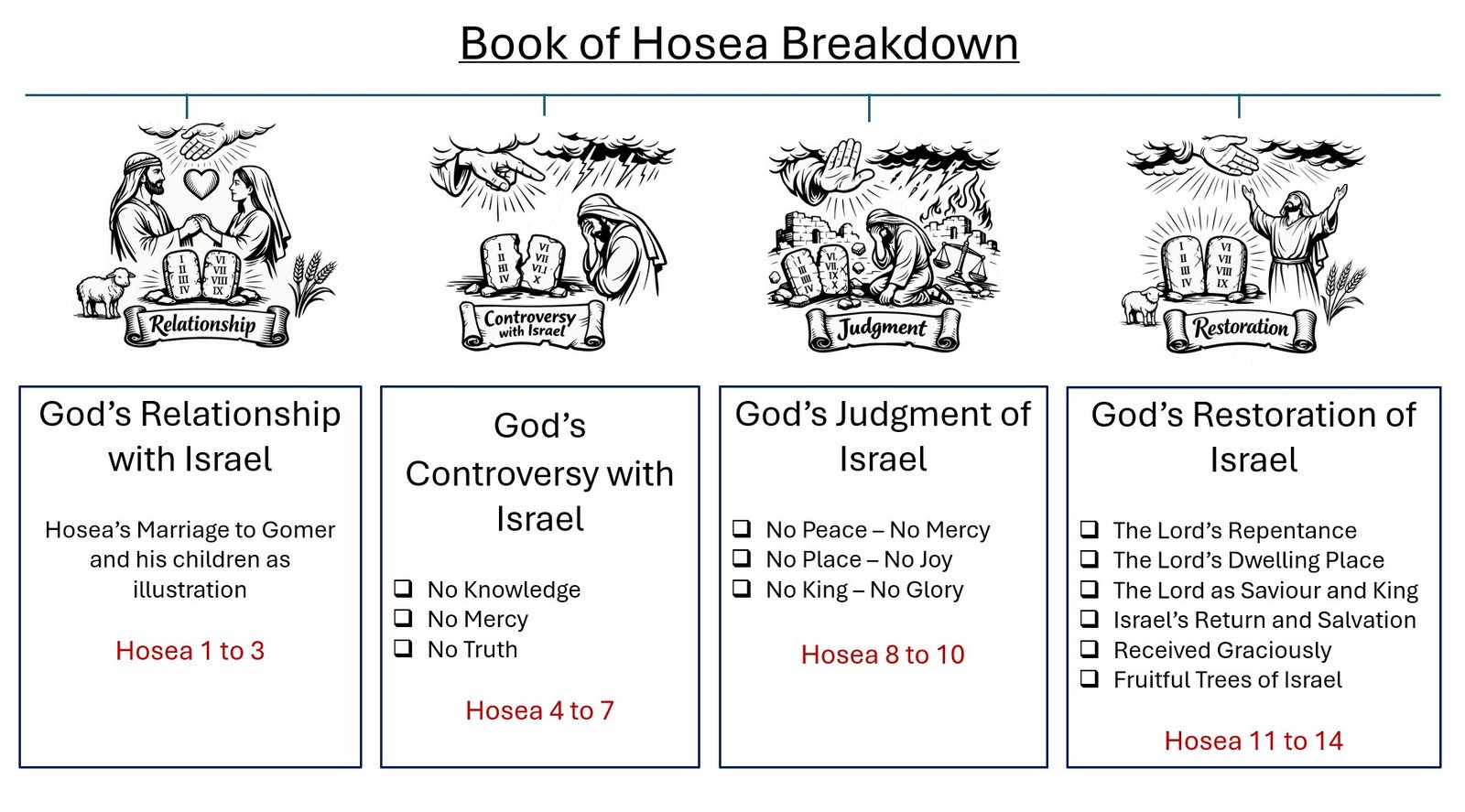
Hosea 4:1 summarised the coming chapters: “There is no truth, nor mercy, nor knowledge of God in the land.”
Hosea 4:6 exposed their ignorance—“My people are destroyed for lack of knowledge”.
They were not merely uninformed; they outright rejected knowing God and His commandments, though He’d provided priests and Scripture for that purpose. The same principle applies today. God’s given His Word so people may know Him, yet many churches today neglect it and substitute it for lifestyle messages and sermons based on cherry-picked verses while neglecting the theme and purpose of the whole Word. Hosea’s warning shows what happens when the system that’s meant to teach truth collapses.
Chapter 5 now turns to Israel’s lack of repentance.
Hosea 5:1 calls out,
HEAR ye this, O priests; and hearken, ye house of Israel; and give ye ear, O house of the king; for judgment is toward you, because ye have been a snare on Mizpah, and a net spread upon Tabor.
The message is not to us, the Body of Christ today, and it’s also not to the House of Judah, the northern kingdom, except for its warning not to mimic Israel.
Since King Solomon, the royal line had been divided. Through a rebellion against Solomon’s son, Rehoboam, who took the throne after Solomon’s death, the nation of Israel split into two kingdoms, Epraim/Irsael became the Northern Kingdom, the House of Israel, while Judah and Benjamin became the House of Judah, the Southern Kingdom.
In the Northern Kingdom, the priests were no longer Levites serving under God’s law; under king Jereboam they’d invented their own religion, their own priesthood, and a false king.
Hosea’s rebuke is with this Northern Kingdom of Israel, which is seen as a counterfeit nation. God’s judgment is directed toward the leaders of the Northern Kingdom because they’ve become a snare to the people.
God always explains His judgments.
When He acts, He first reveals His intent. In our age today, in the dispensation of grace, His wrath is revealed as Romans 1:18 shows us, but it’s not being poured out yet. Grace is offered instead.
Israel, at the time of Hosea, however, was at that point of wrath. The priests and kings who should have judged righteously had failed. Under the law, when human authorities refuse justice, God Himself intervenes. As we just read, Hosea 5:1 says, “For judgment is toward you, because ye have been a snare on Mizpah and a net spread upon Tabor.”
These names mark real places.
“Mizpah”, which means “Watchtower”, was in the southwest section of the kingdom. It was once a place of remembrance for God’s works. “Tabor” is a mountain in the valley of Jezreel, up in the northeast section of the kingdom.
In Genesis 31, Jacob—whose name became Israel—made a covenant with Laban there, promising faithfulness. They raised a heap of stones as a witness. That ancient Mizpah marked loyalty; now, in Hosea’s day, Mizpah marks betrayal. The northern tribes have committed spiritual adultery, seeking other “spouses” than the Lord.
At Mizpah, people offered sacrifices—but to false gods. What was once a place of worship became a snare of idolatry. God says, “Judgment is toward you, because you have been a snare on Mizpah and a net spread upon Tabor.”
Mizpah also appears in 1 Samuel 7, where Samuel gathered Israel to repent and rededicate themselves to God. Between Mizpah and Shen, he set up a memorial stone called Ebenezer, meaning “stone of help,” saying, “Hitherto hath the Lord helped us.” It symbolised God’s faithfulness.
Hosea’s generation had corrupted that memory—turning the place of victory and covenant renewal into a centre of idolatry. What was once a watchtower of remembrance became a trap for rebellion.
These places had become worship centres for false gods, and the people were worshipping idols under every green tree they could find—there were idols all over the land.
Hosea speaks to the priests and to the king as representing the leadership of the nation. We saw in chapter 4 that God said, “Like people, like priests.” The priests, who should have been setting an example, were unable to rise above the level of the lowest man in society, and that was true of the king also.
The watchmen no longer watched; the priests no longer taught; the kings no longer ruled in righteousness.
So, Hosea declares that Israel’s leadership has turned holy places into traps and the covenant system meant to preserve truth has become a net catching souls in idolatry. God’s judgment is therefore just: when the watchtowers fail, He Himself becomes the Watchman who sees and acts. Hosea 5 stands as a solemn warning that when truth, mercy, and knowledge vanish, and repentance is refused, divine intervention follows—not by surprise, but exactly as God said He would.
Now Hosea 5:2 continues, saying,
And the revolters are profound to make slaughter, though I have been a rebuker of them all.
These “revolters” are Israel’s priests and kings—leaders who have turned from God. Their sacrifices are no longer holy offerings but mere slaughter. The word “slaughter” shows how far worship has fallen; it’s no longer sacrifice born of obedience but killing without meaning. Hosea’s era saw kings rise and fall through assassination—one conspirator killing another to seize the throne. The nation had become skilled in violence. “Profound to make slaughter” means they were deeply practised, efficient in evil. They were experts at rebellion, not righteousness.
God says, “I have been a rebuke of them all.”
His rebuke came through prophets and through His Word. Today, Scripture serves that same purpose. 2 Timothy 3:16 tells us that,
All Scripture is given by inspiration of God, and is profitable for doctrine, for reproof, for correction, for instruction in righteousness:
Paul told Timothy and Titus to rebuke with authority, because rebuke is meant to produce repentance. Yet, as in Hosea’s day, rebuke often meets resistance. Pride builds walls and anger replaces conviction. Proverbs says, “A righteous man loves rebuke,” because he desires truth. Rebuke should lead to guilt, confession, and change—acknowledging wrong and turning from it.
Rebuke aims at repentance, turning away from the thing that required rebuke, but it must be done properly. Scripture shows there are different ways to rebuke depending on the person and situation. Paul says to speak the truth in love, and to treat an elder as a father, not as a child. Rebuke is not a license to attack people; it must follow biblical wisdom.
Luke 17:3 shows the principle, Jesus speaking:
Take heed to yourselves: If thy brother trespass against thee, rebuke him; and if he repent, forgive him.
Revelation 3:19 echoes it:
As many as I love, I rebuke and chasten: be zealous therefore, and repent.
God’s rebuke is love in action.
Hosea 5 reveals that Israel refused that love. The watchtowers no longer watched, the priests no longer taught, and the kings no longer ruled in truth. They were proficient in slaughter but ignorant of repentance. Thus judgmentdidn’t come suddenly and out of the blue, but exactly as God had warned.
Hosea 5 continues with God Himself as the rebuke.
Hosea 5:3 is God speaking,
I know Ephraim, and Israel is not hid from me: for now, O Ephraim, thou committest whoredom, and Israel is defiled.”
Their idolatry is not hidden.
False religion often hides its practices behind secrecy, but God sees everything. Proverbs 15:3 says,
The eyes of the LORD are in every place, beholding the evil and the good.
Ecclesiastes 12:14 adds that God will judge every secret thing. Jeremiah 16:17 says their iniquity is not hidden from God’s eyes. Hebrews 4:12–13 teaches that God’s Word discerns the thoughts and intents of the heart, and nothing is hidden from Him. God sees what people can’t.
Hose 5:4 explains the deeper problem:
They will not frame their doings to turn unto their God: for the spirit of whoredoms is in the midst of them, and they have not known the LORD.
God rebukes them, but they refuse to repent. Their condition is rebellion. The “spirit of whoredoms” is in them, driving them away from repentance.
Idolatry in Hosea is spiritual adultery, and all adultery and fornication picture rebellion—people doing what they want regardless of God’s commands.
The issue is not only the sin itself but their refusal to turn when they’re rebuked. Even under the law, God was merciful and gave opportunities for repentance, but Israel “would not.”
The contrast is clear: in verse 3, God knows them completely; in verse 4, they don’t know Him. Israel had been given prophets, law, and covenant so they could know the Lord, yet they rejected that privilege.
Now to Hosea 5:5
And the pride of Israel doth testify to his face: therefore shall Israel and Ephraim fall in their iniquity; Judah also shall fall with them.
Pride keeps them from repentance.
Proverbs 16:18 says,
Pride goeth before destruction, and an haughty spirit before a fall.
Israel and Ephraim will fall because of pride, and Hosea adds, “Judah also shall fall with them.” This is an early warning of Judah’s future collapse. When the northern tribes fall, Judah must not assume they’re safe; they must repent as well.
Then Hosea 5:6 says,
They shall go with their flocks and with their herds to seek the LORD; but they shall not find him; he hath withdrawn himself from them.
This withdrawal is a serious condition for Israel.
God had covenanted with Abraham, Isaac, and Jacob to be their God, yet Hosea shows there were times when God withdrew His presence because of their rebellion. Israel was God’s chosen nation, but that didn’t mean He was always with them or always protecting them.
The prophets repeatedly warn that God’s withdrawal is the result of persistent pride, idolatry, and refusal to repent.
Hosea 5 reveals a nation that will not hear rebuke, will not repent, and therefore can’t find the God who once helped them. Their pride blinds them, their idolatry enslaves them, and their refusal to turn brings the judgment God had long warned about.
Israel tried to defend itself in the land with military strength, yet God said, “I am not with you; you are not my people.” Hosea shows that understanding God’s actions requires knowing the dispensation and rightly dividing Scripture.
In Hosea 5:6, Israel brings flocks and herds—animal sacrifices required under the law—to seek the Lord, but “they shall not find him,” the verse says. Their worship is empty because God’s not in it.
Isaiah 1:12 describes the same condition. God asks,
When ye come to appear before me, who hath required this at your hand, to tread my courts?
Even though God Himself had commanded sacrifices, He calls their offerings “vain oblations” in Isaiah 1:13.
Their incense was an abomination and their feasts hateful to Him. He says in Isaiah 1:15 that He will hide His eyes and not hear their prayers because their hands are full of blood.
Isaiah prophesied during a time when God had already withdrawn from His people due to persistent rebellion. Hosea’s warning matches Isaiah’s: outward worship can’t hide inward treachery.
Hosea 5:7 says,
They have dealt treacherously against the LORD: for they have begotten strange children: now shall a month devour them with their portions.
Treachery is betrayal here.
Their sacrifices only maintain appearances. God says, “I know Ephraim,” meaning He sees the whoredom behind their actions. Hosea 6:7 explains the treachery: “They, like men, have transgressed the covenant.”
Israel broke the covenant made with Moses centuries earlier. Though the covenant was old, God had not forgotten it. His Word endures, and Israel’s long history did not erase their responsibility. They may have thought they’d “progressed” beyond Moses, but God never progresses past His own Word. Jesus Himself affirmed Moses’ law long after it was given.
This principle matters to us because even though two thousand years have passed since Paul revealed the gospel of grace, God has not grown weary or changed His mind. We forget; He does not. Israel’s history teaches that God means what He says.
Hosea 5:7 also says, “They have begotten strange children.” “Strange” means foreign or contrary to what God intended. Under Israel’s covenant, they were commanded to marry within the nation to preserve the lineage for the kingdom and the coming Messiah. This law never applied to any other nation or to the church. Timothy’s mother, a Jew married to a Greek, produced exactly this “strange” situation under the law, and yet Paul circumcised Timothy so Jews wouldn’t reject him. This was not law‑keeping for salvation but removing an obstacle for ministry.
Another form of “strange children” comes from failing to teach children the Lord. Israelite children could grow up as God’s people yet not know the God of Israel because parents neglected the law’s command to teach them. The Old Testament repeatedly instructs parents to pass down God’s works and commandments. While the church is not under that law, the principle remains timeless: children must be taught truth, especially the gospel of God’s grace.
Israel was commanded under the law to teach their children constantly—write God’s words on their hands and foreheads, speak of them day and night, and remind them of the works God did to create their nation.
Later generations of Israel took writing God’s words on their hands and foreheads literally, wearing Scripture on their hands and foreheads in containers known as tefillin. Tefillin are a pair of small black leather boxes with leather straps that contain parchment scrolls with Torah verses, worn by adult Jews during weekday morning prayers.
But Moses’ original command carried a symbolic meaning: God’s Word must govern your actions (hand) and your thoughts (forehead).
All this made Israel unique. Their national history was biblical history. God actually formed their nation, gave them covenants, and spoke to their fathers.
Christians today can teach Bible stories, but we can’t claim God founded our country the way He founded Israel. Our constitution was written by men; Israel’s covenant was given directly by God, and yet Israel failed to teach their children, and the result was “strange children”—children who no longer knew the God of their fathers, even though they were descendants of Jacob.
Hosea’s message is clear: Israel’s treachery, idolatry, pride, and refusal to repent have led to God’s withdrawal. Their worship is empty, their covenant broken, and their children estranged from the knowledge of God.
Hosea 5:7 also says, “Now shall a month devour them with their portions.”
The phrase “a month” simply indicates a short time. Some speculate it refers to a king, Shallum, who reigned less than a month before being killed, but Scripture doesn’t confirm this. What is clear is the speed of judgment. Although God’s judgment didn’t come out of the blue or suddenly, once the judgment actually began, the Assyrians conquered the northern tribes quickly, and their destruction came suddenly.
Hosea’s ministry ended just a few years before the Assyrian captivity began.
Now to Hosea 5:8,
Blow ye the cornet in Gibeah, and the trumpet in Ramah: cry aloud at Beth-aven, after thee, O Benjamin.
These places—Gibeah, Ramah, Beth‑aven—are all in the land of Benjamin. By Hosea’s time these had also become centres of idolatry.
Gibeah, for example, was the site of the horrific event in Judges 19, where a concubine was abused and killed. Her body was cut into twelve pieces and sent throughout Israel to summon the tribes. The tragedy united the nation, and they gathered at Mizpah to judge the wickedness of Gibeah. Mizpah often served as a central meeting point for the northern and southern kingdoms.
Ramah also carried history.
In 1 Kings 15:17, the northern king Baasha built Ramah to block Israelites from travelling south to Jerusalem. This was literal division—an attempt to prevent unity and worship according to God’s law. It fits Proverbs 6: “he that soweth discord among brethren.” Beth‑aven was the site of Jeroboam’s golden calf worship, a deliberate corruption of true worship.
Hosea’s battle cry signals that judgment is coming through these border cities. Benjamin sits between Judah and Ephraim, and its territory becomes the front line. God will bring armies to punish the northern tribes, make them desolate, and carry them away. The idolatry that filled these places—Gibeah’s wickedness, Ramah’s division, Beth‑aven’s false worship—now becomes the pathway of judgment. The border where rebellion flourished becomes the border where destruction enters.
Hosea shows that Israel’s downfall’s not random. Their failure to teach their children, their idolatry, their treachery, and their pride all lead to swift judgment. God withdraws, the enemy advances, and the places once filled with covenant history become scenes of warning and ruin.
Hosea 5:9 declares,
Ephraim shall be desolate in the day of rebuke: among the tribes of Israel have I made known that which shall surely be.
This is the nature of prophecy. God reveals the future to His prophets so they can warn the people. Hosea prophesied during the final years of Israel’s existence, along with Amos, Micah, Isaiah, and others. God repeatedly warned Israel, but they refused to repent.
Then Hosea 5:10 says,
The princes of Judah were like them that remove the bound: therefore I will pour out my wrath upon them like water.
Removing boundaries—whether it was physical landmarks or limiting covenants—was forbidden. Deuteronomy 19:14 states;
Thou shalt not remove thy neighbour’s landmark, which they of old time have set in thine inheritance, which thou shalt inherit in the land that the LORD thy God giveth thee to possess it.
Deuteronomy 27:17also says;
Cursed be he that removeth his neighbour’s landmark. And all the people shall say, Amen.
Then we have Proverbs 22:28,
Remove not the ancient landmark, which thy fathers have set.
Changing God’s established worship or covenant is like moving a property marker: the line still exists, but not where God placed it. Judah compromised God’s boundaries, and God says He will pour out His wrath “like water.”
Paul in Acts 17:26–27 shows that God sets boundaries for nations so they might seek Him. Israel’s leaders moved God’s boundaries, changed His worship, and broke His covenant. Hosea 5 shows that such rebellion brings judgment swiftly and surely.
Hosea 5:11 then says,
Ephraim is oppressed and broken in judgment, because he willingly walked after the commandment.
This doesn’t mean Ephraim obeyed God’s command. He obeyed a commandment God never gave. He followed false religious laws that were created by Jeroboam and continued on by every northern king. Hosea 10:5 shows Samaria fearing for the golden calves at Bethel, and Hosea 13:2 says they made molten images and told worshipers, “Let the men that sacrifice kiss the calves.”
Their religion was man‑made idolatry.
1 Kings 12 explains how it all began.
Jeroboam created a counterfeit system: golden calves in Bethel and Dan, priests “of the lowest of the people” who were not Levites, and a feast “like unto the feast in Judah” but held on the eighth month, fifteenth day—a date God never ordained.
Leviticus 23 lists Israel’s holy days, and none occur in the eighth month. Jeroboam simply “devised it of his own heart.” He offered sacrifices on a false altar to a false god on a false holy day, yet he claimed it was for the Lord. This tradition continued through every northern king, who “did that which Jeroboam did,” as 2 Kings chapters 13 to 15 record.
Hosea’s warning shows that sincerity does not sanctify false worship. Ephraim “willingly walked” after these commandments, but willingness doesn’t make error truth. God cares about what He actually said, not what people invent “of their own heart.”
To Hosea 5:12 now, which says,
Therefore will I be unto Ephraim as a moth, and to the house of Judah as rottenness.
A moth slowly eats a garment; rot slowly destroys wood or fruit. God’s judgment would erode both nations—Ephraim in the north and Judah in the south. Their stability was going to crumble.
This leads into Hosea 5:13, where God describes them as sick.
When Ephraim saw his sickness, and Judah saw his wound, then went Ephraim to the Assyrian, and sent to king Jareb: yet could he not heal you, nor cure you of your wound.
The moth‑eaten garment and rotten structure picture a nation weakened from within.
Their idolatry, false worship, and man‑made commandments produced spiritual decay. They followed traditions, not truth; commandments of men, not the Word of God.
The northern tribes embraced a religion that looked like Moses’ law, with priests, altars, sacrifices, and feasts, but every part was corrupted. The wrong priests, wrong altar, wrong feast day, and the wrong god. They kept the outward form while rejecting the substance. Hosea shows that God sees through imitation. He judges according to His Word, not human invention.
So, Ephraim is broken, Judah is rotting, and God’s wrath flows like water through the broken-down boundaries. Their sickness is self‑inflicted: they replaced God’s commandments with their own, and the result is desolation.
The prophets often describe Israel and Judah as sick. Hosea 5:13 says, “When Ephraim saw his sickness, and Judah saw his wound, then went Ephraim to the Assyrian.”
Instead of turning to God, they turned to Assyria. Their response shows deep rebellion. Under the covenant, sickness was a sign of judgment meant to drive Israel back to God. But they refused to repent and sought help from the very nation that God would use to punish them.
This highlights the difference between Israel under the law and us today.
God covenanted with Israel to send sickness, pestilence, and physical affliction when they disobeyed, as in Leviticus 26:25. He did not covenant such things with the Body of Christ today. We can’t interpret sickness as being God’s judgment. Illness today comes from living in mortal bodies in a broken world. God is dispensing grace, not covenant curses. We get sick because humanity is fallen, not because God’s striking us.
But Israel should have recognised sickness as covenant discipline because they knew, and should have listened to Leviticus 26:25-26 where God says He’d send pestilence, deliver them to enemies, and increase chastisement “seven times more” if they refused to repent. The proper response was to cry out for mercy, confess sin, and return to God’s statutes. Instead, they rejected Him and turned to Assyria.
Isaiah 10:5 calls Assyria “the rod of mine anger.”
God used Assyria as His instrument to punish Israel. When Israel turned to Assyria for help, they were turning to the rod of correction itself; they were standing directly in front of the cannon. They sought deliverance from the very nation God had appointed to judge them. This is complete rebellion—choosing the rod of correction instead of the Helper.
Hosea prophesied during the final decades of Israel’s history, when Assyria was rising in power. Israel repeatedly tried to buy Assyria’s protection. They paid tribute, hoping Assyria would spare them. But God had already declared Assyria would conquer them.
2 Kings 15 shows how unstable Israel was.
Zechariah, the last king of Jehu’s dynasty, reigned only six months before being assassinated.
This fulfilled Hosea’s prophecy that Jehu’s line would end at the fourth generation. After Zechariah, Shallum killed him and reigned briefly. Then Menahem killed Shallum and took the throne. Menahem came from Tirzah, not Samaria, and had no blood connection to Jehu’s dynasty. You can see the timeline of these kings in the chart below this recording.
This pattern—conspiracy, murder, and short reigns—reveals a nation collapsing from within. Every king “departed not from the sins of Jeroboam,” continuing the idolatry of the golden calves.
Israel’s sickness was not only physical; it was spiritual, political, and moral. Their wound was self‑inflicted. They rejected God’s covenant, embraced false worship, ignored His prophets, and trusted foreign powers. When rebuke came, they did not repent. When sickness came, they did not return, and when danger came, they turned to Assyria.
Hosea 5 shows a nation refusing the cure God offered. Instead of turning to the Lord, they turned to the rod. Their sickness deepened, their wound widened, and judgment followed exactly as God had said.
So, 2 Kings 15 shows the pattern of Israel’s collapse. Menahem, the first king after Jehu’s generation on the throne had ended, continued the wicked reigns of the kings, “departing not from the sins of Jeroboam.” When Assyria’s king Pul invaded Israel, Menahem paid him a thousand talents of silver to “confirm the kingdom.” He didn’t pay from his own wealth; he taxed Israel’s rich men fifty shekels each. Assyria withdrew temporarily, but—as always happens when you pay off a bully—they returned.
Later, under King Pekah, Assyria came again. Tiglath‑pileser captured large northern territories—Naphtali, Galilee, Gilead—and carried them away captive. Half the northern tribes were removed in one sweep. Israel had tried to buy safety, but Assyria simply took more.
Tiglath‑pileser III was one of the most powerful kings of Assyria. His reign marked the turning point when Assyria became a true empire rather than just a regional power. He was efficient, ruthless, and unstoppable in Hosea’s generation.
Judah faced the same fear. King Ahaz saw Assyria conquering the north and panicked. Instead of trusting God, as Isaiah urged, he stripped gold and bronze from the temple and used it to build a pagan altar to impress Assyria.
He hoped Assyria would spare Jerusalem. Hezekiah later trusted God and Jerusalem was delivered, but Ahaz chose compromise and fear.
This is the background of Hosea 5:13: “When Ephraim saw his sickness, and Judah saw his wound, then went Ephraim to the Assyrian.” They saw danger, but instead of repentance, they sought human help. They turned to the rod God was using to strike them. Hosea says the Assyrian “could not heal you, nor cure you of your wound,” because the wound was covenant judgment from God. Only repentance could stop it.
To Hosea 5:14 now,
For I will be unto Ephraim as a lion, and as a young lion to the house of Judah: I, even I, will tear and go away; I will take away, and none shall rescue him.
God would use Assyria as His lion to tear the northern tribes. Judah is warned as well—a “young lion” would come for them if they refused to repent.
Hosea 5:15 is the turning point. It says, God speaking, of course:
I will go and return to my place, till they acknowledge their offence, and seek my face: in their affliction they will seek me early.
Like a lion returning to its den after striking, God withdraws His presence until Israel repents. Acknowledging their offence means abandoning idolatry and turning back to the covenant.
Proverbs 1:23-24 echoes Hosea’s warning, saying,
Turn you at my reproof: behold, I will pour out my spirit unto you, I will make known my words unto you.
Because I have called, and ye refused; I have stretched out my hand, and no man regarded;
Because they hated knowledge, destruction comes “as a whirlwind,” as Proverbs 1:27 describes.
They will seek God, “but I will not answer.” He says. This matches Hosea 5:6—Israel will seek the Lord but not find Him. Yet Proverbs 1:33 also promises, “Whoso hearkeneth unto me shall dwell safely.”
Proverbs 1 also speaks of God pouring out His Spirit—fulfilled at Pentecost.
But in Jesus’ day, Israel again rejected knowledge and rejected Christ. After His resurrection, Jesus “returned to His place” in heaven, just as Hosea 5:15 describes.
Acts 3 shows Peter preaching to Israel: “Repent… and he shall send Jesus Christ.” Jesus had already come, but He returned to heaven until Israel acknowledges its offence. Hosea’s pattern continues: God withdraws until repentance comes.
Hosea 5 ends with a nation refusing rebuke, seeking help from the rod, and losing the presence of God—waiting for the day they finally acknowledge their offence.
When Jesus returns, all Israel shall be saved—meaning they finally repent, and we see this in Romans 11; Zechariah 12 and Isaiah 53. Hosea 6:1–3 looks forward to that future repentance when Israel cries out, “Come, let us return unto the Lord.” This never happened in Hosea’s day. The northern tribes never repented, never returned, and were never healed. Hosea 6 is prophetic, still future, pointing to Israel’s restoration when Christ comes again.
Hosea 6:1, as we’ll see when we get there next episode, says,
He hath torn, and he will heal us; he hath smitten, and he will bind us up.
God promised Israel healing if they repented and kept His covenant. Hosea 6 describes that future time.
Hosea 6:2 says,
After two days will he revive us; in the third day he will raise us up.
The “us” is Israel. They haven’t yet, as of today, been revived or raised up. The northern tribes remain scattered. The language also echoes Christ’s resurrection—two days down, raised the third day—showing that Israel’s restoration is tied to the risen Messiah.
Hosea 6:3 continues:
Then shall we know if we follow on to know the Lord.
This was not true in Hosea’s time. Hosea 4:6 said Israel lacked knowledge. Hosea 6:3 describes a future day when Israel will know the Lord. This matches Hebrews 8:11:
They shall not teach every man his neighbour… for all shall know me, from the least to the greatest.
Hosea 6:3 and Hebrews 8:11 speak of the same event—the New Covenant kingdom promised to Israel, not the church.
If Hebrews 8:11 were about the church, Hosea 6 would be describing us. But Hosea 6 is clearly Israel’s restoration, so Hebrews 8 must also be Israel’s kingdom blessing.
Hosea 5:15 sets the stage: “I will go and return to my place, till they acknowledge their offence.”
After judgment, God withdraws.
Like a lion returning to its den after tearing its prey, He goes back to His place. Jesus did the same. Israel rejected Him; He rose from the dead, and He returned to heaven. He remains there until Israel acknowledges its offence.
Acts 3 confirms this pattern.
After Pentecost, Peter preaches to Israel: “Repent… and he shall send Jesus Christ.”
Jesus had already come, and He’d already returned to His place. Peter says He’ll come again when Israel repents. Hosea 5:15 and Acts 3 describe the same truth: Israel’s repentance precedes Christ’s return.
Hosea 6:1–3 is a prophecy of Israel’s future restoration.
They will return to the Lord. He will heal them. He will raise them up, and they’ll finally know Him. The rains of blessing—“the latter and former rain”—will come upon them.
This is Israel’s kingdom under the New Covenant, not the church’s present dispensation.
The mystery revealed to Paul remains distinctly different. Hosea speaks of Israel’s national repentance and restoration. Hebrews 8 speaks of Israel’s New Covenant kingdom. Acts 3 calls Israel to repentance so Christ may return. All three passages align: God will return to His place until Israel acknowledges its offence, and when they do, He’ll come, and He’ll heal, restore, and reign.
Even though we know Hosea is not speaking to us, the body of Christ today, I can’t help but imagine the scene that must have been playing out in both the northern and southern kingdoms at the time.
Life was good. It was prosperous, and even though the people existed with no truth, nor mercy, nor knowledge of God in the land, their day-to-day life would have been consumed with the quest for amusement, fun and wealth. Life would have been about living their best life today and, because that life in the flesh was so real and absorbing, they never really sat down to think about all the loved ones who had died, showing undeniable evidence that the natural life is temporary and short and that it was the ultimate folly to see only the natural life in the flesh while disregarding the spiritual life that is forever. Natural life was just too absorbing. As the years rolled by, the idea of a coming judgement would have seemed unlikely at best. They obviously scoffed at the many prophets who gave warnings about the reality of God, a perfectly just and righteous God who must judge unrighteousness.
As I get older and see the shortness of the time left in this natural realm, the clearer these realities of God become and the more futile the world’s quest for health, wealth and happiness over and above the knowledge of God becomes.
In the next episode, we’ll examine this wonderful restoration of Israel in Hosea chapter 6


Leave a Reply
Want to join the discussion?Feel free to contribute!