Understanding The Bible – Episode 2

Time Past, But Now & To Come (Understanding the 3 Part Division of Scripture)

Time Past – God’s prophesied dealings with the nation of Israel

But Now – The dispensation of Gentile grace

To Come – The resumption & fulfilment of Israel’s prophetic program

“Speed Slider”
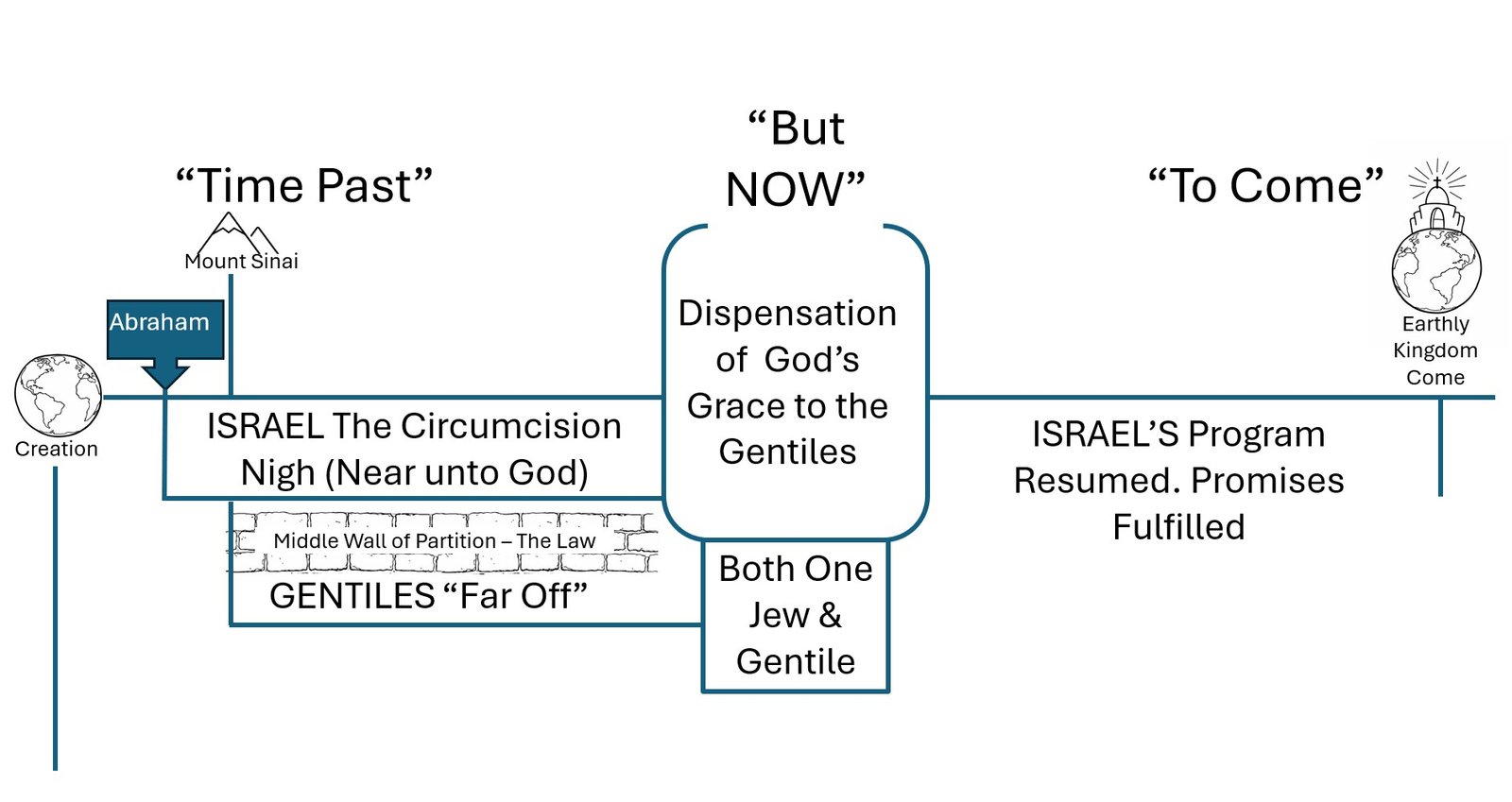
Episode 2 ChartClick Image To Enlarge

Understanding The Bible – Episode 2 – Transcript

Welcome to episode two in our series on Basic Bible Understanding, which is designed to help appreciate how to rightly divide the word of truth as Paul tells us we must do in 2 Timothy 2:15, which is,
Study to shew thyself approved unto God, a workman that needeth not to be ashamed, rightly dividing the word of truth.
We need to properly handle God’s Word to fully understand it, to know exactly what portion of it deals with us in the dispensation of grace in which you and I live today.
We have a simple chart beneath this recording that lets us see in timeline form what we’re saying.

Let’s open Ephesians chapter two again.

We’re trying to clearly see God’s timing. His program or dispensation, in time past, dealt exclusively with the nation of Israel. Then there was a great dispensational change that took place through Christ’s revelation to Paul. That’s the one in place now, today. Paul calls this change the dispensation of grace.

We saw last time that that’s very different from what God was doing in “time past”.

Then, we need to see the difference between the dispensation of grace that applies today and the things yet to come in God’s dealings with humanity.

This dispensation of grace has not always been in existence, nor is it always going to be in existence in the future. It’s going to end one of these days. It’s been going on for about 2000 years now, since the day of the Apostle Paul, but it will cease one day, and when it does, the things that have yet to be fulfilled in God’s program with Israel are going to come about. These are the things Paul describes as happening in the “To Come” period.

We need to have a basic understanding of that “yet to come” part of God’s plan and purpose.

So, as we saw last time, we have those three time periods. “Time past”, “But Now” and “To come”.

In this episode, we’ll talk a little bit more about the differences that exist in those three time periods.

In this dispensation of grace, God’s dealing with us Christians, members of the church, the body of Christ, members of that one new man.

He’s dealing with us differently today than he dealt with his nation, Israel, in the past, and how he’s going to deal with it in the time to come, and right dividing of the Word of Truth is critical to our understanding of that.

Many, if not most, Christians today are taking promises, commandments, instructions and teachings from God’s former time past program with Israel or from times yet to come, when He fulfils His program with Israel, and trying to make them fit into today’s dispensation of grace, and it simply won’t work.

The result is a lot of heartache and uncertainty, all because of a failure to rightly divide the word of truth.

No matter how sincere a Christian may be, he or she’s not going to force God to do something that contradicts His word by acting outside of His current program and start doing something today that was specifically for the ‘time past’ or the period “to come” just to satisfy our misguided desire.

So, it’s critical for you and me as Christians to rightly divide the word of truth and to know what portion of God’s Word is telling us what to do, and talking to us as members of the church, the body of Christ.

We’re going to deal with some of those things in an introductory manner, and as the series goes on, we’ll deal with them in more detail.

So, to recap, Ephesians 2:11-12,

Wherefore remember, that ye being in time past Gentiles in the flesh, who are called Uncircumcision by that which is called the Circumcision in the flesh made by hands;

That at that time ye were without Christ, being aliens from the commonwealth of Israel, and strangers from the covenants of promise, having no hope, and without God in the world:

Here is that “Time passed” where we see God’s program and dealings are exclusively with the nation of Israel.

He’s nigh, or near, unto them. He’s given them a token of his covenant with them, circumcision, which is a physical manifestation, a sign of his dealings with them, and the special nature of those dealings that excluded the other nations of the world.

God even set up a middle wall of partition between Himself and the nations with the law, which kept Israel on the near side of that wall towards Him and kept the Gentiles on the far side of that wall.

And that separation was so great that the Apostle Paul says at the end of verse twelve, that we Gentiles, at that time before the dispensation of grace, were without God in the world.

Now we’re going to look at each of those expressions there in Ephesians 2:12 later on, and we’ll understand the depth of meaning of them. But now, we’re simply acknowledging that that’s the way it was.

Ephesians 2:13 says,

But now in Christ Jesus ye who sometimes were far off are made nigh by the blood of Christ.

See this “But Now” expression?

It’s making a contrast, an opposite, to what was going on in “time past”.

Now something different applies. Now in Christ Jesus, you who sometimes were far off are made nigh or near by the blood of Christ. Ephesians 2:14 says in continuation,

For he is our peace, who hath made both one, and hath broken down the middle wall of partition between us;

Notice this critical point. God hath made both one!

Israel was near or nigh to God. Gentiles were afar off.

God’s now changed Israel’s “nigh” status and their exclusive nature. He’s also changed the Gentiles “afar off” status.

Now, in the dispensation of grace, He’s made both one.

We, both Jew and Gentile, stand on the exact same level before God in the dispensation of grace.

That wasn’t the way it was in time past, and it won’t be the way it is in time to come, but that’s the way it is right now in the dispensation of grace.

Ephesians 2:15 says that God,

Having abolished in his flesh the enmity, even the law of commandments contained in ordinances; for to make in himself of twain one new man, so making peace;

That’s the purpose of this new dispensation — to create “one new man” out of the “twain”, the two groups of people who were, up until this point, permanently divided from each other and from God. This “One new man” is the true church, the body of Christ. This is a new creation. It’s not Israel, and it’s not Gentiles. It’s something entirely new, as 2 Corinthians 5:7 and Galatians 6:15 say.

Ephesians 2:15  finishes with so making peace.

Making Peace between man and God was the goal; breaking down the wall that permanently separated us from Him was God’s incredible achievement, and it was done by His own death on the cross.

More about that later.

Remember what a dispensation is from the last episode? It’s a program that someone puts into effect and administers to achieve a particular end. A dispensation is never put into effect carelessly or just for the fun of it. It’s got a purpose behind it.

God’s got a distinct purpose with the nation of Israel. His program with Israel had a purpose, and it still does. It’ll be fulfilled out there in the “to come”, the future.

God has set Israel’s program temporarily aside and ushered in this dispensation of grace, making both Jew and gentile one new man, the church, the body of Christ. That’s the purpose behind it.

Why has God done that?

We’ll talk about that in detail as we go on, but right now, we need to acknowledge the fact that He’s brought the dispensation of grace in to create the one new man.

We find that expression a number of times in Paul’s epistles. The church, the body of Christ, is also called the new creation, a new creature. It’s a new thing in God’s overall program. Of course, it wasn’t new to God; He knew about it since before the world was formed, but it was never revealed to mankind throughout the history of the prophets.

Ephesians 2:16-18 begins with the word “And”, which directly links it to Ephesians 2:15, which ends in, so making peace;

Ephesians 2:15-18… so making peace;

And  that he might reconcile both unto God in one body by the cross, having slain the enmity thereby:

And came and preached peace to you which were afar off, and to them that were nigh.

For through him we both have access by one Spirit unto the Father.

Then we go to Ephesians 2:19, which opens with,

Now therefore…

All we want up to this point is to note the “now” issue.

We’re not ready yet to deal with the things spelled out in Ephesians 2:19-22, but we need to be aware of this”Now therefore”.

So, “now therefore” means that because of this great dispensational change, we possess now the things that Paul describes in these verses.

That’s now in the dispensation of grace. Now we possess all that as members of the one new man, the church, the body of Christ. We didn’t possess them in “time passed”, but the things revealed by Paul, our apostle today, in connection with the revelation of the dispensation of grace are for us today. We’ll deal with that a little later on in this episode when we open Ephesians chapter 3.

So, what do we have?

We’ve got “time passed, and “but now”, and “to come” as per the chart below.

Paul’s revelation, given to him by the risen Christ Himself, is the outworking of God’s plan and purpose contained in those three time expressions. Paul’s understanding as the apostle to the Gentiles should be our understanding.

Let’s focus on “things to come” for a few minutes.

Go to Romans 11.

In Romans chapters nine, ten and eleven, Paul’s dealing with the same thing we’ve just been talking about in Ephesians chapters 2 and 3, “time past”, “but now” and “to come”.

The only difference is in Romans nine, ten and eleven, he’s looking at it from the time past. He recognises the fact that before this dispensation of grace came in, God’s program was with Israel. He acknowledges the fact that this dispensation of grace has interrupted God’s program with Israel.

In other words, God brought this dispensation of grace in before He’d fulfilled His program with Israel. And from that perspective, Paul deals with the issue of “time past”, “but now”, and “to come”, and he deals with the question of what’s happened to Israel in this dispensation of grace. What does it all mean for Israel? Has God cast his people away? Does that mean that His word, His promises to them, have been broken? Does that mean that the things He’s promised and covenanted with them, they’re now not going to get?

It’s from that perspective that Paul, in Romans, looks at the same issue of the great dispensational change we’re talking about in Ephesians.

So, what we’re concerned with at the moment is getting an understanding of what’s yet to come after the dispensation of grace has ended, which is the resumption and fulfilment of God’s program with Israel.

Now, in Romans, notice the way chapter nine begins.

Romans 9:1-3,

I SAY the truth in Christ, I lie not, my conscience also bearing me witness in the Holy Ghost,

That I have great heaviness and continual sorrow in my heart.

For I could wish that myself were accursed from Christ for my brethren, my kinsmen according to the flesh:

Paul’s talking about Israel, of course, and he goes on to finish his thought in Romans 9:4-5, …For I could wish that myself were accursed from Christ for my brethren, my kinsmen according to the flesh…

Who are Israelites; to whom pertaineth the adoption, and the glory, and the covenants, and the giving of the law, and the service of God, and the promises;

Whose are the fathers, and of whom as concerning the flesh Christ came, who is over all, God blessed for ever. Amen.

The great heaviness and continual sorrow in Paul’s heart is because he recognises that the things that pertain to the nation of Israel, and God’s program with them, haven’t been fulfilled yet, and God’s cut off his dealings with the nation of Israel.

Remember, Paul’s a Jew from the tribe of Benjamin, so Israel is his kinsmen in the flesh.

Paul knows that if God’s cut off His program with Israel, and that’s exactly what He’s done, then God’s program with Israel is not being fulfilled in this dispensation of grace.

Now, as we’re going to see later in Romans 11, Israel’s been set aside, and a blindness has been imposed upon them temporarily.

God’s program with them is not being fulfilled in this dispensation of grace, and Paul acknowledges that here in these opening verses of Romans 9.

God’s now turned to the Gentiles without giving them the things He promised them. Not yet.

Notice the glory in Romans 9:4. That’s the glory of the Kingdom on this earth and the great nation of the Abrahamic Covenant made directly between God and Abraham with the marvellous declarations of glory promised to them in passages like Isaiah 60 and 61.

They don’t have that yet. Also, there are several covenants God made with Israel beyond the Abrahamic covenant. They don’t have the fulfilment of those things yet either.

What about the giving of the law? They certainly had that, didn’t they? Well, in one sense, yes, they had the law given to them, but there are things in that law that they don’t have yet. And the service of God. Well, why aren’t they serving God? There’s provision in the law for serving God in connection with being that great nation and a Kingdom of priests that they have never had yet.

By the way, those things pertaining to Israel don’t pertain to us Gentiles today.

We’ll look more into that, but it’s important to see who those things do and don’t pertain to.

One of the greatest mistakes made by not rightly dividing the word of truth is made when Christians are either taught or think that they’re spiritual Israelites, and that the things that pertain to Israel that God spelled out in the Old Testament scriptures are things that pertain to us today in some weird spiritual sense.

The only reason why people ever come up with ideas like that is that they don’t do what God tells them to do with His Word and rightly divide it, so they fail to recognise the critical importance of the dispensation of grace, to both Jew and Gentile, as God’s program today. If we fail to grasp that we mishandle the Word of God, and when we mishandle it, we come up with ideas like, we’re spiritual Israelites, and we assume that in some manner or form, we’re part of Israel’s program and God’s promises and so forth to Israel are ours. And that just isn’t true. That isn’t what God says. That’s what men say when they mishandle God’s Word.

These things spoken about here in Romans 9:4 pertain to Israel, and Paul’s going to go on to show throughout Romans nine, ten and eleven that they still pertain to Israel.

He’s going to explain that even though Israel, the literal, physical seed of Abraham, hasn’t received those things yet, they’re going to.

What God’s done in bringing in this dispensation of grace isn’t to cast away His people and take away from them things He’s promised them by His inviolate word and by His oath-bound covenants.

Paul’s going to show us at the end of Romans chapter 11 that the gifts and calling of God to Israel are without repentance, which means He hasn’t changed His mind about His program with them. He’s made irrevocable promises and covenants with them, so much so that the very integrity of God Himself is at stake.

When we Christians come along and assume those things and claim them for ourselves, we’re actually declaring that God never meant what He said. We’re calling the very integrity of God into question.

These things pertain to Israel. Notice that in Romans 9:4, it says to whom pertaineth?

It doesn’t say to whom they did pertain once, but don’t anymore. They still do. It’s just that God set their program aside temporarily. He’ll pick it up again. He’ll resume it, and they’ll receive the things He’s promised them and covenanted with them. That’s what times “to come” is all about.

Let’s go to Romans 11:25. If we had time, we would deal with everything from verse eleven on, because in verse eleven, the Apostle Paul explains how God has blinded His nation and temporarily set them aside.

Once again, His program and dealings with them since He separated Abraham from the rest of the world and created Israel, are on hold, but not cancelled.

Romans 11:25  now declares.

For I would not, brethren, that ye should be ignorant of this mystery, lest ye should be wise in your own conceits; that blindness in part is happened to Israel, until the fulness of the Gentiles be come in.

Paul starts off saying, I don’t want you to be ignorant.

Anytime Paul ever says anything like that, we can be sure he’s underscoring something vital for us to understand, and ignorance of it’s going to cause us problems.

The truth is, many of us Christians fall for and accept a whole theological system called covenant theology.

That’s because so many of us are ignorant of Romans 11:25. This system, covenant theology, makes statements and assumptions that are in error, and it misunderstands many things in God’s Word. They talk about us being spiritual Israel and things along those lines. And that just isn’t the case.

Blindness, in part, Paul says in Romans 11:25, has happened to Israel. If it’s in part, it’s not permanent. It’s temporary. Blindness has come upon them until Paul says, “The fullness of the Gentiles be come in”.

God’s turned to us Gentiles. He’s broken off his dealings with national Israel. He’s ushered in this dispensation of grace. But it’s not a permanent thing.

And, by the way, every Jew who has lived for the last 2000 years since Christ ushered in the dispensation of grace through Paul has had access to salvation, but it’s not an access that’s gained by being Israel and following the commandments and ordinances in the law. They proved time and again that they could never do. They come the same way as we Gentiles do, by grace through faith, by believing the gospel, believing in the birth, death, burial and resurrection of Christ. This is why it’s misleading to talk of “Messianic Jews”. If a Jew is saved, it’s on the same basis as you and me, as the true church, members of the body of Christ.

We see this in Galatians 3:28,

There is neither Jew nor Greek, there is neither bond nor free, there is neither male nor female: for ye are all one in Christ Jesus.

And in

Colossians 3:11,

Where there is neither Greek nor Jew, circumcision nor uncircumcision, Barbarian, Scythian, bond nor free: but Christ is all, and in all.

When the fullness or the completeness of what He’s doing with us Gentiles be come in, then that blindness that God brought upon the nation Israel will be removed, and God will resume and fulfil His program with Israel.

In fact, that’s what the whole section of Paul’s “to come” period is all about. It’s Israel’s program resumed and fulfilled.

That’s exactly what he says in Rom 11:26,

And so all Israel shall be saved: as it is written, There shall come out of Sion the Deliverer, and shall turn away ungodliness from Jacob:

The whole chapter of Romans 11 deals with this fact.

And so, since that’s the case. Blindness has happened to Israel until the fullness of the Gentiles be come in. And, after that, all Israel shall be saved. As written and promised back through the prophets.

Paul’s going to quote two hallmark passages in connection with that coming to pass. It’s not going to come to pass in the dispensation of grace, though, it’s going to come to pass once the fulness of the Gentiles be come in, and God’s done with this dispensation of grace, then He’ll get back to His program with Israel, and the salvation promised to that nation will be theirs. And so all Israel shall be saved as it is written.

God wrote it down as part of His Word. He cannot lie. It’s going to come to pass.

Therefore there shall come out of Zion the deliverer, and shall turn away ungodliness from Jacob. For this is my covenant.

God didn’t simply say that to fill up some space in His Word! He made a covenant about it, an oath-bound covenant.

In Romans 11:27, Paul is quoting  Isaiah 27:9 and Jeremiah 31:33-34, when God shall take away their sins under the terms of the New Covenant. We’ll read it,

For this is my covenant unto them, when I shall take away their sins.

The resumption and fulfilment of God’s program with Israel rests upon two immovable things, the Word of God and the covenants of God.

When Christians mistakenly come along and assume promises and covenants and things that God promised to Israel and assume them for themselves, they’re literally declaring that God’s Word and his covenants to Israel are useless.

Romans 11:28,

As concerning the gospel, they are enemies for your sakes: but as touching the election, they are beloved for the fathers’ sakes.

God closed them out in accordance with his plan and purpose, but Paul says they are beloved for the fathers sakes. Notice that. But God still values and esteems them. They’re still beloved by him. And notice, “For the fathers’ sakes” – plural, the fathers of Israel to whom God made the promises. The ones with whom He made the covenants.

God values and esteems His nation for their, the fathers’,  sakes because His integrity is at stake.

His very character and essence rest upon the things He promised and covenanted to those fathers.

Romans 11:29,

For the gifts and calling of God are without repentance.

The gifts and calling of God that he’s talking about here are the gifts and calling of God in connection with Israel. That’s the context here. And Paul’s saying that the gifts and calling of God are without repentance to His nation. When you repent, you change your mind about something. God doesn’t change His mind about His nation, Israel.

He’s temporarily set His program with them aside, while the dispensation of Gentile grace has been brought in and is being administered by Him.

They’re still temporarily set aside right now because the dispensation of grace is in effect. But when the fulness of the Gentiles be come in, God’s going to end this dispensation of grace. He’s going to end it by what’s commonly referred to as the rapture of the church.

The Lord Jesus Christ is going to come back and receive us unto Himself at the end of this dispensation of Grace.

This dispensation starts and ends the same way. It started with the Lord Jesus Christ unexpectedly coming back from heaven and raising up Paul there in chapter 9 of the Book of Acts, and it’ll end with the Lord Jesus Christ descending from heaven with a shout.

1 Thessalonians 4:15-17.

For this we say unto you by the word of the Lord, that we which are alive and remain unto the coming of the Lord shall not prevent them which are asleep.

For the Lord himself shall descend from heaven with a shout, with the voice of the archangel, and with the trump of God: and the dead in Christ shall rise first:

Then we which are alive and remain shall be caught up together with them in the clouds, to meet the Lord in the air: and so shall we ever be with the Lord.

That’s how the dispensation of grace ends.

That’s what takes place when the fulness of the Gentiles be come in. And, after that event takes place, God will resume His program with Israel, and the things that pertain to them will be theirs. That’s what’s on that timeline chart under the “to come” time. Israel’s program resumed and fulfilled.

Notice that little graphic on the chart that represents the establishment of God’s Kingdom on this earth. This Kingdom is what God’s program and purpose with Israel is all about.

Is important to highlight that that is the purpose behind God’s covenant with Abraham. When God promised to make of Abraham a great nation, the goal was the establishment of God’s kingdom on earth. This kingdom is the subject of Israel’s prophetic program, right throughout the Old Testament through to the first part of the Book of Acts and then from Hebrews to The Book of Revelation. It’s the focus of the so-called Lord’s Prayer: “Thy kingdom come.”

This Kingdom is not being brought in today. It will not arrive through the church, the body of Christ. It belongs to Israel’s program, and it’ll be established only after God resumes His dealings with that nation.

We must understand that!

We’re going to be talking about that later, but this is a classic example of wrongly dividing the word of truth, or not rightly dividing the word of truth at all.

Often, we’ll hear Christians today talking about bringing in the Kingdom.

But, my friends, that’s not what God’s doing today. That’s God’s purpose with Israel: to bring His Kingdom to this earth. That’s the whole issue in what’s called the Lord’s Prayer, though it wasn’t the Lord who prayed it. It was how the Jewish disciples should pray at that time, before Paul and before the dispensation of grace was ever known about.

Thy Kingdom come, thy will be done, on earth as it is in heaven. That’s Israel’s program, and that’s what’s going to be set up on this earth.

God’s kingdom is going to come to this earth. His will is going to be done on this earth as it is in heaven. That’s not going on in this dispensation of grace.

Christians have been misapplying those prayer instructions of Matthew chapter six for almost two thousand years, and they’ve not yet made God do something He doesn’t intend for this dispensation of grace, even if this dispensation of grace goes on for another two thousand years.

Christians can say that prayer over and over and over again, and the Kingdom still won’t come while the body of Christ is still on earth, because that’s not God’s purpose in the dispensation of grace.

It’s not what the one new man, the new creature, the church, the Body of Christ, is designed to do in God’s plan and purpose. That’s what Israel’s plan and purpose is. And until God resumes His program with Israel and fulfils it, that kingdom won’t be on this earth until after the dispensation of grace is over.

Let’s go to Ephesians chapter three.

The present dispensation of grace in which we live today is a new program and a divinely designed interruption in God’s dealings, radically different from His program and dealings with the nation of Israel.

But God didn’t just all of a sudden decide to do this.

The Apostle Paul describes this thing as a mystery, something that wasn’t known about, or expected in time past, because God had kept it a secret in time past.

He never said anything about it to Adam, or any human being, from that point on, until He revealed it to the Apostle Paul.

Ephesians 3:1,

FOR this cause I Paul, the prisoner of Jesus Christ for you Gentiles,

If ye have heard of the dispensation of the grace of God which is given me to you-ward:

That’s where we are in the dispensation of grace with both Israel and the Gentiles, Jew and Gentile, one and God making the one new man, the church, the body of Christ. That’s who we are right now.

But now look at Ephesians 3:3-5,

How that by revelation he made known unto me the mystery; (as I wrote afore in few words,

Whereby, when ye read, ye may understand my knowledge in the mystery of Christ)

Which in other ages was not made known unto the sons of men, as it is now revealed unto his holy apostles and prophets by the Spirit;

Paul says this dispensation of grace was a mystery that God had not spoken about before He revealed it to Paul.

God kept it hidden in himself.

Let’s pick up at Ephesians 3:7-9,

Whereof I was made a minister, according to the gift of the grace of God given unto me by the effectual working of his power.

Unto me, who am less than the least of all saints, is this grace given, that I should preach among the Gentiles the unsearchable riches of Christ;

And to make all men see what is the fellowship of the mystery, which from the beginning of the world hath been hid in God, who created all things by Jesus Christ:

That’s why these riches are unsearchable, because they simply weren’t made known by God. He didn’t have anybody write anything about it.

This dispensation of grace and the things Paul’s talking about were a mystery before God revealed them to him.

Look at it again now in Ephesians 3:9

And to make all men see what is the fellowship of the mystery, which from the beginning of the world hath been hid in God, who created all things by Jesus Christ:

There it is. From the beginning of the world, it’s been hidden in God, not hidden in the scriptures as if it was always there, but people just didn’t recognise it. It was hid in God’s own heart. He knew what He was going to do before the world began.

Before time itself was even created, God knew He was going to bring this dispensation of grace into effect, but He didn’t say anything about it from the beginning of the world until he revealed it to the Apostle Paul.

Now, why is that the case?

We’ll talk about that in more detail later on, but before we can deal with the why, we’ve got to see the reality of it, and that’s plain and clear.

The mystery has been hidden from the beginning of the world.

Open Colossians 1:24-27 now. And we read this, and Paul’s talking about himself,

Who (that’s Paul) now rejoice in my sufferings for you, and fill up that which is behind of the afflictions of Christ in my flesh for his body’s sake, which is the church:

Whereof I am made a minister, according to the dispensation of God which is given to me for you, to fulfil the word of God;

Even the mystery which hath been hid from ages and from generations, but now is made manifest to his saints:

To whom God would make known what is the riches of the glory of this mystery among the Gentiles; which is Christ in you, the hope of glory:

There it is again, the mystery which had been hidden from ages and generations, but now is made manifest to his saints. This fact is repeated many times in Paul’s epistles, but let’s see it in Romans 16:25-27,

Now to him that is of power to stablish you according to my gospel, and the preaching of Jesus Christ, according to the revelation of the mystery, which was kept secret since the world began,

But now is made manifest, and by the scriptures of the prophets, according to the commandment of the everlasting God, made known to all nations for the obedience of faith:

To God only wise, be glory through Jesus Christ for ever. Amen.

Notice Paul’s talking about my gospel and the preaching of Jesus Christ. Paul’s got a special message committed to him in connection with his special apostleship, the message of the dispensation of grace.

But notice when he talks about that preaching of Jesus Christ, he talks about, according to the revelation of the mystery which was kept secret since the world began, but now is made manifest. There it is again. It was hid in God. God’s the one who kept it secret since the world began, but now has revealed it.

Adam didn’t know about it. Noah, Abraham, Moses and David didn’t know about it.

Neither did Isaiah, Jeremiah, nor Daniel. John the Baptist didn’t know about it either.

The Lord didn’t say anything about it when He was here in His earthly ministry.

Peter, James, John, and the other disciples didn’t know about it until it was revealed to them later by the apostle Paul.

This dispensation of grace is not only a different program in God’s plan and purpose from what was going on in time past, and from what’s yet to come, when He resumes and fulfils his program.

It’s more than that. It’s a new and different program that had never even been spoken about by God before and therefore never anticipated, prophesied about, or looked for by anybody until God revealed it to the Apostle Paul.

When God revealed it to the Apostle Paul, it came as a complete surprise because God had kept it secret since the world began. Therefore, this dispensation of grace is not the subject matter of the Old Testament prophets. We don’t find anything about it in the Old Testament Scriptures.

Also, it wasn’t the subject of the Lord’s earthly ministry as recorded in Matthew, Mark, Luke and John. Nor was it the subject matter of the twelve apostles’ ministry with the Lord, or in the opening chapters of the book of Acts, before God raised up Paul there in Acts chapter nine.

Turn to 2 Timothy 2:15 again. Here’s the verse we started with in our first episode, where we saw the requirement for us to properly handle God’s Word, rightly dividing that Word of Truth.

When Paul told Timothy that, Timothy knew what it meant. He knew that the Word of Truth recorded everything in the outworking of God’s overall plan and purpose, and that those plans and purposes are made up of more than one program or dispensation.

Timothy understood that Israel’s program was temporarily set aside, and that’s not what’s going on right now.

When Paul talked about rightly dividing the word of truth, Timothy knew what that meant, because Paul had already explained to Timothy what rightly dividing the word of truth meant.

That’s recorded earlier in Paul’s epistles, and we’ve just been dealing with it in Ephesians chapters 2 and 3, and in Romans chapters 9, 10 and 11.

So, when we come to 2 Timothy 2:15 and read about rightly dividing the word of truth, we can’t scratch our heads and say,” What are you talking about, Paul?”

If we know Romans 9, 10, and 11, and if we know Ephesians two and three, we know what that means, because Paul’s already told us. In the Word of Truth, we’ve got things that pertain to God’s “time past” dealings with Israel. We’ve got things that pertain to God’s “Right Now” program in this dispensation of grace with the new creation, the one new man, the church, the body of Christ. And we’ve got things in God’s Word that pertain to what’s yet “to come”, when God resumes His program with Israel, and fulfils it. We definitely have no excuse for not rightly dividing the Word of Truth.

In the next episode, we’re going to see how the Word is laid out in the order of the outworking of God’s plan and purpose.

So until then, may God bless you.

Understanding The Bible – Episode 1

Moses and Paul are the two major revealers of God’s word — Moses to Israel under the Law, Paul to the Body of Christ in the Dispensation of Grace. The Dispensation of Grace is new, unique, and unprecedented — a mystery not revealed in Old Testament prophecy.
Paul’s apostleship is distinct and specially commissioned by the risen Christ for the Gentile nations. To understand the Bible, we must have a full understanding of God’s complete plan from Genesis through to Revelation and how it unfolds across dispensations. God’s message is logically recorded in connection with His plan and purpose throughout all of Scripture.
Understanding our program today — the mystery — is critical; we must rightly divide Paul’s doctrine from Israel’s program.

“Speed Slider”

Episode 1 ChartClick Image To Enlarge

Understanding The Bible – Episode 1 – Transcript

This is a series on basic Bible understanding.
We’re not talking about understanding the stories of the Bible. Neither are we talking about the fact that the Bible actually is the Word of God.
I’m assuming that you already understand that the sixty-six books from Genesis to the book of Revelation make up the completed revelation from God to mankind.
We’re talking about a basic Bible understanding and appreciation of the message that God has outlined in His Word, revealing His plan and purpose, and the outworking of that plan and purpose from Genesis all the way through to the Book of Revelation.
That will lead us into an understanding and appreciation of God’s Program for today.

How do you and I fit into God’s timeline?

God’s program for you and me today is recorded in what the Apostle Paul calls the dispensation of the grace of God.

This is in contrast to what God was doing in time past, before this dispensation of grace began, and what’s yet to come in God’s program and purpose after He concludes this dispensation of grace.

There’s a particular passage in the bible that summarises the most critical issue when it comes to properly understanding God’s Word.

That passage is 2 Timothy 2:15-16.

 Study to shew thyself approved unto God, a workman that needeth not to be ashamed, rightly dividing the word of truth.

But shun profane and vain babblings: for they will increase unto more ungodliness.

That passage is one of the basic foundations of this series.

An enormous amount of time could be taken to expand on the details of the things we’ll present, but we’re keeping it short and simple in this series, concentrating on the basic issues of proper Bible understanding and, in particular, understanding and appreciating what God’s doing today in this dispensation of grace in which we live.

We’re presenting to you a vital key to understanding the Bible, but it’s up to you to check out what we’re saying and employ it in your own life and in your personal Bible study.

So, 2 Timothy 2:15 is a verse that you should probably know from memory.

In this passage, Paul says to Timothy,

Study to show thyself approved unto God, a workman that needeth not to be ashamed, rightly dividing the word of truth.

Now, in the last part of that verse, we see something that’s actually a key that unlocks a critical issue when it comes to properly understanding God’s Word. Without this key, rightly dividing the word of truth, God’s word isn’t going to make as much sense as it should, and it’s going to confuse the Christian’s life.

This, unfortunately, is the case in most Christian fellowships today because Christians don’t understand what it is the Apostle Paul is saying here, and that makes rightly dividing the word of truth impossible to apply.

Looking at the context of this verse, we see that some improper Bible handling was going on, and so the Apostle Paul takes the time to stress this to this young pastor, Timothy, in connection with his study and teaching of God’s Word.

Look at the verses that immediately follow verse fifteen.

2 Timothy 2:16-18 says,

But shun profane and vain babblings: for they will increase unto more ungodliness.

And their word will eat as doth a canker: of whom is Hymenæus and Philetus;

Who concerning the truth have erred, saying that the resurrection is past already; and overthrow the faith of some.

In those three verses, Paul points out some problems that are going on.

In the assemblies, the churches, there in Ephesus, the problems came down to improper Bible handling and improper Bible teaching.

Some things were being preached by Hymenaeus and Philetus that were wrong, that were in error.

They talked about things in the Bible, spiritual things, scriptural things. But the issue was they weren’t handling the Bible properly, and the things they were saying were wrong, even though they were in the scriptures.

Paul talks here about the words of Hymenaeus and Philetus being profane and vain babblings, and the result of those things was an increase in more ungodliness. He talks about their word eating as doth a canker, in other words, destructive and corruptive in nature.

These two were preaching that the resurrection was past already, and this had overthrown the faith of some.

The whole doctrine of the resurrection is something the Bible speaks about repeatedly. It’s not that these individuals were saying that what the Bible says about the resurrection was wrong or that what the Bible says is false.

They were preaching the truth. They were handling the Bible, but they were saying some things in connection with Bible truth that weren’t correct.

What Paul tells Timothy here emphasises the need to be rightly dividing the word of truth; he’s emphasising the proper handling of God’s Word, the word of truth, and the method of properly handling it is by rightly dividing it.

So, here’s this key we’re talking about that unlocks the understanding and appreciation of the scriptures.

The key to knowing what God’s doing today, and not falling into error and mistakes, is in that expression, “rightly dividing the word of truth”.


Now, when we rightly divide something, we’ve first got to recognise there are actually certain things that fit in one place and certain other things that fit in another place.

An example of rightly dividing is in accounting, where the separation, the rightly dividing, of business and personal expenses is critical to understand true profit.

Another illustration is an anecdote about a farmer who brought in a huge harvest of wheat. The grain, the chaff, the straw, and the weed seeds all came in together. Instead of separating them, he shovelled the whole mixture straight into the silo.

At first, it looked full and impressive — but within days the grain began to spoil. The moisture from the green weeds spread through the bin. The chaff attracted pests. The straw held dampness, and what could have been food, seed, and income turned into a rotting mess.

His neighbour shook his head and said, “Mate, the harvest wasn’t the problem — the mixing was.”

The farmer learned the hard way that a good harvest still becomes useless if you don’t divide what belongs together from what doesn’t.

And that’s exactly what happens when we read the Bible without right division.

God’s Word is perfect, but if we mix Israel’s instructions with the Body of Christ, or law with grace, we end up with confusion instead of nourishment.

Right division doesn’t destroy the harvest — it preserves it.

Dividing a thing where a division belongs means we don’t take things from one part and apply them to another part when those two things don’t necessarily fit into each other.

Rightly dividing something is making a correct division and recognising the distinctiveness, the uniqueness of each part; that’s what’s got to be done with God’s Word.

In this series, we’re going to begin to see that all the Bible isn’t talking about what God’s doing today and that everything in the Bible isn’t giving you and me particular doctrines and instructions on what to do today.

The truth is that God’s got more than one program recorded for us in the Bible to show us the outworking of His dealings, his plan and purpose for mankind through the ages, past, present and future.

Now there is a portion of God’s Word that’s dealing expressly with doctrines and instructions about what God’s doing with us today, but that’s not the case with the entire Bible.

God wants us to have an understanding of and an appreciation for everything in the Bible. It’s all profitable for us, and we need to learn it all, and God tells us this in Paul’s letter to Timothy in 2 Timothy 3:16-17,

All scripture is given by inspiration of God, and is profitable for doctrine, for reproof, for correction, for instruction in righteousness:

That the man of God may be perfect, throughly furnished unto all good works.

But not everything from Genesis to Revelation is about you and me as Christians today in the dispensation of God’s grace that’s in effect right now.

Rightly dividing the word of truth is recognising and understanding that, and applying it as we handle the Bible.

Here’s a quick and easy illustration.

In Genesis chapters six, seven, and eight in particular, God gave us details concerning the flood that He used as a judgment on this world in the days of Noah.

Before the flood came, God gave Noah instructions to go out and build an ark, and gave him the specific dimensions of it.

He told Noah how many stories to build it, instructions relating to the animals in it and provisions to store.

They were very detailed, explicit instructions given to Noah in connection with building an ark.

Now God expects you today in the dispensation of grace in which we live, to understand and appreciate that event, to understand why it took place and all the other things in connection with it. But he doesn’t expect you or me to go out and build an ark. Those aren’t the instructions to us today.

It may be a very simplistic example, but it’s also an illustration of rightly dividing the word of truth. That portion of God’s Word, in the book of Genesis, doesn’t pertain to us in this dispensation of grace except as something we need to know about.

So, if I were to go out to build an ark, no matter how sincerely and honestly I believed God had told me to do it, and no matter how much time it took me to do it, or how much sacrifice I made in labour and resources, I’d be disobeying God. I wouldn’t be pleasing him one bit. In fact, I’d be grieving the Holy Spirit.

But no one could say I wasn’t scriptural.

I could easily point the knockers to scripture and verse about building an ark, but I would not be properly handling God’s word, and that’s very obvious. I would not be rightly dividing the word of truth.

It’s a very simplistic illustration, of course, but it illustrates the principle.

And that’s what we’re going to be looking into, the issue of making that right division in God’s Word, recognising the portion of God’s Word that’s dealing with and talking to us today.

That means recognising the portion of God’s Word that’s dealing with His chosen nation, Israel, both in time past and in what’s yet to come, and understanding and appreciating that those dealings with Israel are not the same as His dealings with the church, the body of Christ today.

We do not want to mix God’s distinct programs and misapply the Word of God.

This may not sit well with some of you, but the basic issue is understanding and correctly handling God’s Word, and that relies on us applying this principle of rightly dividing the word of truth.

Let’s go to the book of Ephesians. We’re going to start by focusing on what God’s doing today, and the need to understand that, and we’ll begin by contrasting what God’s doing today with what He was doing before this dispensation of grace came in and what’s yet to come after this dispensation of grace ends.

Notice how we’ve been using that word dispensation and the expression, dispensation of grace, repeatedly for the last five or ten minutes.

In Ephesians 3, we see that today we live in the dispensation of God’s grace, and from there we’ll build a case for the necessity to rightly divide God’s Word.

So, in the passage beginning at Ephesians 3:1 and going down to Ephesians 3:6, the apostle Paul says,

FOR this cause I Paul, the prisoner of Jesus Christ for you Gentiles,

If ye have heard of the dispensation of the grace of God which is given me to you-ward:

How that by revelation he (that’s Jesus Christ) made known unto me (Paul) the mystery; (as I wrote afore in few words,

Whereby, when ye read, ye may understand my knowledge in the mystery of Christ)

Which in other ages was not made known unto the sons of men, as it is now revealed unto his holy apostles and prophets by the Spirit;

That the Gentiles should be fellowheirs, and of the same body, and partakers of his promise in Christ by the gospel:

Alright, back up in verse one there, Paul says, for this cause I, Paul, the prisoner of Jesus Christ, for you Gentiles. That’s you and me. That’s who we are. We’re Gentiles. We’re members of the nations of the world.

Ephesians 3:1 tells us that the apostle Paul is the one whom God raised up and sent out with a message for us, the Gentiles, the nations of the world.

For this cause I, Paul, the prisoner of Jesus Christ, for you Gentiles. If you have heard of the dispensation of the grace of God which is given me to you.

Paul’s the one whom God raised up and dispensed, or gave a revelation, a message to pass on to us about what He’s doing with us and things He wants us as Gentiles, as members of the nations of the world, to understand.

Now, we’ll just flip over for a minute to Romans chapter eleven. We want to be sure of Paul being our apostle from God today. Romans 11:13,

For I speak to you Gentiles, inasmuch as I am the apostle of the Gentiles, I magnify mine office:

That’s who Paul is. He’s the apostle of the Gentiles. That’s a very distinct, very special office. You and I are Gentiles, and that’s who God has raised up as our apostle and the one God expects us to listen to. He’s the one that God sent out to you and me with the message He wants us to hear today.

Now, back again to Ephesians 3, where the apostle Paul reminds these Ephesians of the specialness of his ministry and what God gave to him to give to us and tell us about as Gentiles.

Ephesians 3:2,

If ye have heard of the dispensation of the grace of God which is given me to you-ward:


Now that’s what’s in effect today, people, and it’s been in effect since God raised up the Apostle Paul. That’s what God’s doing today, dispensing grace, in the Dispensation of the grace of God, and that’s what we’re talking about: what’s going on right now.

Once again, Ephesians 3:2,

If ye have heard of the dispensation of the grace of God which is given me to you-ward:

To WHOward? You Gentiles, to us.

So, clicking on to the next slide, we have some brackets to show this dispensation of God’s grace that Paul says was committed to him, given to him for us Gentiles.

So, that’s what’s in effect, now, today.

You and I live in the dispensation of grace. Now what is that, though? What is a dispensation?

We don’t hear that word very often, and that’s a shame.

Many newer English translations declare that to be an archaic concept, and they try to improve on that definition by sometimes translating it as “stewardship” or “administration”.

Administration comes sort of close to what the word dispensation conveys, but in reality, those two words fall short of what the word dispensation really transmits to us.

People today say it’s too hard to understand. That’s simply laziness! It’s very easy to go to an English dictionary and look up a word, and why should it be wrong to look up the word dispensation.

The truth is that the word Dispensation perfectly conveys the meaning as God intended. Even the word economy, which is apparently almost a direct transliteration of the Greek word in our English today, we’ve altered to the point where we’ve robbed it of some of the senses that are in the word dispensation.

Since we don’t use the word very often today, we should say a little bit about it.

A dispensation, as defined in an English dictionary, is

  1. an exemption from a rule or usual requirement.
  2. a political, religious, or social system prevailing at a particular time.

A dispensation is what someone puts into effect, or dispenses, to achieve or accomplish a particular end that he has in view.

In economics, we can find the word dispensation utilised, often in connection with business management.

If the economic climate isn’t good, a business owner or manager has to take steps to preserve capital and ensure that money and resources are not wasted.

He’d have to put in a program that’s designed to save money and limit expenditures, so they could weather the storm of the poor economic climate. This can be called an austerity dispensation.

It’s a political and economic system where governments strictly limit public spending and raise revenue, primarily to control public debt. It would have certain rules and regulations, and certain policies in connection with it that would be in effect for that period of time while the economic climate was bad. Some of those policies in the austerity dispensation may be to lay off some workers, or to shut down an unprofitable plant or temporarily close an unprofitable arm of the organisation or cut back manager salaries, and things like that, to save some money.

If the economy were to turn around and things were to start looking up, they may stop the austerity dispensation and put a prosperity dispensation in place that was geared to investing and hiring new workers and reopening closed arms of the organisation that were now needed to fill increased demand.

Those things would be different from what was going on in the austerity dispensation, but there would be things that would be perfectly suited to the prosperity dispensation.

Hopefully, this illustration gives a bit of insight into that word dispensation.

Quite often, that program or dispensation would be given to a steward to administer, and that’s where the stewardship idea comes from in the Greek.

So, the word dispensation describes a program dispensed by the individual, by the manager, and he dispenses it to achieve a particular goal or objective.

He doesn’t just do it for the fun of it.

So, here we have the apostle Paul telling us that right now God’s got a particular dispensation in view, a particular program He’s working out. And it’s with us Gentiles today. And it’s a very gracious program. It’s a great program in the sense that God dispensed it by His grace, and the key issue here is that it has to do with that word, Grace.

This dispensation of grace today is a very special and a very distinct thing. It had a beginning to it, and it also has an end. Right now, we’re someplace in between the beginning and the end. It’s been going on for quite some time, since God raised up the Apostle Paul around 2000 years ago. And we’ll be talking about that in much greater detail as we go along.

We’re bringing that up now so we can understand that the dispensation of grace in which we live today has not always been in effect.

It’s not the only dispensation or program that God has had.

In fact, for a long, long time before this dispensation of grace began, God had an entirely different program in effect, and after this dispensation of grace ends, God’s going to return to that former dispensation or program that he had before.

And that’s what the Apostle Paul refers to in Ephesians 2:7 as “the ages to come”.

Then, in Ephesians 1:10, Paul says this,

That in the dispensation of the fulness of times he might gather together in one all things in Christ, both which are in heaven, and which are on earth; even in him:

The dispensation of the fullness of times.

We’ll look at that more near the end of this series, but right now, we just want to recognise that now, today, we live in the dispensation of grace, but that’s not the only program God’s had.

Let’s go for a moment to Ephesians 3, and we see that the chapter opens in Ephesians 3:1 with this,

FOR this cause I Paul, the prisoner of Jesus Christ for you Gentiles,

Notice that verse one here starts with the word “FOR”.

Now, anytime you come across the word “FOR”, even when it begins a chapter like here in Ephesians chapter three, we need to realise that the word for is an explanatory term similar to our English word “because” or “since”.

This indicates to us that what’s been said before is important to understand in view of what’s now being said.

And, at the same time, what’s being said now is really amplifying and further developing upon something that’s already been discussed.

Paul’s emphasis here in chapter three is on this dispensation of grace in which we live today, but he’s emphasising it in view of the fact that he’s just been discussing it in very basic terms, and he’s been discussing it in light of the overall plan and purpose of God. He’s emphasising the fact that this present dispensation of grace is a different program than what God had in effect before.

Come back now to Ephesians 2:11, where the Apostle Paul describes the fact that we Gentiles, before this dispensation of Gentile grace was brought in by God, did not have the status we now possess. We didn’t have a program being dispensed by God towards us like we now have, but rather God’s program and his dealings were with one nation in particular, the nation of Israel.

We Gentiles, before this dispensation of grace began, were far off, Paul says, and were actually without God in the world.

Ephesians 2:11-12 reads,

Wherefore remember, that ye being in time past Gentiles in the flesh, who are called Uncircumcision by that which is called the Circumcision in the flesh made by hands; That at that time ye were without Christ, being aliens from the commonwealth of Israel, and strangers from the covenants of promise, having no hope, and without God in the world:

Notice there’s a colon at the end of verse twelve, so Paul doesn’t stop there; the thought is not yet finished.

We’ll see that shortly, but before we do, we need to see that in these two verses, Paul’s describing how we Gentiles used to stand in God’s sight before this dispensation of grace was ushered in by God.

Notice the very important two-word expression there in verse eleven,

Wherefore remember, that ye being in time past. Time past isn’t now, is it?

Time passes before now.

Paul here in Ephesians 2:11-12 isn’t dealing with now; he’s dealing with time passed.

Of course, if it’s “time passed”, it can’t be “Now”, can it?

So, this is before the dispensation of grace began.

By the way, we stopped reading at the end of Ephesians 2:12, but Ephesians 2:13 starts off saying, “but now”.

“But Now” is describing a contrast between what was just said and what’s now going to be said.

It’s describing the contrast between God’s program in time past and his program right now.

Now, as we saw in Ephesians chapter three, the apostle Paul talked about the fact that the dispensation of grace was given to him for us Gentiles. Well, we know Paul wasn’t the first man; Adam was. So, if the dispensation of grace in which we live began with Adam, it would have been given to Adam. But it didn’t begin with Adam. Paul’s obviously not mentioned in the book of Genesis or in Exodus, or Leviticus, or Numbers. He’s not in anything that we call the Old Testament.

He’s not in the gospel accounts either. We don’t come across Paul until we’re well into the book of Acts in Acts 7:58, and he’s not dealt with by God until we get to Acts chapter nine.

So we know, therefore, that the dispensation of grace that Paul said was given to him for us Gentiles hasn’t always been in effect, but he’s dealing with the reality of that dispensation in great detail.

Now, here in Ephesians 2, he’s describing what things were like in time past before the dispensation of grace came in and how things are now with the dispensation of grace in place. He’s also going to describe what things are going to be like after the dispensation of grace is over and God resumes and fulfils his program with Israel in what he calls the “time to come”.

While we’re here in Ephesians chapter two, come back up to Ephesians 2:7, and we’ll read that,

That in the ages to come he might shew the exceeding riches of his grace in his kindness toward us through Christ Jesus.

Notice that Paul says that in the ages to come, he (God) might show the exceeding riches of His grace and His kindness toward us through Christ Jesus.

Now, look at Ephesians 1:21,

Far above all principality, and power, and might, and dominion, and every name that is named, not only in this world, but also in that which is to come:

Notice he talks about not only in this world, but also in that which is to come.

If things are to come, they’re out there in the future. Right?

So, we’ve got these three time expressions outlined by the Apostle Paul: “Time Passed”, “But Now” and “Things to Come”.

Set aside the “To Come” for now, and let’s get back to Ephesians chapter two and begin to deal with the contrast between what God’s doing right now in the dispensation of grace, his program today, and his program in time past, before God raised up the Apostle Paul and dispensed the program of grace we live in today.

These times, these ages, these dispensations should be by now beginning to gel with you a bit, and hopefully, you’re beginning to see that when the Apostle Paul talks about rightly dividing the Word of Truth, he’s making it obvious that there’s a division in God’s Word and that division needs to be recognised and handled correctly.

When the apostle Paul says that what God was doing before in time past is not the same as what He’s doing right now in this dispensation of grace, or what He will do in the future, we need to listen. And, the issue in rightly dividing the word of truth is that if we don’t see that, God’s Word is going to be misapplied, and confusion and heartache will follow, along with a corrupt, error-riddled doctrine. That’s what was going on there in 2 Timothy 2.

Once again, remember it wasn’t that the two men Paul talks about weren’t handling the Scripture, it was that they were mishandling it, and that was because they weren’t rightly dividing the word of truth, causing error in the truth and overthrowing the faith of some.

Now let’s get back to Ephesians chapter two, where we know that now is the dispensation of grace and that “time passed” was not the dispensation of grace, even though it was still a dispensation. God still had a program in effect, but it wasn’t with us Gentiles. It was with someone else entirely. Ephesians 2:11,

Wherefore remember, that ye being in time past Gentiles in the flesh, who are called Uncircumcision by that which is called the Circumcision in the flesh made by hands;

Now we’ve got two groups of individuals spoken about here. We’ve got us Gentiles who are also called uncircumcision. And we’ve got the others who are called circumcision, and that lot used to look at us Gentiles as entirely different from them.

Now the circumcision are the seed of Abraham, the people of the nation of Israel, and what the Apostle Paul is telling us here is that in time past, God’s program, God’s dispensation, was to do with the people of Israel and not with us Gentiles.

Let’s go on to Ephesians 2:12,

That at that time (what time? Time past) ye were without Christ, being aliens from the commonwealth of Israel, and strangers from the covenants of promise, having no hope, and without God in the world:

The nation of Israel mentioned here is the circumcision, and what the Apostle Paul is telling us is that in time past, before he brought in this dispensation of grace, God’s program was with the nation of Israel and not with us.

In fact, Paul says we Gentiles were without God in the world. We were alienated from God’s program with Israel. In fact, the word alien is used there in verse twelve, being aliens from the commonwealth of Israel and strangers from the covenants of promise.

If we’re an alien and a stranger from something, it means we’re not part of it. We’re separated, excluded from it. That’s what we were as Gentiles.

Now, it’s important to keep in mind that Paul’s not talking about how things were with us before we were saved.

He’s talking about how things were with us as Gentiles, as members of the nations of the world, before God began dealing with the nations of the world.

Once again, we repeat, this is how we Gentiles stood in the world in accordance with what God was doing in time past, before this dispensation of grace came in and before God raised up the Apostle Paul and gave that dispensation of grace to him for us.

And so, historically, before that took place, we Gentiles were aliens and strangers from what God’s program was all about and who it was with. We were without God in the world.

We had a name given to us by the ones God was dealing with, the people of Israel. That name was the uncircumcision.

Look at Genesis 17:1. We need to note the issue of circumcision and see that it is a sign of the covenant that God made with Abraham and his seed, a sign of the covenant relationship that they were in with Him, separate and distinct from all of the other people in the world.

Genesis 17:1-2

AND when Abram was ninety years old and nine, the LORD appeared to Abram, and said unto him, I am the Almighty God; walk before me, and be thou perfect.

And I will make my covenant between me and thee, and will multiply thee exceedingly.

God made a covenant with Abram and his seed, and he got his name changed to Abraham.

Now to Genesis 17:7-12,

And I will establish my covenant between me and thee and thy seed after thee in their generations for an everlasting covenant, to be a God unto thee, and to thy seed after thee.

And I will give unto thee, and to thy seed after thee, the land wherein thou art a stranger, all the land of Canaan, for an everlasting possession; and I will be their God.

And God said unto Abraham, Thou shalt keep my covenant therefore, thou, and thy seed after thee in their generations.

This is my covenant, which ye shall keep, between me and you and thy seed after thee; Every man child among you shall be circumcised.

And ye shall circumcise the flesh of your foreskin; and it shall be a token of the covenant betwixt me and you.

And he that is eight days old shall be circumcised among you, every man child in your generations, he that is born in the house, or bought with money of any stranger, which is not of thy seed.

Genesis 17:7-12 says,

And the uncircumcised man child whose flesh of his foreskin is not circumcised, that soul shall be cut off from his people; he hath broken my covenant.

Circumcision was a token, a sign of the covenant God made with Abraham and his seed. It was a sign of the specialness of the relationship that that man and, later on, his seed, the nation of Israel, had with God. To be called the circumcision didn’t simply refer to the medical procedure of cutting off the foreskin of the man’s flesh. Being called the circumcision was a declaration that you were God’s people, that you belong to God, and that he’s dealing with you. His programs are with you, and not the rest of humanity.

To be called the uncircumcision signified the exact opposite. You’re not God’s people. He’s not dealing with you. You don’t belong to him. His program’s not with you. You’re separate from Him and aliens from Him, without Him in the world.

In “Time Passed”, God’s program was with the seed of Abraham, the circumcision, and that’s the nation of Israel. So we’ve entered Israel’s name in here.

Now, let’s go to Deuteronomy 4:6-7. God’s program is with Israel, and when Israel responded correctly to that program, there was to be an impact made upon the nations, the Gentiles. They would see something in connection with it. They would see the unique relationship with God. Let’s read,

Keep therefore and do them; (that’s the statutes and judgments, the commandments of God to them) for this is your wisdom and your understanding in the sight of the nations, which shall hear all these statutes, and say, Surely this great nation is a wise and understanding people.

For what nation is there so great, who hath God so nigh unto them, as the LORD our God is in all things that we call upon him for?

The Gentiles would see their alienation from God and see Israel’s union, their nearness to God.

Now we go back to Ephesians chapter two, and this passage will be a focal point at various times throughout this series. Right now, though, we’re after the basic understanding of what’s stated here, that what God was doing in time past is different from what he’s doing right now, and that in time past, the present dispensation of grace that we live in today was not in effect, and, in that time past, God wasn’t dealing with us Gentiles.

Therefore, when we handle the Bible, and we’re dealing with a portion of God’s Word that’s dealing with time past, we’re not dealing with instructions to us today, and for us to handle the Bible in that manner is not rightly dividing the word of truth.  It’s mishandling God’s Word. It’s a misapplication of Scripture.

It’s mistaking and misunderstanding what God’s doing, and we see that everywhere in Christianity today.

Ephesians 2:11-12 again, and we’re repeating these verses because this concept is such an important key to understanding the Bible.

Wherefore remember, that ye being in time past Gentiles in the flesh, who are called Uncircumcision by that which is called the Circumcision in the flesh made by hands;

That at that time ye were without Christ, being aliens from the commonwealth of Israel, and strangers from the covenants of promise, having no hope, and without God in the world:

When it comes to recognising our Gentile position in time past, we have to see this kind of fence between Israel, who are nigh to God, and we Gentiles who are without God in the world.

If we don’t see this, we’ll struggle to understand how salvation affects us as Gentiles today, and we’ll find it impossible to slot in what God’s doing today with what He has done in the past and will do in the future.

Let’s read Ephesians 2:13-15, which further focuses on the great dispensational change God has made, but we want to see something else, though. Let’s read,

 But now in Christ Jesus ye who sometimes were far off are made nigh by the blood of Christ.

For he is our peace, who hath made both one, and hath broken down the middle wall of partition between us;

Having abolished in his flesh the enmity, even the law of commandments contained in ordinances; for to make in himself of twain one new man, so making peace;

Notice the passage about the middle wall of partition between us. In time past, God put a wall up between Israel and the Gentiles. He put it up to keep Israel distinct from the Gentiles, and to show Israel’s nearness to him and the Gentiles’ far-off position.

The middle wall of partition was the law. See what he says there? Having abolished in his flesh the enmity, even the law of commandments contained in ordinances.

That law functioned not only as a wall between Israel and the Gentiles, but it was also the enmity. It put the Gentiles at odds with God.

See Mount Sinai on the slide? That’s when the law came in. When that law was given to Israel through Moses, the middle wall of partition went up between us Gentiles and Israel, and it showed the nearness of Israel to God and the distance between God and the Gentiles.

Notice how Paul talks about the law of commandments contained in ordinances. That’s one of the primary purposes of the ordinances, like the meats and the drinks and all the rites and rituals.

Israel had dietary commands not to eat this, not to drink that, and the details relating to that are in Leviticus chapter eleven and other passages back there in the law contract.

There, we can see why certain things are unclean to Israel because the nations do those things, and God’s keeping Israel distinct from the nations.

The ordinances talk about the nations as being abominable and an abomination in God’s eyes, while Israel is nigh, near, to God.

They’re not to participate in the things of the nations on the other side of the fence, the other side of the wall.

As we’ve already seen, Paul says we were once having no hope and without God in the world. We had no hope or expectation of this situation ever changing.

Any time God even spoke of us Gentiles in the past, it was always in the context of His program with Israel.

That’s time passed explained in Ephesians 2:11-12.

Now we go into Ephesians 2:13 and read,

But now in Christ Jesus ye who sometimes were far off are made nigh by the blood of Christ.

Again, the first two words in Ephesians 2:13 are “But Now”!

A great dispensational change has been brought in by God. It hasn’t been brought in by us Gentiles, and it hasn’t been brought in by Israel. It’s been brought in by God.

But now! Now the “time past” situation isn’t what’s in effect. Look at Ephesians 2:14 now. Paul says,

For he (that’s Christ) is our peace, who hath made both one, and hath broken down the middle wall of partition between us;

Christ is our peace, and He hath made both one. “But now,” in this dispensation of grace, God has made Israel and the Gentiles one in his sight. How He did this was through His manifold wisdom, which we’ll see in the coming episodes.

Now, in this “Now” time, the “Past” situation, where Israel was nigh unto God, and we Gentiles were far off, separated from both Israel and God by this middle wall of petition is no longer in effect.

This is incredible stuff,  but if you and I as Christians fail to handle God’s word correctly, and we take things from God’s Word that come from time past and try to apply them to our lives today, we’re disobeying God and living contrary to the current program.

If we’re not rightly dividing the Word of Truth properly, we’re misunderstanding and misapplying it, and in doing so, we’re in disobedience to God, no matter how sincere we may try to be.

Now, today, the dispensation of grace is God’s program for the world, where there is no longer Jew or Gentile. Both are one, and the “time past” situation is not in effect now.

What God’s achieved in this dispensation of grace is described in

Ephesians 2:15-16,

Having abolished in his flesh the enmity, even the law of commandments contained in ordinances; for to make in himself of twain one new man, so making peace;

And that he might reconcile both unto God in one body by the cross, having slain the enmity thereby

What God is forming right now in this dispensation of grace is the one new man, the one body called the church, the body of Christ. It’s something that’s brand new in the outworking of God’s plan and purpose.

He wasn’t forming or creating the body of Christ in time past, and it didn’t exist in time past. It only exists in this dispensation of grace. And for us today, as Christians, as members of the church, the body of Christ, to go back into time past and try to follow God’s instructions and claim promises or follow teachings that were specifically for a part of time past, and act as if God is speaking to you as a member of the church, The body of Christ is wrong and isn’t proper Bible handling. It’s mishandling God’s word. It’s not rightly dividing the word of truth. And it’s everywhere today; in fact, the majority of Christians do that.

That’s what this series is all about. Trying to provide a basic understanding so that we don’t confuse and mix God’s specific programs as if in a food blender.

In the next episode of this series, we’re going to return once again here to Ephesians chapter two, and we’re going to fill in some more of the blanks, so to speak, and talk a little bit more in depth about the dispensation of grace. The fact is that God’s program with Israel has been interrupted by this dispensation of grace, but it has not been cancelled by it.

The dispensation of grace will be concluded one of these days, and God will resume his program with Israel. And we’ll talk about that next time. Between this lesson and the next one, we’ll get the basic layout of time passed and see how the Bible, as a whole, from Genesis to Revelation, has been laid out in accordance with the outworking of God’s purpose in “time past”, “but now” and “to come”.

After that, we’ll begin to look in more detail at God’s times. His past problem with Israel, his present problem with us Gentiles and the dispensation of grace and what is yet to come.

Until next time, maybe spend some time in Ephesians chapters two and three, going over these things that we’ve looked at and preparing for the things we’ll open then.

May God richly bless you all!

Science Through the Ages

This is the third episode recorded by Justin Johnson of Grace Ambassadors Church in Greentown Indiana on the confusion between the Bible and science.

In this episode we look at science and its own evolution down through the ages and where it is today.

“Speed Slider”


The Biblical Problem for Evolutionists

This is the second episode recorded by Justin Johnson of Grace Ambassadors Church in Greentown Indiana on the confusion between the Bible and science.

Of all the areas of scientific study none has more glaring holes in it than in the theories around the earth’s beginning and the beginning of every life form on this earth.

We’re going to see how the wide variety of theories, not scientific fact but theories, pose and parade as “proven” scientific knowledge.

These theories generally require a huge dose of blind faith, quite the opposite faith that we as Christian have, or should have, which is not blind but based on truths communicated to us personally by God through His Word, The Bible.

“Speed Slider”


Science and Superstition

We’re starting a series here where we try to define some of the question even many Christians have relating to how we reconcile the vast scientific knowledge we have in today’s world with the timeless truths of the Bible.

Although many people are confused about the seeming contradictions between science and the Bible, when we get to know our Bible, and more importantly our God who authored it, we see that there’s no need for those contradictions.

When we look honestly at our world today, we become aware that vast gaps and misunderstanding occur in the world of science and that it is by no means entirely fact related.

In fact some of the most significant questions about life are woefully inadequately dealt with by science which often times reverts to opinion, hearsay and superstition rather than raw fact.


This series is presented to you by someone who I personally regard as the most straight shooting, honest and biblically literate person I have ever listened to.

I cannot even begin to present this series to you with the depth of understanding, the biblical knowledge and the sheer common sense of this man.

He is Justin Johnson from Grace Ambassadors of Greentown Indiana.

A link to the ministry is included in the transcript.

https://graceambassadors.com/

I dearly hope that this message brings you a greater depth of understanding of the Bible and how it relates to the world we live in today.

“Speed Slider”

Science and Superstiton – Transcript

This series is presented to you by someone who I personally regard as the most straight shooting, honest and biblically literate person I have ever listened to.

I cannot even begin to present this series to you with the depth of understanding, the biblical knowledge and the sheer common sense of this man.

He is Justin Johnson from Grace Ambassadors of Greentown Indiana.

A link to the ministry is included in the transcript.

https://graceambassadors.com/

I dearly hope that this message brings you a greater depth of understanding of the Bible and how it relates to the world we live in today.

Proving The Bible

So often, in relation to God’s existence and His Word the Bible, we get the challenge of “Prove it”!

But so often the ones asking that fail to properly understand what they’re asking. Mostly they want you to recite a sentence or two that miraculously opens their eyes to a truth that they currently reject and desperately don’t want to know.

There’s a misunderstanding about what proof actually is.

“Speed Slider”

Proving The Bible – Transcript

So, what is “Proof”?

If we want to prove anything — in science, in history, in a courtroom, or in everyday life there’s only one method that can be used:  Evidence.

Not feelings. Not opinions. Not traditions. Not what someone “thinks” or “wishes” were true.

All proof rises and falls on the evidence for or against it.

If the evidence is strong, the claim stands.  If the evidence is weak, the claim falls.

Without evidence there is no proof.

This’s true whether you’re proving who committed a crime, who wrote a letter, who won a battle, or whether a certain event really happened.

To “prove” that the Bible is the Word of God we need evidence, and the Bible stands alone because it presents verifiable, historical, testable evidence, especially in the form of perfectly fulfilled prophecy and the many infallible proofs of Jesus Christ as stated in Acts 1:3.

Acts 1:3 is the apostle Peter speaking about Jesus Christ and Who He was and how He rose from the dead, proving through irrefutable evidence that He was God. Peter says,

To whom (that’s to the apostles and others), To whom also he shewed himself alive after his passion by many infallible proofs, being seen of them forty days, and speaking of the things pertaining to the kingdom of God:  


The resurrection of Jesus Christ is the most powerful evidence, that Jesus Christ is Who He said He is, God in the flesh. God’s the only One Who can perform resurrection from the dead.

And, since He is God, and since His birth, death, burial and resurrection was so minutely detailed in the Bible we have today, that’s the highest  evidence by which we can prove the Bible is, in fact, God’s Word to mankind.

The Bible — unlike any other religious book on earth — does not ask us to “just believe.”

It presents evidence.  It invites, even commands, examination and it welcomes testing.

It challenges the world to check the facts.  The Bible’s not afraid of investigation, it’s built on it.

Most religions say, “Just have faith.” but the Bible says something very different.

In 1 Thessalonians 5:21 it says to “Prove all things”

Isaiah 1:18 invites to “Come now, let us reason together”.

Jesus said in John 5:39 to “Search the scriptures” in relation to evidence of who He was.

In 2 Peter 1:16 the apostle Peter states, “We have not followed cunningly devised fables”.

The Bible invites the same kind of testing you’d use in a courtroom.

It presents:

– eyewitness testimony

– written records

– historical details

– names, dates, and places

– fulfilled prophecy

– archaeological confirmation

– and above all, the resurrection of Jesus Christ

No book, religious or otherwise does this and none even tries.

What is the foundation of Christian evidence?

As we’ve already pointed out, Acts 1:3 says,

To whom (that’s the 12 apostles) also he shewed himself alive after his passion by many infallible proofs, being seen of them forty days, and speaking of the things pertaining to the kingdom of God:


This is one of the most important verses in the Bible.

It tells us that Christianity is not built on blind faith. It’s built on proof gained by evidence — and not just proof, but many infallible proofs.

What makes these proofs infallible? Evidence!

“Infallible” means:

– undeniable

– certain

– unbreakable

– cannot be overturned

Luke, the writer of Acts, was a medical doctor, a historian, and one of the most careful writers of the ancient world and he says Jesus gave many such proofs.

What were these proofs?

– He appeared alive to His disciples

– He appeared to over 500 people at once as 1 Corinthians 15:6 states

– He ate food with them

– They touched Him

– They talked with Him

– They saw Him ascend into heaven

– They preached His resurrection in the very city where He was killed

If the body of Jesus were still in the tomb, Christianity would have died in Jerusalem very quickly.  But the tomb was empty — and nobody, not even His enemies, could deny it.

The resurrection is the central evidence of the Christian faith, proving that what the Bible says about Jesus Christ being God in the flesh, the son of God, God with us, was true.

But it’s not the only evidence.

The strongest evidence for the Bible — outside the resurrection — is fulfilled prophecy. Fulfilled prophecy is God’s signature of proof.

Prophecy is God telling the future in advance, with details, and with perfect accuracy. And not only that but providing many past evidences of prophecy being given and fulfilled.

No other religious book contains prophecy like this.

Not the Quran.

Not the Hindu writings.

Not the Buddhist texts.

Not the Book of Mormon.

Not the writings of Confucius.

Not the sayings of philosophers.

Only the Bible.

Why?

Because prophecy requires supernatural knowledge. Knowledge outside and above natural, human knowledge.

It requires the one making the prophecy to be able to see the future as clearly as He sees the present or the past.

And this is not by some crazy human hit and miss medium or crystal or palm reading. The fulfilled prophecy of the bible can only be by the One making the prophecy existing outside our dimensions of energy, matter, time and space.

God, Who made those prophecies, is eternal, which means He’s not a being with a lot of time, it means He exists outside our time dimension altogether.

Only God knows the future.  So when God tells the future in advance — and it happens exactly as He said — that’s evidence. It’s evidence that proves not only the reality and existence of God, but the authenticity of His Word that He gave to man, the Bible.

God states this about Himself in Isaiah 46:9-10,

Remember the former things of old: for I am God, and there is none else; I am God, and there is none like me, Declaring the end from the beginning, and from ancient times the things that are not yet done, saying, My counsel shall stand, and I will do all my pleasure:


God says, “I will prove Myself by telling you the future before it happens.”

And He does.

He spoke prophesies about Jesus centuries before His birth.

The Old Testament contains over 300 clear prophecies about the Messiah and countless shadows and types of Him.

These were written hundreds, and in some case thousands of years before Jesus was born.

Here’s just a few:

  1. Born in Bethlehem. Prophesied in Micah 5:2 – written 700 years before Christ. Fulfilled in Matthew 2:1
  2. Born of a virgin. Isaiah 7:14 – written 700 years before Christ. Fulfilled in Matthew 1:23
  3. He would come from the tribe of Judah. Genesis 49:10 — written 1400 years before Christ and fulfilled in Luke 3:33
  4. A descendant of David Prophesied in 2 Samuel 7:12–13 — written 1000 years before Christ and fulfilled in Luke 1:32
  5. Betrayed for 30 pieces of silver. Written in Zechariah 11:12–13 — written 500 years before Christ and fulfilled in Matthew 26:15
  6. Hands and feet pierced. Psalm 22:16 — written 1000 years before Christ and fulfilled in John 20:25–27
  7. Crucified with criminals. Isaiah 53:12, 700 years before Christ and fulfilled in Luke 23:32
  8. Buried in a rich man’s tomb. Isaiah 53:9 , again 700 years before the event. Fulfilled in Matthew 27:57–60
  9. Risen from the dead. Psalm 16:10 100 years before and fulfilled in Matthew 28
  10. The exact timing of His death. Daniel 9:24–26 — written 500 years before Christ and predicts the exact year the Messiah would die. Fulfilled in the crucifixion

These’re not vague predictions.

They’re specific, detailed, historical, and verifiable.

The odds of one man fulfilling even eight of these prophecies by chance is 1 in 10^17 — a number so large it’s considered in many scientific fields as “effectively impossible”, but Jesus fulfilled over 300 prophecies and they’re just the obvious ones. There’s a shadow or type of Christ on almost every page of the bible.

This doesn’t even begin to take into account prophecy relating to Israel and it’s earthly kingdom.

So the 1 in 10^17 chance of this happening randomly is one chance out of 1 with 17 zeros after it or a 1 in 100 quadrillion chance.

To compare the chances of that, being struck by lightning in your lifetime is a 1 in 15,000 chance. Winning a major lottery jackpot is a 1 in 300 million chance. Finding a specific grain of sand on all the beaches on earth is still much more likely than 1 in 10^17.

That’s not chance. That’s evidence. Of course a person can have every possible morsal of evidence put before them and still reject that proof if they will themselves not to see it.

The resurrection is the central proof of all history with the greatest evidence in all of history.

Why?

Because if Jesus rose from the dead, then:

– He is who He said He is

– His words are true

– His claims are true

– His promises are true

– His warnings are true

– His gospel is true

– The Bible is true

If Jesus rose from the dead, everything else falls into place.

And the resurrection is supported by:

– eyewitness testimony

– written records

– hostile witnesses

– the empty tomb

– transformed disciples

– the explosion of the early church

– the conversion of Paul

– the conversion of James

– the survival of Christianity under persecution

– the inability of enemies to produce a body

This is why Acts 1:3 says Jesus showed Himself alive by many infallible proofs.

Christianity’s not built on blind faith.  It’s built on historical evidence where archaeology has confirmed the Bible again and again.

Just a few of thousands of examples are:

– The Hittites — once thought mythical — were discovered exactly where the Bible said.

– The pool of Bethesda — once mocked — was found with five porches, exactly as John described.

– The city of Jericho — long doubted — was found with walls fallen outward, exactly as Joshua said.

– King David — once called a legend — is now confirmed by multiple inscriptions.

– Pontius Pilate — once denied — is now confirmed by stone inscription.

Every time archaeology digs, the Bible’s proven right.

Not once has archaeology disproved the Bible.

Of course those of us who’ve already long ago accepted the evidence and therefore have proved the bible’s authenticity for ourselves, look at the archaeological evidence a little differently. We say the bible proves the archaeology not the other way round.

The Bible was written:

– over 1500 years

– by 40 different authors

– on three continents

– in three languages

– in different cultures

– by kings, fishermen, shepherds, prophets, soldiers, and doctors

And yet it tells one story, with one message, pointing to one Savior.

And, despite what sceptics have claimed over thousands of years, there are no contradictions, no corrections and no revisions.

This is impossible unless the Bible has one Author behind the human writers — God Himself.

Evidence is not only historical.  It’s also personal.

The Bible changes lives:

– drunkards become sober

– addicts become free

– broken homes are restored

– sinners are forgiven

– the guilty find peace

– the hopeless find purpose

– the dead in sin find life

No other book, no other message and no other religion does this.

Romans 1:16 declares that the gospel, God’s Word, is the power of God.

The Bible’s preservation is further evidence.

For thousands of years, kings, governments, empires, and atheists have tried to destroy the Bible.

They burned it, they banned it, they outlawed it, they mocked it and relentlessly attacked it.

Yet still the Bible stands, secure in what it’s always said, unchanged.

Jesus said in Matthew 24:35:

Heaven and earth shall pass away, but my words shall not pass away.


And they haven’t.

The Bible is the most printed, most translated, most read, most attacked, and most proven book in history.

The Bible stands on evidence and when we put all that evidence together:

– fulfilled prophecy

– historical accuracy

– archaeological confirmation

– eyewitness testimony

– the resurrection

– internal unity

– transformed lives

– supernatural preservation

We’re left with the conclusion that the Bible is true.  Jesus is Lord, God and the gospel is real.

And God Himself has proven it.

Christianity is not a leap in the dark.

It’s a step into the light — the light of evidence, the light of truth, the light of the many infallible proofs of Jesus Christ.

When we study the Bible to understand a doctrine, we have to look at the whole picture—not just one verse here or there.

If we pull a single verse out of its setting, we can easily misunderstand and misrepresent what God meant.

The Bible is one united book with one integrated message, so we need to pay attention to the verses around the verse we’re studying, and in particular, who it was written to, and why it was written. That’s how we find solid evidence for what we believe.

It also helps to look at the Bible through the different dispensations, the different periods in God’s plan where He dealt with people in specific, but different ways.

Each dispensation shows how God worked with humanity at that time in history and that changes. God Himself, His character and Who He is never changes but the way He deals with humanity has and does change.

This helps us understand why certain commands, promises, or prophecies were given, and who they were meant for.

When we recognise these differences, the Bible becomes much clearer, and we avoid mixing things together that don’t belong together. We avoid taking an instruction meant for someone other than us today. For example reading an instruction that was given to the nation of Israel in the dispensation of Moses’s law and trying to fit it into the church age that we live in today in the dispensation of grace.

When we put these two things together—studying the context and understanding the dispensations—we get a fuller, more accurate understanding of Scripture.

This approach gives strong proof, not only for our doctrines but adds to all the other evidences of the whole Bible

What Is “The Fellowship of the Mystery”? – Part 2

Although this mystery is spoken of often by Paul it’s easy to just gloss over it without really paying much attention to it.
But if we’re to know where our position in Christ is today, not in times past or times future, but today, we need to understand what Paul is clearly teaching. We need to know what it is, how it came into being and what it means for you and me today.

Adapted from various teaching material from Grace Ambassadors.

“Speed Slider”

Comparison Between the Old Covenant, The New Covenant and the Fellowship of the Mystery

Click or press image to enlarge it

Old, New and Mystery Comparison


What is the Fellowship of the Mystery? Part 2 – Transcript

In this second part of our study of what this Fellowship of the Mystery is, that the Apostle Paul talks about throughout his 13 epistles, we get to learn exactly what it is, how it came into being and what it means for you and me today.
We’ll see how it’s one of the most important doctrines in the Bible for us the Body of Christ, the church, today.

In part 1 of this short series on What is the Fellowship of the Mystery, we did a brief summary of the history of the nation of Israel, because Israel is a major key in understanding this mystery that was revealed to the apostle Paul for us.

We need to see that it was through Israel’s continued disobedience to God and rejection of His Word that the nation fell, and that fall meant that now, God’s grace would be focused on the Gentiles and no longer Israel as a nation.

We start in Paul’s epistle to the Romans.

In Romans chapters 9, 10 and 11, Paul tells his audience what happened to Israel, and he describes Israel is fallen.

In Romans chapter 9:31 to 33 we read this,

What shall we say then? That Gentiles, who did not pursue righteousness, have attained to righteousness, even the righteousness of faith; but Israel, pursuing the law of righteousness, has not attained to the law of righteousness. 

Why? Because they did not seek it by faith, but as it were, by the works of the law. For they stumbled at that stumbling stone. 

As it is written: “BEHOLD, I LAY IN ZION A STUMBLING STONE AND ROCK OF OFFENSE, AND WHOEVER BELIEVES ON HIM WILL NOT BE PUT TO SHAME.” 

That stumbling stone, that rock of offense, Is Jesus Christ, Israel’s Messiah and the Saviour of the world.

This is a quotation from Isaiah chapter 8 verses 14 and 15 and we won’t read that but just for your own knowledge you could go back to Isaiah and see the quote.

Now let’s look at Romans chapter 10:3, and we read,

For they (Israel) being ignorant of God’s righteousness, and seeking to establish their own righteousness, have not submitted to the righteousness of God. 

Skip down to verse 16,

But they (Israel) have not all obeyed the gospel. For Isaiah says, “LORD, WHO HAS BELIEVED OUR REPORT?” 

Then verse 21,

But to Israel he (God) says: “ALL DAY LONG I HAVE STRETCHED OUT MY HANDS TO A DISOBEDIENT AND CONTRARY PEOPLE.” 

Israel has fallen and that’s what Paul’s describing in these chapters and there are 90 verses in Romans chapters 9, 10 and 11 which give highly detailed evidence of how and why this fallen state of Israel came about.

But God had a plan, a plan that He kept secret from before the beginning of the world and that was that Israel’s fall was the salvation of, and to, the Gentiles.

Look at Romans 11:11,

I say then, have they stumbled that they should fall? Certainly not! But through their fall, to provoke them to jealousy, salvation has come to the Gentiles. 

And in verse 25,

For I do not desire, brethren, that you should be ignorant of this mystery, lest you should be wise in your own opinion, that blindness in part has happened to Israel until the fullness of the Gentiles has come in. 

Look at Romans 11:12

Now if their (Israel’s) fall is riches for the world, and their failure riches for the Gentiles, how much more their fullness! 

The riches of the Gentiles came through Israel’s fall.

Now, Israel may be fallen at this time, however God made promises to Israel, to the nation, and we saw that in the last episode. He promised a land, a kingdom, a nation and that was to be forever, and it was to be here on Earth.

God will save national Israel!

Ok, so we’ve seen the history of Israel and we’ve seen that it’s fallen today but that God will save them in the future. So, what does that all have to do with the Fellowship of the mystery that Christ revealed to Paul?

Everything actually, as we’ll see.

Now what do we clearly see in all this?

Israel is fallen and Israel will be saved in the future. We can see that Israel fell 2000 years ago. When will it be saved?

In the coming Great Tribulation as we see in Jeremaiah 30:7,

Alas! For that day is great (the day of the Lord, the tribulation), So that none is like it; And it is the time of Jacob’s trouble, But he (who? Israel is the subject here.) But he shall be saved out of it.

Then in Zechariah 13:8 and 9,

And it shall come to pass in all the land (the land always refers to Israel),” Says the LORD, “That two-thirds in it shall be cut off and die, But one-third shall be left in it: 

I will bring the one-third through the fire, Will refine them as silver is refined, And test them as gold is tested. They will call on My name, And I will answer them. I will say, ‘This is My people’; And each one will say, ‘The LORD is my God.’ ” 

Again, we see in Revelation 12 verses 13 to 17. The woman in this passage is Israel. She is protected and nourished in the wilderness during the tribulation and God preserves her from the serpent (Satan) who seeks to harm her.

Then in Romans 11:25 to 27 we read,

For I do not desire, brethren, that you should be ignorant of this mystery, lest you should be wise in your own opinion, that blindness in part has happened to Israel until the fullness of the Gentiles has come in. 

And so, all Israel will be saved, as it is written: “THE DELIVERER WILL COME OUT OF ZION, AND HE WILL TURN AWAY UNGODLINESS FROM JACOB; 

FOR THIS IS MY COVENANT WITH THEM, WHEN I TAKE AWAY THEIR SINS.”

And Paul here is quoting the prophecy of Isaiah 59:20.

Of course, there’s many other prophecies relating to this ultimate salvation of Israel.

But that hasn’t happened yet! Israel’s not saved today. They bear no resemblance to the nation that will finally accept Jesus Christ as the Messiah and turn to God. This is yet future.

So, the question is what’s happened in the 2000 years that’ve past between Israel’s fall and today?

Well, there’s an interlude in the great timeline of prophecy. It’s as if the prophetic clock’s been stopped, and this is exactly how it is.

In this interlude to prophecy God’s done an almost inconceivably great work, and He’s revealed it to us, primarily but not exclusively, through the ministry of the apostle Paul.

God has “slotted into history” a period of time, a dispensation, an age, which we know of today as the Dispensation of Grace.

Paul calls it the Dispensation of the Grace of God in Ephesians 3 verse 2. Sometimes this age is called “The Church Age” or even sometimes, “The Age of the Gentiles”.

It’s this disruption, this interlude to God’s great prophecy timeline which has made God’s Grace freely available to all people, both individual Jew and individual Gentile today. And, unlike the other ages, the vehicle is not Israel and their covenants and laws.

The vehicle now is faith!

We’re now saved by God’s Grace, through faith, plus nothing. We believe God’s Word, the Gospel of Salvation, that Christ died for our sins according to scripture, was buried and rose again from the dead according to scripture, and based on that belief we’re saved. We have eternal life and we become members of the Body of Christ and partakers of all the riches of God, in Christ.

Paul was chosen by God in spite of being an intensely committed unbeliever in Jesus Christ and His claim as the Jewish Messiah.

He had an intense hatred for “The Way”. That was the movement that was gathering momentum in Pauls day that had, as its core belief, the death, burial and resurrection of Jesus Christ and that Jesus was the Christ, the Jewish Messiah and the Saviour of the world.

Paul was uniquely saved by God, not by his murderous works, nor by the covenant promises made to Israel, but freely by God’s grace.

We see in Titus 3:3 to 7 Paul describing his salvation,

For we ourselves were also once foolish, disobedient, deceived, serving various lusts and pleasures, living in malice and envy, hateful and hating one another. 

But when the kindness and the love of God our Savior toward man appeared, not by works of righteousness which we have done, but according to His mercy He saved us, through the washing of regeneration and renewing of the Holy Spirit, whom He poured out on us abundantly through Jesus Christ our Savior, that having been justified by His grace we should become heirs according to the hope of eternal life. 

Paul was a unique apostle. He was the chief persecutor of the twelve apostles, and he calls himself the chief of sinners. We see him before he was saved in Acts 8 and verse 1 being a willing participant in the stoning of Stephen,

Now Saul (his name was changed later to Paul) was consenting to his death (that was the stoning of Stephen).

At that time a great persecution arose against the church which was at Jerusalem; and they were all scattered throughout the regions of Judea and Samaria, except the apostles. 

Then, Paul was called by God to be an apostle of God’s grace.

Romans 1:1,

Paul, a bondservant of Jesus Christ, called to be an apostle, separated to the gospel of God…

And in Romans 15:15 and 16,

Nevertheless, brethren, I have written more boldly to you on some points, as reminding you, because of the grace given to me by God, that I might be a minister of Jesus Christ to the Gentiles, ministering the gospel of God, that the offering of the Gentiles might be acceptable, sanctified by the Holy Spirit. 

And also 1st Timothy 1:15 and 16,

This is a faithful saying and worthy of all acceptance, that Christ Jesus came into the world to save sinners, of whom I am chief. 

However, for this reason I obtained mercy, that in me first Jesus Christ might show all longsuffering, as a pattern to those who are going to believe on Him for everlasting life. 

The Lord Jesus Christ appeared to Paul on the road to Damascus where he was on his way to wreak havoc on the church some more. The Lord Jesus appeared many times after that to reveal what was “from the beginning of the world… hid in God”, that is, this fellowship of the mystery.

Ephesians 3:8 and 9,

To me, who am less than the least of all the saints, this grace was given, that I should preach among the Gentiles the unsearchable riches of Christ, and to make all see what is the fellowship of the mystery, which from the beginning of the ages has been hidden in God who created all things through Jesus Christ; 

Paul calls this revelation the “mystery of Christ”, the “mystery among the Gentiles”, and the “dispensation of the grace of God”.

This mystery of Christ is different from what “was spoken of by the mouth of the prophets since the world began” concerning Christ, as Acts 3 verse 21 says,

…whom heaven must receive until the times of restoration of all things, which God has spoken by the mouth of all His holy prophets since the world began.

Paul continues to explain how he came to minister this mystery in Romans 16:25,

Now to Him who is able to establish you according to my gospel and the preaching of Jesus Christ, according to the revelation of the mystery kept secret since the world began

And in Ephesians 3:1 to 3,

For this reason I, Paul, the prisoner of Christ Jesus for you Gentiles— if indeed you have heard of the dispensation of the grace of God which was given to me for you, how that by revelation He made known to me the mystery (as I have briefly written already, 

So, what is this mystery revealed to Paul?

The mystery revealed affected both the message of salvation and sanctification (which is God’s separation of a people for his service).

The mystery regarding salvation is the gospel of Christ: how any man can be justified freely by God’s grace through faith in Christ Jesus as our propitiation. Propitiation is the act of appeasing or satisfying God’s wrath or anger. It’s closely associated with atonement—the reconciliation between God and humanity through Christ’s sacrificial death on the cross.

We look at Romans 3:20 – 26,

Therefore by the deeds of the law no flesh will be justified in His sight, for by the law is the knowledge of sin. 

But now the righteousness of God apart from the law is revealed, being witnessed by the Law and the Prophets, even the righteousness of God, through faith in Jesus Christ, to all and on all who believe. For there is no difference (difference between Jew and Gentile he means) ; for all have sinned and fall short of the glory of God, being justified freely by His grace through the redemption that is in Christ Jesus, whom God set forth as a propitiation by His blood, through faith, to demonstrate His righteousness, because in His forbearance God had passed over the sins that were previously committed, to demonstrate at the present time His righteousness, that He might be just and the justifier of the one who has faith in Jesus. 

The mystery revealed to Paul is the identity of a new creature called the church, the one Body of Christ.

Nowhere does this Body of Christ appear in prophecy, a Body with Christ as it’s head and every other joint and cell made up of all who have received the grace of God, redemption and salvation, through nothing else but faith. Simply believing what God said in His Word.

We see that in Romans 12:5,

so we, being many, are one body in Christ, and individually members of one another. 

And we also see it in Ephesians 4:4,

There is one body and one Spirit, just as you were called in one hope of your calling; 

The church, this Body of Christ in which we are all members if we’ve believed, is to practice and preach the gospel of Christ and all its blessings which are free in Christ to all men through faith.

In Romans 5 to 8, Paul lays this out in great detail.

Also in Ephesians 1:3,

Blessed be the God and Father of our Lord Jesus Christ, who has blessed us with every spiritual blessing in the heavenly places in Christ, 

And Ephesians 3:1 – 9,

For this reason I, Paul, the prisoner of Christ Jesus for you Gentiles— if indeed you have heard of the dispensation of the grace of God which was given to me for you, how that by revelation He made known to me the mystery (as I have briefly written already, by which, when you read, you may understand my knowledge in the mystery of Christ), which in other ages was not made known to the sons of men, as it has now been revealed by the Spirit to His holy apostles and prophets: that the Gentiles should be fellow heirs, of the same body, and partakers of His promise in Christ through the gospel, of which I became a minister according to the gift of the grace of God given to me by the effective working of His power. 

To me, who am less than the least of all the saints, this grace was given, that I should preach among the Gentiles the unsearchable riches of Christ, and to make all see what is the fellowship of the mystery, which from the beginning of the ages has been hidden in God who created all things through Jesus Christ; 

The most important thing we can learn in discerning God’s will in the Bible is to rightly identify and divide the mystery of Christ from what was spoken by the prophets concerning Christ, the nation of Israel and the Gentiles.

What God had spoken of by the mouth of His prophets since the world began is not what God kept secret since the world began.

Act 3:21,

whom (that’s Jesus Christ), whom heaven must receive until the times of restoration of all things (this is the kingdom come), which God has spoken by the mouth of all His holy prophets since the world began.

We put that verse up against Romans 16:25,

Now to Him who is able to establish you according to my gospel and the preaching of Jesus Christ, according to the revelation of the mystery kept secret since the world began.

See the difference? Spoken of by the prophets since the world began, kept secret since the world began!

Mixing mystery truth with the message prophesied to Israel has led to a great deal of confusion of doctrine.

Without understanding the mystery Christ revealed to Paul we can’t be faithful stewards of those mysteries, nor, actually, faithful ministers of Christ.

1st Corinthians 4:1 & 2,

Let a man so consider us, as servants of Christ and stewards of the mysteries of God. 

Moreover it is required in stewards that one be found faithful.

More importantly, if we don’t understand the mystery of Christ revealed to Paul, we can’t obey the Lord’s greatest commission, “to make all men see what is the fellowship of the mystery” with its unsearchable riches and we look at Ephesians 3 verses 8 to 9,

To me (that’s Paul), who am less than the least of all the saints, this grace was given, that I should preach among the Gentiles the unsearchable riches of Christ, and to make all see what is the fellowship of the mystery, which from the beginning of the ages has been hidden in God who created all things through Jesus Christ;

It’s not difficult to see that there was a mystery ‘hid in God’ ‘kept secret since the world began’ and then revealed to Paul.

We see this clearly in Romans 16:25, and Ephesians 3:3 and other places we’ve just looked at.

Yet there seems to be difficulty among many sincere Christians with identifying what this mystery is.

Some claim that this mystery is something that we can’t know. It’s about the nature of God. After all, they say, ‘God works in mysterious ways’.

Yet the scripture says that the mystery is now ‘known’ and ‘revealed’. Though it was once a secret it’s not hidden any more.

Others say that the mystery is simply Gentile salvation. But, there’s evidence of Gentile salvation in the both the Old and New testaments before the mystery was revealed to us through Paul.

One purpose of the nation Israel being established was to be a blessing, a light, and the ‘Priests of the Lord’ to the Gentiles. The blessing of the Gentiles couldn’t be a mystery or a secret if it was told about so often in the prophecies to Israel.

Another belief says the mystery is Gentiles becoming part of Israel and their covenants. This is a dangerous misunderstanding because it leads to confusion about both Israel and the church, which are very clearly separate throughout the Bible.

This view requires us to replace most of the prophecies given to Israel with prophecies supposedly referring to a Gentile church. The prophecies and commandments of Jesus himself concerning Zion, Israel, Jacob, Jerusalem, and ‘my people’ would need to be replaced with commandments to ‘the church today’.

This is pretty much impossible to do and still keep the verses in their correct context.

Unfortunately, many denominations and pastors believe at least one of these views of the mystery.

What leads to a mistaken view of the mystery is ignoring the revelation of the mystery which was first given to Paul.

Paul was the first to explain that Israel has fallen from their special status with God. Through this fall, salvation is no longer the covenant possession of Israel alone but is being given to the Gentiles.

It’s not until Paul that we read about salvation apart from the law and the covenants based on faith alone in the death, burial and resurrection of Jesus Christ.

Those who’re saved do not become Israel or remain heathen Gentiles; instead, they become part of the body of Christ, which is the church today.

Our hope today lies in our heavenly position reigning forever with Christ in heaven, but for now we’re left on earth to represent the Lord and the message of his reconciliation to God by grace through faith alone to a world that’s entirely rejected God.

It’s a good thing for us to understand the differences between the Old Covenant, The New Covenant, and the Fellowship of the Mystery which, as we’ve seen, all describe different ways in which people receive God’s blessings throughout different ages.

If we ignore the differences, or we’re not aware of them, we can claim blessings or curses belonging to someone else and miss blessings belonging to us.

So, what are the differences between the old covenant, new covenant, and the fellowship of the mystery? We’ve got a chart included below this episode list to help see these differences.

As a sidenote, we do have a covenant called the Abrahamic Covenant which is found in Genesis chapter 15 where God makes a formal agreement, a covenant, with Abraham that He would do what He’d said. Interestingly, Abraham had no part in this, he was put to sleep, showing that this was God’s responsibility to ensure it was fulfilled and didn’t rely on anything Abraham would or wouldn’t do.

We also have another covenant known as the Davidic covenant where, in 2 Samuel 7:12 God makes this promise to King David,

“When your days are fulfilled and you rest with your fathers, I will set up your seed after you, who will come from your body, and I will establish his kingdom.

But we’re concerned here with the two main covenants that we know as the Old Covenant and the New Covenant.

We’ll start with the Old Covenant.

The law was given to Israel, by God, through Moses in the exodus out of Egypt.

This law was intended to be a blessing to the world through Israel’s separation and obedience.

God declared to Israel, “You will be my people, and I will be your God.”

The covenant outlined specific terms for Israel’s relationship with God.

The law was the basis of this Old Covenant, and the terms were that if Israel was obedient to the law it would lead to blessings, prosperity, and them remaining in the land.

But disobedience would result in curses, judgment, and potential exile from the land.

It was this latter condition of the covenant that Israel would learn the hard way throughout their history. They couldn’t keep the law and they required a multitude of sacrifices to cover their sin. And, into the bargain they constantly suffered for their disobedience as we saw in part 1 of this series.

However, and this important, Israel as a channel of God’s blessing was not done away by their failure to keep the law.

God had made promises to the fathers of Israel to make Israel the nation through which the world would be blessed. Those promises of God cannot be cancelled out because they were given to the fathers before the law. Israel did not fulfill them by their own power to keep the law.

So, to summarise the Old Covenant we have:

  • Israel must perform on their own, by their own works of obedience
  • Israel is a nation separate from the Gentiles
  • The law given to obey
  • It was a Covenant to make Israel the channel of blessing to the world

Now we come to the New Covenant.

Israel was given promises from God to be the nation through which the world would be blessed. The old and new covenants were both intended to fulfill this promise. This is why both the old and new covenants are made with the house of Israel and Judah. It’s hard to see why most modern-day churches regard the New Covenant as for the church today.

We see Jeremaiah 31:31,

“Behold, the days are coming, says the LORD, when I will make a new covenant with the house of Israel and with the house of Judah— not according to the covenant that I made with their fathers in the day that I took them by the hand to lead them out of the land of Egypt, My covenant which they broke, though I was a husband to them, says the LORD. 

But this is the covenant that I will make with the house of Israel after those days, says the LORD: I will put My law in their minds, and write it on their hearts; and I will be their God, and they shall be My people.

Then we see Hebrews 8:10 & 11,

FOR THIS IS THE COVENANT THAT I WILL MAKE WITH THE HOUSE OF ISRAEL AFTER THOSE DAYS, SAYS THE LORD: I WILL PUT MY LAWS IN THEIR MIND AND WRITE THEM ON THEIR HEARTS; AND I WILL BE THEIR GOD, AND THEY SHALL BE MY PEOPLE. 

NONE OF THEM SHALL TEACH HIS NEIGHBOR, AND NONE HIS BROTHER, SAYING, ‘KNOW THE LORD,’ FOR ALL SHALL KNOW ME, FROM THE LEAST OF THEM TO THE GREATEST OF THEM.

Both the old covenant and the new covenant include the law, priests, a kingdom, and sacrifices for sin. Both were intended to provide blessing to the world through Israel.

Both are the subject of prophecy, and were not part of God’s mystery kept secret since the world began.

The new covenant was made better for Israel in that God would perform all that they couldn’t do on their own. He would be the better priest, he would give the Spirit to cause them to keep the law, and he would send Christ to establish the kingdom.

The new covenant is merely the old covenant blessing, the promises to the fathers, made possible through the provision of God.

John 1:17,
For the law was given through Moses, but grace and truth came through Jesus Christ.

Whereas the old covenant emphasized man’s performance, the new covenant was God performing for Israel what they could not do. The old covenant failed to fulfill the promises because of that inability of Israel to perform, but the new would not fail.

Hebrews 8: 7 – 8,

For if that first covenant had been faultless, then no place would have been sought for a second. Because finding fault with them, He says: “BEHOLD, THE DAYS ARE COMING, SAYS THE LORD, WHEN I WILL MAKE A NEW COVENANT WITH THE HOUSE OF ISRAEL AND WITH THE HOUSE OF JUDAH—

and then we go into the remainder that we’ve already read.

So, to summarise the New Covenant and compare it to the old we see this:

  • In the Old Covenant Israel must perform on their own, by their own works of obedience, whereas in the New Covenant God gives His grace for Israel to perform by the Spirit.
  • In The Old Covenant Israel is a nation separate from the Gentiles and it’s the same in the New Covenant.
  • In the Old Covenant the law given for Israel to obey in their own strength whereas in the New Covenant God’s law would be written on their hearts and minds as we saw in Jeremaiah 31 verse 33.
  • The Old Covenant was to make Israel the channel of blessing to the world, and in just the same way the New Covenant was to make Israel the channel of blessing to the world.

Now we want to compare The Fellowship of the Mystery.

Because the new covenant describes God’s performance on behalf of Israel, many people get confused by the difference between the new covenant and the fellowship of the mystery. People think that because they both require God’s grace they must be talking about the same thing.

But we can’t make a decision based on similarities. Both a Ford car and a Toyota have wheels, doors an engine and steering wheels, but does that make them the same? Of course not! It’s the differences that define them.

And the differences are critical for us to see here.

The new covenant is God’s blessing of grace through Israel, through their covenants, and their law written in their hearts.

The fellowship of the mystery is God’s grace given to all, Jew and Gentile freely, without the nation of Israel, without their earthly covenants, and without their law written in hearts.

Whereas under the old covenant God was the law giver, and under the new covenant God in Christ was the law keeper, under the fellowship of the mystery, God in Christ is the law remover. We see that in Romans 6:14,

For sin shall not have dominion over you, for you are not under law but under grace.

We also see it in Colossians 2:14,

…having wiped out the handwriting of requirements that was against us, which was contrary to us. And He has taken it out of the way, having nailed it to the cross. 

Whereas the old covenant was given to Israel, and the new covenant was given to believing Israel, the fellowship of the mystery is for all that believe the gospel of Christ: Jew or Gentile.

2Corinthians 5:17,

Therefore, if anyone (Jew or Gentile) is in Christ, he is a new creation; old things have passed away; behold, all things have become new. 

Ephesians 2:15,

…having abolished in His (Jesus’s) flesh the enmity, that is, the law of commandments contained in ordinances (or regulations), so as to create in Himself one new man from the two, thus making peace,

Colossians 3:11,

…where there is neither Greek nor Jew, circumcised nor uncircumcised, barbarian, Scythian, slave nor free, but Christ is all and in all. 

See, there is no place in the one body, revealed through the mystery, for a separation between Israel and Gentile.

Whereas the old and new covenants are the subject of prophecy to fulfill God’s promise of blessing through Israel, the fellowship of the mystery was not revealed in any promise from God since the world began.

Romans 16:25,

Now to Him who is able to establish you according to my gospel and the preaching of Jesus Christ, according to the revelation of the mystery kept secret since the world began 

The fellowship of the mystery is not the fulfillment of any covenant, prophecy, or promise given to Israel. The dispensation of grace was hid in God until revealed to the apostle Paul for the church today.

Ephesians 3:1 – 2,

For this reason I, Paul, the prisoner of Christ Jesus for you Gentiles— if indeed you have heard of the dispensation of the grace of God which was given to me for you…

Ephesians 3:9 – 11,

…and to make all see what is the fellowship of the mystery, which from the beginning of the ages has been hidden in God who created all things through Jesus Christ; to the intent that now the manifold wisdom of God might be made known by the church to the principalities and powers in the heavenly places, according to the eternal purpose which He accomplished in Christ Jesus our Lord, </strong

Once the differences between the old covenant, the new covenant, and the fellowship of the mystery are understood, then the riches of God’s grace according to the revelation of the mystery will be better valued.

Grace and faith were always necessary to receive blessings from God, but today, through the fellowship of the mystery, grace stands alone without Israel, the law, or covenants. This is the way God blesses the world today.

Today , in the body of Christ, in this dispensation of grace that has temporarily interrupted the great timeline of prophecy, Grace stands alone because of the differences between the old and new covenants and this fellowship of the mystery of Christ.

What Is “The Fellowship of the Mystery”? – Part 1

In this episode we look at one of the most important doctrines in the Bible for us the Body of Christ, the church, today.
The Apostle Paul talks throughout his 13 epistles about something called the Fellowship of the Mystery.
Since Paul was given the position of Apostle to the Gentiles by Jesus Christ Himself and because the 13 epistles he wrote are the instructions and the doctrine for the church today, we need to know what this Fellowship of the Mystery is.

Adapted from various teaching material from Grace Ambassadors.

“Speed Slider”

Summary of Israel’s History

Click or press image to enlarge it

Timeline of Israels History


What is the Fellowship of the Mystery? Part 1 – Transcript

In this episode we look at one of the most important doctrines in the Bible for us the Body of Christ, the church, today.

The Apostle Paul talks throughout his 13 epistles about something called the Fellowship of the Mystery.

Since Paul was given the position of Apostle to the Gentiles by Jesus Christ Himself and because the 13 epistles he wrote are the instructions and the doctrine for the church today, we need to know what this Fellowship of the Mystery is.

Although this mystery is spoken of often by Paul it’s easy to just gloss over it without really paying much attention to it.

But if we’re to know where our position in Christ is today, not in times past or times future, but today, we need to understand what Paul is clearly teaching. We need to know what it is, how it came into being and what it means for you and me today.

The natural place to begin to understand what Paul’s teaching is to look at the verses in the Bible where this mystery is presented to us.

We’re going to take these verses in the order that the epistles of Paul appear in our Bibles, realising that this is not the chronological order in which the epistles were written.

Romans 11:25,

For I do not desire, brethren, that you should be ignorant of this mystery, lest you should be wise in your own opinion, that blindness in part has happened to Israel until the fullness of the Gentiles has come in. 

Romans 16 verses 25 and 26,

Now to Him who is able to establish you according to my gospel and the preaching of Jesus Christ, according to the revelation of the mystery kept secret since the world began but now made manifest, and by the prophetic Scriptures made known to all nations, according to the commandment of the everlasting God, for obedience to the faith

1st Corinthians 2 verses 6 and 7,

However, we speak wisdom among those who are mature, yet not the wisdom of this age, nor of the rulers of this age, who are coming to nothing.

But we speak the wisdom of God in a mystery, the hidden wisdom which God ordained before the ages for our glory,

1st Corinthians 15:51,

Behold, I tell you a mystery: We shall not all sleep (that means die), but we shall all be changed—

Ephesians 1 verses 7 to 9,

In Him we have redemption through His blood, the forgiveness of sins, according to the riches of His grace which He made to abound toward us in all wisdom and prudence, having made known to us the mystery of His will, according to His good pleasure which He purposed in Himself,

Ephesians 3 verses 1 to 5,

For this reason I, Paul, the prisoner of Christ Jesus for you Gentiles— if indeed you have heard of the dispensation of the grace of God which was given to me for you, how that by revelation He made known to me the mystery (as I have briefly written already, by which, when you read, you may understand my knowledge in the mystery of Christ), which in other ages was not made known to the sons of men, as it has now been revealed by the Spirit to His holy apostles and prophets:

Ephesians 3 verse 9,

and to make all see what is the fellowship of the mystery, which from the beginning of the ages has been hidden in God who created all things through Jesus Christ.

Ephesians 6 verses 18 and 19,

praying always with all prayer and supplication in the Spirit, being watchful to this end with all perseverance and supplication for all the saints— and for me, that utterance may be given to me, that I may open my mouth boldly to make known the mystery of the gospel,

Colossians 1 verses 25 and 26,

of which I became a minister according to the stewardship from God which was given to me for you, to fulfill the word of God, the mystery which has been hidden from ages and from generations, but now has been revealed to His saints.

Colossians 1:27,

To them God willed to make known what are the riches of the glory of this mystery among the Gentiles: which is Christ in you, the hope of glory.

Colossians 2 verses 2 and 3,

that their hearts may be encouraged, being knit together in love, and attaining to all riches of the full assurance of understanding, to the knowledge of the mystery of God, both of the Father and of Christ, in whom are hidden all the treasures of wisdom and knowledge.

Colossians 4:3,

meanwhile praying also for us, that God would open to us a door for the word, to speak the mystery of Christ, for which I am also in chains,

1st Timothy 3:9,

holding the mystery of the faith with a pure conscience.

There are other passages where Pauls refers to the mystery as well but some of these are, if could put it like this mystery within the mystery, so we’ve not included them.

Mystery! How come a mystery? How come God kept it a secret from the foundation of the world? Why was it revealed at that time to the apostle Paul?

What is it? Is it important that we, the church, the Body of Christ know this today?

These are questions we hope to satisfactorily answer.

We’ll make a bold claim here that without understanding this mystery, now revealed, our attempts to understand the Bible, particularly that which relates to us today, and the coming events of the end times, will be confusing and leave us with more questions than answers.

Let’s start by understanding that although this mystery was kept secret by God from the foundation of the world, the vast majority of God’s revealed Word, The Bible, was not kept secret.

In fact, one of the many ways, we can be sure that our Bible is the Word of God, that it was inspired by Him, is through hundreds of prophecies that were given by God long before the events actually happened, in some cases, centuries and even thousands of years before they were perfectly fulfilled.

This shows that that author was from outside of our time dimension.

Prophecy is the major portion of the Bible, and it was God revealing His plan and His will to mankind over time. He spoke through many prophets, inspired by the Holy Spirit, and these prophets wrote all these prophecies down.

So, in these prophecies God has told man about His plan and His will.

  • He would send a Saviour Who would willingly pay for the price for the sin of Adam and, by His death and His spilled blood, would take away the sins of the world.
  • He would create a special nation, separated from the rest of the world for His own purposes. That nation is Israel.
  • He told us how that nation, Israel, would continually reject Him and go their own way and how they would pay a very heavy price when they did, but how when they did do God’s will, He would bless and prosper them. As a result of their rejection, they would be enslaved and be taken captive by other nations, but that God would deliver them.
  • He told us how that nation would be a nation of priests to where the other nations of the world would come to learn of God and His ways.
  • He told how He would send a Messiah, The Saviour, to Israel through Whom they could be saved, and He told us that the Saviour would die and how the nation would reject Him and the salvation He bought.
  • He told us about a great and glorious Kingdom that would come to earth and be the inheritance of His separated nation and how this Messiah, this King would rule this kingdom for 1000 years.
  • He told us about a terrible period of time that would come upon the earth before the setting up of this glorious kingdom, where God would pour out His wrath on all the unrighteous and all the unbelievers on earth. This would happen because no unrighteous or unbelieving person could ever enter this earthly kingdom.
  • He told us how through this terrible period, a remnant of His beloved nation of Israel would finally turn from their rejection of the Messiah and accept Him.
  • He told us how the earth would be restored after that awful period of tribulation.
  • He told us about the end of sin on earth permanently.
  • He told us about a final judgement where every person who ever lived will be judged and how every person who had not trusted in the way He Had made whereby man could become righteous, at an awesome cost to Himself, would be judged to eternal damnation.
  • He told us that the current heaven and earth would pass away, and a new heaven and a new earth would replace them and how a magnificent city, called the New Jerusalem, would come down from heaven and from there God would dwell and His King, the Messiah would rule for ever and sin, death tears and sorrow would never be again.

All of this and much, much more was revealed to mankind through the prophets.

But what was never revealed to mankind, what was kept secret by God, since before the foundation of the world, told to no man, was this mystery that was finally revealed to mankind by Jesus Christ Himself to the apostle Paul.

At the same time this mystery was revealed to Paul he was given a ministry to preach this mystery to mankind both Jew and Gentile. But his main ministry was preaching it to the Gentiles.

So, the difference with this mystery revealed to Paul, is that completely opposite to prophecy, which was God revealing His plans and His will to mankind, this mystery was not revealed. It was kept secret by God until Christ revealed it to Paul.

There’s one more foundation that we’re going to need to firmly stand on as we look at these things.

That foundation is the knowledge that God deals with different people, in different ways, in different ages.

Hebrews 1 verses 1 and 2 tell us,

God, who at various times and in various ways spoke in time past to the fathers by the prophets, has in these last days spoken to us by His Son, whom He has appointed heir of all things, through whom also He made the worlds.

See God at one time, in the past, spoke through the prophets. However, in the last days He’s spoken by His son. See different methods of speaking to people at different times.

Common sense tells us that although God instructed Noah to build an ark, He’s not instructing you and I to do that today.

Likewise, God, in a test of faith, instructed Abraham to offer his beloved only son as a sacrifice. Are we to do that as a test of faith today?

All through the Gospels of Matthew, Mark, Luke and John we see Jesus Christ coming to the nation of Israel, proving He was the long-promised Messiah by fulfilling prophecy to the letter and yet we see enormous contrasts in what Jesus taught to Israel and how we, the modern-day church, live today.

So, it’s of the highest importance that we recognise that there are differences in the way God deals with mankind through the ages, and we need to know what God’s doing today so that we can understand what he requires of us today.

It’s also important to realise that God Himself never changes, scripture tells us that, but the way he deals with mankind does.

Although the Bible shows us clearly how God dealt with man down through the ages, we cannot try and select things that God did in the past, or will do in the future, and relate them to us today.  It’s vital for us to know what God’s doing today! If we don’t, if we try and mix these ways that God’s dealt with mankind so that we apply bits of what God’s done in the past, with bits He’s going to do in the future and then try and understand what’s happening today, we’re opening ourselves up for a heap of confusion, a mish mash of bits and pieces that don’t fit.

In order to guard against this confusion, we must understand the whole story, the whole plan of God, in order to understand our place today in that plan.

Scripture bears this out in 2nd Timothy 3:16 and 17,

All Scripture is given by inspiration of God, and is profitable for doctrine, for reproof, for correction, for instruction in righteousness, that the man of God may be complete, thoroughly equipped for every good work.

And we’re instructed to understand scripture. In 2nd Timothy 2:15 we read,

Be diligent (or study) to present yourself approved to God, a worker who does not need to be ashamed, rightly dividing the word of truth.

Notice the emphasis on “rightly dividing” the Word of truth?

See we’re to understand these division between how God worked with man in the past, how He’s dealing with man today and how He will deal with man in the future, and those big differences are vital to you and me if we’re to know God and His purpose for us.

One word of warning!

As these differences become more and more familiar we can easily find ourselves questioning traditional church teachings and doctrines, many of which are passed down and distributed as truth without any real questions being asked.

Often they’re the product of misunderstandings about context and the reliance on single, or limited, passages of scripture that tend to become regarded as doctrine.

When we ask ourselves simple questions like who is speaking, who are they speaking to, and what is the age or dispensation they’re living in and referring to, we can see these passages in an entirely different light.

One other thing we must keep in mind is that the vast majority of the Bible is written to and about Israel, God’s separated nation, not us Gentiles.

We mustn’t try and put ourselves, as the church today, in place of Israel.

That’s not only wrong but dangerous as it’ll completely hide the truth of God’s plan and our part in it.

Israel is the key focus of the Bible even though, as we’ll see, Israel is in a fallen state in this day we’re living in now.

So, to understand this “Fellowship of the Mystery” we need to go back in time to past ages, past dispensations and understand how and why this nation of Israel has such a huge influence on what’s happening to us today.

Let’s look at some terms that relate to these past ages so when they appear we know what they mean.

These terms are parts of God’s program through the ages.

We have the promises, the Covenants and the law.

Understanding the promises, the covenants, and the law, all given to the nation Israel, is another key to understanding this mystery.

The Promises.

When we talk about the promises we’re talking about both unconditional and conditional promises that God made the nation of Israel.

We see that in Genesis chapter 12 and God’s unconditional promises to Abram who would later be Abraham. Then in Exodus chapter 19 we see the conditional promises made to the nation of Israel which had grown from Abraham.

The Law

This is the mosaic law, the law given to Israel, by God Himself, through Moses. The 10 commandments were just a sort of table of contents because there’re 613 laws.

We see the start of these laws in Exodus 20 and the details throughout Deuteronomy and many come from the Hebrew Bible, the Tanakh.

The Covenants.

The covenants are agreements that God made with the nation of Israel. There were two. The Old covenant, and the New Covenant.

The Old Covenant, which Israel did not, and could not keep their part of, relied on them keeping the law that God had given to them through Moses.

The New Covenant that God made with Israel was that, at the correct time, He would put His laws into their hearts and into their minds so they would do what God required of them as a natural instinct.

There’d be no need for them to be taught the things of God because they’d all know Him and His ways in their hearts and minds.

We see the old covenant in Exodus 20 and the New Covenant prophesied by Jeremaiah in Jeremaiah 31:31 and confirmed in Hebrews 8:10.

Then, last but certainly not least, we need to understand a person. The promises, the law and the covenants along with everything else in the Bible revolves around a hub and that hub is a person.

We’re talking, of course about The Lord, Jesus Christ.

He’s a part, a member of the Godhead, the triune God, God the Father, God the Son and God the Holy Spirit.

He was the Word of God Who was in the beginning with God, and was God.

All things were made through Him, and without Him nothing was made that was made.

And the Word became flesh and dwelt among us, and we beheld His glory, the glory as of the only begotten of the Father, full of grace and truth.

The Word became flesh in the town of Bethlehem some 2000 years ago, born of flesh through the body of a virgin, human woman. Born apart from the seed of Adam which carried the sin nature from person to person, every person who’d ever been born, except this One. The seed of this person was not from man but from God, making Him fully God and fully man both at the same time.

He was given the name Jesus, according to prophecy, which means saviour.

Jesus came to His own, to the nation of Israel, as the long-prophesied Messiah who would save Israel, though Israel did not receive Him. They rejected Him and crucified Him, all according to prophecy.

He came to Israel in the flesh to fulfill prophecy. We see this in Matthew 5 verse 17 and 18, Jesus Himself speaking,

Do not think that I came to destroy the Law or the Prophets. I did not come to destroy but to fulfill.

For assuredly, I say to you, till heaven and earth pass away, one jot or one tittle will by no means pass from the law till all is fulfilled.

Then we see in Matthew 15:24 Jesus speaking to the Syrophoenician woman,

But He answered and said, “I was not sent except to the lost sheep of the house of Israel.”

The prophecies and the prophetic dates that were given through prophets like Daniel made certain that there was no puzzle about this coming Messiah or the time He was due.

The nation should have known and there was no excuse for them.

But we’re jumping ahead of the story.

What exactly happened to Israel? Let’s look at a brief history.

Below this broadcast list is a timeline showing this history to make it easy to follow.

From the creation we see mankind continually rejecting God, and outliving the sin which is in every person’s heart, inherited from the fallen first humans. We see that sin and wickedness get so bad that God wipes out the population of the earth except for eight people, Noah and his family. As Noah and His family repopulate the earth we see that population continue in evil and disobedience to God and His plan through the account of the Tower of Babel at which point God disperses the population by separating their language, forcing them to spread over the earth.

But then we get to a man named Abram, whose name would be later changed by God to Abraham, and wife Sarai whose name would also be changed to Sarah.

God chooses this man to make a promise to and we see that in Genesis 12 verses 1 to 3,

Now the LORD had said to Abram: “Get out of your country, From your family And from your father’s house To a land that I will show you. 

I will make you a great nation; I will bless you And make your name great; And you shall be a blessing. 

I will bless those who bless you, And I will curse him who curses you; And in you all the families of the earth shall be blessed.”

God has promised that a great nation would emerge from this man and that this nation would be a blessing to all the earth. That promise was passed on to Abraham’s son Isaac and then to Isaac’s son Jacob.

Jacob’s name was changed to Israel, and he had the 12 sons that would become the 12 tribes of the nation of Israel.

One of those 12 sons, Joseph, was despised by the other brothers who were jealous of him, and the brothers sold him into slavery and told their father Jacob, Israel, that he’d been killed by a wild animal.

However, Joseph, through one of the most amazing life journeys ever, becomes a ruler in Egypt where he’d become a slave.

In a background of high drama, which can be found in Genesis chapters 37 to 50, there came a great worldwide famine which ended up with this fledging tribe of Israel, 70 people at this stage, coming to Egypt for food and through Joseph, who bought them to live in Egypt, they survived as a nation.

In Genesis chapter 15 God tells Abraham that this would all happen.

Let’s look at Genesis chapter 15 verse 13 and 14,

Then He said to Abram: “Know certainly that your descendants will be strangers in a land that is not theirs, and will serve them, and they will afflict them four hundred years. 

And also the nation whom they serve I will judge; afterward they shall come out with great possessions.

That happens. The nation of Israel goes into Egypt and as they’re in Egypt they increase greatly and the Egyptians fear that they may grow to be more powerful than them, so they put them into harsh slavery.

God hears their cries for deliverance from this slavery and raises up a person who would lead them out of captivity, Moses.

In Exodus 12 verses 35 and 36,

Now the children of Israel had done according to the word of Moses, and they had asked from the Egyptians articles of silver, articles of gold, and clothing. 

And the LORD had given the people favour in the sight of the Egyptians, so that they granted them what they requested. Thus, they plundered the Egyptians. 

It was God’s way of simply collecting back wages for their years of slave labour in Egypt. The Egyptians owed the Israelites so much in back wages that the children of Israel plundered them and left with much of Egypt’s wealth.

Then we go down to Exodus 12:41,

And it came to pass at the end of the four hundred and thirty years—on that very same day—it came to pass that all the armies of the LORD went out from the land of Egypt. 

They go from Egypt into the Wilderness where they got God’s law. The fathers weren’t perfect people, and we can read a lot about Abraham, Isaac and Jacob’s failures in life, but the nation also learned all sorts of incorrect customs while in Egypt. They served other gods and as they came out they had to get rid of those idols and things.

So, God gave them a law.

And what did they do? Moses goes up to Mount Sinai to receive the law and the very first thing the nation does is build a golden calf, an obscene idol.

It’s the same as the story of the Earth. From the beginning sin entered by one man Adam, ruining the thing that God had created.

Now, God has created this special nation, and their fall begins right away. They start a history of tripping and falling that continues to this day.

Now out of Egypt, it’s God’s intention for them to go in and possess the land that He’d given them through His promise to Abraham.

When they get there, probably after a few weeks, they’re too afraid to go in. They’re afraid of the people who’re in the land at the time.

What they’re really saying is, “We can’t trust God to give us our land, we don’t believe His promise.”

So, God punishes them and says, “Well you’re going to wander in the wilderness until all of this current generation are dead.”

After forty years wandering in that wilderness, they finally get into their promised land, led by the only two people of that unbelieving generation who did believe, Joshua and Caleb.

As usual, they mess up very quickly. God tells them to get rid of the native peoples and they don’t, and so those people remain and cause them problems for the rest of their history.

Then, as soon as God’s man, Joshua dies the nation of Israel disobeys God.

They followed God’s statutes while Joshua was alive and as soon as he died they chucked out those statutes.

In the law that they were given God clearly told them what He would do when they disobeyed

and what they He would do when they obeyed that law.

However, its vital to point out what Paul makes clear in Galatians chapter 3 verse 16 to 18 and we read,

Now to Abraham and his Seed were the promises made. He does not say, “And to seeds,” as of many, but as of one, “AND TO YOUR SEED,” who is Christ. 

And this I say that the law, which was four hundred and thirty years later, cannot annul the covenant that was confirmed before by God in Christ, that it should make the promise of no effect. 

For if the inheritance is of the law, it is no longer of promise; but God gave it to Abraham by promise. 

What Paul’s saying is that the requirement for Israel to be obedient came with the law. However, the promise to Abraham was made 430 years before the law was even given. This means that the promise of the land made to Abraham was not annulled or cancelled out by the nation’s disobedience to the law.

Let’s move to Judges now and look at Judges chapter 2 verse 14 and 15,

And the anger of the LORD was hot against Israel. So, He delivered them into the hands of plunderers who despoiled them; and He sold them into the hands of their enemies all around, so that they could no longer stand before their enemies. 

Wherever they went out, the hand of the LORD was against them for calamity, as the LORD had said, and as the LORD had sworn to them. And they were greatly distressed. 

The Lord raised up these judges which delivered them out of the hand of those that spoiled them. Let’s keep reading in verses 17 to 19,

Yet they would not listen to their judges, but they played the harlot with other gods, and bowed down to them. They turned quickly from the way in which their fathers walked, in obeying the commandments of the LORD; they did not do so. 

And when the LORD raised up judges for them, the LORD was with the judge and delivered them out of the hand of their enemies all the days of the judge; for the LORD was moved to pity by their groaning because of those who oppressed them and harassed them. 

And it came to pass, when the judge was dead, that they reverted and behaved more corruptly than their fathers, by following other gods, to serve them and bow down to them. They did not cease from their own doings nor from their stubborn way.

This is the continuing story of Israel. They didn’t just fall at the end; they were tripping up all along the path of their history.

Israel gets to a point that God said in the law that they would, they look around at the other nations and decide that what they need a king, a man to lead them.

That was wrong because God was their King, and they should have been looking to God for their leadership. However, God then began appointing them Kings and it’s in this time period of the Kings where they get punished some more because their Kings aren’t good.

They end up messing up yet again and God, according to the law, punishes them.

Now let’s look at 2 Samuel chapter 7 and a very important promise that God makes to King David, a man of whom God said was quote, “A man after my own heart”,

“When your days are fulfilled and you rest with your fathers, I will set up your seed after you, who will come from your body, and I will establish his kingdom. 

He shall build a house for My name, and I will establish the throne of his kingdom forever. 

Here’s a prophecy talking about the Kingdom of Israel being forever.

God will eventually raise the Kingdom of Israel regardless of how they mess up and fall, and, of course, they did mess up.

David had issues with BethSheba, and his son Solomon had issues with his 700 wives and 300 concubines.

We just saw David getting promised the throne in the Kingdom forever, but still, it didn’t take long before the problems of the nation continued and compounded.

In 1 Kings 11 starting verse 9 to 13 we see,

So, the LORD became angry with Solomon, because his heart had turned from the LORD God of Israel, who had appeared to him twice, and had commanded him concerning this thing, that he should not go after other gods; but he did not keep what the LORD had commanded. 

Therefore, the LORD said to Solomon, “Because you have done this, and have not kept My covenant and My statutes, which I have commanded you, I will surely tear the kingdom away from you and give it to your servant. 

Nevertheless, I will not do it in your days, for the sake of your father David; I will tear it out of the hand of your son. 

However, I will not tear away the whole kingdom; I will give one tribe to your son for the sake of my servant David, and for the sake of Jerusalem which I have chosen.”

After King Solomon’s death his two son’s Jeroboam and Rehoboam (who was Solomon’s rightful successor) cause a civil war in Israel resulting in the nation being split in two.

Israel split into the 10 kingdoms referred to as Ephraim or the house of Israel in the north of the land and only the tribes of Judah and Benjamin remained loyal to Rehoboam in the new kingdom of Judah in the south.

We read about it earlier when God was telling Solomon what was going to happen for his disobedience.

Jeroboam the first king to the 10 tribes, didn’t want those tribes returning to Jerusalem so he set up his own Temple and he set up his own idols, calves made of silver and gold, just like they did in the wilderness.

After this split in the time of the Kings, Hosea prophesied. This is when there’s still a nation, so Israel’s not fallen at this time but they’re making mistakes.

In the future, when Israel goes again into captivity, other nations came in and lived in that area and the Samaritans, who we hear a lot about in the Bible are a mixture of those peoples.

This was in the northern part of the promised land that God had given the nation, and the Samaritans originated there.

In 2nd Kings chapter 17 verse 24 we read,

Then the king of Assyria brought people from Babylon, Cuthah, Ava, Hamath, and from Sepharvaim, and placed them in the cities of Samaria instead of the children of Israel; and they took possession of Samaria and dwelt in its cities. 

Then in 22nd Kings 17:29,

However, every nation continued to make gods of its own, and put them in the shrines on the high places which the Samaritans had made, every nation in the cities where they dwelt. 

The idolatry and spiritual adultery were almost universal.

As the nation of Israel continued to disobey God He did what he said in the law. The punishment for that disobedience was that they were taken out of the land.

This is the period of captivity that Hosea is prophesying about. He’s says you lot are going to get punished and the kingdom is going to end, and you’ll be carried away to Egypt and to Assyria and you won’t live here anymore in your promised land.

Well, after this split occurs, they keep messing up, and eventually they fall into captivity.

The prophet Jeremiah prophesied that after the 70th year of their captivity, Israel would return back to the land.

This happens during the rule of Cyrus who, despite not being a follower of the God of the Bible, played a pivotal role in God’s plan for His people.

He decrees that they should go back to their land.

This is the tribes of Judah and Benjamin, or the nation of Judah and it’s to Jerusalem to where they’re returning.

The prophet Daniel reads the book of the prophet Jeremiah and in Daniel chapter 9 verse 2 we read,

in the first year of his reign I, Daniel, understood by the books the number of the years specified by the word of the LORD through Jeremiah the prophet, that He would accomplish seventy years in the desolations of Jerusalem. 

Go to Jeremiah chapter 29 verse 10 and 11,

For thus says the LORD: After seventy years are completed at Babylon, I will visit you and perform My good word toward you, and cause you to return to this place. 

For I know the thoughts that I think toward you, says the LORD, thoughts of peace and not of evil, to give you a future and a hope.

We clearly see in Jeremiah that Daniel is speaking of the 70 years of punishment that God gave the nation of Judah for their sins and disobedience of the Covenant.

It talks about their return to that land.

Take a look at Jeremiah 25 verse 11 and 12,

And this whole land shall be a desolation and an astonishment, and these nations shall serve the king of Babylon seventy years.

‘Then it will come to pass, when seventy years are completed, that I will punish the king of Babylon and that nation, the land of the Chaldeans, for their iniquity,’ says the LORD; ‘and I will make it a perpetual desolation.

Then, Cyrus, king of Persia, (the Persians had by now conquered Babylon), issues a decree and sends those from the nation back to rebuild the city of Jerusalem in the land of Judah and to rebuild the temple.

That’s described in the books of Ezra and Nehemiah, which detail the actual people. It even gives a list their names and how many there were that returned to Judah and Jerusalem and how they rebuilt the wall and then rebuilt the temple.

After that there’s nothing that God says to this nation any longer.

He’s punished them with captivity away from their promised land and then some of them returned to Jerusalem and Judah.

Then God is silent.

Then one day a prophet named John the Baptist came along.

His appearance is prophesied about in the book of Malachi, the last prophetic book in the so-called Old Testament.

Look at Malachi 3 verse 1,

“Behold, I send My messenger, And he will prepare the way before Me. And the Lord, whom you seek, Will suddenly come to His temple, Even the Messenger of the covenant, In whom you delight. Behold, He is coming,” Says the LORD of hosts. 

We also see this in Isaiah 40 verse 3,

The voice of one crying in the wilderness: “Prepare the way of the LORD; Make straight in the desert A highway for our God. 

In Mark chapter 1 verse 2 we read,

As it is written in the Prophets: “BEHOLD, I SEND MY MESSENGER BEFORE YOUR FACE, WHO WILL PREPARE YOUR WAY BEFORE YOU.” 

“THE VOICE OF ONE CRYING IN THE WILDERNESS: ‘PREPARE THE WAY OF THE LORD; MAKE HIS PATHS STRAIGHT.'” 

It’s here that God begins to speak to the nation of Israel again.

God spoke to the fathers previously and gave the nation prophets and here’s John, another prophet, and then God Himself comes to the nation in the form of humanity.

What did Israel do in that time?

They did what they’d done since the beginning of their history. They disobeyed God. They didn’t do what He said.

Jesus, who was God Himself came and they rejected him. They nailed him to a cross and crucified him. They rejected the kingdom that he preached was coming. This was their promised kingdom which now The Lord Himself was there to bring to fulfillment.

They rejected Christ Himself and they rejected the Apostles Christ sent to herald the coming kingdom.

Let’s look at that in Matthew 21 verses 42 and 43 where Jesus is telling his disciples what’s going to happen,

Jesus said to them, “Have you never read in the Scriptures: ‘THE STONE WHICH THE BUILDERS REJECTED HAS BECOME THE CHIEF CORNERSTONE. THIS WAS THE LORD’S DOING, AND IT IS MARVELOUS IN OUR EYES’?

“Therefore, I say to you, the kingdom of God will be taken from you and given to a nation bearing the fruits of it. 

And whoever falls on this stone will be broken; but on whomever it falls, it will grind him to powder.”  

That stone is Jesus. Jesus is also referred to by Paul as The Stumbling Stone or what Israel tripped over and we read that in Romans chapters 9, 10, and 11 where Israel failed to receive that Kingdom because of their disobedience.

Their disobedience continued even after God punished them and sent them out of their land.

They continue to reject God.

Look at Matthew chapter 16 verse 15 to 18 where Jesus talks about how he would be rejected. He’d already asked the disciples, “Who do men say I am.” and they answered telling Him that some say John the Baptist, some Elijah, and others Jeremiah or one of the prophets.,

He (Jesus) said to them (the disciples), “But who do you say that I am?” 

Simon Peter answered and said, “You are the Christ, the Son of the living God.” 

Jesus answered and said to him, “Blessed are you, Simon Bar-Jonah, for flesh and blood has not revealed this to you, but My Father who is in heaven. 

And I also say to you that you are Peter, and on this rock I will build My church, and the gates of Hades shall not prevail against it. 

Here we see a play on words by Jesus. Peter means rock and “on this rock” Jesus says. On Peter did He mean?

No! Don’t fall into the Catholic trap. This is not the rock of Peter! The rock is who? Jesus!

The nation of Israel rejected that Cornerstone which became the chief Stone.

Jesus is talking about Himself, Who He is, and it’s upon believing Who He is that He’s going to build his church and the Gates of Hell will not Prevail against it.

Of course, true to form, the nation of Israel rejected that stone. They stumbled over that stone which was Jesus.

They didn’t have faith in God and all God had promised but instead they sought to establish their own righteousness through the works of the law.

This is, in fact, has the opposite result, proving them unrighteous through their lack of faith in Who Jesus was, The Messiah.

Right back into the dawn of mankind faith in what God had said was accounted to man as righteousness as we see in Romans 4 verse 3,

For what does the Scripture say? “ABRAHAM BELIEVED GOD, AND IT WAS ACCOUNTED TO HIM FOR RIGHTEOUSNESS.”

So, the nation rejects Jesus and crucifies Him, and His Apostles preach at Pentecost that thank God He was resurrected. He rose again from the dead and lives.

There’s still hope for our kingdom they say, just repent, or turn from your rejection of God.

The apostles continue to preach that message until we get to the stoning of Stephen in Acts chapter 7.

It’s at this time that the nation falls for the final time. They’ve rejected the prophets which the Father sent, they rejected the Son and now they’re rejecting the Holy Spirit, who the apostles at Pentecost were preaching under the influence of. Jesus Himself said there’s no forgiveness for that rejection or blasphemy of the Holy Spirit.

In God’s great prophetic timeline, what should have happened was that Israel would receive their Messiah with overwhelming joy and then, after a short but horrific time of tribulation, where God would pour out His wrath on all unbelievers and all those that had rejected the Messiah, the promised kingdom would be set up on earth and Christ would rule over that kingdom from Jerusalem and from King David’s throne, again in full accordance with prophecy.

In the next episode, part 2 of What is the Fellowship of the Mystery, we’ll see what did happen and we’ll see why this brief summary of the rise and fall of Israel was key to our understanding of that Mystery.


How Do I Pray – Part 2

We’re continuing our study looking at prayer and trying to understand just what it is and how we’re supposed to approach it under the dispensation of grace in we live in today and what should we expect in response to prayer.
We’re trying toclear up some of the confusion about prayer by knowing God’s will for the age we currently live in and learning to pray according to that will.

“Speed Slider”

How Do I Pray – Part 2 Transcript

We’re in a series about prayer and we’re just trying to deal with some Elementary lessons about prayer under grace.
Last episode was simply the idea that it’s normal not to know how to pray. Romans 8:26 says,
…For we do not know what we should pray for as we ought…

There’s reasons for that and we’re trying to uncover them in our study here.
It’s very natural for people to pray to God for things, but it’s not natural to understand the things of God and to know what to pray for as we ought. Those things have to be learned.
We learned last time that a good prayer might be, “Lord teach me to pray.” Teach me to pray so I can pray knowing what you’re doing.
It’s natural for people to pray prayers saturated with requests, a laundry list of things to ask God for relating to the life they’re trying to live, but there’s gaps and holes and questions and uncertainties.
Last episode we tried to change the perspective a bit to the perspective of knowing all that God’s already done for us. That change in our prayer perspective should move us from constantly praying to get to praying to give as Paul tells us in 1st Thessalonians 5:18,
In everything give thanks: for this is the will of God in Christ Jesus concerning you.
That’s a result of knowing what God’s done. If we don’t know what God’s given us, what He’s done for us, it’s hard to say thank you.
Not everyone in the Bible was able to pray prayers of thanksgiving. Many didn’t receive the same things God’s given us which puts us in a unique position in this dispensation to pray certain prayers of thanksgiving.

It’s normal not to know how to pray according to God’s Will and how His will affects our prayers in this dispensation.
It’s normal not to know how to pray and we’ve covered that before.
It’s normal to make requests in prayer. Paul even instructs us to in Philippians 4:6,
Be careful for nothing; but in everything by prayer and supplication with thanksgiving let your requests be made known unto God.

It’s also normal to think that prayer is something that should work for us.
We say prayer is a tool God’s given us to submit our requests and suggestions and things because I need help and it’s all about my needing help.

But, what if it wasn’t entirely about that?
Now we wouldn’t know this unless God has revealed things in the scripture about what He’s doing and what His will actually is.

This is what we’ll explore today.
Prayer does not come naturally. We’re born with a spirit, we’re born with a conscience, we’re born with the knowledge that there is a Creator, and so praying to that creator for things is natural.
But prayer is not about making our voice heard before God even though some people think of prayer that way. They even talk about the number of people who join in prayer having a higher chance of getting that prayer heard by God. Almost like making a petition to the government or something, but that’s not how prayer functions, or how God wants it to work, especially in this dispensation of grace that we live in today.
If there’s just one person praying, God hears their prayer just fine.
It’s much less about how many people want a thing or what it is that we want and more about what God wants.
However, if we say prayers about God’s will and not ours then people tend to turn off. It’s not what they want to hear. They say well then what’s the point of me praying?
Well, now our heart is exposed for what it really is which is us wanting things according to our will.

God will hear our prayers, especially in this dispensation where we have access to God through Christ and everything we pray He hears. And that’s different from how it was before.
Prayer has the purpose of aligning our will with God’s will, that’s what prayer’s purposes is and when we go into prayer with that thinking then we’ll understand it instead of thinking that prayer is trying to get God to align with our will.
That’s how most people naturally pray and that’s normal for people to pray that way until we learn differently.

So, rather than thinking that I’m going to pray to tell God what’s up with me so that he can get on board with what I’m doing and help me out, we begin to realise it’s the opposite.
We pray so that the wills that we’re constantly using to do the things we do in life can be aligned in those moments of prayer with what God’s doing. That’s what prayer’s supposed to do.

When we do that, what tends to happen is our own will becomes very diminished. the things that we thought were problems don’t seem as big as before, because now we know what God’s will is.
So, having that perspective about prayer being about God’s will is important. We’ve already learned that God instructs us to pray in this dispensation, so we pray by the will of God, and we pray according to the will of God, with knowledge of that will, and then we pray for the will of God to be done.
We pray as God’s instruct us to pray and we pray with the knowledge of what He’s doing according to His will.
What do we pray for as we ought? Well, that requires us to learn some things and the thing we need to learn is exactly what the will of God is, so we know what to pray for. We’re going to pray for His will to be done.

People talk about prayer and how prayer it didn’t work for them and usually it’s because they want God to do something that they want, and it doesn’t matter whether it’s God’s will or not.
But that’s not what prayer is!
Prayer is us aligning with God’s will. Prayer will work for the will of God, but we have to know what the will of God is. If we don’t know the will of God we’re going to be stuck praying prayers that’re trying to get God to know our will and
it just doesn’t seem like He’s hearing us. He is but prayer doesn’t have that function. Prayer is trying to align us with His will and if we don’t know His will what are we being aligned with? It simply doesn’t work that way.

Let’s look at some men from the Bible who prayed in this way, prayed God’s will in their prayers. There’s a pattern in these scriptures that we should notice.
First, we should notice how they’re praying according to the will of God and for the will of God and secondly how what they’re praying for and how they’re praying according to the will of God changes in different dispensations.

Before the cross of Christ and before Grace, Grace being something that God’s dispensing right now, God operated through the law. He operated through Covenants and He operated through Israel, and this is the way God operated even through the day of the cross through to Pentecost as he was promising a future Kingdom.
And then we have this revelation of a mystery given to Paul by Jesus Christ Himself. It was never prophesied but was kept secret by God before the foundation of the world and then it was revealed to Paul.
It’s a new dispensation that would interrupt prophesy because of the nation of Israel’s rejection of the Messiah.
In this dispensation called the dispensation of Grace, God pours out grace, saving grace, to a wicked world and He’s no longer working through the law, Israel or Israel’s covenants. So, the way God’s operating now, or the will of God today has changed from what God was doing before. Before the law was given God was operating with people in a different way again, without the law and without covenants.
Remember, Abraham back there was not an Israelite. Israel hadn’t even been created yet until Jacob, whose name was changed to Israel. It was his twelve sons that became the tribes of Israel. Abraham was not under Israel’s covenants like the Davidic covenants, or the Mosaic covenants and he was not under the law. He wasn’t even circumcised at one point in his life when God made His unconditional promise of the land to him. The apostle Paul takes great pains to point that out in his epistle to the Romans.
And so, we have God operating with Abraham differently than how he’s operating here today.
And we can easily see this in the scripture and reflected in the prayers of men living in these different times of God’s operation.

Let’s look at Genesis chapter 20. We’ll start with Abraham and by this time, Abraham is circumcised, and he’s given a promise that he would have a seed, a son and his son would be a blessing and Abraham would be a blessing among the Nations, and if anyone blessed him they’d be blessed and if anyone cursed him they’d be cursed. It’s important to realise that this promise given to Abraham at this time is not with Israel being present.
This is for this man and his family. So, in Genesis 20 verses 1 and 2 we see this,
And Abraham journeyed from there to the South, and dwelt between Kadesh and Shur, and stayed in Gerar. Now Abraham said of Sarah his wife, “She is my sister.” And Abimelech king of Gerar sent and took Sarah.
This causes an ordeal. Abimelech thinks well she’s a pretty woman, I think I’ll take her to be my wife. Then God appears to him in a dream down in verse 3,
But God came to Abimelech in a dream by night, and said to him, “Indeed you are a dead man because of the woman whom you have taken, for she is a man’s wife.”

What’s interesting here is that many people come to the scripture and read these stories and they say well this must be how God deals with everybody.
But, it isn’t how God deals with everybody. These people we’re reading about are the exceptions to how God deals with people.
God gave Abraham a unique promise and Sarah was special because he gave her a promise as well to have a son, Abraham’s son, and so this is a big problem for God’s will being done.
This king of Gerar is going to take Sarah to be his wife. God interrupts and says you’re dead. Now that’s how you change the course of history!
So, Abimelech says whoa, hold on!
Genesis 20 verses 4 to 6,
But Abimelech had not come near her; and he said, “Lord, will You slay a righteous nation also?
Did he not say to me, ‘She is my sister’? And she, even she herself said, ‘He is my brother.’ In the integrity of my heart and innocence of my hands I have done this.”
And God said to him in a dream, “Yes, I know that you did this in the integrity of your heart. For I also withheld you from sinning against Me; therefore I did not let you touch her.

From down in verse seven God tells Abimelech to restore Abraham’s wife to him He’s a prophet and he’ll pray for you, and you’ll live. But if you don’t restore her you’ll die and everyone who is associated with you will die.

Abimelech then wakes up and calls Abraham and said, “Why’d you do this to me? Why’d you lie to me? God threatened me.
He goes back and rebukes Abraham, then down at the end of the chapter in verse 16 he tells Sarah behold I’ve given your brother a thousand pieces of silver, go and be at peace and leave me alone. Now in verse 17 we read and here’s the part that we want to see, it’s Abraham’s prayer,
So Abraham prayed to God; and God healed Abimelech, his wife, and his female servants. Then they bore children; for the LORD had closed up all the wombs of the house of Abimelech because of Sarah, Abraham’s wife.
You see, God gave a promise to Abraham.
Abraham and Sarah had a special Covenant with God and God actually intervenes to make sure His will gets done.
Abraham prays to God and God healed Abimelech so that his household could again bear children.
So, we see the healing of Abimelech’s household after Abraham prays.
He prays for the healing of Abimelech’s household, and it works, let’s look at how this occurs.
This praying for healing isn’t Abraham coming out of the blue saying you’re sick and I’ve got power from God, so let’s heal you.
It’s God having a purpose with Abraham, Abimelech’s interrupting this purpose and God’s the one that actually caused the sickness here, the barrenness in the wombs. Then he tells Abimelech that Abraham will pray for you.
What’s God’s will here? God’s will is that Abimelech gives Sarah back and for Abraham to pray for him Abimelech obeys the will of God.
Abraham obeys the will of God and says the prayer.
The passages don’t even tell us what Abraham prayed but God heals Abimelech’s household.
Does it even have anything to do with what Abraham prayed? It’s that he prayed in obedience to God and God’s will was already stated. He was going to heal Abimelech when Abraham prayed. That’s what he said!
So, this isn’t some desire of Abraham, it was God’s will for Abimelech’s household to be healed.
It was written in Scripture. Abraham did it and God’s will was done.
That’s how this prayer worked!

Now let’s go to Psalm 37 and we’ll see this pattern over and over again in the scripture, where people, men of faith, pray according to the will of God that’s already known to them and then God’s will’s done.
People tend to think they’re going to pray for their own will when prayer is really about God’s will being done.
People often use Psalm 37 to justify praying for what they themselves want.
Psalm 37 verses 4 and 5,
Delight yourself also in the LORD, And He shall give you the desires of your heart.
Commit your way to the LORD, Trust also in Him, And He shall bring it to pass.

Well, there it is in scripture! We take that verse and put it on a bookmark or a sticker on the fridge. But sadly, most people take the verse completely out of the context. When that happens, we see the verse as whatever the will of your heart is just pray and the Lord’ll give it to you.
Well, firstly, scripture cuts to the chase when speaking of the heart of man.
Jeremaiah 17:9,
The heart is deceitful above all things, And desperately wicked; Who can know it?
So, knowing that the heart is desperately wicked and knowing that we don’t know what to pray for as you ought. Knowing that we might desire things God doesn’t want us to desire it’s good advice to follow our heart.
But Psalm 37 verses 4 and 5 say God will give us the desires of our heart if we delight ourselves in the Lord.
So, what does it mean to Delight yourself in the lord? What does the Bible say about delighting in the Lord?
Is it that God gives me the desires of my heart and I really want the desires of my heart?
Well, David says in verse 5, commit your way to the Lord!
Now, David’s operating under the law covenants that God gave to Israel. Those covenants were that if you obey, I (God) will bless your field and bless your children and give you prosperity.
Everything that was part of the Covenant was already written down, and it’s the will of God.
So, God is saying here that He’ll give you the desires of your heart after he’s already told you to circumcise your heart and love God with all your heart.
Deuteronomy 10:16,
Therefore circumcise the foreskin of your heart, and be stiff-necked no longer.

Deuteronomy 30:6,
And the LORD your God will circumcise your heart and the heart of your descendants, to love the LORD your God with all your heart and with all your soul, that you may live.

See how it fits with the good will of God already?
So, us saying well this is the desire of my heart even though I don’t love God very much, that’s breaking the Covenant.
Verse 5’s instruction to, “Commit your way to the Lord” means that your way has to be the Lord’s way. If our way is not the Lord’s way we’re not going to get anything. But what’s the Lord’s way? What’s the lord’s will?
He declared in the covenants keep my Commandments, and so verse five, “Trust also in Him and He shall bring it to pass”, does not in any way mean God’s going to do what I want. No! He’s going to do what He wants and when we get on board with what He’s doing, what He wants, that’s when Psalm 37 becomes a reality.
Let’s drop down to verse 9 of Psalm 37,
For evildoers shall be cut off; But those who wait on the LORD, They shall inherit the earth.
We can’t rip these verses out of context. The land was given to Israel. They had land covenants, earth covenants and by the way this this type of language here that they shall inherit the earth sounds familiar doesn’t it?
Look at Verse 11,
But the meek shall inherit the earth, And shall delight themselves in the abundance of peace.

Remember someone else saying this in the Bible? Jesus said it. He didn’t invent it, apart from the fact that He’s God and He did say it in this Psalm as well!
Jesus said this in Matthew Chapter 5 and 6 repeating prophecy about Israel’s land covenant and it’s fulfillment on the Earth. They’re going to inherit the earth is what God promised to them going right back to Abraham’s promise.
God’s will was known. It was in the law and the covenants. So, the promise God’s going to fulfill for them is what He’s already made known to them.
When they pray to inherit the earth and obey the terms of God’s covenant, God’s going to do what He wills to do. He’s going to keep His promise.

This is not willy-nilly stuff like someone saying, “I like that beachfront property on the Gold Coast, so God give it to me please.”
That’s just not the promise here. There’s nowhere where God said it’s His will for that.
But it was His will for Abraham, Isaac and Jacob and Israel to have a certain specific measured out piece of land.
Meanwhile in this same Psalm 37:23 David writes,
The steps of a good man are ordered by the LORD, And He delights in his way.
This is in the same chapter about delighting in the Lord. We shouldn’t read this like whatever I’m going to do he’s going to lead me mystically to do it.
God has given 613 Commandments to Israel from everything about what they wear to what they eat to where they go to what days they celebrate.
He’s ordered everything in Israel and in their society and how they’re to live.
The steps of a good man order by the Lord is that if you’re a good man in Israel you will keep the law. It wasn’t simply love your neighbour, even though that was the second Chief commandment, it was a whole range of very specific details.
They’re ordered by the Lord it says and He Delights in His way.
You see what that’s saying? Delighting yourself in the Lord in Psalm 37’s context is doing the law.

God already revealed what He wanted them to do and what it means to Delight in Him.
Then in Psalm 37:29,
The righteous shall inherit the land, And dwell in it forever.
There it is again. The righteous shall inherit the land! There’s a half a dozen times in this chapter it talks about the land the land the land. This is Israel! The righteous shall inherit the land and dwell therein forever.
Well, there goes Heaven if you’re going to be on the Earth forever. This is Israel!
Then down in verse 31,
The law of his God is in his heart; None of his steps shall slide.
The law of his God is in his heart. Delight yourself in the Lord and He’ll give you the desires of your heart. Well, what’s in his heart? The law of God!
What’s the law of God say? You’ll get the land forever.
Well, that seems like God’s only going to do what He wants. We come to prayer thinking we’re going to manipulate and change God to get him to do what we want. That’s not how prayer works.
We might say, “Well, God, a lot of us down here want something different than what you’re doing.”
However, it’s not going to convince Him.

Go to Psalm 40 verse 8,
I delight to do Your will, O my God, And Your law is within my heart.”
David’s talking about how to condition your heart under the law.
Delight yourself in the Lord’s law. They had to understand that the law of God wasn’t a suggestion or just something that ruled an earthly nation, it was divinely given. It was God’s will for them to do it.
It’s different from the laws of our country which were Man created. Even though many of them were originally influenced by the Bible they were not given from Heaven on Mount Sinai.
We follow laws in our society for various reasons and motivations but it’s not because God gave them from Heaven.
But the law of God that Moses was given was God given from Heaven.

See, the scripture’s clear about what’s the desires of the person’s heart in Psalm 37? The law of God! They delight in the Lord’s will. So, you see where we’re going here?
The prayer it’s not, “Oh goodie, I get to finally make my own request. God says you be good for a week I’ll give you whatever you want.”
No, it’s God saying, “I want to change your heart to do My will because although you don’t know it, My will is better than yours.”
That’s what the Bible’s trying to teach in a nutshell.
God knows better than us, but we think otherwise.

Now let’s look at Solomon.
Go to 2nd Chronicles chapter 7 verse 14,
…if My people who are called by My name will humble themselves, and pray and seek My face, and turn from their wicked ways, then I will hear from heaven, and will forgive their sin and heal their land..
God’s people here are of course the nation of Israel.
Humble themselves and Pray. In that context it says to Humble yourselves which means we’re not saying me, me, me.
First we have we have the “if” and then we have the “then”.
The “if” is humble themselves, pray seek God’s face, turn from their wicked ways.
The “then” is I will hear from heaven, forgive their sin and heal their land.
Question. Does God hear from heaven when they don’t turn from their wicked ways? Not according to this verse! If they’re not turning from their wicked ways God will not hear from Heaven.
This is why we don’t use this verse as a prayer in this dispensation today, because the unique thing about prayer in this dispensation is that if we’re in Christ, God hears all our prayers by Grace.
We’ve done nothing to be saved by grace. Nothing we’ve done or not done gets us access to God. Therefore, anything we utter in prayer God receives, unlike under the Covenant program and the law where God would only hear their prayers when they obeyed his Covenant. Obey first then I’ll listen to you says God.
Under grace today it’s, “I’ve saved you by My grace. You’re my child in Christ. Pray.” What an amazing privilege and benefit to have.

But back there with Solomon, God says forgiveness and healing of their land is received through humbling themselves, praying and seeking God’s face and turning from their wicked ways.

Forgiveness in this dispensation of grace we live in today is through the shed blood of Jesus Christ.
Colossians 1 verse 14,
…in whom we have redemption through His blood, the forgiveness of sins.
You see using this verse in 2nd Chronicles as a prayer denies the grace blessings you’ve been given by Christ today.
Forgiveness then was not yet being offered based on Christ’s shed blood.
They were under a covenant program which said you need to do the law then
24:07
God’ll hear and then respond, and that’s what God promised. He’ll hear from heaven and forgive their sin and heal their land.

God’s talking about Israel in 2nd Chronicles 7:14. God’s speaking to Solomon privately in Solomon’s house in response to Solomon’s Prayer.
So we should go back and see exactly what Solomon prayed, because if Solomon can get a private response from God and some sort of prayer promise even though it’s not the dispensation you and I live in today, then maybe we should learn how Solomon prayed.
2nd Chronicles 6 verse one,
Then Solomon spoke: “The LORD said He would dwell in the dark cloud.
The context of what’s going on here is that Solomon is dedicating the temple that he built for God.
The prayer to which God is responding to in chapter 7 is this prayer of Solomon’s.
2nd Chronicles 6:2,
I have surely built You an exalted house, And a place for You to dwell in forever.”
He’s talking to God there saying I built you a house to dwell in forever.
2nd Chronicles 6:3,
Then the king turned around and blessed the whole assembly of Israel, while all the assembly of Israel was standing.

The notice what Solomon says next in 2nd Chronicles 6:4,
And he said: “Blessed be the LORD God of Israel, who has fulfilled with His hands what He spoke with His mouth to my father David,
See, Solomon is praying according to what God’s already said He’s going to do. look at verse 5,
Since the day that I brought My people out of the land of Egypt, I have chosen no city from any tribe of Israel in which to build a house, that My name might be there, nor did I choose any man to be a ruler over My people Israel.

Now verse 6,
Yet I have chosen Jerusalem, that My name may be there, and I have chosen David to be over My people Israel.’
This is what God promised David!

Verse 7,
Now it was in the heart of my father David to build a temple for the name of the LORD God of Israel.
Remember, David wanted to do that. He wanted to build a house. What did God say to David? No!
But what did he say to David instead?
Verse 9,
Nevertheless you shall not build the temple, but your son who will come from your body, he shall build the temple for My name.’
When David wanted to build God’s house, God said no but his son, Solomon would build it.
Now Solomon’s built the temple and He’s dedicating it.
See how all this was God’s will. Solomon’s prayer is that we did God’s will and he’s now praying according to that will!
You see a lot of background knowledge in all these verses. Solomon’s not just praying something like, “Well I built something for you God, even though you didn’t ask for it and I hope you can bless it even though you never promised you would, and I hope that if anyone comes in this building that you know they’ll have spiritual fulfillment even though you’ve never said that.”
That’s how many of us Christians pray.
We pray about things we do when there’s no biblical justification for it.
Solomon built this because God said to!
God made a promise to do it and to bless him for doing it. And he’s is praying to fulfill what God said he wanted him to do.
In verses 10 and 11, Solomon goes on,
So the LORD has fulfilled His word which He spoke, and I have filled the position of my father David, and sit on the throne of Israel, as the LORD promised; and I have built the temple for the name of the LORD God of Israel. And there I have put the ark, in which is the covenant of the LORD which He made with the children of Israel.”
So over and over again he’s talking about God’s fulfilling of what He promised Down in verse 17 and 18 he says,
And now, O LORD God of Israel, let Your word come true, which You have spoken to Your servant David. “But will God indeed dwell with men on the earth? Behold, heaven and the heaven of heavens cannot contain You. How much less this temple which I have built!
Solomon turns his attention to speak to God directly and this is in front of the congregation of Israel.

Do not make this house the house you go to for church.
This is a house God told Solomon to build specifically for Him.
No church organisation ever received that instruction.
Solomon goes on for the remainder of the chapter praying about the temple according to the will of God.

God responds to Solomon privately as Solomon goes home and tells him that he has heard his prayer and that, quote, “I will be in this house and if my people who are called by my name shall humble themselves and pray then I will heal their land I’ll forgive their sins.”

People don’t know what to pray for because often they’re not interested in learning what God will is.
That’s why it’s not easy to know what to pray for in this dispensation of today because knowing God’s will requires us to understand how His will has been revealed and how it has changed and now been revealed in this dispensation.
Christians, not understanding that not all the Bible is written to them and about them, take prayers from everywhere.
Whenever we hear Christians taking verses out of context and asking for
things contrary to God’s will, a red flag should go off in our mind.
If it’s not God’s will as clearly given tin the Bible, then there’s no way we can walk in that information or participate in it. It’s just simply outside God’s will and we should back away.
We saw Jesus in the last episode is teaching the disciples to pray in the so called Lord’s prayer and it was easy to see from prophecy that it was all according to God’s will, and the disciples knew that.

And as we pointed out last time also, to think that the church is to pray this prayer, especially as frequently as they do, is to say that in this prayer is the will of God for the church today and there’s a problem with that.
If this prayer is the will of God for the church today it doesn’t include the cross at all, or seeing all men saved, or the body of Christ, the creating of that new creature, or the church anywhere for that matter!
It’s eating every day to survive, being led on the earth to a kingdom come and forgiving others so you might receive forgiveness.
That is actually for the 12 tribes of Israel, it’s simply not the will of God for you and me today in this dispensation of grace.
But what that prayer does include, as Jesus taught it, was the will of God for Israel.
Jesus knew the will of God. Jesus knew He was God, but he also said He came to do the will of His father. That’s why He came to Earth to do the will of His father, to confirm the promise made in the covenants and also to die on the cross.
See the pattern of prayer? God’s will, God’s will, God’s will, not our partitions for things, for health, wealth and happiness that emerge from our own desires.

In Luke 18 verse 31 to 33 we hear Jesus say,
Then He took the twelve aside and said to them, “Behold, we are going up to Jerusalem, and all things that are written by the prophets concerning the Son of Man will be accomplished.” For He will be delivered to the Gentiles and will be mocked and insulted and spit upon.
They will scourge Him and kill Him. And the third day He will rise again.”

What He just said was that whatever God said before that He was going to do; He’s going to do. Is it a mystery here what Christ is going to do? No, it’s been revealed even though the disciples are kind of ignorant of it.
We see this in the next verse, verse 34,
But they understood none of these things; this saying was hidden from them, and they did not know the things which were spoken.
Like a lot of us Christians today, they just don’t know what the Bible actually says, but that doesn’t mean God hasn’t said it.
Now the disciples were not taught to pray about the situation, for Jesus’s work to die on the cross for the sins of the world.
That wasn’t even in that prayer the Lord taught them.
The disciples don’t understand anything he says here.
They didn’t know about his death and Resurrection, but Jesus did know. He
Knew He’d come to this earth to die. He also knew why.
In Luke 22, the night of His betrayal, and remember the disciples don’t understand anything about it, Jesus says this,
Likewise He also took the cup after supper, saying, “This cup is the new covenant in My blood, which is shed for you.
He hasn’t died yet. No one there that night understood the gospel preaching of the Cross, but Jesus says I’m going to shed My blood for the New Testament, I’m going to shed my blood for sins, I’m going to shed my blood for Israel’s promises being fulfilled.
Jesus knew what God’s will was for Him and why.
Now drop down to Luke 22 verse 42. It’s after the meal and they go out and sing a song then go to the Garden of Gethsemane. Peter, James and John are with Him and He’s told them to pray that you may not enter into temptation.
Jesus then prays saying,
“Father, if it is Your will, take this cup away from Me; nevertheless, not My will, but Yours, be done.”
Jesus knows why He came. It was to die. He knew He’d come to fulfill the promises and the prophets. He knew He’d come to die for the sin of the world. He knew even what was not yet revealed according to God’s will, which is that His death on the cross would accomplish something far greater, the creation of a new creature in the body of Christ. To perform His will for the ages and that’s why He says, “Nevertheless not My will but yours be done.”
Whatever pain and suffering and sorrow He’s feeling, whatever the resistance and temptation to not perform this thing, it needs to be accomplished because it’s God’s will, incidentally, the will He Himself purposed with the Father.
That’s Jesus’s prayer to the father. Should our prayers be any less according to God’s will?
However, for us to pray God’s will we need to know His will!

1st John 5 verses 14 and 15 is a popular prayer today, taught by Jon who was there in the Garden with Jesus on that dreadful night. John says,
Now this is the confidence that we have in Him, that if we ask anything according to His will, He hears us.
And if we know that He hears us, whatever we ask, we know that we have the petitions that we have asked of Him.

That’s what we’re trying to get across from the scripture.
When we pray it should be according to God’s will.
Then we have to recognise that God’s will relating to how he deals with mankind changes from age to age. God Himself never changes of course, but the way he deals with His human creation does.
John writes in this epistle of 1st John as a member of the remnant of Israel. One of those who’ve been promised a kingdom come.
He says we know we have confidence in him that whatever we ask we have the petitions we desired of Him.
That sounds like Psalm 37 which said,
Delight yourself also in the LORD, And He shall give you the desires of your heart.
As we saw at length He’ll give you the desires of your heart because your heart contains God’s will.
God’s not waiting for us to have a good idea. He has His will. We’re the ones that need to know it, for us to align with His will. In the circumstances of our lives, where sometimes it’s hard to see God’s will, we do our own thing anyway, but to do the things we need to do we must align ourselves, in that moment of prayer, to say God has a will and I’m supposed to be aligning with it. That helps us in how we walk day to day in this world.

According to Romans 8, we don’t know what to pray for, but the Holy Spirit helps but His words are not given to us in a supernatural inner voice today, they’re given to us in the scripture, which means we’ve got to open up the book and read and understand these things.
If we go back to 1st John 5 we see in verse 16 why they could ask anything according to His will and He hears, and they have the petitions they asked of Him.
See they’re talking about forgiving sins. The things that they’re asking God to do is forgiving sins.
In 1st John 1 verse 9 we see,
If we confess our sins, He is faithful and just to forgive us our sins and to cleanse us from all unrighteousness.
That’s what they’re ask Him. That’s why verse 16 says there’s some sins you shouldn’t pray for, which is another issue for another day, but they’re praying specifically for forgiveness.
Do we need to pray for forgiveness today? Is it our job to pray for forgiveness of someone else? No! Christ has shed his blood for all men’s forgiveness. Our pray today is that mankind, including the people we know and love, trust His completed work for the forgiveness of their sins.

In every prayer that we’ve just covered, and there are many, many more throughout the Bible, all these men prayed the will of God and their own will aligned with it.
None of them said, “Well that’s a good idea God but I have a better thought on how to do it.”
How do we get prayer to work? We need to know how God is working and what He wants. When we align ourselves with God’s will and His work then we see God working more clearly. Now we’re praying the same thing that God’s doing, His will for today.
Prayer works today according to how God works, what He’s doing in this dispensation, knowing full well that what He does changes throughout the scripture. Of course, God Himself never changes. Jesus is the same yesterday, today and forever, but how he deals with His precious creation, mankind, does change from age to age.
What He’s doing today is not what He’ll do in the future on the earth.
It’s not what He was doing at Pentecost or during Israel’s wilderness wanderings or when Israel conquered the land. And, when God changes his mode of operation with man, then prayer must change as well.
We know that The Body of Christ is not Israel. The body of Christ is neither Jew nor Gentile. We’re not under the law. As Romans 6:14 says,
For sin shall not have dominion over you, for you are not under law but under grace.
The body of Christ is a new creature created to serve God outside of the law.
2nd Corinthians 5:1,
Therefore, if anyone is in Christ, he is a new creation; old things have passed away; behold, all things have become new.
Then in Galatians 6:15,
For in Christ Jesus neither circumcision (the Jew) nor uncircumcision (the Gentile) avails anything, but a new creation.
That doesn’t mean that we’re walking in sin. It means the law’s not the motivation for us to do right. We have a greater motivation which is God’s grace explained to us in the incredible book of Romans.
Not only are we not under the Mosaic law, we’re also strangers from the covenants relating to the earthly Kingdom.
Ephesians 2 says that we’re strangers from Israel’s covenants and when we join to God we don’t join to God through Israel’s covenants We join to God through the new man that he’s made, the new creature, the Body of Christ.

To fully understand God’s will for us today we need to understand the dispensation of grace that we’re now living in today.

We look to Romans 16 verses 25 to 26,
Now to Him who is able to establish you according to my gospel and the preaching of Jesus Christ, according to the revelation of the mystery kept secret since the world began but now made manifest, and by the prophetic Scriptures made known to all nations, according to the commandment of the everlasting God, for obedience to the faith—

Now, it isn’t just knowing that there was a mystery that was kept secret even though that’s important. It’s knowing that this mystery that God kept secret from the foundation of the world has now been revealed. It was revealed by Jesus Christ Himself through the apostle Paul.
The point of this verse is that Jesus Christ will establish us in the will of God that’s the point of the verse.
It’s so we might know God’s will according to that mystery.
How did this mystery period, which is the dispensation of grace come into being?
Ephesians 3 verses 1 to 7,
For this reason I, Paul, the prisoner of Christ Jesus for you Gentiles— if indeed you have heard of the dispensation of the grace of God which was given to me for you, how that by revelation He made known to me the mystery (as I have briefly written already, by which, when you read, you may understand my knowledge in the mystery of Christ), which in other ages was not made known to the sons of men, as it has now been revealed by the Spirit to His holy apostles and prophets: that the Gentiles should be fellow heirs, of the same body, and partakers of His promise in Christ through the gospel, of which I became a minister according to the gift of the grace of God given to me by the effective working of His power.

It’s hard to imagine that the apostle Paul, before he met Jesus Christ on the road to Damascus and was saved, was a violent and unrelenting persecutor of all who believed in Jesus Christ.

If you go through some of our other material you can find a more detailed explanation of the mystery revealed.
This dispensation that was revealed to Paul after being kept secret by God before the foundation of the world came into reality as an interruption, if you like, to the timeline of prophecy. This timeline included all the things that happened throughout Israel’s history and during Jesus’s earthly ministry when He came to earth to fulfill prophecy and the law to the letter. It also included the events of the day of Pentecost after the Lord had ascended back to heaven after His resurrection.
This is where the apostle Peter quotes the prophet Joel and refers to this time as the time that those events spoken of in Joel are actually happening. This certainly would have been the case but for one major factor, Israel rejected Jesus Christ, the Messiah. They rejected Him when He was on earth, and they continue to reject Him after He returned to heaven. The last straw for Israel was when they stoned Stephen in Acts chapter 7.
They had Rejected the Messiah, they’d rejected God and rejected the Holy Spirit and, as a result God rejected them, and Israel fell.
All that they were promised, the New Covenant, the Kingdom and the restoration of the nation to its former glory under King David and King Solomon were postponed and Israel entered a state of blindness which lasts right up till today.
So, in place of what should have happened, according to prophecy, God introduces this interlude that He knew about and knew would come, but kept it secret.
Every promise and prophecy relating to Israel was now on hold.
This period, this dispensation of grace, would be a time where God offered free Grace to a rebellious and wicked world. Grace that would be bestowed no longer through Israel, their priests and their religious systems, but directly from God by no other vehicle than faith in God’s Word, the gospel of grace. This gospel and salvation by grace is now open to every human, no matter how bad or good or whether he’s a Jew or a Gentile. The nation Israel has been temporarily sidelined as God’s priesthood that brings all nations to the knowledge of God. They’re sidelined until a day comes, which it will during the great tribulation, when they turn and realise that Jesus was the Messiah all along and they accept Him.
This incredible dispensation of grace has so far lasted for 2000 years.

So, now God has once again changed the way He deals with mankind. Now salvation is by grace alone, through faith, without works of the law or works of any kind. It’s through believing and nothing else!
Where do we find our instruction, our doctrine and what God’s will is for this incredible dispensation of grace today?
We find it in the 13 epistles written by the apostle Paul. The interesting thing with Paul is that in those 13 epistles Paul gives us both instruction in prayer and examples. He continually uses his own prayer life as an example of the instruction to pray.

In 1st Timothy 2 verses 3 and 4 we read about God’s overall will and therefore a baseline for our prayers,
For this is good and acceptable in the sight of God our Savior, who desires all men to be saved and to come to the knowledge of the truth.

So, we have salvation by the gospel of grace of God as Paul preaches and then coming to a knowledge of the truth. The truth of what? Of whom we are and what God’s doing today and what He’s accomplished by the cross and through his grace today.

In 1 Thessalonians 4 verse 1 and 2 Paul writes concerning our walk,
Finally then, brethren, we urge and exhort in the Lord Jesus that you should abound more and more, just as you received from us how you ought to walk and to please God; for you know what commandments we gave you through the Lord Jesus.
He says very clearly that this is the will of God concerning us that we should abound more and more. In what?
In the knowledge of God and His will as we see in Colossians 1 verses 9 and 10,
For this reason we also, since the day we heard it, do not cease to pray for you, and to ask that you may be filled with the knowledge of His will in all wisdom and spiritual understanding; that you may walk worthy of the Lord, fully pleasing Him, being fruitful in every good work and increasing in the knowledge of God;
When we read what Paul wrote in Romans and Corinthians and Galatians and his other epistles we’re reading what Paul taught these churches and we can
receive from Paul what they received from Paul, and we can know how we ought to walk.
If we don’t know we go back and learn. It’s that learning process that takes us from not knowing how or what to pray for as we ought to knowing what and how to pray.

1st Thessalonians 4 verse 3,
For this is the will of God, your sanctification:
Our sanctification or our purity is God’s will. To be who God made us to be, set apart for His purpose which means we have to know His purpose, which is Grace today.
Part of that’s, in fact a very big part, is being grateful. In 1st Thessalonians 5 verses 17 and 18 we’re told,
pray without ceasing, in everything give thanks; for this is the will of God in Christ Jesus for you.

We’ve covered these verses before. Knowing the will of God is clear in these passages. In everything give thanks. That’s a prayer verse but what we’re talking about today is praying knowing the will of God and then praying for the will of God.
If we struggle praying from this perspective of grace today, maybe we need to pray to God to change our perspective.
If we constantly think that the only thing we can pray for is something that we need and we don’t respect what God’s already given us in abundance then maybe our prayer might be, “God please help me to be thankful because I know that’s your will.” See we’d no longer praying our will we’re praying His will.
We can pray, “Lord teach me what it means to be a member of the body of Christ and to be sanctified. What does it mean to walk according to what you told Paul because I’m still trying to learn that, but I know that’s your will because I can see it clearly in scripture.”
See, we’re praying according to His will and that should help inform our Prayers.
It’s sometimes easier to read these verses about God’s will and know the will of God than it is to practice the will of God in prayer.
It requires a heart change.

We have to believe that what God’s doing today is the best thing for today.
We can’t pray to God to ask Him to act like He did in another age, like start healing the masses or bring that Kingdom in because we think that’d be better. What God is doing today is what He wills to do today, and it will work when we pray according to His will.
We can clearly know the ministry God’s doing today and it’s different than what He was doing before. He’s dealing with the spiritual today. He wants to see Souls saved and be spiritually strengthened in our inner man.

Paul prays in Colossians 1 verses 9 to 12,
For this reason, we also, since the day we heard it, do not cease to pray for you, and to ask that you may be filled with the knowledge of His will in all wisdom and spiritual understanding;
that you may walk worthy of the Lord, fully pleasing Him, being fruitful in every good work and increasing in the knowledge of God; strengthened with all might, according to His glorious power, for all patience and longsuffering with joy; giving thanks to the Father who has qualified us to be partakers of the inheritance of the saints in the light.

This is God’s will for us.
Colossians 4 verse 2 to 4 is a great prayer of Pauls,
Continue earnestly in prayer, being vigilant in it with thanksgiving; meanwhile praying also for us, that God would open to us a door for the word, to speak the mystery of Christ, for which I am also in chains, that I may make it manifest, as I ought to speak.
This is for all those who strive to bring the whole counsel of God to people.

We’re trying to see how all these prayers even in the old Testament were patterned according to the will of God. We just have to discern what the will of God is for today.
The Colossians 4 prayer works by understanding what God’s doing then we pray accordingly and then we watch because when we know God’s will we know what to look for and as we pray according to God’s will we’re participating in that will.

We change our will to recognise we want God’s will being done not ours.
A good prayer to start with may be, “Lord, your will be done not mine.” And then go and learn his will and our prayers will align us with that will.
There’s reasons for that and we’re trying to uncover them in our study here.
It’s very natural for people to pray to God for things, but it’s not natural to understand the things of God and to know what to pray for as we ought. Those things have to be learned.
We learned last time that a good prayer might be, “Lord teach me to pray.” Teach me to pray so I can pray knowing what you’re doing.
It’s natural for people to pray prayers saturated with requests, a laundry list of things to ask God for relating to the life they’re trying to live, but there’s gaps and holes and questions and uncertainties.
Last episode we tried to change the perspective a bit to the perspective of knowing all that God’s already done for us. That change in our prayer perspective should move us from constantly praying to get to praying to give as Paul tells us in 1st Thessalonians 5:18,
In everything give thanks: for this is the will of God in Christ Jesus concerning you.
That’s a result of knowing what God’s done. If we don’t know what God’s given us, what He’s done for us, it’s hard to say thank you.
Not everyone in the Bible was able to pray prayers of thanksgiving. Many didn’t receive the same things God’s given us which puts us in a unique position in this dispensation to pray certain prayers of thanksgiving.
It’s normal not to know how to pray according to God’s Will and how His will affects our prayers in this dispensation.
It’s normal not to know how to pray and we’ve covered that before.
It’s normal to make requests in prayer. Paul even instructs us to in Philippians 4:6,
Be careful for nothing; but in everything by prayer and supplication with thanksgiving let your requests be made known unto God.

It’s also normal to think that prayer is something that should work for us.
We say prayer is a tool God’s given us to submit our requests and suggestions and things because I need help and it’s all about my needing help.

But, what if it wasn’t entirely about that?
Now we wouldn’t know this unless God has revealed things in the scripture about what He’s doing and what His will actually is.

This is what we’ll explore today.
Prayer does not come naturally. We’re born with a spirit, we’re born with a conscience, we’re born with the knowledge that there is a Creator, and so praying to that creator for things is natural.
But prayer is not about making our voice heard before God even though some people think of prayer that way. They even talk about the number of people who join in prayer having a higher chance of getting that prayer heard by God. Almost like making a petition to the government or something, but that’s not how prayer functions, or how God wants it to work, especially in this dispensation of grace that we live in today.
If there’s just one person praying, God hears their prayer just fine.
It’s much less about how many people want a thing or what it is that we want and more about what God wants.
However, if we say prayers about God’s will and not ours then people tend to turn off. It’s not what they want to hear. They say well then what’s the point of me praying?
Well, now our heart is exposed for what it really is which is us wanting things according to our will.

God will hear our prayers, especially in this dispensation where we have access to God through Christ and everything we pray He hears. And that’s different from how it was before.
Prayer has the purpose of aligning our will with God’s will, that’s what prayer’s purposes is and when we go into prayer with that thinking then we’ll understand it instead of thinking that prayer is trying to get God to align with our will.
That’s how most people naturally pray and that’s normal for people to pray that way until we learn differently.

So, rather than thinking that I’m going to pray to tell God what’s up with me so that he can get on board with what I’m doing and help me out, we begin to realise it’s the opposite.
We pray so that the wills that we’re constantly using to do the things we do in life can be aligned in those moments of prayer with what God’s doing. That’s what prayer’s supposed to do.

When we do that, what tends to happen is our own will becomes very diminished. the things that we thought were problems don’t seem as big as before, because now we know what God’s will is.
So, having that perspective about prayer being about God’s will is important. We’ve already learned that God instructs us to pray in this dispensation, so we pray by the will of God, and we pray according to the will of God, with knowledge of that will, and then we pray for the will of God to be done.
We pray as God’s instruct us to pray and we pray with the knowledge of what He’s doing according to His will.
What do we pray for as we ought? Well, that requires us to learn some things and the thing we need to learn is exactly what the will of God is, so we know what to pray for. We’re going to pray for His will to be done.

People talk about prayer and how prayer it didn’t work for them and usually it’s because they want God to do something that they want, and it doesn’t matter whether it’s God’s will or not.
But that’s not what prayer is!
Prayer is us aligning with God’s will. Prayer will work for the will of God, but we have to know what the will of God is. If we don’t know the will of God we’re going to be stuck praying prayers that’re trying to get God to know our will and
it just doesn’t seem like He’s hearing us. He is but prayer doesn’t have that function. Prayer is trying to align us with His will and if we don’t know His will what are we being aligned with? It simply doesn’t work that way.

Let’s look at some men from the Bible who prayed in this way, prayed God’s will in their prayers. There’s a pattern in these scriptures that we should notice.
First, we should notice how they’re praying according to the will of God and for the will of God and secondly how what they’re praying for and how they’re praying according to the will of God changes in different dispensations.

Before the cross of Christ and before Grace, Grace being something that God’s dispensing right now, God operated through the law. He operated through Covenants and He operated through Israel, and this is the way God operated even through the day of the cross through to Pentecost as he was promising a future Kingdom.
And then we have this revelation of a mystery given to Paul by Jesus Christ Himself. It was never prophesied but was kept secret by God before the foundation of the world and then it was revealed to Paul.
It’s a new dispensation that would interrupt prophesy because of the nation of Israel’s rejection of the Messiah.
In this dispensation called the dispensation of Grace, God pours out grace, saving grace, to a wicked world and He’s no longer working through the law, Israel or Israel’s covenants. So, the way God’s operating now, or the will of God today has changed from what God was doing before. Before the law was given God was operating with people in a different way again, without the law and without covenants.
Remember, Abraham back there was not an Israelite. Israel hadn’t even been created yet until Jacob, whose name was changed to Israel. It was his twelve sons that became the tribes of Israel. Abraham was not under Israel’s covenants like the Davidic covenants, or the Mosaic covenants and he was not under the law. He wasn’t even circumcised at one point in his life when God made His unconditional promise of the land to him. The apostle Paul takes great pains to point that out in his epistle to the Romans.
And so, we have God operating with Abraham differently than how he’s operating here today.
And we can easily see this in the scripture and reflected in the prayers of men living in these different times of God’s operation.

Let’s look at Genesis chapter 20. We’ll start with Abraham and by this time, Abraham is circumcised, and he’s given a promise that he would have a seed, a son and his son would be a blessing and Abraham would be a blessing among the Nations, and if anyone blessed him they’d be blessed and if anyone cursed him they’d be cursed. It’s important to realise that this promise given to Abraham at this time is not with Israel being present.
This is for this man and his family. So, in Genesis 20 verses 1 and 2 we see this,
And Abraham journeyed from there to the South, and dwelt between Kadesh and Shur, and stayed in Gerar. Now Abraham said of Sarah his wife, “She is my sister.” And Abimelech king of Gerar sent and took Sarah.
This causes an ordeal. Abimelech thinks well she’s a pretty woman, I think I’ll take her to be my wife. Then God appears to him in a dream down in verse 3,
But God came to Abimelech in a dream by night, and said to him, “Indeed you are a dead man because of the woman whom you have taken, for she is a man’s wife.”

What’s interesting here is that many people come to the scripture and read these stories and they say well this must be how God deals with everybody.
But, it isn’t how God deals with everybody. These people we’re reading about are the exceptions to how God deals with people.
God gave Abraham a unique promise and Sarah was special because he gave her a promise as well to have a son, Abraham’s son, and so this is a big problem for God’s will being done.
This king of Gerar is going to take Sarah to be his wife. God interrupts and says you’re dead. Now that’s how you change the course of history!
So, Abimelech says whoa, hold on!
Genesis 20 verses 4 to 6,
But Abimelech had not come near her; and he said, “Lord, will You slay a righteous nation also?
Did he not say to me, ‘She is my sister’? And she, even she herself said, ‘He is my brother.’ In the integrity of my heart and innocence of my hands I have done this.”
And God said to him in a dream, “Yes, I know that you did this in the integrity of your heart. For I also withheld you from sinning against Me; therefore I did not let you touch her.

From down in verse seven God tells Abimelech to restore Abraham’s wife to him He’s a prophet and he’ll pray for you, and you’ll live. But if you don’t restore her you’ll die and everyone who is associated with you will die.

Abimelech then wakes up and calls Abraham and said, “Why’d you do this to me? Why’d you lie to me? God threatened me.
He goes back and rebukes Abraham, then down at the end of the chapter in verse 16 he tells Sarah behold I’ve given your brother a thousand pieces of silver, go and be at peace and leave me alone. Now in verse 17 we read and here’s the part that we want to see, it’s Abraham’s prayer,
So Abraham prayed to God; and God healed Abimelech, his wife, and his female servants. Then they bore children; for the LORD had closed up all the wombs of the house of Abimelech because of Sarah, Abraham’s wife.
You see, God gave a promise to Abraham.
Abraham and Sarah had a special Covenant with God and God actually intervenes to make sure His will gets done.
Abraham prays to God and God healed Abimelech so that his household could again bear children.
So, we see the healing of Abimelech’s household after Abraham prays.
He prays for the healing of Abimelech’s household, and it works, let’s look at how this occurs.
This praying for healing isn’t Abraham coming out of the blue saying you’re sick and I’ve got power from God, so let’s heal you.
It’s God having a purpose with Abraham, Abimelech’s interrupting this purpose and God’s the one that actually caused the sickness here, the barrenness in the wombs. Then he tells Abimelech that Abraham will pray for you.
What’s God’s will here? God’s will is that Abimelech gives Sarah back and for Abraham to pray for him Abimelech obeys the will of God.
Abraham obeys the will of God and says the prayer.
The passages don’t even tell us what Abraham prayed but God heals Abimelech’s household.
Does it even have anything to do with what Abraham prayed? It’s that he prayed in obedience to God and God’s will was already stated. He was going to heal Abimelech when Abraham prayed. That’s what he said!
So, this isn’t some desire of Abraham, it was God’s will for Abimelech’s household to be healed.
It was written in Scripture. Abraham did it and God’s will was done.
That’s how this prayer worked!

Now let’s go to Psalm 37 and we’ll see this pattern over and over again in the scripture, where people, men of faith, pray according to the will of God that’s already known to them and then God’s will’s done.
People tend to think they’re going to pray for their own will when prayer is really about God’s will being done.
People often use Psalm 37 to justify praying for what they themselves want.
Psalm 37 verses 4 and 5,
Delight yourself also in the LORD, And He shall give you the desires of your heart.
Commit your way to the LORD, Trust also in Him, And He shall bring it to pass.

Well, there it is in scripture! We take that verse and put it on a bookmark or a sticker on the fridge. But sadly, most people take the verse completely out of the context. When that happens, we see the verse as whatever the will of your heart is just pray and the Lord’ll give it to you.
Well, firstly, scripture cuts to the chase when speaking of the heart of man.
Jeremaiah 17:9,
The heart is deceitful above all things, And desperately wicked; Who can know it?
So, knowing that the heart is desperately wicked and knowing that we don’t know what to pray for as you ought. Knowing that we might desire things God doesn’t want us to desire it’s good advice to follow our heart.
But Psalm 37 verses 4 and 5 say God will give us the desires of our heart if we delight ourselves in the Lord.
So, what does it mean to Delight yourself in the lord? What does the Bible say about delighting in the Lord?
Is it that God gives me the desires of my heart and I really want the desires of my heart?
Well, David says in verse 5, commit your way to the Lord!
Now, David’s operating under the law covenants that God gave to Israel. Those covenants were that if you obey, I (God) will bless your field and bless your children and give you prosperity.
Everything that was part of the Covenant was already written down, and it’s the will of God.
So, God is saying here that He’ll give you the desires of your heart after he’s already told you to circumcise your heart and love God with all your heart.
Deuteronomy 10:16,
Therefore circumcise the foreskin of your heart, and be stiff-necked no longer.

Deuteronomy 30:6,
And the LORD your God will circumcise your heart and the heart of your descendants, to love the LORD your God with all your heart and with all your soul, that you may live.

See how it fits with the good will of God already?
So, us saying well this is the desire of my heart even though I don’t love God very much, that’s breaking the Covenant.
Verse 5’s instruction to, “Commit your way to the Lord” means that your way has to be the Lord’s way. If our way is not the Lord’s way we’re not going to get anything. But what’s the Lord’s way? What’s the lord’s will?
He declared in the covenants keep my Commandments, and so verse five, “Trust also in Him and He shall bring it to pass”, does not in any way mean God’s going to do what I want. No! He’s going to do what He wants and when we get on board with what He’s doing, what He wants, that’s when Psalm 37 becomes a reality.
Let’s drop down to verse 9 of Psalm 37,
For evildoers shall be cut off; But those who wait on the LORD, They shall inherit the earth.
We can’t rip these verses out of context. The land was given to Israel. They had land covenants, earth covenants and by the way this this type of language here that they shall inherit the earth sounds familiar doesn’t it?
Look at Verse 11,
But the meek shall inherit the earth, And shall delight themselves in the abundance of peace.

Remember someone else saying this in the Bible? Jesus said it. He didn’t invent it, apart from the fact that He’s God and He did say it in this Psalm as well!
Jesus said this in Matthew Chapter 5 and 6 repeating prophecy about Israel’s land covenant and it’s fulfillment on the Earth. They’re going to inherit the earth is what God promised to them going right back to Abraham’s promise.
God’s will was known. It was in the law and the covenants. So, the promise God’s going to fulfill for them is what He’s already made known to them.
When they pray to inherit the earth and obey the terms of God’s covenant, God’s going to do what He wills to do. He’s going to keep His promise.

This is not willy-nilly stuff like someone saying, “I like that beachfront property on the Gold Coast, so God give it to me please.”
That’s just not the promise here. There’s nowhere where God said it’s His will for that.
But it was His will for Abraham, Isaac and Jacob and Israel to have a certain specific measured out piece of land.
Meanwhile in this same Psalm 37:23 David writes,
The steps of a good man are ordered by the LORD, And He delights in his way.
This is in the same chapter about delighting in the Lord. We shouldn’t read this like whatever I’m going to do he’s going to lead me mystically to do it.
God has given 613 Commandments to Israel from everything about what they wear to what they eat to where they go to what days they celebrate.
He’s ordered everything in Israel and in their society and how they’re to live.
The steps of a good man order by the Lord is that if you’re a good man in Israel you will keep the law. It wasn’t simply love your neighbour, even though that was the second Chief commandment, it was a whole range of very specific details.
They’re ordered by the Lord it says and He Delights in His way.
You see what that’s saying? Delighting yourself in the Lord in Psalm 37’s context is doing the law.

God already revealed what He wanted them to do and what it means to Delight in Him.
Then in Psalm 37:29,
The righteous shall inherit the land, And dwell in it forever.
There it is again. The righteous shall inherit the land! There’s a half a dozen times in this chapter it talks about the land the land the land. This is Israel! The righteous shall inherit the land and dwell therein forever.
Well, there goes Heaven if you’re going to be on the Earth forever. This is Israel!
Then down in verse 31,
The law of his God is in his heart; None of his steps shall slide.
The law of his God is in his heart. Delight yourself in the Lord and He’ll give you the desires of your heart. Well, what’s in his heart? The law of God!
What’s the law of God say? You’ll get the land forever.
Well, that seems like God’s only going to do what He wants. We come to prayer thinking we’re going to manipulate and change God to get him to do what we want. That’s not how prayer works.
We might say, “Well, God, a lot of us down here want something different than what you’re doing.”
However, it’s not going to convince Him.

Go to Psalm 40 verse 8,
I delight to do Your will, O my God, And Your law is within my heart.”
David’s talking about how to condition your heart under the law.
Delight yourself in the Lord’s law. They had to understand that the law of God wasn’t a suggestion or just something that ruled an earthly nation, it was divinely given. It was God’s will for them to do it.
It’s different from the laws of our country which were Man created. Even though many of them were originally influenced by the Bible they were not given from Heaven on Mount Sinai.
We follow laws in our society for various reasons and motivations but it’s not because God gave them from Heaven.
But the law of God that Moses was given was God given from Heaven.

See, the scripture’s clear about what’s the desires of the person’s heart in Psalm 37? The law of God! They delight in the Lord’s will. So, you see where we’re going here?
The prayer it’s not, “Oh goodie, I get to finally make my own request. God says you be good for a week I’ll give you whatever you want.”
No, it’s God saying, “I want to change your heart to do My will because although you don’t know it, My will is better than yours.”
That’s what the Bible’s trying to teach in a nutshell.
God knows better than us, but we think otherwise.

Now let’s look at Solomon.
Go to 2nd Chronicles chapter 7 verse 14,
…if My people who are called by My name will humble themselves, and pray and seek My face, and turn from their wicked ways, then I will hear from heaven, and will forgive their sin and heal their land..
God’s people here are of course the nation of Israel.
Humble themselves and Pray. In that context it says to Humble yourselves which means we’re not saying me, me, me.
First we have we have the “if” and then we have the “then”.
The “if” is humble themselves, pray seek God’s face, turn from their wicked ways.
The “then” is I will hear from heaven, forgive their sin and heal their land.
Question. Does God hear from heaven when they don’t turn from their wicked ways? Not according to this verse! If they’re not turning from their wicked ways God will not hear from Heaven.
This is why we don’t use this verse as a prayer in this dispensation today, because the unique thing about prayer in this dispensation is that if we’re in Christ, God hears all our prayers by Grace.
We’ve done nothing to be saved by grace. Nothing we’ve done or not done gets us access to God. Therefore, anything we utter in prayer God receives, unlike under the Covenant program and the law where God would only hear their prayers when they obeyed his Covenant. Obey first then I’ll listen to you says God.
Under grace today it’s, “I’ve saved you by My grace. You’re my child in Christ. Pray.” What an amazing privilege and benefit to have.

But back there with Solomon, God says forgiveness and healing of their land is received through humbling themselves, praying and seeking God’s face and turning from their wicked ways.

Forgiveness in this dispensation of grace we live in today is through the shed blood of Jesus Christ.
Colossians 1 verse 14,
…in whom we have redemption through His blood, the forgiveness of sins.
You see using this verse in 2nd Chronicles as a prayer denies the grace blessings you’ve been given by Christ today.
Forgiveness then was not yet being offered based on Christ’s shed blood.
They were under a covenant program which said you need to do the law then
24:07
God’ll hear and then respond, and that’s what God promised. He’ll hear from heaven and forgive their sin and heal their land.

God’s talking about Israel in 2nd Chronicles 7:14. God’s speaking to Solomon privately in Solomon’s house in response to Solomon’s Prayer.
So we should go back and see exactly what Solomon prayed, because if Solomon can get a private response from God and some sort of prayer promise even though it’s not the dispensation you and I live in today, then maybe we should learn how Solomon prayed.
2nd Chronicles 6 verse one,
Then Solomon spoke: “The LORD said He would dwell in the dark cloud.
The context of what’s going on here is that Solomon is dedicating the temple that he built for God.
The prayer to which God is responding to in chapter 7 is this prayer of Solomon’s.
2nd Chronicles 6:2,
I have surely built You an exalted house, And a place for You to dwell in forever.”
He’s talking to God there saying I built you a house to dwell in forever.
2nd Chronicles 6:3,
Then the king turned around and blessed the whole assembly of Israel, while all the assembly of Israel was standing.

The notice what Solomon says next in 2nd Chronicles 6:4,
And he said: “Blessed be the LORD God of Israel, who has fulfilled with His hands what He spoke with His mouth to my father David,
See, Solomon is praying according to what God’s already said He’s going to do. look at verse 5,
Since the day that I brought My people out of the land of Egypt, I have chosen no city from any tribe of Israel in which to build a house, that My name might be there, nor did I choose any man to be a ruler over My people Israel.

Now verse 6,
Yet I have chosen Jerusalem, that My name may be there, and I have chosen David to be over My people Israel.’
This is what God promised David!

Verse 7,
Now it was in the heart of my father David to build a temple for the name of the LORD God of Israel.
Remember, David wanted to do that. He wanted to build a house. What did God say to David? No!
But what did he say to David instead?
Verse 9,
Nevertheless you shall not build the temple, but your son who will come from your body, he shall build the temple for My name.’
When David wanted to build God’s house, God said no but his son, Solomon would build it.
Now Solomon’s built the temple and He’s dedicating it.
See how all this was God’s will. Solomon’s prayer is that we did God’s will and he’s now praying according to that will!
You see a lot of background knowledge in all these verses. Solomon’s not just praying something like, “Well I built something for you God, even though you didn’t ask for it and I hope you can bless it even though you never promised you would, and I hope that if anyone comes in this building that you know they’ll have spiritual fulfillment even though you’ve never said that.”
That’s how many of us Christians pray.
We pray about things we do when there’s no biblical justification for it.
Solomon built this because God said to!
God made a promise to do it and to bless him for doing it. And he’s is praying to fulfill what God said he wanted him to do.
In verses 10 and 11, Solomon goes on,
So the LORD has fulfilled His word which He spoke, and I have filled the position of my father David, and sit on the throne of Israel, as the LORD promised; and I have built the temple for the name of the LORD God of Israel. And there I have put the ark, in which is the covenant of the LORD which He made with the children of Israel.”
So over and over again he’s talking about God’s fulfilling of what He promised Down in verse 17 and 18 he says,
And now, O LORD God of Israel, let Your word come true, which You have spoken to Your servant David. “But will God indeed dwell with men on the earth? Behold, heaven and the heaven of heavens cannot contain You. How much less this temple which I have built!
Solomon turns his attention to speak to God directly and this is in front of the congregation of Israel.

Do not make this house the house you go to for church.
This is a house God told Solomon to build specifically for Him.
No church organisation ever received that instruction.
Solomon goes on for the remainder of the chapter praying about the temple according to the will of God.

God responds to Solomon privately as Solomon goes home and tells him that he has heard his prayer and that, quote, “I will be in this house and if my people who are called by my name shall humble themselves and pray then I will heal their land I’ll forgive their sins.”

People don’t know what to pray for because often they’re not interested in learning what God will is.
That’s why it’s not easy to know what to pray for in this dispensation of today because knowing God’s will requires us to understand how His will has been revealed and how it has changed and now been revealed in this dispensation.
Christians, not understanding that not all the Bible is written to them and about them, take prayers from everywhere.
Whenever we hear Christians taking verses out of context and asking for
things contrary to God’s will, a red flag should go off in our mind.
If it’s not God’s will as clearly given tin the Bible, then there’s no way we can walk in that information or participate in it. It’s just simply outside God’s will and we should back away.
We saw Jesus in the last episode is teaching the disciples to pray in the so called Lord’s prayer and it was easy to see from prophecy that it was all according to God’s will, and the disciples knew that.

And as we pointed out last time also, to think that the church is to pray this prayer, especially as frequently as they do, is to say that in this prayer is the will of God for the church today and there’s a problem with that.
If this prayer is the will of God for the church today it doesn’t include the cross at all, or seeing all men saved, or the body of Christ, the creating of that new creature, or the church anywhere for that matter!
It’s eating every day to survive, being led on the earth to a kingdom come and forgiving others so you might receive forgiveness.
That is actually for the 12 tribes of Israel, it’s simply not the will of God for you and me today in this dispensation of grace.
But what that prayer does include, as Jesus taught it, was the will of God for Israel.
Jesus knew the will of God. Jesus knew He was God, but he also said He came to do the will of His father. That’s why He came to Earth to do the will of His father, to confirm the promise made in the covenants and also to die on the cross.
See the pattern of prayer? God’s will, God’s will, God’s will, not our partitions for things, for health, wealth and happiness that emerge from our own desires.

In Luke 18 verse 31 to 33 we hear Jesus say,
Then He took the twelve aside and said to them, “Behold, we are going up to Jerusalem, and all things that are written by the prophets concerning the Son of Man will be accomplished.” For He will be delivered to the Gentiles and will be mocked and insulted and spit upon.
They will scourge Him and kill Him. And the third day He will rise again.”

What He just said was that whatever God said before that He was going to do; He’s going to do. Is it a mystery here what Christ is going to do? No, it’s been revealed even though the disciples are kind of ignorant of it.
We see this in the next verse, verse 34,
But they understood none of these things; this saying was hidden from them, and they did not know the things which were spoken.
Like a lot of us Christians today, they just don’t know what the Bible actually says, but that doesn’t mean God hasn’t said it.
Now the disciples were not taught to pray about the situation, for Jesus’s work to die on the cross for the sins of the world.
That wasn’t even in that prayer the Lord taught them.
The disciples don’t understand anything he says here.
They didn’t know about his death and Resurrection, but Jesus did know. He
Knew He’d come to this earth to die. He also knew why.
In Luke 22, the night of His betrayal, and remember the disciples don’t understand anything about it, Jesus says this,
Likewise He also took the cup after supper, saying, “This cup is the new covenant in My blood, which is shed for you.
He hasn’t died yet. No one there that night understood the gospel preaching of the Cross, but Jesus says I’m going to shed My blood for the New Testament, I’m going to shed my blood for sins, I’m going to shed my blood for Israel’s promises being fulfilled.
Jesus knew what God’s will was for Him and why.
Now drop down to Luke 22 verse 42. It’s after the meal and they go out and sing a song then go to the Garden of Gethsemane. Peter, James and John are with Him and He’s told them to pray that you may not enter into temptation.
Jesus then prays saying,
“Father, if it is Your will, take this cup away from Me; nevertheless, not My will, but Yours, be done.”
Jesus knows why He came. It was to die. He knew He’d come to fulfill the promises and the prophets. He knew He’d come to die for the sin of the world. He knew even what was not yet revealed according to God’s will, which is that His death on the cross would accomplish something far greater, the creation of a new creature in the body of Christ. To perform His will for the ages and that’s why He says, “Nevertheless not My will but yours be done.”
Whatever pain and suffering and sorrow He’s feeling, whatever the resistance and temptation to not perform this thing, it needs to be accomplished because it’s God’s will, incidentally, the will He Himself purposed with the Father.
That’s Jesus’s prayer to the father. Should our prayers be any less according to God’s will?
However, for us to pray God’s will we need to know His will!

1st John 5 verses 14 and 15 is a popular prayer today, taught by Jon who was there in the Garden with Jesus on that dreadful night. John says,
Now this is the confidence that we have in Him, that if we ask anything according to His will, He hears us.
And if we know that He hears us, whatever we ask, we know that we have the petitions that we have asked of Him.

That’s what we’re trying to get across from the scripture.
When we pray it should be according to God’s will.
Then we have to recognise that God’s will relating to how he deals with mankind changes from age to age. God Himself never changes of course, but the way he deals with His human creation does.
John writes in this epistle of 1st John as a member of the remnant of Israel. One of those who’ve been promised a kingdom come.
He says we know we have confidence in him that whatever we ask we have the petitions we desired of Him.
That sounds like Psalm 37 which said,
Delight yourself also in the LORD, And He shall give you the desires of your heart.
As we saw at length He’ll give you the desires of your heart because your heart contains God’s will.
God’s not waiting for us to have a good idea. He has His will. We’re the ones that need to know it, for us to align with His will. In the circumstances of our lives, where sometimes it’s hard to see God’s will, we do our own thing anyway, but to do the things we need to do we must align ourselves, in that moment of prayer, to say God has a will and I’m supposed to be aligning with it. That helps us in how we walk day to day in this world.

According to Romans 8, we don’t know what to pray for, but the Holy Spirit helps but His words are not given to us in a supernatural inner voice today, they’re given to us in the scripture, which means we’ve got to open up the book and read and understand these things.
If we go back to 1st John 5 we see in verse 16 why they could ask anything according to His will and He hears, and they have the petitions they asked of Him.
See they’re talking about forgiving sins. The things that they’re asking God to do is forgiving sins.
In 1st John 1 verse 9 we see,
If we confess our sins, He is faithful and just to forgive us our sins and to cleanse us from all unrighteousness.
That’s what they’re ask Him. That’s why verse 16 says there’s some sins you shouldn’t pray for, which is another issue for another day, but they’re praying specifically for forgiveness.
Do we need to pray for forgiveness today? Is it our job to pray for forgiveness of someone else? No! Christ has shed his blood for all men’s forgiveness. Our pray today is that mankind, including the people we know and love, trust His completed work for the forgiveness of their sins.

In every prayer that we’ve just covered, and there are many, many more throughout the Bible, all these men prayed the will of God and their own will aligned with it.
None of them said, “Well that’s a good idea God but I have a better thought on how to do it.”
How do we get prayer to work? We need to know how God is working and what He wants. When we align ourselves with God’s will and His work then we see God working more clearly. Now we’re praying the same thing that God’s doing, His will for today.
Prayer works today according to how God works, what He’s doing in this dispensation, knowing full well that what He does changes throughout the scripture. Of course, God Himself never changes. Jesus is the same yesterday, today and forever, but how he deals with His precious creation, mankind, does change from age to age.
What He’s doing today is not what He’ll do in the future on the earth.
It’s not what He was doing at Pentecost or during Israel’s wilderness wanderings or when Israel conquered the land. And, when God changes his mode of operation with man, then prayer must change as well.
We know that The Body of Christ is not Israel. The body of Christ is neither Jew nor Gentile. We’re not under the law. As Romans 6:14 says,
For sin shall not have dominion over you, for you are not under law but under grace.
The body of Christ is a new creature created to serve God outside of the law.
2nd Corinthians 5:1,
Therefore, if anyone is in Christ, he is a new creation; old things have passed away; behold, all things have become new.
Then in Galatians 6:15,
For in Christ Jesus neither circumcision (the Jew) nor uncircumcision (the Gentile) avails anything, but a new creation.
That doesn’t mean that we’re walking in sin. It means the law’s not the motivation for us to do right. We have a greater motivation which is God’s grace explained to us in the incredible book of Romans.
Not only are we not under the Mosaic law, we’re also strangers from the covenants relating to the earthly Kingdom.
Ephesians 2 says that we’re strangers from Israel’s covenants and when we join to God we don’t join to God through Israel’s covenants We join to God through the new man that he’s made, the new creature, the Body of Christ.

To fully understand God’s will for us today we need to understand the dispensation of grace that we’re now living in today.

We look to Romans 16 verses 25 to 26,
Now to Him who is able to establish you according to my gospel and the preaching of Jesus Christ, according to the revelation of the mystery kept secret since the world began but now made manifest, and by the prophetic Scriptures made known to all nations, according to the commandment of the everlasting God, for obedience to the faith—

Now, it isn’t just knowing that there was a mystery that was kept secret even though that’s important. It’s knowing that this mystery that God kept secret from the foundation of the world has now been revealed. It was revealed by Jesus Christ Himself through the apostle Paul.
The point of this verse is that Jesus Christ will establish us in the will of God that’s the point of the verse.
It’s so we might know God’s will according to that mystery.
How did this mystery period, which is the dispensation of grace come into being?
Ephesians 3 verses 1 to 7,
For this reason I, Paul, the prisoner of Christ Jesus for you Gentiles— if indeed you have heard of the dispensation of the grace of God which was given to me for you, how that by revelation He made known to me the mystery (as I have briefly written already, by which, when you read, you may understand my knowledge in the mystery of Christ), which in other ages was not made known to the sons of men, as it has now been revealed by the Spirit to His holy apostles and prophets: that the Gentiles should be fellow heirs, of the same body, and partakers of His promise in Christ through the gospel, of which I became a minister according to the gift of the grace of God given to me by the effective working of His power.

It’s hard to imagine that the apostle Paul, before he met Jesus Christ on the road to Damascus and was saved, was a violent and unrelenting persecutor of all who believed in Jesus Christ.

If you go through some of our other material you can find a more detailed explanation of the mystery revealed.
This dispensation that was revealed to Paul after being kept secret by God before the foundation of the world came into reality as an interruption, if you like, to the timeline of prophecy. This timeline included all the things that happened throughout Israel’s history and during Jesus’s earthly ministry when He came to earth to fulfill prophecy and the law to the letter. It also included the events of the day of Pentecost after the Lord had ascended back to heaven after His resurrection.
This is where the apostle Peter quotes the prophet Joel and refers to this time as the time that those events spoken of in Joel are actually happening. This certainly would have been the case but for one major factor, Israel rejected Jesus Christ, the Messiah. They rejected Him when He was on earth, and they continue to reject Him after He returned to heaven. The last straw for Israel was when they stoned Stephen in Acts chapter 7.
They had Rejected the Messiah, they’d rejected God and rejected the Holy Spirit and, as a result God rejected them, and Israel fell.
All that they were promised, the New Covenant, the Kingdom and the restoration of the nation to its former glory under King David and King Solomon were postponed and Israel entered a state of blindness which lasts right up till today.
So, in place of what should have happened, according to prophecy, God introduces this interlude that He knew about and knew would come, but kept it secret.
Every promise and prophecy relating to Israel was now on hold.
This period, this dispensation of grace, would be a time where God offered free Grace to a rebellious and wicked world. Grace that would be bestowed no longer through Israel, their priests and their religious systems, but directly from God by no other vehicle than faith in God’s Word, the gospel of grace. This gospel and salvation by grace is now open to every human, no matter how bad or good or whether he’s a Jew or a Gentile. The nation Israel has been temporarily sidelined as God’s priesthood that brings all nations to the knowledge of God. They’re sidelined until a day comes, which it will during the great tribulation, when they turn and realise that Jesus was the Messiah all along and they accept Him.
This incredible dispensation of grace has so far lasted for 2000 years.

So, now God has once again changed the way He deals with mankind. Now salvation is by grace alone, through faith, without works of the law or works of any kind. It’s through believing and nothing else!
Where do we find our instruction, our doctrine and what God’s will is for this incredible dispensation of grace today?
We find it in the 13 epistles written by the apostle Paul. The interesting thing with Paul is that in those 13 epistles Paul gives us both instruction in prayer and examples. He continually uses his own prayer life as an example of the instruction to pray.

In 1st Timothy 2 verses 3 and 4 we read about God’s overall will and therefore a baseline for our prayers,
For this is good and acceptable in the sight of God our Savior, who desires all men to be saved and to come to the knowledge of the truth.

So, we have salvation by the gospel of grace of God as Paul preaches and then coming to a knowledge of the truth. The truth of what? Of whom we are and what God’s doing today and what He’s accomplished by the cross and through his grace today.

In 1 Thessalonians 4 verse 1 and 2 Paul writes concerning our walk,
Finally then, brethren, we urge and exhort in the Lord Jesus that you should abound more and more, just as you received from us how you ought to walk and to please God; for you know what commandments we gave you through the Lord Jesus.
He says very clearly that this is the will of God concerning us that we should abound more and more. In what?
In the knowledge of God and His will as we see in Colossians 1 verses 9 and 10,
For this reason we also, since the day we heard it, do not cease to pray for you, and to ask that you may be filled with the knowledge of His will in all wisdom and spiritual understanding; that you may walk worthy of the Lord, fully pleasing Him, being fruitful in every good work and increasing in the knowledge of God;
When we read what Paul wrote in Romans and Corinthians and Galatians and his other epistles we’re reading what Paul taught these churches and we can
receive from Paul what they received from Paul, and we can know how we ought to walk.
If we don’t know we go back and learn. It’s that learning process that takes us from not knowing how or what to pray for as we ought to knowing what and how to pray.

1st Thessalonians 4 verse 3,
For this is the will of God, your sanctification:
Our sanctification or our purity is God’s will. To be who God made us to be, set apart for His purpose which means we have to know His purpose, which is Grace today.
Part of that’s, in fact a very big part, is being grateful. In 1st Thessalonians 5 verses 17 and 18 we’re told,
pray without ceasing, in everything give thanks; for this is the will of God in Christ Jesus for you.

We’ve covered these verses before. Knowing the will of God is clear in these passages. In everything give thanks. That’s a prayer verse but what we’re talking about today is praying knowing the will of God and then praying for the will of God.
If we struggle praying from this perspective of grace today, maybe we need to pray to God to change our perspective.
If we constantly think that the only thing we can pray for is something that we need and we don’t respect what God’s already given us in abundance then maybe our prayer might be, “God please help me to be thankful because I know that’s your will.” See we’d no longer praying our will we’re praying His will.
We can pray, “Lord teach me what it means to be a member of the body of Christ and to be sanctified. What does it mean to walk according to what you told Paul because I’m still trying to learn that, but I know that’s your will because I can see it clearly in scripture.”
See, we’re praying according to His will and that should help inform our Prayers.
It’s sometimes easier to read these verses about God’s will and know the will of God than it is to practice the will of God in prayer.
It requires a heart change.

We have to believe that what God’s doing today is the best thing for today.
We can’t pray to God to ask Him to act like He did in another age, like start healing the masses or bring that Kingdom in because we think that’d be better. What God is doing today is what He wills to do today, and it will work when we pray according to His will.
We can clearly know the ministry God’s doing today and it’s different than what He was doing before. He’s dealing with the spiritual today. He wants to see Souls saved and be spiritually strengthened in our inner man.

Paul prays in Colossians 1 verses 9 to 12,
For this reason, we also, since the day we heard it, do not cease to pray for you, and to ask that you may be filled with the knowledge of His will in all wisdom and spiritual understanding;
that you may walk worthy of the Lord, fully pleasing Him, being fruitful in every good work and increasing in the knowledge of God; strengthened with all might, according to His glorious power, for all patience and longsuffering with joy; giving thanks to the Father who has qualified us to be partakers of the inheritance of the saints in the light.

This is God’s will for us.
Colossians 4 verse 2 to 4 is a great prayer of Pauls,
Continue earnestly in prayer, being vigilant in it with thanksgiving; meanwhile praying also for us, that God would open to us a door for the word, to speak the mystery of Christ, for which I am also in chains, that I may make it manifest, as I ought to speak.
This is for all those who strive to bring the whole counsel of God to people.

We’re trying to see how all these prayers even in the old Testament were patterned according to the will of God. We just have to discern what the will of God is for today.
The Colossians 4 prayer works by understanding what God’s doing then we pray accordingly and then we watch because when we know God’s will we know what to look for and as we pray according to God’s will we’re participating in that will.

We change our will to recognise we want God’s will being done not ours.
A good prayer to start with may be, “Lord, your will be done not mine.” And then go and learn his will and our prayers will align us with that will.

How Do I Pray – Part 1

In this episode we’re looking at prayer to try and understand just what it is and how we’re supposed to approach it under the dispensation of grace in we live in today and what should we expect in response to prayer.
There’s a lot of discouragement about prayer because many of us don’t understand it’s purpose.
Frustration also comes by not understanding how prayer can change in the Bible from one dispensation, one age, to the next.
Let’s try and clear up some of the confusion about prayer by knowing God’s will for the age we currently live in and learning to pray according to that will.

“Speed Slider”

How Do I Pray – Part 1 – Transcript

There’s a lot of discouragement about prayer because many of us don’t understand it’s purpose.
Frustration also comes by not understanding how prayer can change in the Bible from one dispensation, one age, to the next.

Additionally, when we talk to God, He doesn’t really talk back to us, so is he really listening?
So, prayer can be confusing and there’s a lot of ignorance associated with it.
Talking to the Eternal Creator, our maker Who’s in heaven and all around us is a difficult concept to get hold of. He’s invisible, a spirit and, into the bargain, we’re not even worthy of talking to Him.

Now, if you’re struggling with prayer and really don’t know what to pray for or how to pray, how to approach God, you’re normal!
You and I have to accept the fact that our struggle with prayer is the normal situation for Humanity.
Even us Christians who’re saved by God’s grace find it difficult to pray. It’s normal! We need to accept that and realise that the Bible actually says we need to be taught how to pray because we don’t know how.
That’s both comforting to know we’re normal and discouraging at the same time, especially when we realise there’s such a thing in the Bible as praying wrong.

We’re certainly told by Jesus Himself that we can pray wrongly.
In Matthew chapter 6 verse 5 for example, Jesus said this,
And when you pray, you shall not be like the hypocrites. For they love to pray standing in the synagogues and on the corners of the streets, that they may be seen by men. Assuredly, I say to you, they have their reward.
To pray like the hypocrites would be wrong according to Jesus.
A hypocrite here means a stage player, an actor, a pretender, a moral or religious counterfeit or fraud.

How do the hypocrites pray? Jesus tells us in this verse. They put on a public spectacle to draw attention to themselves, to their own importance. Jesus said that’s the sum total of their reward, they get that recognition, and their self-importance is satisfied.

There’re so many passages on prayer in the Bible, much more than we could study here, however there’s not a lot of instruction or specific detail on how to do it.
Despite that, prayer is something God wants us to do, so we’re left with a question mark.

We learn in the scripture that prayer is something very personal between an individual and God. It’s something that we pray out of our inner man.
But these hypocrites are making a performance out of it and so they’re making it about their flesh and that’s the hypocrisy.
In Matthew 6:6 Jesus goes on to say,
But you, when you pray, go into your room, and when you have shut your door, pray to your Father who is in the secret place; and your Father who sees in secret will reward you openly.
So basically, the Lord’s saying rather than pray like the hypocrites do it in secret.
There’s another way to pray that’s wrong.
Matthew 6:7,

And when you pray, do not use vain repetitions as the heathen do. For they think that they will be heard for their many words.

Saying the same thing over and over and over again like a chant doesn’t affect God any more or less.
He says the Heathen, those who don’t have knowledge of God, pray that way.
They think if they repeat these incantations God’s going to hear them.

Jesus says no He doesn’t hear them.
There are religious dominations that do that, just chanting the same thing over and over again, and it’s nonsense. So’s the idea that we just pray whatever jibber jabber we want.
There’s a right way to pray and a wrong way to pray.
The difficulty surrounding prayer is partly to do with that because we’re trying to learn how to talk to our maker to the Holy God of the universe and none of us want to do it wrong.

Luke 11 verse 1 we see the disciple after ministering with Jesus and seeing all that He did and listening to Him pray. Here’s what happens,
Now it came to pass, as He was praying in a certain place, when He ceased, that one of His disciples said to Him, “Lord, teach us to pray, as John also taught his disciples.”
Jesus follows up with the so-called Lord’s Prayer, which we’ll look at closer shortly, but the fascinating thing is that if prayer was something natural, something we were born knowing, then it was a silly question they asked Jesus.
Instead, Jesus said, “When you pray say this.”
He was teaching and they were listening. So, learning how to pray is something we to do. We need to learn how and what God says about how to pray to him.
There’s good news and bad news here.
Romans 8 verse 26 says this,

Likewise the Spirit also helps in our weaknesses. For we do not know what we should pray for as we ought, but the Spirit Himself makes intercession for us with groanings which cannot be uttered.

Paul’s talking here about us, the body of Christ, in this current dispensation of grace.
Romans 8:26 describes us as not knowing what to pray for.
The good news is that God knows that, and this verse says the Holy Spirit helps our infirmities making intercession for us with groanings that cannot be uttered.
Contrary to the belief of many charismatic Christians that’s not tongue talking or us groaning. It’s the things that cannot be said and the Holy Spirit who dwells in you in this dispensation can intercede between us and God with things that we need when we don’t know what to say.

I mean, that’s a very comforting verse. When we come to prayer not knowing what to pray for, God knows the mind of the Holy Spirit, Who dwells in us, and that even though you don’t know what to even request, He knows what we need.
That he can give us what we need is helpful.
Of course, we need to deal with what we think we need, and we’ll get to that, but it’s helpful to know that God knows what we feel and think and what’s in our mind and heart.
That’s interesting way to pray just like that. “God, I don’t know how to pray. You know better than me what I need. Help!”
It might not seem real eloquent but the good news is that God knows that we don’t know, and He’s provided help for us.

Another part of the reason why people don’t know how to pray is that prayer concerns the spiritual. When we talk to each other we can have a sort of two-way conversation about things in the world, but is there anything God doesn’t know? No!
It’s a bit awkward sometimes in prayer when God knows everything. What’s left for me to say?
And, it’s not easy for us to engage with someone that’s seemingly not in the room, even if God’s omnipresent, everywhere, all the time.
When we talk to other people our conversation is geared around the mutual interest of the things you have in common or the things we’re discussing, but with God, we’re dealing with His mind. How much do we know about God? When we pray to God, how do we know Him? Who is He? What and how does He think?
Well, of course we learn this from scripture of course, but how much of that have we really studied? Not as much as we should have right?
So, it’s hard to enter prayer when we don’t know the mind of God and especially when we request things of God.
Paul tells us to make our requests known to God so He can help, and He can intervene.
But what we’re talking about here is what is God’s will.
Jesus prayed in Mark 14:36 just before going to the cross,

“Abba, Father, all things are possible for You. Take this cup away from Me; nevertheless, not what I will, but what You will.”

Not my will! But what is the will of God? This is also a big question for Christians and it’s why a lot of people pray in ignorance and don’t know how to pray, because they simply don’t know what God wants, what His will is.

As the charismatic movement influences the church more and more, many churches turn to the idea that God will do anything that we ask and intervene in any way that He has throughout the Bible.
In so doing they destroy any dispensational changes in God’s operation. We’re talking about God’s divine intervention you see and who are we to know how God intervenes.
When we’re talking about God’s Will and God’s intervention that’s a big subject. A lot of the prayer ignorance today is because there’s generally ignorance about God and particularly in what He’s doing today as opposed to what He was doing in the past or future dispensations.
If you don’t know that we won’t know how to pray correctly, and the result is frustration and confusion. We want to communicate to God. We want to talk to Him, and we need His help. We want to depend on Him, but we simply don’t know what He’s promised and what He’s doing now, what His mind is now, and so we’re confused.
We might try to offer up a prayer thinking God may be doing this or we read a verse in the Bible thinking maybe He’s doing that, and you pray, and it doesn’t seem to work out, or it doesn’t work out the way you thought or hoped. So, confusion and frustration.
Each of us need to simply acknowledge when we’re ignorant about something. That’s the first step to learning. We can’t learn if we think we already know. If we think we know it, we’re not going to learn anything.
We need to change what we think.

So, if you’re coming to prayer and you think you already have this sorted, you already know how to pray, then good for you. But we’re dealing with people who don’t know how to pray as we ought.
Now we combine this idea that we don’t know what to pray for as we ought with the Bible’s instruction that we’re to pray, then we’ve got a real issue.
I don’t know how to pray but God says pray!

Even outside Christianity there are pagan religions where people pray to their gods based on what they believe. They come because of faith. When you pray, you pray because of Faith, believing that there’s a God who’ll hear you.

Many pray to Saints and even to different beings in the universe claiming that they can hear them.
People pray to God because of fear. It’s like the no atheists in a Foxhole idea. People pray because they’re desperate. There’s nowhere else they can turn.
“I’m afraid so God if you’re listening, I need help”.
People pray out of a desire for something. “God, I really, really, really, want this, so pretty please give it to me”.
People pray because they need help even when they don’t know anything about God or His Word or what He’s doing today.
It’s a good thing to pray, but we shouldn’t pray in ignorance and yet we’re all ignorant of how to pray in the beginning.

Prayer usually stops when people think they don’t need God anymore or that prayer doesn’t work. “I prayed about it, and it didn’t work”.
Sometimes prayer stops or slows down amongst those who learn the Bible and start to understand what God is and is not doing in the age in which we live.
Before that, we assumed that all the Bible is written to us and we could just open the Bible at any place, wherever it falls open, and there’ll a promise there for us.
So, God will do anything today that He’s done anywhere else in the Bible.
For example, I can pray Gideon’s prayer in Judges 6:36 and we read,

So Gideon said to God, “If You will save Israel by my hand as You have said look, I shall put a fleece of wool on the threshing floor; if there is dew on the fleece only, and it is dry on all the ground, then I shall know that You will save Israel by my hand, as You have said.”

Or Jabez’s prayer in 1st Chronicles 4:10,

And Jabez called on the God of Israel saying, “Oh, that You would bless me indeed, and enlarge my territory, that Your hand would be with me, and that You would keep me from evil, that I may not cause pain!” So God granted him what he requested.

Or Elisha’s prayers in 2nd Kings 6 verses 17 and 18,

And Elisha prayed, and said, “LORD, I pray, open his eyes that he may see.” Then the LORD opened the eyes of the young man, and he saw. And behold, the mountain was full of horses and chariots of fire all around Elisha.
So when the Syrians came down to him, Elisha prayed to the LORD, and said, “Strike this people, I pray, with blindness.” And He struck them with blindness according to the word of Elisha.

Or Revelation 6:10,

And they cried with a loud voice, saying, “How long, O Lord, holy and true, until You judge and avenge our blood on those who dwell on the earth?”

We could go on and on, but it’s pretty obvious that these types of prayers would not be answered by God today.
Through the understanding that God works through different people at different times in different ways we begin to rightly divide the Word and we start to learn that God’s doing that particular thing for Israel according to His covenant with them and that not everything God said is talking to you and me today.

So, when we begin to see that God works through different people at different times in different ways, we tend to stop praying at all.
Why? Because we’re left not knowing how to pray.

God tells us to pray so at the very least it’d be good to try and learn how.
In the prophecies relating to the New Covenant made to Israel and the House of Judah there’s a huge advantage in that the Holy Spirit comes, and He guides into all truth, but the benefit of the period that you and I are living in now, the dispensation of grace where we’re members of Christ’s body is that we’re given clear information that we can understand and put into practice.
We need to be aware that as many of God’s ways of dealing with humanity change from age to age, dispensation to dispensation, prayer changes as well!

We don’t want to waste our time with things that don’t work today and unfortunately a lot that’s preached today doesn’t work and quite often it doesn’t work because we’ve not understood how things change from age to age. We try and do things today that simply aren’t for the current age.

So, can we talk to God? Sure, we can, but praying rightly requires information that we need to learn.
We might ask, “Isn’t God just happy that we’re talking to him?”
Well, He tells us to pray. And, the Holy Spirit’s in us if we’re saved in order to intercede for us, but God wants us to know and to do his will and we get that by learning.

We look at Job.
Job who existed and lived at a time long before there was a written Bible. He lived without the Revelation that we have today of all scripture.
Even the Book of Job wasn’t written to Job.
So, job didn’t have a book and he was a bit frustrated because he’s living his life, upright before the Lord and he was being blessed in prosperity and physical blessings until all this was removed because of the deal Satan had with God and God was silent towards Job.
If God had said, “Okay Job there’s going to be some trouble going on but don’t worry I’m still here and I know what’s going on,” Job could have understood but God didn’t say that.
Suddenly Job loses his children his wealth, everything, and he’s left frustrated. His friends are trying to defend God trying to tell him how he should speak to God and apologise to God and how to pray to God, and Job says this in
Job 31 verse 35,

Oh, that I had one to hear me! Here is my mark. Oh, that the Almighty would answer me, That my Prosecutor (God Himself) had written a book!

Oh, that God would hear me. He’s not talking to me. I don’t know what He’s doing. If only the almighty would answer me.
This sounds like many Christians today when it comes to prayer.
I want to pray and oh that God would just tell me something, even if he just verbally said no! But he doesn’t even do that.
We just assume it’s NO when he doesn’t respond. Or maybe it’s a YES but I’ve got to be patient. We don’t know.
But Job says oh I desire the almighty would answer me and that my prosecutor, meaning God in this situation, had written a book. We Christians pray as if God never wrote a book, but He did and it’s about what He’s done before, what He’s doing now and what He’ll do in the future, and it needs to be understood.
The trouble is when we have a book, what’s that require? Study, and who likes doing that?
We’re back to study again, because God has spoken through these words, they’re God’s words to us. It’s his revelation and if we don’t understand this revelation, we’re no better off than Job.
Things can happen to us for better or worse and we don’t know why and all we desire is that God answers us, and He doesn’t.
Job says in Job 31 verse 36 about this book he wishes he had,
Surely I would carry it on my shoulder, And bind it on me like a crown;
Job says just tell me what’s going on and why and I’ll gladly endure anything for you.
Most of us don’t have that heart to endure anything like Job did, but it doesn’t excuse us. Job had an excuse. He didn’t have a book. We do have one.

The disciples in Luke 11 verse 1 had Jesus, the Son of God, right there with them and it’s a fair question for them to ask, teach us to pray.
It’s recorded in scripture which shows us they didn’t know how to pray and here’s the Lord right here, so why wouldn’t you ask Him?

Did you know that in the law of Moses there’s no commandment to pray?
If you look up the word prayer it doesn’t show up as a commandment in Deuteronomy, Exodus, Numbers or Leviticus, yet Moses prays, and Israel prays.
When we need help in life we want to communicate with God.
But the big challenge for us is to know and understand what God’s doing today.
Is what we’re asking Him for according to His will?
And what is His will for the age we live in today?
What He’s doing today in this present age may be, and most certainly is, entirely different than what He was doing in Moses, or David’s day. Even what He did when Jesus walked the earth may be different than this church age we live in today.
We need to know how God is dealing with mankind today in order to know if what we’re asking is even His will, remembering that the most pointless prayer would be asking something that’s not His will.

The person who writes more about prayer than anyone else is King David.
Many of the Psalms are prayers from David. However, they’re written under the law and Israel’s covenants so, if we’re praying David’s prayers we’re praying Israel’s covenants. Clearly this is not the way for us to pray today.

The one whose writings are filled with more instruction on prayer for you and me today than anyone else in the scripture is the apostle, Paul.
Every epistle Paul writes it’s filled with instructions and examples of Prayer.
In the dispensation of Grace that we live in today, it’s Paul’s Epistles where we find the instructions stating the will of God for today, this present age, and how to pray.
In 1st Timothy 2 verses 1 and 2 Paul says this,

Therefore, I exhort first of all that supplications, prayers, intercessions, and giving of thanks be made for all men, for kings and all who are in authority, that we may lead a quiet and peaceable life in all godliness and reverence.

First, before anything else, prayers should made for all those that be in authority.
This is Paul’s instructions to Timothy on how to respond to those that’re in authority and why. That we may lead a quiet and peaceable life in all godliness and reverence.
The in the next two verses of 1st Timothy 2, verse 3 and 4 we read Paul further explaining why,

For this is good and acceptable in the sight of God our Savior,
who desires all men to be saved and to come to the knowledge of the truth.
We’re praying for all men to be saved and come knowledge of the truth.

Then in 1st Thessalonians verses 16 to 18 Paul writes this to the Thessalonians,

Rejoice always, pray without ceasing, in everything give thanks; for this is the will of God in Christ Jesus for you.

This is perhaps the most popular prayer instruction in the scripture and it’s very clear.
Rejoice always!
Christians, those who have believed in Christ and His completed work on the cross, can rejoice always because their joy isn’t based on circumstances, but in God. Circumstances change constantly, but God doesn’t.
In the midst of the worst that this world can dish up to us we know our Saviour and we know we’re saved by His grace, and permanently secure in Him by the Holy Spirit. We know our ultimate destiny!
This is why we can rejoice always.
Pray without ceasing.
We don’t find anything like that in the law of Moses, but we find it here in Paul’s Epistles, under the age of grace.
What does it mean to pray without ceasing?
Surely Paul here doesn’t mean prayer without stopping.

To stop eating, sleeping, and working in the place of praying all the time would be silly. Paul himself says he does not ‘cease to pray’ for the Colossians in Colossians 1:9, yet in 2nd Thessalonians 3:8 he says that he quote, “worked with labour and toil night and day.”
The idea is that we shouldn’t give up on prayer and chuck the process of praying into the bin.
However, we shouldn’t spiritualise this verse either by saying that our whole life is a perpetual prayer to God. We simply ought to walk in continuous attitudes of prayer by being aware of God’s existence in our everyday lives and knowing our destiny through the blood of Christ.
The passage refers to regular prayer communication with God faithfully and without failing.
Paul says pray without ceasing and in everything give thanks for this is the will of God in Christ Jesus for you.
So, what’s the will of God?
In everything give thanks and pray without ceasing!
This is the will of God Paul’s talking about here.
We say we want to know God’s will for our life? Well, it’s in black and white in the scripture.
We might say, “But that’s not specific to my situation”. But, yes, it is!
Pray without ceasing in everything give thanks in Christ Jesus.

Why is prayer so important in this dispensation of grace today?
One reason may be because under grace, unlike any other dispensation, we don’t see God intervening in the way He did back then.
So, we need to know how God intervenes today, and to learn how God operates today and then act according to that.

Even though we don’t know how to pray there is a way we ought to pray, and the Holy Spirit can help us.
But then we’re stuck because we don’t know how to do that.
This is why people are discouraged about praying but the instruction’s clear.

In Philippians chapter 1 Paul tells the Philippians how he thanks God for them and how they’re in every prayer of his as he makes requests for them with joy. Joy because of their fellowship in the gospel and for how God has begun a good work in them and will complete it until the day of Jesus Christ.

Paul gives us more instruction on prayer and the results if we do it, by what he says to these Philippians in Philippians 4 verses 6 and 7,

Be anxious for nothing, but in everything by prayer and supplication, with thanksgiving, let your requests be made known to God; and the peace of God, which surpasses all understanding, will guard your hearts and minds through Christ Jesus.

The word “anxious” in the King James is “careful” meaning don’t take the care of the world and the circumstances of everyday life on board.
Paul gives an example of this in his own life a bit later in verses 12 and 13 of the same chapter, Philippians 4,

I know how to be abased, and I know how to abound. Everywhere and in all things I have learned both to be full and to be hungry, both to abound and to suffer need.
I can do all things through Christ who strengthens me.

What are the “all things” he’s talking about? Being able to live and rejoice in whatever circumstances he finds himself in because of his knowledge of God.

He says stop being careful for everything. Pray to God make your request be made known to him and the peace of God which passes all understanding shall keep your hearts and Minds through Christ Jesus.
See the instruction here? In everything, by prayer, let your requests be made known.
But hold on! We still don’t know what to pray for because it doesn’t tell us what to request does it?
So, we’re going to have to learn.
In Colossians 4:2 Paul says,

Continue earnestly in prayer, being vigilant in it with thanksgiving;

Notice he says “continue” in prayer, so they must have started already. Being vigilant in it. The King James has the word “watch” instead of vigilant.
Watch in the same with Thanksgiving.
There’s thanksgiving again.
Then in the next two verses Colossians 4:3 – 4 Paul tells them what to pray for,

…meanwhile praying also for us, that God would open to us a door for the word, to speak the mystery of Christ, for which I am also in chains, that I may make it manifest (to make it known or apparent), as I ought to speak.

What should the Colossians pray for?
That God would open to us a door of utterance, for the word, to speak the mystery of Christ.
To speak what? The mystery of Christ!
Have you heard of the mystery of Christ? Well, we sure need to because this is what Paul says we should pray for. Our prayer won’t help Paul now. He’s been with the Lord for 2000 years but there’re ministries now popping up everywhere that have had a revelation of this mystery period, this age that we now live in called the dispensation of grace and they’re boldly preaching it and, just like Paul did, they’re challenging traditions that the Body of Christ has accepted without sound bible foundations. We need to pray this same prayer that Paul told the Colossians to pray for him, for these ministries.

In Colossians 1 verse 9 Paul describes his prayer for the Colossian Christians,

For this reason we also, since the day we heard it, (heard of their love in the Spirit) do not cease to pray for you, and to ask that you may be filled with the knowledge of His will in all wisdom and spiritual understanding;


You see the people he tells to pray need wisdom and understanding.
When we don’t have wisdom and understanding what are we? Ignorant!
The Colossians were ignorant just as we all are. So, the very people Pauls telling to pray are the people he says need to grow in understanding.
When we start to learn to rightly divide the Bible it starts becoming clearer, much clearer. We start seeing things we didn’t see before even though they were always there in black and white.
Our understanding goes up really quick but sometimes we miss the connection of how that understanding helps our prayers.
We can even think that don’t need to pray anymore, but the opposite’s true. We need to be taught how to pray. First comes the teaching then comes the praying.
Paul explains this in the next verses Colossians 1 verses 10 to 12,

That you may walk worthy of the Lord, fully pleasing Him, being fruitful in every good work and increasing in the knowledge of God; strengthened with all might, according to His glorious power, for all patience and longsuffering with joy; giving thanks to the Father who has qualified us to be partakers of the inheritance of the saints in the light.

When we get this understanding of the Bible it’s time to start walking worthy of the Lord, pleasing Him.
Well, how do I do that exactly?
How about in everything give thanks or pray without ceasing, learning to implement what God’s taught us.
Then, we can increase more in the knowledge of God. Some things we can only learn after we put into effect what God’s already taught us.

Prayer’s not something that saves us, and it’s not something we know how to do naturally.
When we learn the Bible it helps inform our prayers but often we kind of forget why we’re praying in the first place.
For example, maybe we prayed that we didn’t understand God’s will, but we wanted to know His will.
Then we learn God’s will as we study and then it’s, “great, prayer answered, no need to pray ever again because I now know what God’s will is.
Well now it’s time to try doing His will.
Prayer’s not the magic tool that gets you God’s answer. The Bible is God’s revelation it’s not something that gets you saved. Christ did that on the cross and when you put your trust in that it’s something that you use in your walk every day.
To not be interested in that walk, often results in the knowledge we’ve gained making us puffed up with pride, knowing things without actually doing them.
God wants us to do!
The instruction to pray is very clear in scripture but at this point we know that we don’t know how to pray. We know we need understanding but we don’t have it and yet we have to pray because the Bible tells us to. So, the conclusion we come to is that prayer must be taught to us.

It’s very interesting that in Jesus’s earthly ministry, His disciples came to Him and asked Him to teach them to pray. Although they were Jews, bought up on the law and the Jewish scriptures, they didn’t know how to pray!
When they asked, Jesus didn’t treat them as idiots who should have known. On the contrary, Jesus responded with the most famous Prayer in the Bible, popularly called The Lord’s Prayer in Matthew 6 from verse 5 to 13.
It’s a weird title and Jesus certainly didn’t call it that. Jesus himself would never have prayed that prayer for Himself because the prayer asked to forgive your sins. Jesus didn’t have any sins. He was the sinless Son of God.
To see a prayer that Jesus did pray for Himself we look at the entire chapter of John 17.
We’re not going to study that prayer right now, but it’s Jesus praying to the Father. What’s not in Jesus’s prayer in John 17, is anything in the so-called Lord’s Prayer.

So, the disciples ask Jesus to teach them how to pray and Jesus gives them just three verses. But then he Himself prays 26 verses to the father!

Our reaction might be, well teach me how to pray those long prayers the glorious ones.
Jesus says pray this. Compared to His prayers it’s like He’s talking to Children. Look at Luke 6 verse 12,
Now it came to pass in those days that He went out to the mountain to pray, and continued all night in prayer to God.
This records Jesus praying.
There are many, many books written about prayer, and they often talk about how much Jesus prayed. The motive is often to exhort us to pray as much.
I mean we’re talking hours here! How many hours did you spend in prayer last week? See, guilt starts rising.
Many books use this verse to tell us we’ve got to get somewhere where we can see the glory of God, like in the mountains. That’s how this verse is often preached. He continued all night in prayer.
So, you have the International House of Prayer where they pray all night and all day. 24/7 in praise and prayer.
What did Jesus pray all night? Maybe that’s the secret to accessing God’s power?
When Jesus’s disciples asked Him how to pray Jesus was patterning something a little different, at least in the length of time that he prayed.
Turn to Luke 11 verse 1, and we’re trying to get an understanding of the basic truth that we don’t know how to pray, and we have to acknowledge that before we can learn anything about it. So, Luke 11 verse 1,
Now it came to pass, as He was praying in a certain place, when He ceased, that one of His disciples said to Him, “Lord, teach us to pray, as John also taught his disciples.”

Now, we already know that here in Matthew, Mark, Luke, and John, is not instructions for the Body of Christ in today’s dispensation of grace, so when Jesus is instructing his disciples here He’s instructing men that would reign over the tribes of Israel in the coming Earthly Kingdom.
He’s teaching Israel how to pray through that tribulation to come before their earthly kingdom. We know that because down in verse 10 to 13 Jesus says,

For everyone who asks receives, and he who seeks finds, and to him who knocks it will be opened.
If a son asks for bread from any father among you, will he give him a stone? Or if he asks for a fish, will he give him a serpent instead of a fish?
Or if he asks for an egg, will he offer him a scorpion?
If you then, being evil, know how to give good gifts to your children, how much more will your heavenly Father give the Holy Spirit to those who ask Him!”

You see He’s talking here about the Holy Spirit. These are going to be Holy Spirit filled Israel, who will know what to pray by the unction of the Holy Spirit telling them the words.
In fact, later in Luke Jesus’ll say the Holy Spirit will give you the words to say. People then go and teach prayer like that saying, “Well to pray you just sit down wait for the Holy Spirit to give you the words. You wait and you wait and sometimes you just force it out.
Sometimes you need to help the Holy Spirit, maybe open your mouth move your tongue a little bit, you know make a noise or groan and then the prayer’ll come.
But that’s not the instruction to pray here. The Holy Spirit giving these people words to speak is not what God’s doing today!
We’re members of the Body of Christ today.
Romans 8:26,

Likewise the Spirit also helps in our weaknesses. For we do not know what we should pray for as we ought, but the Spirit Himself makes intercession for us with groanings which cannot be uttered.

We’ll cover this shortly.
In Luke 11 and Matthew 6 Jesus is talking to people who receive the New Covenant Holy Spirit before this prophesied tribulation period after which they’ll enter their Kingdom. They can ask and they’ll receive because they’ll know what to speak because the Holy Spirit, given to them under the New Covenant, will be the One saying it.
Every word Peter said at Pentecost was Holy Spirit inspired.
He didn’t prepare that sermon!
Let’s go back to the lesson Jesus taught to the disciples in response to their request to teach them to pray.
Luke 11:2,

So He said to them, “When you pray, say: Our Father in heaven, Hallowed be Your name. Your kingdom come. Your will be done On earth as it is in heaven.

As we said this prayer is given to New Covenant Israel going to their Kingdom and so in the context of Luke 11, when Jesus tells his disciples, who are Jews, “Our Father” God is the father of Israel.
A gentile wouldn’t pray that. He’s not talking here about the fact that He’s our Creator and so He’s everyone’s Daddy and we’re all children of God. No!
You get to be children of God through Israel’s covenants. That’s how that is in Luke 11.
There’s another way you and I are the children of God which is explained in Paul’s epistles written specifically to you and me, the Body of Christ today but that’s not the audience here in Luke 11. Paul hadn’t even been saved at this time and the mystery of the dispensation of grace certainly had not been revealed. It was still kept secret by God since the foundation of the world at this time.
So the Father here’s the Father of Israel. Jesus starts with the acknowledging who He is, Our Father, and where He is, in heaven.
Hallowed, holy, be thy name. So there’s an acknowledgement of who God is and how holy He is.
Now, even though this prayer’s not even given to us to pray, we need to learn who God is! If we’re not praying to God or the right God, we’re doing it wrong. We can all agree I think that if we’re praying to a stone figure we’re doing it wrong.
If we’re praying to the birds we’re doing it wrong. If we’re praying to Poseidon the god of the sea, who never existed, we’re doing it wrong. If we’re praying to a god that we think is God but is not what the Bible describes as God, that’s idolatry and we’re doing it wrong.
How do I know I’m praying to the right God? I can’t see Him! Well, have to be informed from the scripture who the true God is.
We must know who God is and when we don’t we just vainly throw up a prayer with the question, “If there’s a God there, hear me.”
When you teach our children we have to teach them who God is before they know who they’re talking to.
So, there’s step one of the things you have to be taught.
Jesus goes on and says our Father which art in heaven, Hallowed be thy name thy kingdom come thy will be done on earth as it is in heaven. On Earth as in Heaven!
Jesus is saying thy kingdom come now. Where did he get that idea, the kingdom come? Is this just a desire he has? “God I really want a kingdom.”
No! This is something that’s been promised and prophesied since the world began to the nation of Israel, that He would bring his kingdom to the earth. Something we must learn, along with who God is, is what He’s doing. What’s His will? Right after Jesus says, “thy Kingdom come”, He follows it up with, “Your will be done.”
You see God’s already promised Israel this earthly Kingdom and said that it would come, and Jesus is telling the Disciples of Israel here as he’s preaching of the nearness of the Kingdom, to pray for God’s kingdom come to Earth for the fulfillment of those prophecies about the earthly Kingdom. Thy kingdom come. God bring your kingdom down.
We have to know what God’s will is behind “thy kingdom come” and understand what God has promised already and what He’s doing now.
That inform our prayers so we can pray for what God’s will is.
For example, “God I pray that I’d be more thankful. You tell me to be thankful and I’m not feeling it but I want to be more thankful according to Your will.” That’s a good place to start!
We can pray for that right now. “I pray your will be done, Lord.” If we know his will and we certainly can through His Word, we can pray it.
Jesus goes on to say, “Give us day by day our daily bread.” Matthew 6 says give us this day our daily bread.
The famous Daily Bread verse that took a swift change from thy glorious Kingdom from the heaven down to earth to I’m hungry and give me bread. Israel needed daily bread when they were wandering through the Wilderness. Until they get to their promised land they had no land to bear food to eat and they were in a desert that God led them to, and they had nothing to eat. God gave them bread every day.
Behind this part of the prayer is knowing what God provides, what He has provided, and what He will provide.
We need to know that in the context of the time.
Jesus says to the disciples, you’ll go to the kingdom. The kingdom will come. But before you get there you’ll need provision and God will provide your daily bread.
So, in Luke 11 and Matthew 6, give us day by day our daily bread is speaking of what God is providing for them.
We need to know what God is providing for us today also. How do we know that? How do we know what God’s giving us?
It helps to learn what the scripture says God has done before and what He’s doing now.
To learn what God’s provided for you informs your prayers.
Jesus goes on to say, “and forgive us our sins for we also forgive everyone that is indebted to us.”
We need to learn what God requires of us. The forgiving of sins is something that a sinner, before God, would recognise, that He’s holy and they’re not. How are our sins forgiven today? Is it because you forgave other people their debts? Many people don’t see it, but Jesus is teaching very clearly here, as he does in Matthew 6, that if you do not forgive others their sins God in heaven will not forgive your sins. Your forgiveness of sin, according to Jesus’s teachings in this instruction to pray, is dependent upon your forgiving others. God requires them to forgive other people before He will grant them the request of forgiveness.
This is opposite to Colossians 2:13 and 14,

And you, being dead in your trespasses and the uncircumcision of your flesh, He has made alive together with Him, having forgiven you all trespasses, having wiped out the handwriting of requirements that was against us, which was contrary to us. And He has taken it out of the way, having nailed it to the cross.

So, if we’re going to make a request to God if we’re going to pray to God we need to know what He requires and what His will is for today, not what His will was in past dispensations or what it will be in the future.
We can pray till we’re blue in the face but if we’re not meeting what God requires today, in the time in which we live, nothing’s going to happen.
What does God require today? What kind of work does God require for our salvation? Nothing, only believe His Word, The Gospel. What works does God require before you engage with him in prayer? Nothing!
What does God require before you get forgiven? Faith in Jesus Christ and nothing more! This informs our prayers, you see. We can say, “Thank you Lord for forgiving me on my faith in the gospel, even if I haven’t forgiven my neighbours. That teaches me what forgiveness looks like so that I can forgive my neighbours.”
That’s a very good prayer. We’re not talking about how you can speak, with the wisdom of men.
We must learn what God provides and what He requires of us.

The Lord’s teaching the disciples here that they’re to forgive other people to get their sins forgiven. So, you see, no one. no disciple could actually pray forgive me my sins as I forgive my neighbour unless they actually did that.

Jesus goes on to say, “and lead us not into temptation but Deliver Us from Evil” Again, we need to learn Who God is, what His will is, what He provides for us and what’s required of us.
We’ve also got to learn how God leads us.
The request here is lead us not into Temptation. But what if God wants to lead you there? How do you know? We need to know what God’s leading is, which has to do with His will.
What’s the path, what’s the ladder look like for me?
Is it just it I’m saved and now I’m stuck here the rest of my life, grateful I’m saved? Or, is there a means of growth and a purpose and a mission God’s given that he’s leading me somewhere and to do something? And what is that?
Jesus is talking about His audience going to the tribulation, and being tempted not to face that suffering but instead, take the mark of the beast and everything else.
“Deliver Us from Evil.” We live in a present evil world. How do we get delivered from evil? Well, we die, and we go to heaven! That’s how we’re delivered from this present evil world.
But, we don’t want to go through the evil, do we? Or maybe we need help to get through the evil.
But, we need to know how God leads us now, in our present day.
We’re going through what Jesus taught his disciples to pray, which they didn’t know.
Jesus gave these men an example, so should we pray that way also?
No. Because Jesus’s example has a different context. When we study the bible through a dispensational lens we recognise who is speaking and to whom. Jesus is speaking obviously, and to whom is He speaking? Israel. To the 12 disciples of the 12 tribes of Israel.
We recognise what God is doing and how what He’s doing changes from age to age, or dispensation to dispensation.
When we study the Bible recognising the changing instructions of God throughout the scripture, so we also see man’s responsibility changing accordingly.
When God instructs Noah to build an ark, no one before him or after him had to build an ark, but Noah did.
When God told Moses and Israel to keep these Commandments they had to. When he tells us that we’re not under the law but under grace, guess what, our responsibility is to walk with the knowledge that we’re under grace not under the law.
So as God’s instructions change, as he progressively, over time reveals new information, it’s our responsibility to learn that information and put it to use. So, we’re talking about how we don’t know how to pray so isn’t that a different thing from realising God’s changing instructions to mankind through the different ages? No! They’re connected.
If we think that prayer is simply the same throughout the Bible we’re wrong! What we do in response to those changing ages and changing instructions has everything to do with the way we pray.
Because prayer is our responsibility, and we’re instructed to pray, how do I pray? Well, that’s going to change according to God’s instructions. Does that mean we’ve got to learn how to pray? Yes, because we don’t know until we learn what God’s revealed.
If we don’t know what God’s doing today, we don’t know what we need to do. We talk to God knowing what He’s said for us today, His progressive revelation.
We could say, “Lord I know you created the world with Your Word and that you spoke to Moses and You parted the waters and You spoke to David and gave him promises, and I know what you’re doing now.
That’s an important prayer! Prayer changes with God’s progressive revelation. None of us know how to do it in the beginning. We need to learn.
We have to learn how to use the scripture as a tool, as a weapon, as a sword. We have to learn to use it and it’s the same with prayer.
We learn it through personal Bible study.
We should never leave it to the so-called experts to tells us what God has said to mankind so we can just close the book and don’t even consider it any further, just listen to the high and mighty priest or minister who knows it better than us anyway.
That’s not what God intended. He wants us to learn and part of that learning is opening up the book so the book can teach us what God said and what we should do.
God wrote the Bible for you and me to understand. It just requires us to engage with it so we can teach one another, and we can show each other how the scripture tells us to study it and rightly divide the Bible.

People get concerned about their lifetime struggle with prayer. They think it’s impossible to ever learn how to pray but we can if we can learn what God’s doing. We have the Bible to inform us and that’s more than Job did.
Even without a book, Job would not blaspheme God, knowing that God knew what he was doing.
God still knows what he’s doing, but unlike Job, you and I can now know too if you read the scripture and rightly divide it.

So how do we pray under grace, under this present dispensation of the Body of Christ?
First, we realise, and accept, that as we learn under grace, and learn to study and rightly divide the Bible, we will fail. We’re all going to do it wrong and that’s okay. But pray anyway.
There’s examples in the Bible of people praying wrong.
Peter’s a great example. Poor old Peter’s the guy who fails over and over again. He’s got so much zeal, and he longs to do it right. He jumps out of the boat, and he actually walks on the water but drops into the water. He gets blamed for not having faith but those other guys in the boat never stepped out. Would we?
Peter took his sword out and cut Malchus’s ear off, and Jesus says no Peter, put it up. Failed again. The guy was going to fight for his Messiah.
It’s a good thing to have zeal and to fail. At least you can learn some things from it.
Paul himself, though different than Peter, also failed when he prayed specifically in 2nd Corinthians 12:8 to 9.
Paul didn’t know but this is the thing, even when we fail it’s only because we don’t know.
If we have the heart to pray and we’re not trying to lie to God and we want to pray rightly and talk to him, Hebrews 4:12 says that the Word of God knows the thoughts and intents of our heart and the spirit who’s in us knows. God knows the mind of the spirit.
Paul got it wrong in 2nd Corinthians 12 verse 8,

For this thing I besought the Lord thrice, that it might depart from me.
And he said unto me, My grace is sufficient for thee: for my strength is made perfect in weakness. Most gladly therefore will I rather glory in my infirmities, that the power of Christ may rest upon me.

Jesus actually responded to Paul’s prayer and this’s not a common thing. Jesus is speaking to teach Paul so that you and I can learn something from Paul’s failure.
Jesus doesn’t say no to Paul, He says my grace is sufficient. I’ve given you what you need. He tells Paul to acknowledge what I’ve given you what I provided for you, Grace.
And then Jesus gives the reason why His grace is sufficient. “For my strength, Christ’s strength, is made perfect in weakness.
Paul’s learning something and he changes from thinking, “I need to remove this thorn In the flesh,” to “Now therefore will I rather glory in the thorn in my flesh.”
He went from remove this thorn in the flesh, to I’m going to glory in this thorn in my flesh.
What changed? Paul learned something and this is how it’s going to work for us too.
When we pray with sincerity and with a heart to do right with God, to communicate with Him for His will to be done, and we do it selfishly and wrong, We can learn.

Romans 5:8 says God committed his love toward us that while we were yet sinners Christ died for us.
Christ died for Sinners who didn’t pray and could not pray.
Oh, maybe they were praying Pagan prayers or maybe they were praying to another god or maybe they were praying to what they knew was the true God but not according to His will, either way they didn’t have to pray. How could they? They’re unsaved! If you don’t know God’s grace and don’t know what he’s doing then that’s us folks.
Christ died for our sins when we didn’t know how to pray. He died for our sins when we didn’t know how to walk rightly.
Do you think our inability to pray is going to somehow hinder our relationship to God or our salvation? No!
We’ve seen already in Romans 8:26 that the Holy Spirit dwells in us. He seals us in Christ. He dwells in us and intercedes for us when we don’t know what prayers and help that we need.
That’s a relief but it’s still left to us to learn what the fruit of the spirit is and how to walk after the spirit and what God has done. Under grace the spirit’s not given to you to judge our prayers and whether we’re doing it right and if we’re not He’s going to leave us. He dwells in us.

A very wise man once said about prayer, “Don’t frame a saviour out of your prayers. Don’t think that praying is going to save you or that praying rightly is somehow going to make you a better Christian. You are who you are because Christ made you that way.”
Paul didn’t say pray and be saved. He didn’t even say pray so that we’ll be mature Christians. Prayer, he says, is the utterance of a living soul, the breathing of a child’s desire to our heavenly Father. We are the children of God by faith in Christ Jesus, not by faith and prayer.
We mustn’t think prayer is going to do something that it doesn’t actually do. Many Christians give too much power to prayer, but the power is in Jesus Christ through the Holy Spirit that dwells in us. Prayer is how you talk to God to engage Him in His will. We need to learn how to do that.
Galatians 3:26 says,

For you are all sons of God through faith in Christ Jesus.

We’re children of God by faith alone. No one that tells us that we must pray to make God merciful can tell us how long we must pray to be make God merciful because we can’t make God merciful or make Him save us by our lengthy prayers.
We’re saved by grace through faith. It’s a gift of God not of works (or prayer) lest any man should boast.
That means ignorant selfish prayers do not save us and rather righteous holy prayers don’t save us. Neither do they change our standing with God.

In this dispensation of Grace, we’re made a child of God by virtue of God’s grace, justified by faith. We’re put into his son, into the body of Christ and so praying wrongly or ignorantly or selfishly doesn’t change our standing with God.
It wasn’t always like that! In 1 John 1:9 there’s forgiveness of sins and confessions of sins to get back a right standing with God, but that’s not the case for us who’re in the Body of Christ.
That’s written for Israel under their Covenant program. We’ve been crucified with Christ, and we’re resurrected in Him.
That access to God through Christ cannot change by what we do which includes our prayers.
So how do we pray under grace? With that understanding! We’ve got to learn and know some things so that when we pray we’re not praying, fearful that we’ve somehow lost fellowship with God because we forgot to pray for three months. We haven’t lost anything with Christ if we’re saved by God’s grace.
So, we’re learning here that we don’t know how to pray be we should pray according to Paul’s instructions.
The disciples themselves asked Jesus to teach them and we also have to be taught how to pray in this dispensation we live in and when we pray it has to be with the knowledge of what we have in this dispensation.
If we struggle praying a good prayer might be, “Lord teach me to pray.”