Understanding The Bible – Episode 2

Time Past, But Now & To Come (Understanding the 3 Part Division of Scripture)

Time Past – God’s prophesied dealings with the nation of Israel

But Now – The dispensation of Gentile grace

To Come – The resumption & fulfilment of Israel’s prophetic program

“Speed Slider”
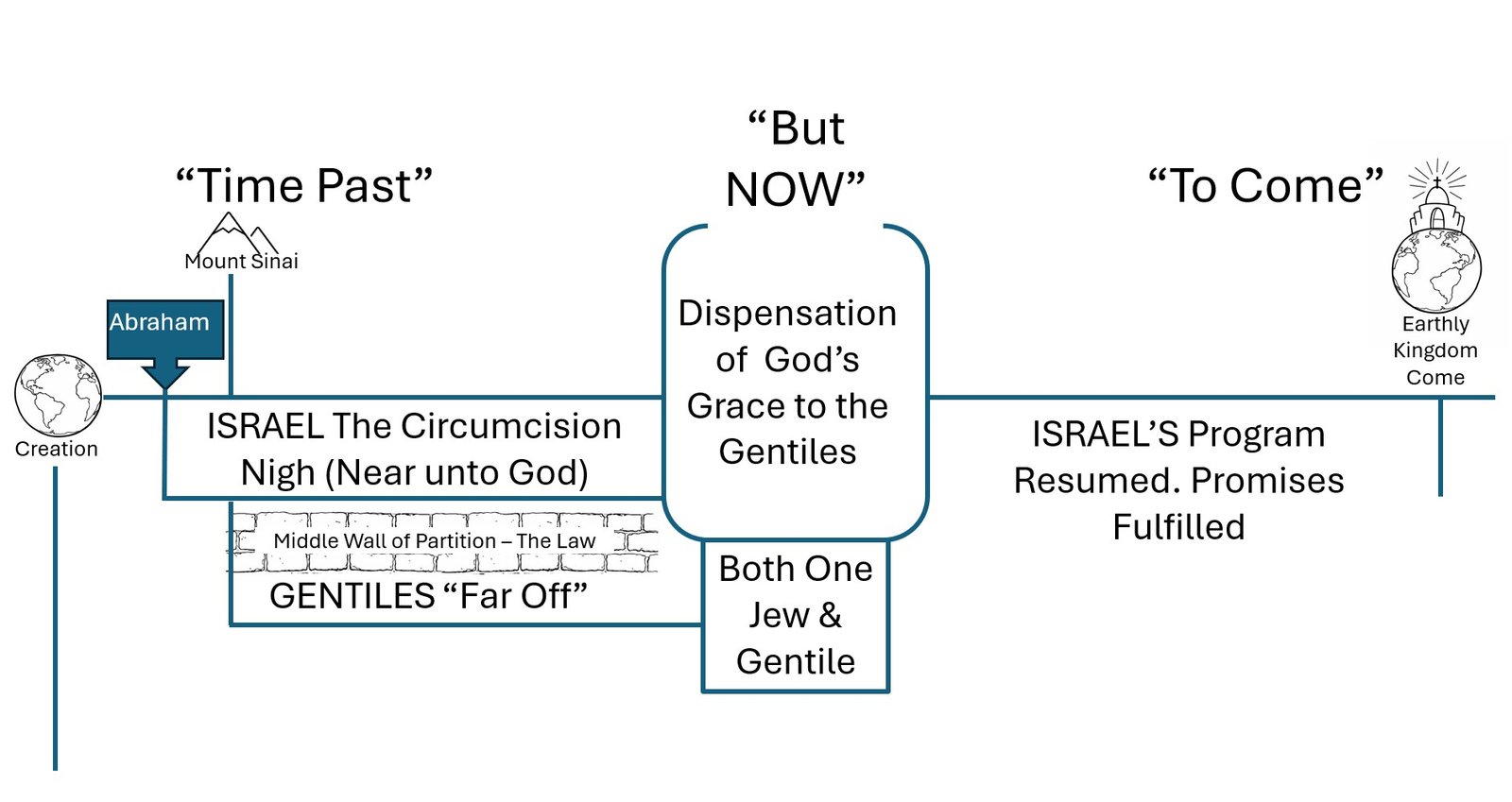
Episode 2 ChartClick Image To Enlarge

Understanding The Bible – Episode 2 – Transcript

Welcome to episode two in our series on Basic Bible Understanding, which is designed to help appreciate how to rightly divide the word of truth as Paul tells us we must do in 2 Timothy 2:15, which is,
Study to shew thyself approved unto God, a workman that needeth not to be ashamed, rightly dividing the word of truth.
We need to properly handle God’s Word to fully understand it, to know exactly what portion of it deals with us in the dispensation of grace in which you and I live today.
We have a simple chart beneath this recording that lets us see in timeline form what we’re saying.

Let’s open Ephesians chapter two again.

We’re trying to clearly see God’s timing. His program or dispensation, in time past, dealt exclusively with the nation of Israel. Then there was a great dispensational change that took place through Christ’s revelation to Paul. That’s the one in place now, today. Paul calls this change the dispensation of grace.

We saw last time that that’s very different from what God was doing in “time past”.

Then, we need to see the difference between the dispensation of grace that applies today and the things yet to come in God’s dealings with humanity.

This dispensation of grace has not always been in existence, nor is it always going to be in existence in the future. It’s going to end one of these days. It’s been going on for about 2000 years now, since the day of the Apostle Paul, but it will cease one day, and when it does, the things that have yet to be fulfilled in God’s program with Israel are going to come about. These are the things Paul describes as happening in the “To Come” period.

We need to have a basic understanding of that “yet to come” part of God’s plan and purpose.

So, as we saw last time, we have those three time periods. “Time past”, “But Now” and “To come”.

In this episode, we’ll talk a little bit more about the differences that exist in those three time periods.

In this dispensation of grace, God’s dealing with us Christians, members of the church, the body of Christ, members of that one new man.

He’s dealing with us differently today than he dealt with his nation, Israel, in the past, and how he’s going to deal with it in the time to come, and right dividing of the Word of Truth is critical to our understanding of that.

Many, if not most, Christians today are taking promises, commandments, instructions and teachings from God’s former time past program with Israel or from times yet to come, when He fulfils His program with Israel, and trying to make them fit into today’s dispensation of grace, and it simply won’t work.

The result is a lot of heartache and uncertainty, all because of a failure to rightly divide the word of truth.

No matter how sincere a Christian may be, he or she’s not going to force God to do something that contradicts His word by acting outside of His current program and start doing something today that was specifically for the ‘time past’ or the period “to come” just to satisfy our misguided desire.

So, it’s critical for you and me as Christians to rightly divide the word of truth and to know what portion of God’s Word is telling us what to do, and talking to us as members of the church, the body of Christ.

We’re going to deal with some of those things in an introductory manner, and as the series goes on, we’ll deal with them in more detail.

So, to recap, Ephesians 2:11-12,

Wherefore remember, that ye being in time past Gentiles in the flesh, who are called Uncircumcision by that which is called the Circumcision in the flesh made by hands;

That at that time ye were without Christ, being aliens from the commonwealth of Israel, and strangers from the covenants of promise, having no hope, and without God in the world:

Here is that “Time passed” where we see God’s program and dealings are exclusively with the nation of Israel.

He’s nigh, or near, unto them. He’s given them a token of his covenant with them, circumcision, which is a physical manifestation, a sign of his dealings with them, and the special nature of those dealings that excluded the other nations of the world.

God even set up a middle wall of partition between Himself and the nations with the law, which kept Israel on the near side of that wall towards Him and kept the Gentiles on the far side of that wall.

And that separation was so great that the Apostle Paul says at the end of verse twelve, that we Gentiles, at that time before the dispensation of grace, were without God in the world.

Now we’re going to look at each of those expressions there in Ephesians 2:12 later on, and we’ll understand the depth of meaning of them. But now, we’re simply acknowledging that that’s the way it was.

Ephesians 2:13 says,

But now in Christ Jesus ye who sometimes were far off are made nigh by the blood of Christ.

See this “But Now” expression?

It’s making a contrast, an opposite, to what was going on in “time past”.

Now something different applies. Now in Christ Jesus, you who sometimes were far off are made nigh or near by the blood of Christ. Ephesians 2:14 says in continuation,

For he is our peace, who hath made both one, and hath broken down the middle wall of partition between us;

Notice this critical point. God hath made both one!

Israel was near or nigh to God. Gentiles were afar off.

God’s now changed Israel’s “nigh” status and their exclusive nature. He’s also changed the Gentiles “afar off” status.

Now, in the dispensation of grace, He’s made both one.

We, both Jew and Gentile, stand on the exact same level before God in the dispensation of grace.

That wasn’t the way it was in time past, and it won’t be the way it is in time to come, but that’s the way it is right now in the dispensation of grace.

Ephesians 2:15 says that God,

Having abolished in his flesh the enmity, even the law of commandments contained in ordinances; for to make in himself of twain one new man, so making peace;

That’s the purpose of this new dispensation — to create “one new man” out of the “twain”, the two groups of people who were, up until this point, permanently divided from each other and from God. This “One new man” is the true church, the body of Christ. This is a new creation. It’s not Israel, and it’s not Gentiles. It’s something entirely new, as 2 Corinthians 5:7 and Galatians 6:15 say.

Ephesians 2:15  finishes with so making peace.

Making Peace between man and God was the goal; breaking down the wall that permanently separated us from Him was God’s incredible achievement, and it was done by His own death on the cross.

More about that later.

Remember what a dispensation is from the last episode? It’s a program that someone puts into effect and administers to achieve a particular end. A dispensation is never put into effect carelessly or just for the fun of it. It’s got a purpose behind it.

God’s got a distinct purpose with the nation of Israel. His program with Israel had a purpose, and it still does. It’ll be fulfilled out there in the “to come”, the future.

God has set Israel’s program temporarily aside and ushered in this dispensation of grace, making both Jew and gentile one new man, the church, the body of Christ. That’s the purpose behind it.

Why has God done that?

We’ll talk about that in detail as we go on, but right now, we need to acknowledge the fact that He’s brought the dispensation of grace in to create the one new man.

We find that expression a number of times in Paul’s epistles. The church, the body of Christ, is also called the new creation, a new creature. It’s a new thing in God’s overall program. Of course, it wasn’t new to God; He knew about it since before the world was formed, but it was never revealed to mankind throughout the history of the prophets.

Ephesians 2:16-18 begins with the word “And”, which directly links it to Ephesians 2:15, which ends in, so making peace;

Ephesians 2:15-18… so making peace;

And  that he might reconcile both unto God in one body by the cross, having slain the enmity thereby:

And came and preached peace to you which were afar off, and to them that were nigh.

For through him we both have access by one Spirit unto the Father.

Then we go to Ephesians 2:19, which opens with,

Now therefore…

All we want up to this point is to note the “now” issue.

We’re not ready yet to deal with the things spelled out in Ephesians 2:19-22, but we need to be aware of this”Now therefore”.

So, “now therefore” means that because of this great dispensational change, we possess now the things that Paul describes in these verses.

That’s now in the dispensation of grace. Now we possess all that as members of the one new man, the church, the body of Christ. We didn’t possess them in “time passed”, but the things revealed by Paul, our apostle today, in connection with the revelation of the dispensation of grace are for us today. We’ll deal with that a little later on in this episode when we open Ephesians chapter 3.

So, what do we have?

We’ve got “time passed, and “but now”, and “to come” as per the chart below.

Paul’s revelation, given to him by the risen Christ Himself, is the outworking of God’s plan and purpose contained in those three time expressions. Paul’s understanding as the apostle to the Gentiles should be our understanding.

Let’s focus on “things to come” for a few minutes.

Go to Romans 11.

In Romans chapters nine, ten and eleven, Paul’s dealing with the same thing we’ve just been talking about in Ephesians chapters 2 and 3, “time past”, “but now” and “to come”.

The only difference is in Romans nine, ten and eleven, he’s looking at it from the time past. He recognises the fact that before this dispensation of grace came in, God’s program was with Israel. He acknowledges the fact that this dispensation of grace has interrupted God’s program with Israel.

In other words, God brought this dispensation of grace in before He’d fulfilled His program with Israel. And from that perspective, Paul deals with the issue of “time past”, “but now”, and “to come”, and he deals with the question of what’s happened to Israel in this dispensation of grace. What does it all mean for Israel? Has God cast his people away? Does that mean that His word, His promises to them, have been broken? Does that mean that the things He’s promised and covenanted with them, they’re now not going to get?

It’s from that perspective that Paul, in Romans, looks at the same issue of the great dispensational change we’re talking about in Ephesians.

So, what we’re concerned with at the moment is getting an understanding of what’s yet to come after the dispensation of grace has ended, which is the resumption and fulfilment of God’s program with Israel.

Now, in Romans, notice the way chapter nine begins.

Romans 9:1-3,

I SAY the truth in Christ, I lie not, my conscience also bearing me witness in the Holy Ghost,

That I have great heaviness and continual sorrow in my heart.

For I could wish that myself were accursed from Christ for my brethren, my kinsmen according to the flesh:

Paul’s talking about Israel, of course, and he goes on to finish his thought in Romans 9:4-5, …For I could wish that myself were accursed from Christ for my brethren, my kinsmen according to the flesh…

Who are Israelites; to whom pertaineth the adoption, and the glory, and the covenants, and the giving of the law, and the service of God, and the promises;

Whose are the fathers, and of whom as concerning the flesh Christ came, who is over all, God blessed for ever. Amen.

The great heaviness and continual sorrow in Paul’s heart is because he recognises that the things that pertain to the nation of Israel, and God’s program with them, haven’t been fulfilled yet, and God’s cut off his dealings with the nation of Israel.

Remember, Paul’s a Jew from the tribe of Benjamin, so Israel is his kinsmen in the flesh.

Paul knows that if God’s cut off His program with Israel, and that’s exactly what He’s done, then God’s program with Israel is not being fulfilled in this dispensation of grace.

Now, as we’re going to see later in Romans 11, Israel’s been set aside, and a blindness has been imposed upon them temporarily.

God’s program with them is not being fulfilled in this dispensation of grace, and Paul acknowledges that here in these opening verses of Romans 9.

God’s now turned to the Gentiles without giving them the things He promised them. Not yet.

Notice the glory in Romans 9:4. That’s the glory of the Kingdom on this earth and the great nation of the Abrahamic Covenant made directly between God and Abraham with the marvellous declarations of glory promised to them in passages like Isaiah 60 and 61.

They don’t have that yet. Also, there are several covenants God made with Israel beyond the Abrahamic covenant. They don’t have the fulfilment of those things yet either.

What about the giving of the law? They certainly had that, didn’t they? Well, in one sense, yes, they had the law given to them, but there are things in that law that they don’t have yet. And the service of God. Well, why aren’t they serving God? There’s provision in the law for serving God in connection with being that great nation and a Kingdom of priests that they have never had yet.

By the way, those things pertaining to Israel don’t pertain to us Gentiles today.

We’ll look more into that, but it’s important to see who those things do and don’t pertain to.

One of the greatest mistakes made by not rightly dividing the word of truth is made when Christians are either taught or think that they’re spiritual Israelites, and that the things that pertain to Israel that God spelled out in the Old Testament scriptures are things that pertain to us today in some weird spiritual sense.

The only reason why people ever come up with ideas like that is that they don’t do what God tells them to do with His Word and rightly divide it, so they fail to recognise the critical importance of the dispensation of grace, to both Jew and Gentile, as God’s program today. If we fail to grasp that we mishandle the Word of God, and when we mishandle it, we come up with ideas like, we’re spiritual Israelites, and we assume that in some manner or form, we’re part of Israel’s program and God’s promises and so forth to Israel are ours. And that just isn’t true. That isn’t what God says. That’s what men say when they mishandle God’s Word.

These things spoken about here in Romans 9:4 pertain to Israel, and Paul’s going to go on to show throughout Romans nine, ten and eleven that they still pertain to Israel.

He’s going to explain that even though Israel, the literal, physical seed of Abraham, hasn’t received those things yet, they’re going to.

What God’s done in bringing in this dispensation of grace isn’t to cast away His people and take away from them things He’s promised them by His inviolate word and by His oath-bound covenants.

Paul’s going to show us at the end of Romans chapter 11 that the gifts and calling of God to Israel are without repentance, which means He hasn’t changed His mind about His program with them. He’s made irrevocable promises and covenants with them, so much so that the very integrity of God Himself is at stake.

When we Christians come along and assume those things and claim them for ourselves, we’re actually declaring that God never meant what He said. We’re calling the very integrity of God into question.

These things pertain to Israel. Notice that in Romans 9:4, it says to whom pertaineth?

It doesn’t say to whom they did pertain once, but don’t anymore. They still do. It’s just that God set their program aside temporarily. He’ll pick it up again. He’ll resume it, and they’ll receive the things He’s promised them and covenanted with them. That’s what times “to come” is all about.

Let’s go to Romans 11:25. If we had time, we would deal with everything from verse eleven on, because in verse eleven, the Apostle Paul explains how God has blinded His nation and temporarily set them aside.

Once again, His program and dealings with them since He separated Abraham from the rest of the world and created Israel, are on hold, but not cancelled.

Romans 11:25  now declares.

For I would not, brethren, that ye should be ignorant of this mystery, lest ye should be wise in your own conceits; that blindness in part is happened to Israel, until the fulness of the Gentiles be come in.

Paul starts off saying, I don’t want you to be ignorant.

Anytime Paul ever says anything like that, we can be sure he’s underscoring something vital for us to understand, and ignorance of it’s going to cause us problems.

The truth is, many of us Christians fall for and accept a whole theological system called covenant theology.

That’s because so many of us are ignorant of Romans 11:25. This system, covenant theology, makes statements and assumptions that are in error, and it misunderstands many things in God’s Word. They talk about us being spiritual Israel and things along those lines. And that just isn’t the case.

Blindness, in part, Paul says in Romans 11:25, has happened to Israel. If it’s in part, it’s not permanent. It’s temporary. Blindness has come upon them until Paul says, “The fullness of the Gentiles be come in”.

God’s turned to us Gentiles. He’s broken off his dealings with national Israel. He’s ushered in this dispensation of grace. But it’s not a permanent thing.

And, by the way, every Jew who has lived for the last 2000 years since Christ ushered in the dispensation of grace through Paul has had access to salvation, but it’s not an access that’s gained by being Israel and following the commandments and ordinances in the law. They proved time and again that they could never do. They come the same way as we Gentiles do, by grace through faith, by believing the gospel, believing in the birth, death, burial and resurrection of Christ. This is why it’s misleading to talk of “Messianic Jews”. If a Jew is saved, it’s on the same basis as you and me, as the true church, members of the body of Christ.

We see this in Galatians 3:28,

There is neither Jew nor Greek, there is neither bond nor free, there is neither male nor female: for ye are all one in Christ Jesus.

And in

Colossians 3:11,

Where there is neither Greek nor Jew, circumcision nor uncircumcision, Barbarian, Scythian, bond nor free: but Christ is all, and in all.

When the fullness or the completeness of what He’s doing with us Gentiles be come in, then that blindness that God brought upon the nation Israel will be removed, and God will resume and fulfil His program with Israel.

In fact, that’s what the whole section of Paul’s “to come” period is all about. It’s Israel’s program resumed and fulfilled.

That’s exactly what he says in Rom 11:26,

And so all Israel shall be saved: as it is written, There shall come out of Sion the Deliverer, and shall turn away ungodliness from Jacob:

The whole chapter of Romans 11 deals with this fact.

And so, since that’s the case. Blindness has happened to Israel until the fullness of the Gentiles be come in. And, after that, all Israel shall be saved. As written and promised back through the prophets.

Paul’s going to quote two hallmark passages in connection with that coming to pass. It’s not going to come to pass in the dispensation of grace, though, it’s going to come to pass once the fulness of the Gentiles be come in, and God’s done with this dispensation of grace, then He’ll get back to His program with Israel, and the salvation promised to that nation will be theirs. And so all Israel shall be saved as it is written.

God wrote it down as part of His Word. He cannot lie. It’s going to come to pass.

Therefore there shall come out of Zion the deliverer, and shall turn away ungodliness from Jacob. For this is my covenant.

God didn’t simply say that to fill up some space in His Word! He made a covenant about it, an oath-bound covenant.

In Romans 11:27, Paul is quoting  Isaiah 27:9 and Jeremiah 31:33-34, when God shall take away their sins under the terms of the New Covenant. We’ll read it,

For this is my covenant unto them, when I shall take away their sins.

The resumption and fulfilment of God’s program with Israel rests upon two immovable things, the Word of God and the covenants of God.

When Christians mistakenly come along and assume promises and covenants and things that God promised to Israel and assume them for themselves, they’re literally declaring that God’s Word and his covenants to Israel are useless.

Romans 11:28,

As concerning the gospel, they are enemies for your sakes: but as touching the election, they are beloved for the fathers’ sakes.

God closed them out in accordance with his plan and purpose, but Paul says they are beloved for the fathers sakes. Notice that. But God still values and esteems them. They’re still beloved by him. And notice, “For the fathers’ sakes” – plural, the fathers of Israel to whom God made the promises. The ones with whom He made the covenants.

God values and esteems His nation for their, the fathers’,  sakes because His integrity is at stake.

His very character and essence rest upon the things He promised and covenanted to those fathers.

Romans 11:29,

For the gifts and calling of God are without repentance.

The gifts and calling of God that he’s talking about here are the gifts and calling of God in connection with Israel. That’s the context here. And Paul’s saying that the gifts and calling of God are without repentance to His nation. When you repent, you change your mind about something. God doesn’t change His mind about His nation, Israel.

He’s temporarily set His program with them aside, while the dispensation of Gentile grace has been brought in and is being administered by Him.

They’re still temporarily set aside right now because the dispensation of grace is in effect. But when the fulness of the Gentiles be come in, God’s going to end this dispensation of grace. He’s going to end it by what’s commonly referred to as the rapture of the church.

The Lord Jesus Christ is going to come back and receive us unto Himself at the end of this dispensation of Grace.

This dispensation starts and ends the same way. It started with the Lord Jesus Christ unexpectedly coming back from heaven and raising up Paul there in chapter 9 of the Book of Acts, and it’ll end with the Lord Jesus Christ descending from heaven with a shout.

1 Thessalonians 4:15-17.

For this we say unto you by the word of the Lord, that we which are alive and remain unto the coming of the Lord shall not prevent them which are asleep.

For the Lord himself shall descend from heaven with a shout, with the voice of the archangel, and with the trump of God: and the dead in Christ shall rise first:

Then we which are alive and remain shall be caught up together with them in the clouds, to meet the Lord in the air: and so shall we ever be with the Lord.

That’s how the dispensation of grace ends.

That’s what takes place when the fulness of the Gentiles be come in. And, after that event takes place, God will resume His program with Israel, and the things that pertain to them will be theirs. That’s what’s on that timeline chart under the “to come” time. Israel’s program resumed and fulfilled.

Notice that little graphic on the chart that represents the establishment of God’s Kingdom on this earth. This Kingdom is what God’s program and purpose with Israel is all about.

Is important to highlight that that is the purpose behind God’s covenant with Abraham. When God promised to make of Abraham a great nation, the goal was the establishment of God’s kingdom on earth. This kingdom is the subject of Israel’s prophetic program, right throughout the Old Testament through to the first part of the Book of Acts and then from Hebrews to The Book of Revelation. It’s the focus of the so-called Lord’s Prayer: “Thy kingdom come.”

This Kingdom is not being brought in today. It will not arrive through the church, the body of Christ. It belongs to Israel’s program, and it’ll be established only after God resumes His dealings with that nation.

We must understand that!

We’re going to be talking about that later, but this is a classic example of wrongly dividing the word of truth, or not rightly dividing the word of truth at all.

Often, we’ll hear Christians today talking about bringing in the Kingdom.

But, my friends, that’s not what God’s doing today. That’s God’s purpose with Israel: to bring His Kingdom to this earth. That’s the whole issue in what’s called the Lord’s Prayer, though it wasn’t the Lord who prayed it. It was how the Jewish disciples should pray at that time, before Paul and before the dispensation of grace was ever known about.

Thy Kingdom come, thy will be done, on earth as it is in heaven. That’s Israel’s program, and that’s what’s going to be set up on this earth.

God’s kingdom is going to come to this earth. His will is going to be done on this earth as it is in heaven. That’s not going on in this dispensation of grace.

Christians have been misapplying those prayer instructions of Matthew chapter six for almost two thousand years, and they’ve not yet made God do something He doesn’t intend for this dispensation of grace, even if this dispensation of grace goes on for another two thousand years.

Christians can say that prayer over and over and over again, and the Kingdom still won’t come while the body of Christ is still on earth, because that’s not God’s purpose in the dispensation of grace.

It’s not what the one new man, the new creature, the church, the Body of Christ, is designed to do in God’s plan and purpose. That’s what Israel’s plan and purpose is. And until God resumes His program with Israel and fulfils it, that kingdom won’t be on this earth until after the dispensation of grace is over.

Let’s go to Ephesians chapter three.

The present dispensation of grace in which we live today is a new program and a divinely designed interruption in God’s dealings, radically different from His program and dealings with the nation of Israel.

But God didn’t just all of a sudden decide to do this.

The Apostle Paul describes this thing as a mystery, something that wasn’t known about, or expected in time past, because God had kept it a secret in time past.

He never said anything about it to Adam, or any human being, from that point on, until He revealed it to the Apostle Paul.

Ephesians 3:1,

FOR this cause I Paul, the prisoner of Jesus Christ for you Gentiles,

If ye have heard of the dispensation of the grace of God which is given me to you-ward:

That’s where we are in the dispensation of grace with both Israel and the Gentiles, Jew and Gentile, one and God making the one new man, the church, the body of Christ. That’s who we are right now.

But now look at Ephesians 3:3-5,

How that by revelation he made known unto me the mystery; (as I wrote afore in few words,

Whereby, when ye read, ye may understand my knowledge in the mystery of Christ)

Which in other ages was not made known unto the sons of men, as it is now revealed unto his holy apostles and prophets by the Spirit;

Paul says this dispensation of grace was a mystery that God had not spoken about before He revealed it to Paul.

God kept it hidden in himself.

Let’s pick up at Ephesians 3:7-9,

Whereof I was made a minister, according to the gift of the grace of God given unto me by the effectual working of his power.

Unto me, who am less than the least of all saints, is this grace given, that I should preach among the Gentiles the unsearchable riches of Christ;

And to make all men see what is the fellowship of the mystery, which from the beginning of the world hath been hid in God, who created all things by Jesus Christ:

That’s why these riches are unsearchable, because they simply weren’t made known by God. He didn’t have anybody write anything about it.

This dispensation of grace and the things Paul’s talking about were a mystery before God revealed them to him.

Look at it again now in Ephesians 3:9

And to make all men see what is the fellowship of the mystery, which from the beginning of the world hath been hid in God, who created all things by Jesus Christ:

There it is. From the beginning of the world, it’s been hidden in God, not hidden in the scriptures as if it was always there, but people just didn’t recognise it. It was hid in God’s own heart. He knew what He was going to do before the world began.

Before time itself was even created, God knew He was going to bring this dispensation of grace into effect, but He didn’t say anything about it from the beginning of the world until he revealed it to the Apostle Paul.

Now, why is that the case?

We’ll talk about that in more detail later on, but before we can deal with the why, we’ve got to see the reality of it, and that’s plain and clear.

The mystery has been hidden from the beginning of the world.

Open Colossians 1:24-27 now. And we read this, and Paul’s talking about himself,

Who (that’s Paul) now rejoice in my sufferings for you, and fill up that which is behind of the afflictions of Christ in my flesh for his body’s sake, which is the church:

Whereof I am made a minister, according to the dispensation of God which is given to me for you, to fulfil the word of God;

Even the mystery which hath been hid from ages and from generations, but now is made manifest to his saints:

To whom God would make known what is the riches of the glory of this mystery among the Gentiles; which is Christ in you, the hope of glory:

There it is again, the mystery which had been hidden from ages and generations, but now is made manifest to his saints. This fact is repeated many times in Paul’s epistles, but let’s see it in Romans 16:25-27,

Now to him that is of power to stablish you according to my gospel, and the preaching of Jesus Christ, according to the revelation of the mystery, which was kept secret since the world began,

But now is made manifest, and by the scriptures of the prophets, according to the commandment of the everlasting God, made known to all nations for the obedience of faith:

To God only wise, be glory through Jesus Christ for ever. Amen.

Notice Paul’s talking about my gospel and the preaching of Jesus Christ. Paul’s got a special message committed to him in connection with his special apostleship, the message of the dispensation of grace.

But notice when he talks about that preaching of Jesus Christ, he talks about, according to the revelation of the mystery which was kept secret since the world began, but now is made manifest. There it is again. It was hid in God. God’s the one who kept it secret since the world began, but now has revealed it.

Adam didn’t know about it. Noah, Abraham, Moses and David didn’t know about it.

Neither did Isaiah, Jeremiah, nor Daniel. John the Baptist didn’t know about it either.

The Lord didn’t say anything about it when He was here in His earthly ministry.

Peter, James, John, and the other disciples didn’t know about it until it was revealed to them later by the apostle Paul.

This dispensation of grace is not only a different program in God’s plan and purpose from what was going on in time past, and from what’s yet to come, when He resumes and fulfils his program.

It’s more than that. It’s a new and different program that had never even been spoken about by God before and therefore never anticipated, prophesied about, or looked for by anybody until God revealed it to the Apostle Paul.

When God revealed it to the Apostle Paul, it came as a complete surprise because God had kept it secret since the world began. Therefore, this dispensation of grace is not the subject matter of the Old Testament prophets. We don’t find anything about it in the Old Testament Scriptures.

Also, it wasn’t the subject of the Lord’s earthly ministry as recorded in Matthew, Mark, Luke and John. Nor was it the subject matter of the twelve apostles’ ministry with the Lord, or in the opening chapters of the book of Acts, before God raised up Paul there in Acts chapter nine.

Turn to 2 Timothy 2:15 again. Here’s the verse we started with in our first episode, where we saw the requirement for us to properly handle God’s Word, rightly dividing that Word of Truth.

When Paul told Timothy that, Timothy knew what it meant. He knew that the Word of Truth recorded everything in the outworking of God’s overall plan and purpose, and that those plans and purposes are made up of more than one program or dispensation.

Timothy understood that Israel’s program was temporarily set aside, and that’s not what’s going on right now.

When Paul talked about rightly dividing the word of truth, Timothy knew what that meant, because Paul had already explained to Timothy what rightly dividing the word of truth meant.

That’s recorded earlier in Paul’s epistles, and we’ve just been dealing with it in Ephesians chapters 2 and 3, and in Romans chapters 9, 10 and 11.

So, when we come to 2 Timothy 2:15 and read about rightly dividing the word of truth, we can’t scratch our heads and say,” What are you talking about, Paul?”

If we know Romans 9, 10, and 11, and if we know Ephesians two and three, we know what that means, because Paul’s already told us. In the Word of Truth, we’ve got things that pertain to God’s “time past” dealings with Israel. We’ve got things that pertain to God’s “Right Now” program in this dispensation of grace with the new creation, the one new man, the church, the body of Christ. And we’ve got things in God’s Word that pertain to what’s yet “to come”, when God resumes His program with Israel, and fulfils it. We definitely have no excuse for not rightly dividing the Word of Truth.

In the next episode, we’re going to see how the Word is laid out in the order of the outworking of God’s plan and purpose.

So until then, may God bless you.

Understanding The Bible – Episode 1

Moses and Paul are the two major revealers of God’s word — Moses to Israel under the Law, Paul to the Body of Christ in the Dispensation of Grace. The Dispensation of Grace is new, unique, and unprecedented — a mystery not revealed in Old Testament prophecy.
Paul’s apostleship is distinct and specially commissioned by the risen Christ for the Gentile nations. To understand the Bible, we must have a full understanding of God’s complete plan from Genesis through to Revelation and how it unfolds across dispensations. God’s message is logically recorded in connection with His plan and purpose throughout all of Scripture.
Understanding our program today — the mystery — is critical; we must rightly divide Paul’s doctrine from Israel’s program.

“Speed Slider”

Episode 1 ChartClick Image To Enlarge

Understanding The Bible – Episode 1 – Transcript

This is a series on basic Bible understanding.
We’re not talking about understanding the stories of the Bible. Neither are we talking about the fact that the Bible actually is the Word of God.
I’m assuming that you already understand that the sixty-six books from Genesis to the book of Revelation make up the completed revelation from God to mankind.
We’re talking about a basic Bible understanding and appreciation of the message that God has outlined in His Word, revealing His plan and purpose, and the outworking of that plan and purpose from Genesis all the way through to the Book of Revelation.
That will lead us into an understanding and appreciation of God’s Program for today.

How do you and I fit into God’s timeline?

God’s program for you and me today is recorded in what the Apostle Paul calls the dispensation of the grace of God.

This is in contrast to what God was doing in time past, before this dispensation of grace began, and what’s yet to come in God’s program and purpose after He concludes this dispensation of grace.

There’s a particular passage in the bible that summarises the most critical issue when it comes to properly understanding God’s Word.

That passage is 2 Timothy 2:15-16.

 Study to shew thyself approved unto God, a workman that needeth not to be ashamed, rightly dividing the word of truth.

But shun profane and vain babblings: for they will increase unto more ungodliness.

That passage is one of the basic foundations of this series.

An enormous amount of time could be taken to expand on the details of the things we’ll present, but we’re keeping it short and simple in this series, concentrating on the basic issues of proper Bible understanding and, in particular, understanding and appreciating what God’s doing today in this dispensation of grace in which we live.

We’re presenting to you a vital key to understanding the Bible, but it’s up to you to check out what we’re saying and employ it in your own life and in your personal Bible study.

So, 2 Timothy 2:15 is a verse that you should probably know from memory.

In this passage, Paul says to Timothy,

Study to show thyself approved unto God, a workman that needeth not to be ashamed, rightly dividing the word of truth.

Now, in the last part of that verse, we see something that’s actually a key that unlocks a critical issue when it comes to properly understanding God’s Word. Without this key, rightly dividing the word of truth, God’s word isn’t going to make as much sense as it should, and it’s going to confuse the Christian’s life.

This, unfortunately, is the case in most Christian fellowships today because Christians don’t understand what it is the Apostle Paul is saying here, and that makes rightly dividing the word of truth impossible to apply.

Looking at the context of this verse, we see that some improper Bible handling was going on, and so the Apostle Paul takes the time to stress this to this young pastor, Timothy, in connection with his study and teaching of God’s Word.

Look at the verses that immediately follow verse fifteen.

2 Timothy 2:16-18 says,

But shun profane and vain babblings: for they will increase unto more ungodliness.

And their word will eat as doth a canker: of whom is Hymenæus and Philetus;

Who concerning the truth have erred, saying that the resurrection is past already; and overthrow the faith of some.

In those three verses, Paul points out some problems that are going on.

In the assemblies, the churches, there in Ephesus, the problems came down to improper Bible handling and improper Bible teaching.

Some things were being preached by Hymenaeus and Philetus that were wrong, that were in error.

They talked about things in the Bible, spiritual things, scriptural things. But the issue was they weren’t handling the Bible properly, and the things they were saying were wrong, even though they were in the scriptures.

Paul talks here about the words of Hymenaeus and Philetus being profane and vain babblings, and the result of those things was an increase in more ungodliness. He talks about their word eating as doth a canker, in other words, destructive and corruptive in nature.

These two were preaching that the resurrection was past already, and this had overthrown the faith of some.

The whole doctrine of the resurrection is something the Bible speaks about repeatedly. It’s not that these individuals were saying that what the Bible says about the resurrection was wrong or that what the Bible says is false.

They were preaching the truth. They were handling the Bible, but they were saying some things in connection with Bible truth that weren’t correct.

What Paul tells Timothy here emphasises the need to be rightly dividing the word of truth; he’s emphasising the proper handling of God’s Word, the word of truth, and the method of properly handling it is by rightly dividing it.

So, here’s this key we’re talking about that unlocks the understanding and appreciation of the scriptures.

The key to knowing what God’s doing today, and not falling into error and mistakes, is in that expression, “rightly dividing the word of truth”.


Now, when we rightly divide something, we’ve first got to recognise there are actually certain things that fit in one place and certain other things that fit in another place.

An example of rightly dividing is in accounting, where the separation, the rightly dividing, of business and personal expenses is critical to understand true profit.

Another illustration is an anecdote about a farmer who brought in a huge harvest of wheat. The grain, the chaff, the straw, and the weed seeds all came in together. Instead of separating them, he shovelled the whole mixture straight into the silo.

At first, it looked full and impressive — but within days the grain began to spoil. The moisture from the green weeds spread through the bin. The chaff attracted pests. The straw held dampness, and what could have been food, seed, and income turned into a rotting mess.

His neighbour shook his head and said, “Mate, the harvest wasn’t the problem — the mixing was.”

The farmer learned the hard way that a good harvest still becomes useless if you don’t divide what belongs together from what doesn’t.

And that’s exactly what happens when we read the Bible without right division.

God’s Word is perfect, but if we mix Israel’s instructions with the Body of Christ, or law with grace, we end up with confusion instead of nourishment.

Right division doesn’t destroy the harvest — it preserves it.

Dividing a thing where a division belongs means we don’t take things from one part and apply them to another part when those two things don’t necessarily fit into each other.

Rightly dividing something is making a correct division and recognising the distinctiveness, the uniqueness of each part; that’s what’s got to be done with God’s Word.

In this series, we’re going to begin to see that all the Bible isn’t talking about what God’s doing today and that everything in the Bible isn’t giving you and me particular doctrines and instructions on what to do today.

The truth is that God’s got more than one program recorded for us in the Bible to show us the outworking of His dealings, his plan and purpose for mankind through the ages, past, present and future.

Now there is a portion of God’s Word that’s dealing expressly with doctrines and instructions about what God’s doing with us today, but that’s not the case with the entire Bible.

God wants us to have an understanding of and an appreciation for everything in the Bible. It’s all profitable for us, and we need to learn it all, and God tells us this in Paul’s letter to Timothy in 2 Timothy 3:16-17,

All scripture is given by inspiration of God, and is profitable for doctrine, for reproof, for correction, for instruction in righteousness:

That the man of God may be perfect, throughly furnished unto all good works.

But not everything from Genesis to Revelation is about you and me as Christians today in the dispensation of God’s grace that’s in effect right now.

Rightly dividing the word of truth is recognising and understanding that, and applying it as we handle the Bible.

Here’s a quick and easy illustration.

In Genesis chapters six, seven, and eight in particular, God gave us details concerning the flood that He used as a judgment on this world in the days of Noah.

Before the flood came, God gave Noah instructions to go out and build an ark, and gave him the specific dimensions of it.

He told Noah how many stories to build it, instructions relating to the animals in it and provisions to store.

They were very detailed, explicit instructions given to Noah in connection with building an ark.

Now God expects you today in the dispensation of grace in which we live, to understand and appreciate that event, to understand why it took place and all the other things in connection with it. But he doesn’t expect you or me to go out and build an ark. Those aren’t the instructions to us today.

It may be a very simplistic example, but it’s also an illustration of rightly dividing the word of truth. That portion of God’s Word, in the book of Genesis, doesn’t pertain to us in this dispensation of grace except as something we need to know about.

So, if I were to go out to build an ark, no matter how sincerely and honestly I believed God had told me to do it, and no matter how much time it took me to do it, or how much sacrifice I made in labour and resources, I’d be disobeying God. I wouldn’t be pleasing him one bit. In fact, I’d be grieving the Holy Spirit.

But no one could say I wasn’t scriptural.

I could easily point the knockers to scripture and verse about building an ark, but I would not be properly handling God’s word, and that’s very obvious. I would not be rightly dividing the word of truth.

It’s a very simplistic illustration, of course, but it illustrates the principle.

And that’s what we’re going to be looking into, the issue of making that right division in God’s Word, recognising the portion of God’s Word that’s dealing with and talking to us today.

That means recognising the portion of God’s Word that’s dealing with His chosen nation, Israel, both in time past and in what’s yet to come, and understanding and appreciating that those dealings with Israel are not the same as His dealings with the church, the body of Christ today.

We do not want to mix God’s distinct programs and misapply the Word of God.

This may not sit well with some of you, but the basic issue is understanding and correctly handling God’s Word, and that relies on us applying this principle of rightly dividing the word of truth.

Let’s go to the book of Ephesians. We’re going to start by focusing on what God’s doing today, and the need to understand that, and we’ll begin by contrasting what God’s doing today with what He was doing before this dispensation of grace came in and what’s yet to come after this dispensation of grace ends.

Notice how we’ve been using that word dispensation and the expression, dispensation of grace, repeatedly for the last five or ten minutes.

In Ephesians 3, we see that today we live in the dispensation of God’s grace, and from there we’ll build a case for the necessity to rightly divide God’s Word.

So, in the passage beginning at Ephesians 3:1 and going down to Ephesians 3:6, the apostle Paul says,

FOR this cause I Paul, the prisoner of Jesus Christ for you Gentiles,

If ye have heard of the dispensation of the grace of God which is given me to you-ward:

How that by revelation he (that’s Jesus Christ) made known unto me (Paul) the mystery; (as I wrote afore in few words,

Whereby, when ye read, ye may understand my knowledge in the mystery of Christ)

Which in other ages was not made known unto the sons of men, as it is now revealed unto his holy apostles and prophets by the Spirit;

That the Gentiles should be fellowheirs, and of the same body, and partakers of his promise in Christ by the gospel:

Alright, back up in verse one there, Paul says, for this cause I, Paul, the prisoner of Jesus Christ, for you Gentiles. That’s you and me. That’s who we are. We’re Gentiles. We’re members of the nations of the world.

Ephesians 3:1 tells us that the apostle Paul is the one whom God raised up and sent out with a message for us, the Gentiles, the nations of the world.

For this cause I, Paul, the prisoner of Jesus Christ, for you Gentiles. If you have heard of the dispensation of the grace of God which is given me to you.

Paul’s the one whom God raised up and dispensed, or gave a revelation, a message to pass on to us about what He’s doing with us and things He wants us as Gentiles, as members of the nations of the world, to understand.

Now, we’ll just flip over for a minute to Romans chapter eleven. We want to be sure of Paul being our apostle from God today. Romans 11:13,

For I speak to you Gentiles, inasmuch as I am the apostle of the Gentiles, I magnify mine office:

That’s who Paul is. He’s the apostle of the Gentiles. That’s a very distinct, very special office. You and I are Gentiles, and that’s who God has raised up as our apostle and the one God expects us to listen to. He’s the one that God sent out to you and me with the message He wants us to hear today.

Now, back again to Ephesians 3, where the apostle Paul reminds these Ephesians of the specialness of his ministry and what God gave to him to give to us and tell us about as Gentiles.

Ephesians 3:2,

If ye have heard of the dispensation of the grace of God which is given me to you-ward:


Now that’s what’s in effect today, people, and it’s been in effect since God raised up the Apostle Paul. That’s what God’s doing today, dispensing grace, in the Dispensation of the grace of God, and that’s what we’re talking about: what’s going on right now.

Once again, Ephesians 3:2,

If ye have heard of the dispensation of the grace of God which is given me to you-ward:

To WHOward? You Gentiles, to us.

So, clicking on to the next slide, we have some brackets to show this dispensation of God’s grace that Paul says was committed to him, given to him for us Gentiles.

So, that’s what’s in effect, now, today.

You and I live in the dispensation of grace. Now what is that, though? What is a dispensation?

We don’t hear that word very often, and that’s a shame.

Many newer English translations declare that to be an archaic concept, and they try to improve on that definition by sometimes translating it as “stewardship” or “administration”.

Administration comes sort of close to what the word dispensation conveys, but in reality, those two words fall short of what the word dispensation really transmits to us.

People today say it’s too hard to understand. That’s simply laziness! It’s very easy to go to an English dictionary and look up a word, and why should it be wrong to look up the word dispensation.

The truth is that the word Dispensation perfectly conveys the meaning as God intended. Even the word economy, which is apparently almost a direct transliteration of the Greek word in our English today, we’ve altered to the point where we’ve robbed it of some of the senses that are in the word dispensation.

Since we don’t use the word very often today, we should say a little bit about it.

A dispensation, as defined in an English dictionary, is

  1. an exemption from a rule or usual requirement.
  2. a political, religious, or social system prevailing at a particular time.

A dispensation is what someone puts into effect, or dispenses, to achieve or accomplish a particular end that he has in view.

In economics, we can find the word dispensation utilised, often in connection with business management.

If the economic climate isn’t good, a business owner or manager has to take steps to preserve capital and ensure that money and resources are not wasted.

He’d have to put in a program that’s designed to save money and limit expenditures, so they could weather the storm of the poor economic climate. This can be called an austerity dispensation.

It’s a political and economic system where governments strictly limit public spending and raise revenue, primarily to control public debt. It would have certain rules and regulations, and certain policies in connection with it that would be in effect for that period of time while the economic climate was bad. Some of those policies in the austerity dispensation may be to lay off some workers, or to shut down an unprofitable plant or temporarily close an unprofitable arm of the organisation or cut back manager salaries, and things like that, to save some money.

If the economy were to turn around and things were to start looking up, they may stop the austerity dispensation and put a prosperity dispensation in place that was geared to investing and hiring new workers and reopening closed arms of the organisation that were now needed to fill increased demand.

Those things would be different from what was going on in the austerity dispensation, but there would be things that would be perfectly suited to the prosperity dispensation.

Hopefully, this illustration gives a bit of insight into that word dispensation.

Quite often, that program or dispensation would be given to a steward to administer, and that’s where the stewardship idea comes from in the Greek.

So, the word dispensation describes a program dispensed by the individual, by the manager, and he dispenses it to achieve a particular goal or objective.

He doesn’t just do it for the fun of it.

So, here we have the apostle Paul telling us that right now God’s got a particular dispensation in view, a particular program He’s working out. And it’s with us Gentiles today. And it’s a very gracious program. It’s a great program in the sense that God dispensed it by His grace, and the key issue here is that it has to do with that word, Grace.

This dispensation of grace today is a very special and a very distinct thing. It had a beginning to it, and it also has an end. Right now, we’re someplace in between the beginning and the end. It’s been going on for quite some time, since God raised up the Apostle Paul around 2000 years ago. And we’ll be talking about that in much greater detail as we go along.

We’re bringing that up now so we can understand that the dispensation of grace in which we live today has not always been in effect.

It’s not the only dispensation or program that God has had.

In fact, for a long, long time before this dispensation of grace began, God had an entirely different program in effect, and after this dispensation of grace ends, God’s going to return to that former dispensation or program that he had before.

And that’s what the Apostle Paul refers to in Ephesians 2:7 as “the ages to come”.

Then, in Ephesians 1:10, Paul says this,

That in the dispensation of the fulness of times he might gather together in one all things in Christ, both which are in heaven, and which are on earth; even in him:

The dispensation of the fullness of times.

We’ll look at that more near the end of this series, but right now, we just want to recognise that now, today, we live in the dispensation of grace, but that’s not the only program God’s had.

Let’s go for a moment to Ephesians 3, and we see that the chapter opens in Ephesians 3:1 with this,

FOR this cause I Paul, the prisoner of Jesus Christ for you Gentiles,

Notice that verse one here starts with the word “FOR”.

Now, anytime you come across the word “FOR”, even when it begins a chapter like here in Ephesians chapter three, we need to realise that the word for is an explanatory term similar to our English word “because” or “since”.

This indicates to us that what’s been said before is important to understand in view of what’s now being said.

And, at the same time, what’s being said now is really amplifying and further developing upon something that’s already been discussed.

Paul’s emphasis here in chapter three is on this dispensation of grace in which we live today, but he’s emphasising it in view of the fact that he’s just been discussing it in very basic terms, and he’s been discussing it in light of the overall plan and purpose of God. He’s emphasising the fact that this present dispensation of grace is a different program than what God had in effect before.

Come back now to Ephesians 2:11, where the Apostle Paul describes the fact that we Gentiles, before this dispensation of Gentile grace was brought in by God, did not have the status we now possess. We didn’t have a program being dispensed by God towards us like we now have, but rather God’s program and his dealings were with one nation in particular, the nation of Israel.

We Gentiles, before this dispensation of grace began, were far off, Paul says, and were actually without God in the world.

Ephesians 2:11-12 reads,

Wherefore remember, that ye being in time past Gentiles in the flesh, who are called Uncircumcision by that which is called the Circumcision in the flesh made by hands; That at that time ye were without Christ, being aliens from the commonwealth of Israel, and strangers from the covenants of promise, having no hope, and without God in the world:

Notice there’s a colon at the end of verse twelve, so Paul doesn’t stop there; the thought is not yet finished.

We’ll see that shortly, but before we do, we need to see that in these two verses, Paul’s describing how we Gentiles used to stand in God’s sight before this dispensation of grace was ushered in by God.

Notice the very important two-word expression there in verse eleven,

Wherefore remember, that ye being in time past. Time past isn’t now, is it?

Time passes before now.

Paul here in Ephesians 2:11-12 isn’t dealing with now; he’s dealing with time passed.

Of course, if it’s “time passed”, it can’t be “Now”, can it?

So, this is before the dispensation of grace began.

By the way, we stopped reading at the end of Ephesians 2:12, but Ephesians 2:13 starts off saying, “but now”.

“But Now” is describing a contrast between what was just said and what’s now going to be said.

It’s describing the contrast between God’s program in time past and his program right now.

Now, as we saw in Ephesians chapter three, the apostle Paul talked about the fact that the dispensation of grace was given to him for us Gentiles. Well, we know Paul wasn’t the first man; Adam was. So, if the dispensation of grace in which we live began with Adam, it would have been given to Adam. But it didn’t begin with Adam. Paul’s obviously not mentioned in the book of Genesis or in Exodus, or Leviticus, or Numbers. He’s not in anything that we call the Old Testament.

He’s not in the gospel accounts either. We don’t come across Paul until we’re well into the book of Acts in Acts 7:58, and he’s not dealt with by God until we get to Acts chapter nine.

So we know, therefore, that the dispensation of grace that Paul said was given to him for us Gentiles hasn’t always been in effect, but he’s dealing with the reality of that dispensation in great detail.

Now, here in Ephesians 2, he’s describing what things were like in time past before the dispensation of grace came in and how things are now with the dispensation of grace in place. He’s also going to describe what things are going to be like after the dispensation of grace is over and God resumes and fulfils his program with Israel in what he calls the “time to come”.

While we’re here in Ephesians chapter two, come back up to Ephesians 2:7, and we’ll read that,

That in the ages to come he might shew the exceeding riches of his grace in his kindness toward us through Christ Jesus.

Notice that Paul says that in the ages to come, he (God) might show the exceeding riches of His grace and His kindness toward us through Christ Jesus.

Now, look at Ephesians 1:21,

Far above all principality, and power, and might, and dominion, and every name that is named, not only in this world, but also in that which is to come:

Notice he talks about not only in this world, but also in that which is to come.

If things are to come, they’re out there in the future. Right?

So, we’ve got these three time expressions outlined by the Apostle Paul: “Time Passed”, “But Now” and “Things to Come”.

Set aside the “To Come” for now, and let’s get back to Ephesians chapter two and begin to deal with the contrast between what God’s doing right now in the dispensation of grace, his program today, and his program in time past, before God raised up the Apostle Paul and dispensed the program of grace we live in today.

These times, these ages, these dispensations should be by now beginning to gel with you a bit, and hopefully, you’re beginning to see that when the Apostle Paul talks about rightly dividing the Word of Truth, he’s making it obvious that there’s a division in God’s Word and that division needs to be recognised and handled correctly.

When the apostle Paul says that what God was doing before in time past is not the same as what He’s doing right now in this dispensation of grace, or what He will do in the future, we need to listen. And, the issue in rightly dividing the word of truth is that if we don’t see that, God’s Word is going to be misapplied, and confusion and heartache will follow, along with a corrupt, error-riddled doctrine. That’s what was going on there in 2 Timothy 2.

Once again, remember it wasn’t that the two men Paul talks about weren’t handling the Scripture, it was that they were mishandling it, and that was because they weren’t rightly dividing the word of truth, causing error in the truth and overthrowing the faith of some.

Now let’s get back to Ephesians chapter two, where we know that now is the dispensation of grace and that “time passed” was not the dispensation of grace, even though it was still a dispensation. God still had a program in effect, but it wasn’t with us Gentiles. It was with someone else entirely. Ephesians 2:11,

Wherefore remember, that ye being in time past Gentiles in the flesh, who are called Uncircumcision by that which is called the Circumcision in the flesh made by hands;

Now we’ve got two groups of individuals spoken about here. We’ve got us Gentiles who are also called uncircumcision. And we’ve got the others who are called circumcision, and that lot used to look at us Gentiles as entirely different from them.

Now the circumcision are the seed of Abraham, the people of the nation of Israel, and what the Apostle Paul is telling us here is that in time past, God’s program, God’s dispensation, was to do with the people of Israel and not with us Gentiles.

Let’s go on to Ephesians 2:12,

That at that time (what time? Time past) ye were without Christ, being aliens from the commonwealth of Israel, and strangers from the covenants of promise, having no hope, and without God in the world:

The nation of Israel mentioned here is the circumcision, and what the Apostle Paul is telling us is that in time past, before he brought in this dispensation of grace, God’s program was with the nation of Israel and not with us.

In fact, Paul says we Gentiles were without God in the world. We were alienated from God’s program with Israel. In fact, the word alien is used there in verse twelve, being aliens from the commonwealth of Israel and strangers from the covenants of promise.

If we’re an alien and a stranger from something, it means we’re not part of it. We’re separated, excluded from it. That’s what we were as Gentiles.

Now, it’s important to keep in mind that Paul’s not talking about how things were with us before we were saved.

He’s talking about how things were with us as Gentiles, as members of the nations of the world, before God began dealing with the nations of the world.

Once again, we repeat, this is how we Gentiles stood in the world in accordance with what God was doing in time past, before this dispensation of grace came in and before God raised up the Apostle Paul and gave that dispensation of grace to him for us.

And so, historically, before that took place, we Gentiles were aliens and strangers from what God’s program was all about and who it was with. We were without God in the world.

We had a name given to us by the ones God was dealing with, the people of Israel. That name was the uncircumcision.

Look at Genesis 17:1. We need to note the issue of circumcision and see that it is a sign of the covenant that God made with Abraham and his seed, a sign of the covenant relationship that they were in with Him, separate and distinct from all of the other people in the world.

Genesis 17:1-2

AND when Abram was ninety years old and nine, the LORD appeared to Abram, and said unto him, I am the Almighty God; walk before me, and be thou perfect.

And I will make my covenant between me and thee, and will multiply thee exceedingly.

God made a covenant with Abram and his seed, and he got his name changed to Abraham.

Now to Genesis 17:7-12,

And I will establish my covenant between me and thee and thy seed after thee in their generations for an everlasting covenant, to be a God unto thee, and to thy seed after thee.

And I will give unto thee, and to thy seed after thee, the land wherein thou art a stranger, all the land of Canaan, for an everlasting possession; and I will be their God.

And God said unto Abraham, Thou shalt keep my covenant therefore, thou, and thy seed after thee in their generations.

This is my covenant, which ye shall keep, between me and you and thy seed after thee; Every man child among you shall be circumcised.

And ye shall circumcise the flesh of your foreskin; and it shall be a token of the covenant betwixt me and you.

And he that is eight days old shall be circumcised among you, every man child in your generations, he that is born in the house, or bought with money of any stranger, which is not of thy seed.

Genesis 17:7-12 says,

And the uncircumcised man child whose flesh of his foreskin is not circumcised, that soul shall be cut off from his people; he hath broken my covenant.

Circumcision was a token, a sign of the covenant God made with Abraham and his seed. It was a sign of the specialness of the relationship that that man and, later on, his seed, the nation of Israel, had with God. To be called the circumcision didn’t simply refer to the medical procedure of cutting off the foreskin of the man’s flesh. Being called the circumcision was a declaration that you were God’s people, that you belong to God, and that he’s dealing with you. His programs are with you, and not the rest of humanity.

To be called the uncircumcision signified the exact opposite. You’re not God’s people. He’s not dealing with you. You don’t belong to him. His program’s not with you. You’re separate from Him and aliens from Him, without Him in the world.

In “Time Passed”, God’s program was with the seed of Abraham, the circumcision, and that’s the nation of Israel. So we’ve entered Israel’s name in here.

Now, let’s go to Deuteronomy 4:6-7. God’s program is with Israel, and when Israel responded correctly to that program, there was to be an impact made upon the nations, the Gentiles. They would see something in connection with it. They would see the unique relationship with God. Let’s read,

Keep therefore and do them; (that’s the statutes and judgments, the commandments of God to them) for this is your wisdom and your understanding in the sight of the nations, which shall hear all these statutes, and say, Surely this great nation is a wise and understanding people.

For what nation is there so great, who hath God so nigh unto them, as the LORD our God is in all things that we call upon him for?

The Gentiles would see their alienation from God and see Israel’s union, their nearness to God.

Now we go back to Ephesians chapter two, and this passage will be a focal point at various times throughout this series. Right now, though, we’re after the basic understanding of what’s stated here, that what God was doing in time past is different from what he’s doing right now, and that in time past, the present dispensation of grace that we live in today was not in effect, and, in that time past, God wasn’t dealing with us Gentiles.

Therefore, when we handle the Bible, and we’re dealing with a portion of God’s Word that’s dealing with time past, we’re not dealing with instructions to us today, and for us to handle the Bible in that manner is not rightly dividing the word of truth.  It’s mishandling God’s Word. It’s a misapplication of Scripture.

It’s mistaking and misunderstanding what God’s doing, and we see that everywhere in Christianity today.

Ephesians 2:11-12 again, and we’re repeating these verses because this concept is such an important key to understanding the Bible.

Wherefore remember, that ye being in time past Gentiles in the flesh, who are called Uncircumcision by that which is called the Circumcision in the flesh made by hands;

That at that time ye were without Christ, being aliens from the commonwealth of Israel, and strangers from the covenants of promise, having no hope, and without God in the world:

When it comes to recognising our Gentile position in time past, we have to see this kind of fence between Israel, who are nigh to God, and we Gentiles who are without God in the world.

If we don’t see this, we’ll struggle to understand how salvation affects us as Gentiles today, and we’ll find it impossible to slot in what God’s doing today with what He has done in the past and will do in the future.

Let’s read Ephesians 2:13-15, which further focuses on the great dispensational change God has made, but we want to see something else, though. Let’s read,

 But now in Christ Jesus ye who sometimes were far off are made nigh by the blood of Christ.

For he is our peace, who hath made both one, and hath broken down the middle wall of partition between us;

Having abolished in his flesh the enmity, even the law of commandments contained in ordinances; for to make in himself of twain one new man, so making peace;

Notice the passage about the middle wall of partition between us. In time past, God put a wall up between Israel and the Gentiles. He put it up to keep Israel distinct from the Gentiles, and to show Israel’s nearness to him and the Gentiles’ far-off position.

The middle wall of partition was the law. See what he says there? Having abolished in his flesh the enmity, even the law of commandments contained in ordinances.

That law functioned not only as a wall between Israel and the Gentiles, but it was also the enmity. It put the Gentiles at odds with God.

See Mount Sinai on the slide? That’s when the law came in. When that law was given to Israel through Moses, the middle wall of partition went up between us Gentiles and Israel, and it showed the nearness of Israel to God and the distance between God and the Gentiles.

Notice how Paul talks about the law of commandments contained in ordinances. That’s one of the primary purposes of the ordinances, like the meats and the drinks and all the rites and rituals.

Israel had dietary commands not to eat this, not to drink that, and the details relating to that are in Leviticus chapter eleven and other passages back there in the law contract.

There, we can see why certain things are unclean to Israel because the nations do those things, and God’s keeping Israel distinct from the nations.

The ordinances talk about the nations as being abominable and an abomination in God’s eyes, while Israel is nigh, near, to God.

They’re not to participate in the things of the nations on the other side of the fence, the other side of the wall.

As we’ve already seen, Paul says we were once having no hope and without God in the world. We had no hope or expectation of this situation ever changing.

Any time God even spoke of us Gentiles in the past, it was always in the context of His program with Israel.

That’s time passed explained in Ephesians 2:11-12.

Now we go into Ephesians 2:13 and read,

But now in Christ Jesus ye who sometimes were far off are made nigh by the blood of Christ.

Again, the first two words in Ephesians 2:13 are “But Now”!

A great dispensational change has been brought in by God. It hasn’t been brought in by us Gentiles, and it hasn’t been brought in by Israel. It’s been brought in by God.

But now! Now the “time past” situation isn’t what’s in effect. Look at Ephesians 2:14 now. Paul says,

For he (that’s Christ) is our peace, who hath made both one, and hath broken down the middle wall of partition between us;

Christ is our peace, and He hath made both one. “But now,” in this dispensation of grace, God has made Israel and the Gentiles one in his sight. How He did this was through His manifold wisdom, which we’ll see in the coming episodes.

Now, in this “Now” time, the “Past” situation, where Israel was nigh unto God, and we Gentiles were far off, separated from both Israel and God by this middle wall of petition is no longer in effect.

This is incredible stuff,  but if you and I as Christians fail to handle God’s word correctly, and we take things from God’s Word that come from time past and try to apply them to our lives today, we’re disobeying God and living contrary to the current program.

If we’re not rightly dividing the Word of Truth properly, we’re misunderstanding and misapplying it, and in doing so, we’re in disobedience to God, no matter how sincere we may try to be.

Now, today, the dispensation of grace is God’s program for the world, where there is no longer Jew or Gentile. Both are one, and the “time past” situation is not in effect now.

What God’s achieved in this dispensation of grace is described in

Ephesians 2:15-16,

Having abolished in his flesh the enmity, even the law of commandments contained in ordinances; for to make in himself of twain one new man, so making peace;

And that he might reconcile both unto God in one body by the cross, having slain the enmity thereby

What God is forming right now in this dispensation of grace is the one new man, the one body called the church, the body of Christ. It’s something that’s brand new in the outworking of God’s plan and purpose.

He wasn’t forming or creating the body of Christ in time past, and it didn’t exist in time past. It only exists in this dispensation of grace. And for us today, as Christians, as members of the church, the body of Christ, to go back into time past and try to follow God’s instructions and claim promises or follow teachings that were specifically for a part of time past, and act as if God is speaking to you as a member of the church, The body of Christ is wrong and isn’t proper Bible handling. It’s mishandling God’s word. It’s not rightly dividing the word of truth. And it’s everywhere today; in fact, the majority of Christians do that.

That’s what this series is all about. Trying to provide a basic understanding so that we don’t confuse and mix God’s specific programs as if in a food blender.

In the next episode of this series, we’re going to return once again here to Ephesians chapter two, and we’re going to fill in some more of the blanks, so to speak, and talk a little bit more in depth about the dispensation of grace. The fact is that God’s program with Israel has been interrupted by this dispensation of grace, but it has not been cancelled by it.

The dispensation of grace will be concluded one of these days, and God will resume his program with Israel. And we’ll talk about that next time. Between this lesson and the next one, we’ll get the basic layout of time passed and see how the Bible, as a whole, from Genesis to Revelation, has been laid out in accordance with the outworking of God’s purpose in “time past”, “but now” and “to come”.

After that, we’ll begin to look in more detail at God’s times. His past problem with Israel, his present problem with us Gentiles and the dispensation of grace and what is yet to come.

Until next time, maybe spend some time in Ephesians chapters two and three, going over these things that we’ve looked at and preparing for the things we’ll open then.

May God richly bless you all!