
Hosea 14:4-9 – Fruitful Trees of Israel
In this episode, we continue in Hosea 14, and we look at verses 4 to 9. In this passage, we encounter a lesson built around trees, plants, and growth, which is imagery common throughout Scripture—especially in prophecies concerning Israel’s land.
God promised Israel a real land with real trees, animals, and fruitfulness, so the Old Testament often uses this language
“Speed Slider”
Tap or click on images to enlarge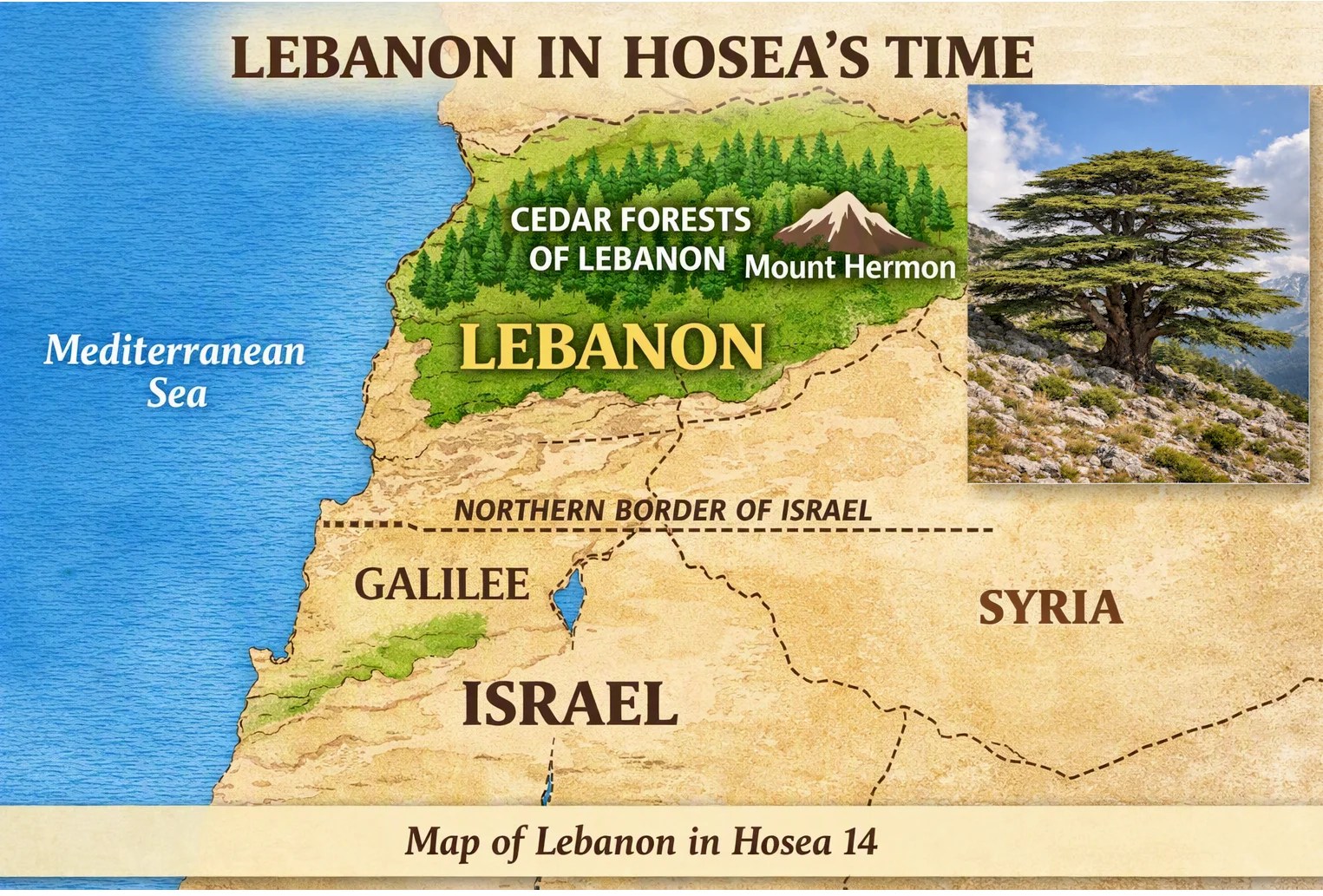
Click or tap on the slideshow to open in a larger presentation


Hosea 14:4-9 – Fruitful Trees of Israel – Transcript
Last episode we finished Hosea 14:2 and began verse 3, seeing Israel’s future confession: “Receive us graciously.” This grace is the grace promised to Israel under the New Covenant, fulfilled when their kingdom comes—when the Messiah returns, dwells with them, and saves them from the wilderness. In that context, Hosea 14:3 continues Israel’s words:
“Asshur shall not save us.”
Asshur was a descendant of Shem and the builder of the city of Nineveh, and he became the head of Assyria, the nation God used earlier to judge Israel. But now Israel declares they’ll no longer trust powerful nations for deliverance. They’ll trust God alone.
Next, the verse says,
“We will not ride upon horses.”
This means they will no longer rely on their own military strength. And: “Neither will we say any more to the work of our hands, Ye are our gods.”
They renounce idolatry, abandon self‑reliance, and reject the works of their own hands. This should sound familiar: salvation is not by works, and Israel finally acknowledges that truth. They confess:
“For in thee the fatherless find mercy.”
God—not idols, armies, or alliances—gives mercy.
Now Hosea 14:4 shifts to God speaking:
I will heal their backsliding, I will love them freely: for mine anger is turned away from him.
Israel has slid into a pit they can’t escape from. Fourteen chapters have shown their rebellion, idolatry, and covenant‑breaking. They can’t save themselves. But God says, “I will heal you.”
Every “I will” in Scripture is grace—God acting where man can’t.
“I will love them freely,” He says.
This is unconditional love—the kind Hosea illustrated in chapters 1–3. “Freely” is grace. The next time Scripture uses “freely” in relation to Israel is Revelation 21:6, when the kingdom comes, the curse is removed, and God says:
“I will give unto him that is athirst of the fountain of the water of life freely.”
Revelation 21 describes the new heaven and new earth, the wiping away of tears, the removal of death, and the fulfilment of Israel’s covenants. God says, “It is done.” All promises are completed.
Revelation 22 expands the imagery: trees lining the river from God’s throne, bearing fruit each month, and again:
“Let him take the water of life freely.”
This is Israel restored, blessed, and dwelling in the presence of God. But notice that this happens after the Great White Throne, after the curse is gone, after death is destroyed. It’s not happening now.
Though “freely” next appears in Revelation for Israel, Paul uses the same word to describe our salvation today. This is part of what makes the mystery unique. While Israel waits for covenant promises to be fulfilled, Paul announces that God now justifies sinners freely:
– Romans 3:24 — “Justified freely by his grace through the redemption that is in Christ Jesus.”
– Romans 8:32 — God “freely gives us all things.”
– 1 Corinthians 2:12 — We know “the things freely given to us of God.”
Unlike Israel, we don’t wait for a kingdom, a land, or a covenant. We receive grace now, freely, through Christ’s finished work—outside the law, outside Israel’s covenants, and outside prophetic expectation.
Israel will one day receive grace freely in their kingdom.
We receive grace freely today in Christ.
Both are grace—but given to different people, in different ways, at different times.
If we trust the gospel today, we already possess freely‑given salvation, while Israel still waits for their future “freely”. Their “freely” comes with healing, flourishing trees, restored land, and kingdom prosperity.
Ours doesn’t include those earthly blessings. So although we receive salvation freely now, Israel’s “freely” in the kingdom carries a different excellence because it’s tied to their covenants.
Hosea 14:4 says, “I will heal their backsliding; I will love them freely, for mine anger is turned away from him.”
For thirteen chapters, God has declared judgment—removing kings, casting Israel out, calling them Lo‑Ammi, Not my people and Lo‑Ruhamah, No mercy. Yet here He says His anger is turned away. What changed His mind?
Hosea 11 showed that it was His promises to the fathers, meaning He must save them. But how can He righteously do that?
We now know the answer to that today: Christ Jesus.
The cross of Christ makes Hosea 14 possible. It’s the only way God can fulfil His promises and remain just. Back in Hosea, the cross was still a mystery. God had promised grace, but hadn’t revealed how He would provide it. Today, through the revelation of the mystery, we understand both how we are saved apart from covenants and how Israel’s covenants can be fulfilled—through the same cross.
The cross does all this and more. According to the mystery, it provides something far more excellent for the Body of Christ than prophecy ever described.
So when Hosea says, “I will love them freely; I will heal their backsliding,” those promises make God’s grace and the cross necessary.
Christ had to die for verses like these to come true. God said He would restore Israel, and the only path to that restoration is the cross. And in our dispensation we learn that Christ’s death not only fulfils Israel’s covenants but also accomplishes God’s manifold wisdom in the mystery dispensation of the Church, the Body of Christ.
Hosea 14:5 continues:
I will be as the dew unto Israel: he shall grow as the lily, and cast forth his roots as Lebanon.
The first two “I wills” deal with forgiveness and salvation—healing backsliding and loving freely. Many discussions of the New Covenant stop there. But the New Covenant also includes this third promise: God will be the dew that causes Israel to flourish.
This is more than just refreshing.
It’s depicting Israel as a tree that God cut down because of covenant‑breaking, but He promises to water it again, revive it, and make it grow.
The flourishing of the land pictures the flourishing of the people in their kingdom. Hosea 6 already hinted at resurrection—God reviving them from death. Now He promises growth, fruitfulness, and restoration.
“I [God] will be as the dew unto Israel.”
This is future salvation, New Covenant fulfilment.
If someone claims God’s finished with Israel, this verse clearly contradicts that. God still speaks of Israel as the object of His covenant promises. The cross was necessary for verse 4; verse 5 shows those promises still belong to Israel.
God will be the dew to Israel in Revelation 21–22, when He plants them in their land, and they flourish in their kingdom. That flourishing is part of the New Covenant—Israel’s forgiveness, salvation, and restored dominion. That flourishing is clearly not happening today. The New Covenant is not being fulfilled today.
The prophet Amos in Amos 9:13-15 describes a future so fruitful that the ploughman overtakes the reaper and the mountains drip sweet wine. God promises to bring Israel back from captivity, rebuild their waste cities, plant vineyards they will actually drink from, and establish gardens whose fruit they’ll eat. Then He declares in Amos 9:15:
And I will plant them upon their land, and they shall no more be pulled up out of their land which I have given them, saith the LORD thy God.
Amos ends his book with that promise.
It clearly hasn’t been fulfilled yet. Israel was uprooted in 70 A.D., and the modern return to Israel today is not believing Israel crying, “Receive us graciously.”
Amos speaks of a future planting where Israel will never again be removed.
This matches Hosea.
God saw Israel as a vine in the wilderness, planted them, expected fruit, cut them down for covenant‑breaking, and now promises to restore them. The prophets consistently describe Israel as a plant God will re‑establish.
Amos 9:11–12 is quoted by James in Acts 15 to explain Gentiles being called by God’s name. But James does not quote verses 13–15, because Israel was not yet planted permanently in their land. Gentiles hearing the word was happening; Israel’s final restoration wasn’t.
Returning to Hosea 14:5:
“I will be as the dew unto Israel: he shall grow as the lily.”
The Bible itself explains this imagery of the lily.
Matthew 6:28–29 says Lilies grow without toil or spinning, yet are arrayed in glory. Jesus taught this while preaching the gospel of the kingdom in the Sermon on the Mount, the same kingdom Hosea describes. Lilies grow beautifully without human effort. God clothes them. That’s Hosea’s whole point: Israel’s future growth is entirely by grace, not works.
Song of Solomon adds another detail: lilies grow among thorns in Song of Solomon 2:1–2. They flourish even in harsh surroundings. Likewise, Israel will rise in glory through tribulation and wilderness, just as God originally planted them in the desert.
Hosea’s promise is simple: Israel will grow again—not by their toil, but by God’s gracious planting.
Returning to Hosea 14:5 again, it continues with:
He shall cast forth his roots as Lebanon.
Lebanon appears again in the next verses.
It’s not referring to the modern nation of Lebanon but to the northern region of ancient Israel, famous for its strong, deep‑rooted cedars.
The “cedars of Lebanon” in Hosea 14:5 refer to the towering, deeply rooted cedar trees of the northern Lebanon mountains, used as a symbol of the strength, stability, permanence, and glory God will give restored Israel. The cedars of Lebanon were famous: tall, long‑lived, valuable, and majestic. Cedar wood is still prized today.
We have a map below this recording showing where Lebanon would sit, north of Galilee, above Jerusalem, reaching into the highest mountain ranges such as Mount Hermon.
When Scripture mentions Lebanon in a geographical or botanical context, it refers either to Israel’s far‑north region or to the highest, strongest, most enduring features of the land.
So when Hosea says Israel will “cast forth his roots as Lebanon,” the meaning is clear: Israel’s future restoration will be deep, stable, permanent, and glorious.
Shallow roots fail; Lebanon‑roots endure.
The Song of Solomon also pictures Lebanon.
Song of Solomon is often read as a romantic poem, but its language constantly returns to Israel’s land—trees, streams, spices, mountains and vineyards.
People focus on the man and woman, but the poem’s descriptions overwhelmingly concern Jerusalem, Israel’s terrain, and covenant blessing. Hosea speaks of God’s love: “I will love them freely”, while Song of Solomon describes love using the same imagery of lilies, cedars, gardens, spices, and living waters. The prophets often use trees and fruit to picture Israel’s flourishing, and Song of Solomon does the same.
Song of Solomon 4:8–15 mentions Lebanon repeatedly:
– “Come with me from Lebanon…”
– “From the top of Amana, Shenir, and Hermon…”
– “The smell of thy garments is like Lebanon…”
– “A fountain of gardens… streams from Lebanon…”
This is covenant language. Milk and honey appear again—echoing God’s promise of the land. Living waters appear—echoing Revelation’s river flowing from the throne. The poem ultimately reflects God’s love for Israel, their waiting for Him, and His future return to them in the land.
Song of Solomon 5:15 adds:
…His countenance is as Lebanon, excellent as the cedars.
Lebanon and its cedars represent excellence, glory, and permanence—the very qualities Hosea attributes to Israel’s future kingdom.
Isaiah 2:13 pictures the same thing:
Upon all the cedars of Lebanon that are high and lifted up…
Cedars and oaks picture exalted, majestic places.
Isaiah uses them to describe what God will humble, but the picture itself shows why Hosea uses Lebanon and its cedars to describe Israel’s future: high, lifted up, enduring, and glorious.
Hosea’s promise is consistent with all prophetic imagery: Israel will be planted again, grow like lilies by God’s grace, and stand strong and permanent like the cedars of Lebanon.
Prophecy declares what Israel will one day become—but only after they confess they can’t achieve it themselves.
Hosea 14 shows the turning point when they plead with God, “Receive us graciously.” When Israel finally acknowledges their inability, God becomes their dew, causing them to flourish and lifting them up.
Their exaltation is not self‑produced; it’s entirely God’s work—just like the cedars of Lebanon, which He planted and sustained.
So then, Lebanon represents the highest, most glorious, most enduring part of Israel’s landscape.
Its cedars are among the oldest and strongest trees on earth. Fir, pine, cedar, cypress, olive, and fig trees—many of the world’s oldest species—appear in Hosea 14.
Either the prophets already knew this, or God embedded the pictures intentionally. Either way, it humbles modern scholarship.
Isaiah 60 expands this picture. The chapter describes Israel’s future kingdom, and verse 13 says:
The glory of Lebanon shall come unto thee—the fir tree, the pine tree, the box together—to beautify the place of my sanctuary.
Song of Solomon uses similar pictures to describe beauty and love; Isaiah uses it to describe the beauty of God’s sanctuary—Jerusalem and the land of Israel. When Solomon built the temple, he filled it with cedar, palm trees, lilies, gold, and marble. That temple was a preview of what the entire land will be when the kingdom comes: the whole nation of Israel as priests, the whole land as God’s sanctuary, and the whole world coming to Israel for light, healing, and truth.
Isaiah 60:1-22 continues to picture restored Israel:
– God’s glory rises upon Israel – verses 1–2.
– Gentiles come to Israel’s light – verse 3.
– Israel’s sons and daughters return – verse 4.
– The wealth of the nations flows to them – verses 5, 9, and 11.
– Those who once afflicted Israel bow before them – verse 14.
– Israel becomes an “eternal excellency” – verse 15.
– Violence ends; salvation and praise fill the land – verse 18.
– The Lord becomes their everlasting light – verse 20.
– All Israel becomes righteous and inherits the land forever – verse 21.
– A small one becomes a strong nation – verse 22.
Notice that when God lifts Israel up in glory, the Gentiles will come to them.
There’s only ever been a tiny glimpse of this in history, in the kingdom during Solomon’s rule. Remember the account of the Queen of Sheba?
Prophecy consistently shows that when Israel is saved, the Gentiles gather to their light.
Clearly, this is not happening today. But it will happen when God fulfils Hosea 14: “I will heal… I will love… I will be as the dew.” Israel will be lifted up like the cedars of Lebanon—high, enduring, glorious—because God does it.
Hosea 14:6 continues describing Israel:
His branches shall spread, and his beauty shall be as the olive tree, and his smell as Lebanon.
The “him” is still Israel. Israel will grow like the lily, cast forth roots like Lebanon, spread branches, display beauty like the olive tree, and carry the fragrance of Lebanon. It’ll be enlarged, strengthened, and beautified.
Scripture often speaks of Israel—and the righteous—as trees.
Psalm 92:12–14 says:
“The righteous shall flourish like the palm tree.” “He shall grow like a cedar in Lebanon.” “They shall still bring forth fruit in old age.”
Isaiah 60 says all Israel will be righteous; Hosea 14 says they’ll be like cedars of Lebanon. They match perfectly.
Trees represent kingdoms, dominion, power, and glory. Their height, strength, and fruitfulness picture earthly rule. Jesus taught Israel to pray: “Thine is the kingdom, and the power, and the glory.” Trees perfectly describe that picture.
Daniel 4 confirms this symbolism.
Nebuchadnezzar dreams of a massive tree whose height reaches heaven, whose branches shelter beasts and birds, and whose fruit feeds all. Daniel interprets the dream :
“It is thou, O king… thy greatness is grown… thy dominion to the end of the earth.”
The tree represents an earthly dominion—rooted in the earth, feeding the earth, sheltering the earth. Trees never represent heavenly dominion; they picture earthly rule, which is exactly what Israel will have in the kingdom.
Judges 9 also uses tree imagery: trees seeking a king—olive, fig, vine—each representing dominion and fruitfulness. Trees are symbols of rule, protection, shade, and provision.
Hosea’s promise is clear: Israel will become the great tree of the earth—rooted, fruitful, glorious—when God restores their kingdom.
Solomon understood this imagery deeply. First Kings 4 says God gave him unmatched wisdom, and Solomon spoke 3,000 proverbs and 1,005 songs, many depicting trees—like the cedar of Lebanon. He also used beasts, birds, creeping things, and fish to depict wisdom.
Solomon could be described as the first biblical natural historian. He studied creation to understand God’s world, and he used that knowledge in his writings—especially Song of Solomon, which describes Israel’s land, trees, spices, and streams as pictures of covenant love and kingdom beauty.
People from all nations came to hear Solomon’s wisdom.
He was a picture of Christ in His kingdom. Christ is greater than Solomon, and when He reigns in Jerusalem, the world will come to hear His wisdom*—political, scientific, spiritual, and divine.
That’s the kingdom on earth:
Israel restored, flourishing like Lebanon, and the nations gathering to the wisdom of the Lord.
First Kings 7:22 describes Solomon’s temple, and the trees mentioned in Hosea 14—cedar, fir, and others—were everywhere in that structure.
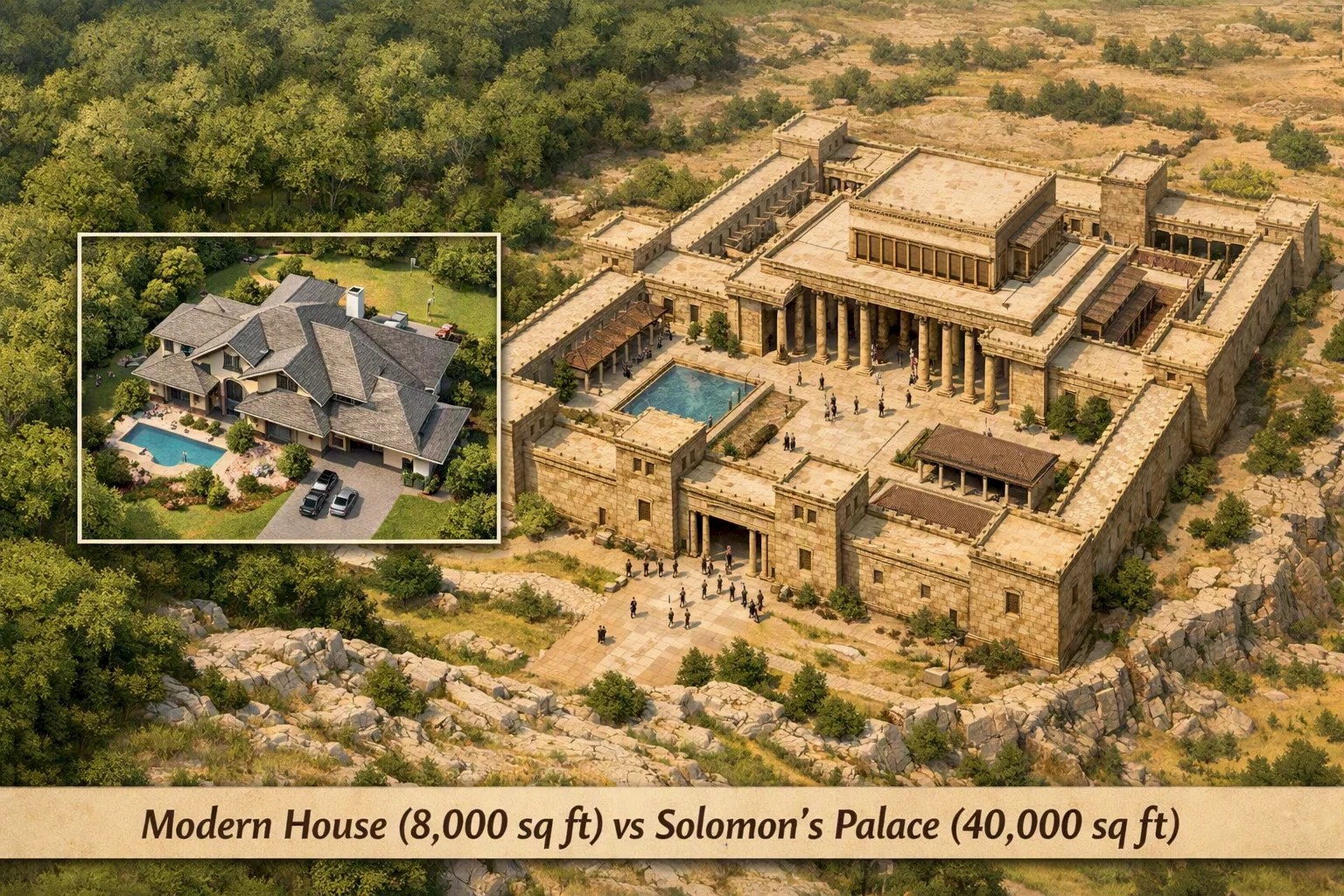
They also filled Solomon’s own house. Modern mansions might reach 5,000–8,000 square feet; Solomon’s house was roughly 40,000 square feet. We thought it would be fun to get AI to create a comparison of a modern mansion to Solomon’s palace, and we’ve included that image below.
Solomon’s house was built with cedar beams, four stories high. His temple likewise used cedar from floor to ceiling, overlaid with gold—glory upon glory. Solomon understood the significance of these trees and built accordingly.
In Scripture, vines, figs, olives, and cedars all carry meaning. They’re not mystical symbols; they’re real plants whose characteristics Solomon studied and used to teach what God promised Israel.
Isaiah 5 identifies the vineyard as the house of Israel and Judah. When the vine bears fruit, Israel is functioning as God intended.
Fig leaves from the fig tree first appear when Adam and Eve try to cover their sin with human effort. Fig trees picture good works, which can be good or bad depending on whether they’re trusted for righteousness. Jesus found a fig tree in Israel with no fruit, showing Israel lacked the works God counted as good—judgment, mercy, and faith.
Olives produce oil, the source of the temple’s light.
Olive trees picture spiritual Israel—faith, truth, and belief. When Israel rejected Christ and later Paul, they became an olive tree without fruit, and branches were cut off as in Romans 11. Hosea 14 and the prophets describe the same reality.
Cedars represent appearance, countenance, and visible glory. Israel’s future kingdom will have apparent glory, seen by all nations. We today possess the hope of glory, heavenly glory, and the glory of God’s grace—but Israel’s kingdom will display visible glory, like the cedars of Lebanon.
Returning to Hosea 14:6:
His branches shall spread, and his beauty shall be as the olive tree, and his smell as Lebanon.
Branches spreading picture dominion extending across the earth. Israel’s beauty will be like the olive tree—faith restored, fruit present, blossoms visible. Trees are beautiful when alive, leafy, and fruitful; barren branches are cut off. Romans 11 describes Israel’s future fullness—when they again become a beautiful olive tree.
Lebanon’s fragrance represents excellence and glory.
Now to Hosea 14:7:
They that dwell under his shadow shall return; they shall revive as the corn, and grow as the vine: the scent thereof shall be as the wine of Lebanon.
Those dwelling under his shadow return. Who provides that shadow? Song of Solomon 2 describes the beloved as a tree whose shade gives delight and whose fruit is sweet. Hosea says Israel will dwell under His shadow..
Isaiah 32 identifies this “man”:
– A king reigning in righteousness
– A hiding place from the wind
– A covert from the tempest
– Rivers of water in a dry place
– The shadow of a great rock
Isaiah 32:3 says, “The eyes of them that see shall not be dim, and the ears of them that hear shall hearken.”
Jesus used those very words in Matthew 13:16 and Luke 10:23–24.
He is the man of Isaiah 32, the beloved of Song of Solomon, the one whose shadow shelters Israel, the one who makes them flourish.
Hosea’s shows that;
– Israel grows as lilies — by grace, not toil
– Israel has roots as Lebanon — strong, enduring, exalted
– Israel becomes a beautiful olive tree — faith restored
– Israel spreads branches — kingdom dominion
– Israel’s fragrance is Lebanon — visible glory
– Israel dwells under His shadow — Messiah’s protection
– Israel revives as corn and grows as the vine — life and fruitfulness*
Jesus Christ is the Beloved of the Father, and we, as believers, are accepted in Him. He’s also the Lord God who returns to provide for Israel, making them the flourishing tree Hosea describes.
“They that dwell under his shadow shall return.”
Hosea’s final chapter reverses the entire book: after judgment, no‑mercy, and “not my people,” God now promises Israel will return—but only under His shadow, only by His provision. If they seek another “tree,” they won’t enter; but under Him, they’ll “revive as the corn.”
We saw this in Hosea 6—Israel coming back from the dead. Paul echoes it in Romans 11:15, which says:
What shall the receiving of them be, but life from the dead?”
Hosea adds: “They shall grow as the vine; the scent thereof shall be as the wine of Lebanon.”
Israel’s seed will prosper, and their remnant will return.
Zechariah 8 confirms Hosea’s promise. God says He was jealous over Zion—like Hosea’s jealous husband—but now declares:
– “I am returned to Zion.”
– “Jerusalem shall be called a city of truth.”
– “I will save my people… I will bring them… they shall be my people.”
Zechariah describes the former days as turmoil and affliction, but then says in Zechariah 8:12:
But now… the seed shall be prosperous, the vine shall give her fruit, the ground shall give her increase, and the heavens shall give their dew.
That’s Hosea 14 exactly: “I will be as the dew unto Israel.” God will save them, heal them, love them, and make them a blessing among the nations.
Hosea 1 began with judgment:
– “Not my people.”
– “No mercy.”
– “I [God] will break the bow of Israel.”
But it ended with hope:
– Israel will be as the sand of the sea.
– In the same place where God said, “Not my people,” He’ll say, “You are the sons of the living God.”
– Judah and Israel will be gathered together under one head.
– They’ll come up out of the land.
Hosea 2 repeats the pattern: the adulterous wife is blocked from her lovers, brought into the wilderness, wooed again, and finally restored. God says:
– “I will sow her unto me in the earth.”
– “I will have mercy on her that had not obtained mercy.”
– “Thou art my people.”
– And she will say, “Thou art my God.”
That’s Hosea 14’s “Receive us graciously.”
Hosea 3:5 adds:
Afterward shall the children of Israel return and seek the Lord their God.
The entire book moves from judgment to restoration, and Hosea 14 is the final declaration of that hope.
Hosea 14:8
Ephraim shall say, What have I to do any more with idols? I [God] have heard him, and observed him: I am like a green fir tree. From me is thy fruit found.
After all Ephraim’s idolatry, this reversal is stunning.
The one God said to “leave alone” because he was joined to idols now says, “No more idols.” God replies:
I have heard him and observed him: I am like a green fir tree.
Ephraim becomes a green fir tree—one of the oldest, strongest, longest‑living trees on earth. Planted by the Lord, enduring forever.
Ephraim saying he will be “like a green fir tree” means he will finally let God plant him, grow him, strengthen him, and shepherd him. The Lord will be his strength, his shepherd, his gate, and his door.
That is remarkable because Ephraim means “fruitful”, yet throughout history he was anything but fruitful. Only in the kingdom does Ephraim finally live up to his name.
Isaiah 41 describes the same restoration: God opens rivers in high places, makes the wilderness a pool of water, and plants cedar, myrtle, olive, fir, pine, and box trees so that all may know the Holy One of Israel has done it.
Just as in Exodus, God saves Israel in a way that leaves no doubt that He did it.
In Revelation 7, the 144,000 witnesses include the tribe of Manasseh, but not Ephraim. Instead of Ephraim, Joseph appears. Joseph had two sons—Ephraim and Manasseh—so Ephraim effectively receives his father’s name. This fits Jesus’ teaching that the first shall be last and the last first.
Ephraim, the second son and historically the more wicked, becomes “Joseph” in Israel’s future tribulation and enters the kingdom under a new name.
Finally, to Hosea 14:9, which concludes the book,
Who is wise, and he shall understand these things? prudent, and he shall know them? for the ways of the LORD are right, and the just shall walk in them: but the transgressors shall fall therein.
Hosea ends with a call to discernment.
The ways of the Lord are right. The just walk in them; transgressors fall therein. Hosea’s entire message—judgment, mercy, restoration, flourishing—is summed up in that final truth.
Wisdom begins with fearing the Lord (Proverbs 9:10 says. Psalm 107:43 adds that the wise understand the lovingkindness—the grace—of the Lord.
Then Paul says in Ephesians 5:17,
Wherefore be ye not unwise, but understanding what the will of the Lord is.
This is no accident. Paul says in 2 Timothy 2:7,
Consider what I say; and the Lord give thee understanding in all things.
He is the apostle of grace.
Understand grace, and you understand Scripture, because God is gracious.
When He brings Israel back, you and I now know why and how He can: He promised them physical healing, physical salvation, and abundant fruitfulness.
So when Hosea says, “The just shall walk in them,” he means God is right in His judgment and right in His mercy.
The just walk in His ways; transgressors fall.
Israel must endure God’s judgment and hope for His grace and glory. That’s exactly the instruction given in Hebrews to the believing remnant outside their city, waiting for their kingdom.
Hosea 14:9 is the book of Hebrews in miniature.
Israel will understand these things when Jesus reveals them in Hebrews and Revelation.
The just will walk in the Lord’s ways; the transgressors will fall. Revelation shows the same pattern: those who don’t abide in Christ are cut off; those who take the mark perish; but the just trust the Lord, wait for His appearing, and look for the day when He lifts up the low places, brings down the high places, and gives Israel their glory.
So that finishes the Book of Hosea after 20 episodes. Thank you for studying it with me, and I hope and pray that you get even a tiny percentage of the pleasure it’s been for me personally to study this book.
In the next episode, we’re returning to Romans, picking up where we left off in Romans chapter 9. Until then, God bless you richly.


