Hosea 1:6-11 – Not My People
In the last episode, we talked about the days in which Hosea was writing.
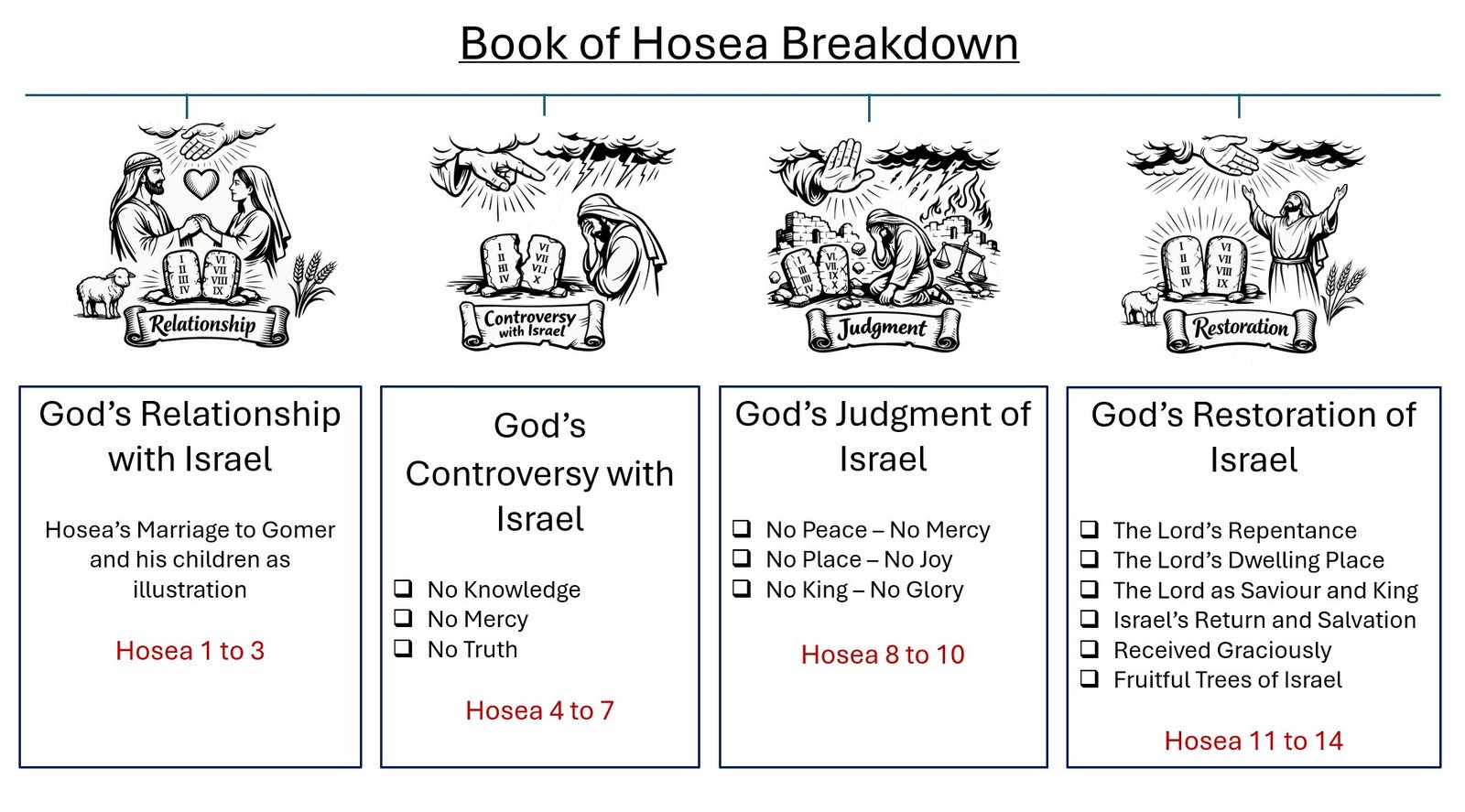
We saw the Kings that reigned and some of the events that occurred. We saw how God used Hosea’s marriage as a living prophecy when He told Hosea to take a “wife of whoredoms” because Israel had committed great whoredom by departing from the Lord. Hosea’s unfaithful wife represents Israel’s unfaithfulness, and their children become signs of God’s response to the nation’s sin.
Hosea marries Gomer, and she bears a son named Jezreel, a name tied to a valley and a city in northern Israel near places like Nazareth and Mount Carmel.
“Speed Slider”

Press or Click to Open Larger Image
Kings of Israel and Judah Showing Hosea’s Ministry

Hosea 1:6-11 – Not My People – Transcript
Jezreel’s name carries three prophecies.
First, God will avenge the blood of Jezreel upon the house of Jehu. Jehu had once been God’s instrument of judgment, but he later became unfaithful. God had promised Jehu four generations on Israel’s throne, and Hosea now announces the end of that dynasty. Second, God will cause the kingdom of Israel to cease. This refers to the political dominion of the northern tribes, not the disappearance of the people themselves. The northern kingdom, which came into being after Solomon, with a rebellion that split the nation. This happened as God said it would because of Solomon’s idolatry and disobedience. It was prophesied. Prophecy is fulfilled when Hoshea becomes the final king.
Third, God will break the bow of Israel in the valley of Jezreel, meaning He’ll shatter their military strength. This points to the coming Assyrian domination.
In this episode, we move to Hosea 1:6, which says,
And she conceived again, and bare a daughter. And God said unto him, Call her name Lo-ruhamah: for I will no more have mercy upon the house of Israel; but I will utterly take them away.
Hosea’s second child is a daughter named Lo‑Ruhamah, meaning “no more mercy.”
God says He’ll no longer have mercy on the house of Israel. This is striking because God is known for His mercy.
Scripture often shows His mercy overcoming His wrath.
For example, in Numbers 14:18, when Israel refuses to enter the Promised Land, God threatens to smite them with pestilence and disinherit them, then Moses appeals to God’s character, saying He is “long-suffering and of great mercy”.
Moses, incredibly, debates directly with God and asks Him to pardon Israel according to the greatness of His mercy. Moses reminds God of past forgiveness and how wiping the nation out is not going to be good for God’s PR with the other nations. They’ve heard of God’s great dealings with Israel, but they’ll say that even though God was able to bring them through the wilderness, He couldn’t bring them into the land He promised them.
God listens to Moses. Even though he would’ve been perfectly righteous to smite and disinherit the nation, He answers Moses in Numbers 14:20, saying,
“I have pardoned according to thy word”
God shows mercy even while maintaining His glory.
David also praises God’s mercy.
Psalm 103:8-12 highlights God’s mercy toward Israel. David says the Lord is “merciful and gracious, slow to anger, and plenteous in mercy”.
God doesn’t deal with Israel according to their sins, but shows mercy far higher than heaven is above the earth. He removes their transgressions “as far as the east is from the west”. David remembers how often God forgave Israel, including the mercy shown in Numbers 14, when Moses debated God as we just saw.
God knows Israel’s frailty, that they’re dust, and though human life fades like grass, His mercy is “from everlasting to everlasting” upon those who fear Him, says Psalm 103:17.
This displays God’s mercy in His character, but it’s not automatically received. Mercy’s offered, but it’s conditioned on fearing Him, just like in this present dispensation where grace is abundant, yet only received through faith.
Hosea’s prophecy shows the moment when mercy’s withdrawn from the northern tribes because of persistent rebellion.
Hosea’s children each carry a message: Israel’s unfaithfulness will bring judgment, their kingdom will fall, their strength will break, and mercy will be withheld. These names reveal God’s response to a nation that’s departed from Him.
This helps explain Hosea 1:6, where God names Hosea’s daughter Lo‑Ruhamah, meaning “no more mercy.”
The “house of Israel”, the northern kingdom, is clearly the target of these prophecies—Hosea’s wife comes from them, Jezreel’s judgments fall on them, and now God says He will no longer show mercy to them.
This is not a flaw of God’s character; it’s His response to Israel’s continued departure from Him. God had shown mercy repeatedly, even after the kingdom split under Solomon, and even through Jehu’s reign. But now He declares a period of judgment.
Psalm 136 reinforces that God’s mercy endures forever. That phrase, for his mercy endureth for ever is repeated after every one of the 26 verses in the chapter. God showed mercy by giving Israel the land and redeeming them from enemies. We even see God’s mercy in His sustaining of His creation, sun, moon, food, and breath. Daily life itself is evidence of His mercy. If God were not merciful, He could remove oxygen, and life would just end.
So when He says He’ll no more have mercy on Israel, it’s not a change in His nature but a change in His dealings with a nation that’s persistently rejected Him.
Paul, in Romans 9:15, shows that God’s mercy is His sovereign choice. It’s not earned by human will or effort; it’s given because God wills it. People also still have a will—they can seek His mercy or refuse it—but God decides when and how He shows it.
In Hosea’s time, God’s mercy toward the northern tribes has run out. Judgment replaces mercy.
Hosea 1:6 says God will “utterly take them away,” and that’s fulfilled in 2 Kings 17:6 and 2 Kings 18:12–13, when Assyria carried the northern kingdom into captivity.
2 Kings 17:6 reads,
In the ninth year of Hoshea the king of Assyria took Samaria, and carried Israel away into Assyria, and placed them in Halah and in Habor by the river of Gozan, and in the cities of the Medes.
Yet even then, God does not “utterly destroy” them, because He promised Israel would never be wiped out. The prophecy is precise: they’ll be taken away, not annihilated.
Hosea 1:7 says,
But I will have mercy upon the house of Judah, and will save them by the LORD their God, and will not save them by bow, nor by sword, nor by battle, by horses, nor by horsemen.
God will have mercy on the house of Judah, even while the house of Israel receives no mercy and is taken away. This prophecy shows God choosing to spare Judah at the same time Israel falls.
There’s a contrast between a vessel of wrath (Israel) and a vessel of mercy (Judah). In Romans 9:22–26, Paul uses these passages from Hosea to show God bearing long‑suffering toward vessels of wrath while showing mercy to vessels of mercy. Hosea’s prophecy is an early example of that pattern.
If we look at that period Hosea prophesied about through the eyes of history, it’s quite amazing because the juggernaut of the Assyrian Empire at that time was conquering everything in its path.
They destroyed the northern kingdom easily, and Jerusalem seemed like the next obvious target. Yet when the Assyrians reached Jerusalem, God stopped them. The Assyrians bypassed Judah, exactly as Hosea prophesied.
People might ask us, “How do you know the Bible is really God’s Word?”
Well, it’s things like this: these continual fulfilments of events that were prophesied many years before they happened, occurring exactly as was prophesied, that clearly show that the One who prophesied, God Himself, through the mouths of the prophets, is outside of our dimension of time.
He’s not restricted by our physical universe of time, energy, space and matter; in fact, He created those very things. There can be no better form of proof that the Bible is indeed the Word of God than perfectly fulfilled prophecy.
Some sceptics might say, well, you can prophesy anything if you’ve got unlimited time to fulfil it, but that’s simply not true. Some things just won’t happen, and the closer you prophesy something to the event, the more likely it would be that someone could guess it. The farther away you are from the event, the harder it is to prophesy something, which is why God often prophesies decades and centuries before things occur.
For example, Isaiah had prophesied the name of the man who would return the remnant of Israel to Jerusalem hundreds of years before Jerusalem even fell, and the man was even born! It’s got nothing to do with random chance or luck; the precision of prophecy and its fulfilment is extraordinary.
Through Hosea, in Hosea 1:7, God explains how He’ll save Judah:
But I will have mercy upon the house of Judah, and will save them by the LORD their God, and will not save them by bow, nor by sword, nor by battle, by horses, nor by horsemen.
Judah will be saved “by the Lord their God,” not by their military might. God says Judah’s army won’t be the means of deliverance. This is, again, fulfilled exactly as prophesied, and we see the account in Isaiah 37, during Hezekiah’s reign.
After Assyria destroyed the northern kingdom, Sennacherib threatened Jerusalem.
He sent Hezekiah a letter outlining all the kingdoms and cities the Assyrians had conquered and pointing out how futile it was for Judah to resist. The letter even blasphemed the Lord, saying, “Don’t let that God whom you trust deceive you into believing He can save you”. The letter goes on to say how Judah well knows that none of the gods of the nations that the Assyrians utterly destroyed helped them. We see this in Isaiah 37:10-13.
Hezekiah prayed and laid the Assyrian letter before the Lord, acknowledging the truth of the letter that Assyria had defeated many nations and their gods and idols, but asking God to save Judah so all kingdoms would know He alone is God.
Now remember, Israel, the northern kingdom, had already fallen to Assyria by this time.
God answered Hezekiah through Isaiah, and we can see in His answer in Isaiah 37:21-35 that the Lord was rather angry at Sennacherib.
Isaiah 37:33-35 is the crux of the Lord’s answer,
Therefore thus saith the LORD concerning the king of Assyria, He shall not come into this city, nor shoot an arrow there, nor come before it with shields, nor cast a bank against it [meaning to lay a siege].
By the way that he came, by the same shall he return, and shall not come into this city, saith the LORD.
For I will defend this city to save it for mine own sake, and for my servant David’s sake.
This is what Hosea 1:7 is talking about when referring to Judah not being saved by its military. God Himself would defend the city.
That night, as we read in Isaiah 37:36, the angel of the Lord struck down 185,000 Assyrian soldiers, and the rest of the army retreated. Judah survived for generations afterwards. Assyria never captured Jerusalem. Babylon did much later, after Judah’s own fall, but Hosea’s prophecy was fulfilled precisely.
Isaiah calls the deliverer who’ll save Judah “the Holy One of Israel,” and Hosea says “the Lord their God” would save them. The angel of the Lord who struck the Assyrians is identified elsewhere with Jehovah Himself. This connects to the truth that Jesus is Jehovah, the Holy One of Israel, the divine warrior who saves His people. Jesus is God, and He’s the one who did it. He’s the angel of the Lord who did that. Jesus is a warrior. He’s a conqueror. And he’ll come back and do that again one day.
Returning now to Hosea 1:8–9, we read,
Now when she, [that’s Gomer, Hosea’s wife], had weaned Lo-ruhamah, she conceived, and bare a son.
Then said God, Call his name Lo-ammi: for ye are not my people, and I will not be your God.
This third child Gomer bears is named Lo‑Ammi, meaning “not my people.” God explains the name directly: “ye are not my people, and I will not be your God.”
In Scripture, “my people” always refers to Israel as God’s chosen nation. This prophecy announces a temporary breaking of that relationship for the northern tribes. God had chosen Israel as His treasured people, but because of persistent rebellion, He now declares they won’t be His people in this period of judgment.
So, we have Hosea’s three children revealing three escalating judgments: the end of Israel’s kingdom, the removal of mercy, and the severing of their covenant identity. Yet even in judgment, God preserves Judah, showing mercy according to His will and fulfilling His word exactly, as history bears out.
Israel was God’s people by covenant, but only when they obeyed Him. In Leviticus 26:12, God said, “If you keep my commandments… I will be your God, and ye shall be my people.”
The reverse was also true: if they rejected His commands, they’d not be His people. Hosea’s prophecy shows this covenant judgment unfolding. Because the northern tribes departed from the Lord, God declares, “Ye are not my people, and I will not be your God.” This is not some random statement; it’s God enforcing the terms Israel itself agreed to.
Losing this status was devastating.
If God was not their God, they didn’t have covenant protection or blessing any more, and they were exposed to their enemies, which is exactly what happened.
This pattern appears earlier in Scripture as well.
In Exodus 32:7, when Israel made the golden calf, God, when talking to Moses, refers to the people as “your people,” Moses’s people, distancing Himself from them.
Then, in Exodus 32:10 and again in Deuteronomy 9:14, God threatened to destroy Israel and start again with Moses.
Moses reminded God that Israel was His people, appealing to God’s mercy.
Hosea shows the same thing: Israel’s long rejection of God leads to God declaring the result of their choices. He will not be their God.
This principle also appears in Romans 1:28, where Gentiles who refused to retain God in their knowledge were “given over” to a reprobate mind. In the same way, Israel had pushed God away, trusting idols, foreign armies, and other gods. God’s statement, “I will not be your God,” was simply a result of their own rejection of Him.
I find it easy to see God’s thinking when I try to put myself in His position for a moment.
He’s done far beyond what man can imagine to make known and bring to mankind His manifold wisdom and His unimaginable blessings, and He’s even sacrificed Himself through death and burial to bring those things to us freely, yet the overwhelming majority of mankind, the recipients of those blessings, rejects Him time after time, even after He patiently repeats His cycle of mercy. Even the air we breathe and all that we need for survival and personal fulfilment in life are provided directly by Him.
Isaiah, who preached in the same era as Hosea, confirms this judgment of “I will not be your God,”.
In Isaiah 7:1–8, he prophesies that within sixty‑five years Ephraim will be broken, that it be not a people.
We also see here that an alliance is formed between Syria and Ephraim, the northern kingdom, against Judah. By this time Ahaz is the king of Israel, and he’s a bad egg. He’d already tried to invade Judah, and so had Syria, but they’d failed; now they think that by forming this alliance they can succeed.
This frames the timeline we’re in, and you can see this timeline on our chart of the kings of Israel and Judah below this recording.
Isaiah’s describing the spiritual condition behind Israel’s fall.
Hosea had already announced “Lo‑Ammi”—not my people— in Hosea 1:9 while Israel still lived in the land. Hosea also had already prophesied in Hosea 1:5,
And it shall come to pass at that day, that I will break the bow of Israel in the valley of Jezreel.
Isaiah now shows the timeline of how that prophecy would be completed, within sixty‑five years.
Isaiah 27:9–11 describes how Jacob’s sin, Israel’s sin of idolatry, is purged when idolatrous altars are smashed. The city becomes desolate, its branches withered and broken off. This is imagery from Hosea and later in Romans 11. Because the people “have no understanding,” God “will not have mercy on them,” matching Hosea’s prophecy of Lo‑Ruhamah, “not my people”.
These passages show a pattern: Israel’s idolatry and refusal to fear God leads to covenant judgment. God withdraws mercy, declares they’re not His people, and allows their enemies to overtake them.
Hosea’s children’s names—Jezreel, Lo‑Ruhamah, Lo‑Ammi—capture this severe judgment on the northern tribes: their kingdom will end, they will be taken away, mercy will stop, and God will say, “You are not my people.” The kingdom’s broken, mercy’s withdrawn, and their covenant identity is severed.
Yet even in judgment, God’s actions follow His covenant terms and His righteous character.
Hosea 1:10 begins with “yet”, signalling future hope.
Yet the number of the children of Israel shall be as the sand of the sea, which cannot be measured nor numbered; and it shall come to pass, that in the place where it was said unto them, Ye are not my people, there it shall be said unto them, Ye are the sons of the living God.
Historically, the northern kingdom disappeared, and by Jesus’ day its descendants were known as Samaritans. But Hosea says Israel will again be “as the sand of the sea,” meaning the northern tribes still have a future.
This hope was already written into the covenant.
In Leviticus 26:44, after listing all the curses for Israel’s disobedience, God says,
And yet for all that, when they be in the land of their enemies, I will not cast them away, neither will I abhor them, to destroy them utterly, and to break my covenant with them: for I am the LORD their God.
He will remember the covenant made with their ancestors. Hosea’s “yet” matches this promise: though Israel loses mercy and covenant standing, God won’t erase them from history. He’ll preserve them for future restoration.
Paul raises the same question in Romans 11:1: “Hath God cast away his people?” He answers, “God forbid,” citing himself as proof—an Israelite saved by grace. God has not cast away the people He foreknew.
In Romans 11:2-4, Paul then uses the story of Elijah from1 Kings 19, who thought he was alone in the northern kingdom, the only one zealous for God, but God had preserved 7,000 who had not bowed to Baal. This remnant was specifically from the northern tribes, showing God never wiped them out.
Paul uses this to teach in Romans 11:5 that even now there’s “a remnant according to the election of grace”. Hosea’s promise of future Israel aligns with Paul’s teaching: God preserves a remnant, guaranteeing Israel’s future existence.
In Genesis 32:12, God told Jacob his seed would be “as the sand of the sea,” and Hosea 1:10 echoes this promise God made to Jacob, whose name, of course, was Israel. Hosea shows that the northern tribes will one day be numerous again.
So, Isaiah, in Isaiah 7:8, prophesies that within sixty‑five years Ephraim (the northern tribes) will “be broken, that it be not a people.”
Then in Isaiah 10:20–22 he says a remnant of Jacob will return to the mighty God. Though Israel was “as the sand of the sea,” only a remnant would come back.
Isaiah describes the northern tribes at the time of Hosea as already numerous “as the sand of the sea,” showing this phrase refers to Israel’s size and covenant promise, not a mystical number or the church.
Hosea 1:10 uses the same language to promise that after judgment, Israel will again be numerous—returning to their former glory, but this time in obedience.
This verse becomes a major point of confusion because many people assume Hosea 1:10 includes the church.
Commentaries often claim the church inherits Israel’s promises or that Hosea is predicting the body of Christ.
But Hosea is speaking about Israel, specifically the northern tribes, not Gentiles or the church, the Body of Christ.
The church, the body of Christ, was not even known about in Hosea’s day.
If that wasn’t the case, the entire Bible can be safely thrown away because it would be a lie! Why?
Because of the numerous passages in Paul’s epistles that relate to Christ in us and us in Christ, the Body of Christ, as being a mystery kept secret since before the world began but revealed to Paul by Christ Himself. If that mystery was known by the prophets before being revealed by Christ Himself to Paul, then Paul’s epistles would be untrue, and therefore, we could not trust that the Bible was the Word of the living God!
But we can trust the Bible as being the Word of God, and that’s much easier to do if we can just recognise these critical differences between Israel and the Church today.
The promise of future restoration belongs to Israel because God made covenant promises to Abraham, Isaac, Jacob, and the nation.
Confusion arises when readers see Paul quote Hosea in Romans 9:25–26 and assume Paul is applying Hosea to the church. The passage reads,
As he saith also in Osee, [which is Hosea], I will call them my people, which were not my people; and her beloved, which was not beloved.
And it shall come to pass, that in the place where it was said unto them, Ye are not my people; there shall they be called the children of the living God.
The reasoning is that Paul writes to Gentiles, and since he quotes Hosea, therefore Hosea must be about the church. But Paul’s quoting Hosea about Israel, not about the body of Christ.
Romans chapters 9 to 11 are Paul teaching about Israel’s fall, Israel’s remnant, and Israel’s future restoration. Paul’s not redefining Hosea; he’s confirming Hosea’s prophecy about Israel. Paul’s shifted his focus from Romans chapter 9 to Israel because what has happened and what will happen to Israel is critical for us, the body of Christ, to know. We can’t fully understand our position in Christ today without an understanding of Israel, its promises, and its current blindness.
The same mistake happens in 1 Peter 2:9–10, where Peter says,
But ye are a chosen generation, a royal priesthood, an holy nation, a peculiar people; that ye should shew forth the praises of him who hath called you out of darkness into his marvellous light:
Which in time past were not a people, but are now the people of God: which had not obtained mercy, but now have obtained mercy.
Many people, if not most, assume Peter’s writing to the church, the body of Christ, but Peter identifies his audience as Jewish strangers, the elect, scattered, as 1 Peter 1:1 addresses.
He applies Israel’s covenant titles—chosen generation, royal priesthood, holy nation—to the believing remnant of Israel, not to Gentiles. Peter and Paul both quote Hosea because Hosea is about Israel’s covenant relationship, not the church’s mystery relationship.
If Hosea 1:10 were about the church, then the church would inherit Israel’s land promises, covenant curses, and its identity in prophecy. That would tie believers today to Leviticus, Deuteronomy, Isaiah, and the Psalms as if they were Israel. But the church is a new creature as Ephesians 2–3 shows us, not Israel, not under the law, and not promised a land.
In Romans 9:26, Paul’s referring to them as Israel. He quotes, “in the place where it was said unto them”. The people he’s talking about in this context are Israel, in Hosea’s time: “in the place where it was said unto them, ye are not my people, there shall they be called the children of the living God.”
Paul immediately clarifies this in verse 27: “Isaiah also cries concerning Israel.”
The “them” and “they” are Israel—the same Israel Hosea addressed. Hosea’s prophecies concern the northern tribes, their removal, their remnant, and their future restoration. Paul quotes Hosea to show that God still has a purpose for Israel and He’s not cast them away.
So, Hosea 1:10 is a promise that Israel will exist, will be numerous again, and will one day be restored. It’s not a prophecy of the church, but a reaffirming of God’s covenant faithfulness to the nation He foreknew.
Romans 9 teaches that God shows mercy and wrath according to His purpose. Paul says God endured “vessels of wrath” with long‑suffering so He could display His glory on “vessels of mercy” (Romans 9:22–23). Hosea shows this clearly: Israel (the northern tribes) became a vessel of wrath, while Judah, the southern kingdom, received mercy, as Hosea 1:7 clearly states.
God endured Israel’s rebellion for generations so a remnant could be saved. Though Israel was once “as the sand of the sea,” only a remnant would return, just as Isaiah said in Isaiah 10:20–22.
When Romans 9:24 says God calls people “not of the Jews only, but also of the Gentiles,” Paul’s quite clearly talking about how God is sovereign and can choose who He likes to show His power and the riches of His glory to. He says even us– that’s Paul and his Jewish brethren. Jews! But he’s adding that God has the sovereign right to even show these things to Gentiles also. This doesn’t have anything to do with Hosea 1:10 prophesying about the church, the body of Christ.
The prophets always spoke of Gentiles being blessed through Israel’s rise. Isaiah 49:6 says the Messiah will restore Israel and also be “a light to the Gentiles.”
Simeon repeats this in Luke 2:32. Gentiles were always included in God’s plan—but through Israel, not by becoming Israel.
Romans 15:8–9 confirms this saying,
Now I say that Jesus Christ was a minister of the circumcision for the truth of God, to confirm the promises made unto the fathers:
And that the Gentiles might glorify God for his mercy; as it is written, For this cause I will confess to thee among the Gentiles, and sing unto thy name.
Christ was “a minister of the circumcision” to confirm promises to Israel so that Gentiles might glorify God for His mercy. Gentile blessing through Israel is prophecy, not the mystery of the church. The mystery was “hid in God”, as Ephesians 3:9 says, not revealed in Hosea.
Hosea 1:10 promises Israel’s future restoration: “the number of the children of Israel shall be as the sand of the sea.” This matches God’s covenant with Abraham, Isaac, and Jacob in Genesis 32:12. Hosea says Israel will again be numerous and blessed. This’s not some sort of spiritual language about the church; it’s literal prophecy about Israel’s future.
Hosea 1:10 continues with “in the place where it was said unto them, Ye are not my people, there it shall be said unto them, Ye are the sons of the living God.”
The place Hosea refers to is crucial.
Hosea spoke these words in the northern kingdom, before Assyria removed them. The “them” in verse 10 is the same “them” in verse 9—the northern tribes. The prophecy says that in their land, where God declared them “not my people,” He’ll one day call them, the same people, His sons. This cannot refer to the church, which is not in that land and was never previously God’s people.
Romans 9:26 quotes Hosea to show Israel’s future restoration, not to redefine the church. Hosea, Isaiah, and Paul all speak of the same group: Israel, especially the northern tribes. The church is a new creature, not Israel, not under the law, and not promised a land.
So, by now we’re clear that Hosea 1:10 is a prophecy of Israel’s future restoration, not a hidden reference to the church. It promises that the same people once declared “not my people” will one day be called “sons of the living God”—in their land, in the place where God said, “You are not my people.” That place is the northern kingdom, before Assyria removed them.
They were still in the land when Hosea spoke.
The “them” in verse 10 must be the same “them” as in verse 9—the northern tribes, and, in their land, the same people who once rejected will one day be restored.
This cannot refer to the church, which is not in that land and was never previously God’s people.
Have you ever heard someone say, “You have to interpret the Old Testament by the New? Whenever someone says that, our red flags should be immediately run up the mast because they’re about to twist something.
The Old Testament is clear when it’s read in its own context. Confusion comes when people blend things together that don’t belong together—especially when they try to interpret Israel’s prophecies through the church or treat the New Covenant as identical to the mystery revealed to Paul. If we simply keep the New Covenant and the mystery separate, both the Old and New Testaments become crystal clear.
If we make Hosea 1:10 about the church, we end up denying the future restoration of the northern tribes, because historically they’ve not yet returned. But Hosea 1:10 gives hope that God will restore all twelve tribes, not just Judah. He’ll again call them “sons of the living God.” This is Israel’s adoption into their kingdom—a future event. The church already has sonship now, from the moment we believed and trusted Christ, as we clearly saw in Romans 8, but Israel has not yet received theirs. Mixing these two blessings diminishes both of them.
Many commentators and teachers correctly cross‑reference Hosea 1:10 with John 1:12 (“as many as received him, to them gave he power to become the sons of God”) and 1 John 3:2 (“now are we the sons of God”).
But they incorrectly assume John was writing to the church. John, James, and Peter write to Israel, the twelve tribes, as we see in James 1:1 and 1 Peter 1:1.
First John 3 contains covenant conditions—keeping commandments, abiding without sin—that just don’t match Paul’s teaching for the body of Christ under grace. First John is written to a remnant under Israel’s covenant, just like Hosea.
So, when Hosea 1:10 says, “in the place where it was said unto them, Ye are not my people, there it shall be said unto them, Ye are the sons of the living God.” Hosea 1:11 then confirms the context:
Then shall the children of Judah and the children of Israel be gathered together, and appoint themselves one head, and they shall come up out of the land: for great shall be the day of Jezreel.
This is the reunion of all twelve tribes, something that hasn’t happened since King Solomon. It’s not the gathering of Jew and Gentile into one body that Ephesians 2 speaks of, nor the gathering of heaven and earth in Christ as Ephesians 1:10 describes. Hosea speaks of a national restoration in the land, not a spiritual union in Christ.
If we make Hosea 1:10 about the church, Hosea 1:11 collapses. We’d have an unsolvable puzzle! Who are Judah and Israel? Where is their land? How do Gentiles fit?
But if we keep the passage in its prophetic context, everything fits: Israel will return, be called sons of God, and be reunited under one head in their kingdom. Hosea 1:10–11 is the sign of Israel’s future restoration, not a prophecy of the church.
Hebrews 8 explains that the first covenant failed because Israel didn’t continue in it. The proof is simple: the northern tribes were destroyed and never returned. God allowed the twelve tribes to split so He could demonstrate that the promises were not yet fulfilled. Judah’s later return from Babylon did not fulfil the covenant because Israel—the northern tribes—remained gone. This is why Hebrews says a new covenant is needed.
Hebrews 8:8 quotes Jeremiah 31:31: God will make a new covenant with the house of Israel and the house of Judah.
This matches Hosea 1:11, where both houses are gathered together in the land. The new covenant is not for the church; it’s for Israel and Judah, the same groups Hosea addresses. Under the new covenant, God will write His laws in their hearts, be their God, and they will be His people—reversing Hosea’s judgment of, “You are not my people.” Hosea declared the northern tribes cut off; the new covenant promises their restoration.
Hebrews 8 also says they’ll no longer need to teach one another “know the Lord,” because all will know Him, exactly as Jeremiah 31:34 says.
Hosea repeatedly says the northern tribes did not know the Lord, so this promise directly answers their condition. God also says He’ll be “merciful to their unrighteousness,” reversing His earlier statement of, “I will no more have mercy.” Hosea 1:10’s “yet” is fulfilled by the new covenant: despite judgment, Israel will again be numerous “as the sand of the sea.”
The new covenant is designed for sinners of both northern and southern tribes. Judah didn’t realise their own sinfulness until they rejected Christ and stoned Stephen. But the northern tribes were already known as sinners, like the Samaritan woman Jesus met. The new covenant brings mercy to both houses and reunites them.
Romans 11:25 shows the mystery concerns Israel’s temporary blindness until the fullness of the Gentiles comes in. Since Israel is still blind in part, Hosea 1:10–11 and Hebrews 8 are not yet fulfilled. Romans 11:26 says, “All Israel shall be saved,” quoting prophecies of national restoration. Hosea 1:10–11 fits perfectly: Israel returns, is called sons of God, and Judah and Israel are gathered under one head.
Jeremiah confirms this hope.
In Jeremiah 3, God tells Jeremiah—who prophesies in Judah, the southern kingdom—to speak “toward the north” and call backsliding Israel to return. Though already scattered, God promises mercy and restoration, saying He’s “married” to them, just as Hosea’s marriage symbolised. He promises to bring them to Zion, give them shepherds who teach knowledge, and multiply them in the land.
Jeremiah 23 expands on this: when the Messiah, the righteous Branch of David, reigns, Judah shall be saved, and Israel shall dwell safely. Both houses are restored under Christ. This is the same future gathering Hosea 1:11 describes.
So Hebrews 8, Jeremiah, and Hosea all teach the same truth: the northern tribes will return, be shown mercy, be called God’s people again, and be reunited with Judah under the Messiah in their land. This is Israel’s future restoration—not the church’s identity.
When Jesus came, in Matthew, Mark, Luke, and John, He called people from Israel, not just Judah. His earthly ministry began the work of reconciling the divided nation. The prophets repeatedly promised that God would reunite the house of Israel and the house of Judah under one shepherd and one king.
Ezekiel 34:23–24 says
And I will set up one shepherd over them, and he shall feed them, even my servant David; he shall feed them, and he shall be their shepherd.
And I the LORD will be their God, and my servant David a prince among them; I the LORD have spoken it.
God will set “one shepherd” over them—David’s greater Son, the Messiah—and make a “covenant of peace,” the same new covenant Hosea anticipates.
Hosea 1:11 says Israel and Judah will “come up out of the land.” Ezekiel 37 and the valley of the dry bones prophecy explain this unusual phrase.
Israel is pictured as a nation resurrected from the dead. The dry bones represent “the whole house of Israel” who say, “our hope is lost.” Ezekiel 37:11 says,
Then he said unto me, [that’s God speaking to Ezekiel] Son of man, these bones are the whole house of Israel: behold, they say, Our bones are dried, and our hope is lost: we are cut off for our parts.
God promises to open their graves, bring them, quote, “up out of your graves,” and place them back “in your own land.” When they’re restored, they’ll be called sons of the living God, fulfilling Hosea 1:10.
Ezekiel then shows two sticks—one for Judah, one for Ephraim (the northern tribes). God commands Ezekiel in Ezekiel 37:16-17 to join them into one stick, symbolising the reunification of the nation.
This prophecy was given after both kingdoms had fallen—Israel to Assyria and Judah to Babylon.
Ezekiel, sitting in exile, declares that God will gather Israel “from among the heathen” and bring them into their land, making them “one nation” with “one king” Ezekiel 37:20–22.
He promises they’ll no longer defile themselves with idols, but will be cleansed and restored. God says, “they shall be my people, and I will be their God,” echoing Hosea’s reversal of “not my people.”
This restoration is the same hope Paul describes in Romans 11:15: if Israel’s fall brought salvation to the world, their future restoration will be “life from the dead.” Hosea calls this moment “the day of Jezreel”—a great day when God sows Israel again in their land.
All these prophets—Hosea, Jeremiah, Ezekiel—describe the same future event: the resurrection, restoration, and reunification of all twelve tribes in their land under the Messiah. Hosea 1:10–11 is not about the church; it’s the foundational promise of Israel’s national restoration.
May God bless you until the next episode, when we look into Hosea chapter 2.