Tag Archive for: israel’s feasts

Understanding The Bible – Episode 12

This is episode 12 and our final episode in this Understanding the Bible series. The whole purpose has been to help us obey 2 Timothy 2:15,
Study to shew thyself approved unto God, a workman that needeth not to be ashamed, rightly dividing the word of truth.
We’re trying to show why that’s absolutely necessary. In this last episode, we look at something most Christians never even think about: Satan’s policy of evil against the Body of Christ in this dispensation of grace.

“Speed Slider”
Episode 9 ChartPress Image To Enlarge

Prophecy To Grace - 9

Press Image to Enlarge

Prophecy To Grace - 9

Press Image to Enlarge

Understanding The Bible – Episode 12 – Transcript

Alright, this is episode 12 and our final episode in this Understanding the Bible series. The whole purpose has been to help us obey 2 Timothy 2:15,

Study to shew thyself approved unto God, a workman that needeth not to be ashamed, rightly dividing the word of truth.

We’re trying to show why that’s absolutely necessary. In this last episode, we look at something most Christians never even think about: Satan’s policy of evil against the Body of Christ in this dispensation of grace.

To rightly divide the Word of Truth means that we not only know what God’s doing today, but also what the adversary’s doing. Satan doesn’t run the same script in every age. What he did in time past against Israel is not what he’s doing today.

When God suspended Israel’s program and brought in the mystery, Satan instantly adjusted. He understands the Body of Christ better than most believers. He understands the mystery better than most believers. And he hates it.

His goal today is simple: keep the mystery a mystery. Keep us ignorant of who we are in Christ, what God’s doing today, and why God brought in this dispensation at all. The revelation of the mystery is an embarrassment to Satan and his principalities and powers in heavenly places.

To grasp this, let’s turn to 1 Corinthians 2:7-8, where we read,

But we speak the wisdom of God in a mystery, even the hidden wisdom, which God ordained before the world unto our glory: Which none of the princes of this world knew: for had they known it, they would not have crucified the Lord of glory.

God kept the mystery secret so Satan would help accomplish the very thing that destroys his entire plan—both on earth and in the heavens.

We need to understand why God brought in the dispensation of grace. It wasn’t because He was frustrated with Israel. Romans 11 makes that clear. God set Israel aside temporarily because He had a secret purpose, “the mystery of His will” as Ephesians 1:9 labels it, planned before the world began. The mystery is about forming a new creation, the one new man, the Body of Christ, made of Jew and Gentile with no difference between them.

Why?

Because God’s reclaiming not only the earth, through Israel’s program, but also the heavenly places, through our program.

Genesis 1:1 says God created the heaven and the earth. Prophecy deals with the earth. But Satan also seized the heavenly governmental realm when he fell. Prophecy said nothing about how God would reclaim the heavens. That’s what the mystery’s for.

Ephesians 1:9-10 says this,

Having made known unto us the mystery of his will, according to his good pleasure which he hath purposed in himself:

That in the dispensation of the fulness of times he might gather together in one all things in Christ, both which are in heaven, and which are on earth; even in him:

God will place all things—heaven and earth—under the headship of Christ.

Israel will reign on earth. The Body of Christ will reign in the heavenly places. That’s why we’re given spiritual bodies, as 1 Corinthians 15 talks about, especially 1 Corinthians 15:44.

That’s why we are “seated with Christ in heavenly places” in Ephesians 2:6. That’s why the rapture, the great catching up of the Body of Christ, takes us into the air—the very realm where Satan is “prince of the power of the air.”

Satan didn’t know or even foresee this, but he knows it all now. He knows the Body of Christ is God’s instrument to replace his fallen principalities. That’s why he fights the mystery harder than anything else. If he can keep us confused—mixing Israel’s program with ours, living in Matthew to Acts 2, then in Hebrews to Revelation, instead of Romans through Philemon—then he keeps us spiritually useless.

So the adversary’s policy today is not demon possession, not signs and wonders, not attacking Israel’s kingdom program. His policy today is the confusing of doctrine—to keep Christians “biblical but not dispensational,” to keep them mishandling Scripture, to keep them blind to the mystery.

That’s why rightly dividing the Word of Truth is not optional. It’s our protection. It’s our stability, and it’s our clarity. It’s the only way to stand against Satan’s policy of evil in this dispensation of grace.

God took the wise in their own craftiness by doing one simple thing: keeping a secret. That’s why Paul calls the mystery “the hidden wisdom” in 1 Corinthians 2:7. God ordained this mystery before the world, long before Israel ever existed, long before Satan ever rebelled. So we mustn’t think God brought in the dispensation of grace because Israel failed or because He had to fix something. The mystery was already planned. He simply kept it hidden.

Ephesians 1:4 says we were chosen in Christ before the foundation of the world. That’s the mystery of God’s will—His secret purpose in Christ, laid out before creation. Keeping it secret was a masterstroke of God’s wisdom.

Satan’s fall in Isaiah 14 and Ezekiel 28 shows he challenged God on the issue of wisdom. He was created “full of wisdom” and “perfect in beauty,” but pride corrupted him. He built his plan of evil on the belief that his wisdom could outsmart God.

But God kept the mystery hidden, and by doing so, He let Satan perform the very act that destroyed his entire plan, crucifying the Lord of glory.

Satan thought the cross was his victory. Instead, it exposed him as a fool. God took the crown that Satan had claimed for himself and replaced it with a dunce cap. That’s what the mystery’s all about.

Because of that, Satan’s infuriated at the revelation and the proclaiming of the mystery. His policy of evil today is aimed at keeping the mystery unknown, as if God never revealed it. He wants the Body of Christ ignorant of who we are, what God’s doing, and why this dispensation exists. Satan’s policy is motivated by pure, blind hatred, both of God and those who are his.

Look at Colossians 2, where Paul shows the embarrassment the mystery brings to Satan and his principalities. Colossians 2:15 says, And having spoiled principalities and powers, he (Christ) made a shew of them openly, triumphing over them in it.

Those three words—spoiled, shew, triumph—tell us exactly how the mystery affected the heavenly rulers.

They were spoiled: Their entire plan of evil collapsed. They’d pledged themselves to Satan’s “superior wisdom,” believing he could avoid the lake of fire and take God’s place. The cross proved their confidence was foolish.

They were made a shew of: God publicly exposed them as fools. The heavenly realm saw that Satan’s wisdom was nothing compared to God’s hidden wisdom.

He triumphed over them: Christ won. Satan lost, and the cross sealed the doom of every principality aligned with him.

This is why Satan hates the mystery. This is why he hates us understanding Paul’s epistles. And this is why Paul warned the Corinthians not to be ignorant of Satan’s devices in 2 Corinthians 2.

Sadly, most Christians today are ignorant of those devices. They only know Satan’s tactics from Israel’s program—signs, wonders, demon possession—but they don’t know what he’s doing now. The mockery and foolishness of today’s “demon hunters” in the church is overwhelming. I’ve had first-hand exposure to this throughout my years of attending church, with many people professing to have been given a ministry directly by God to cast out demonic activity and, as a result, causing immense damage to both individuals directly and the Body of Christ in general, scarring them emotionally and destroying their truthful understanding of scripture.

Today Satan’s attack is doctrinal, and its primary tool is confusion, mixing Israel’s program with ours and keeping believers out of Romans through to Philemon. Keeping the mystery hidden in plain sight.

Those principalities and powers hate the revelation of the mystery because it spoiled them, exposed them, and triumphed over them. But there’s another reason why they hate it so fiercely. Look at Ephesians 3:9–11 which says.

And to make all men see what is the fellowship of the mystery, which from the beginning of the world hath been hid in God, who created all things by Jesus Christ:

To the intent that now unto the principalities and powers in heavenly places might be known by the church the manifold wisdom of God,

According to the eternal purpose which he purposed in Christ Jesus our Lord:

Paul says God wants the mystery preached, taught, rejoiced in, and fellowshipped around, because every time the Body of Christ talks about it, it echoes through the heavenly realm and reminds those fallen rulers that God is infinitely wiser than they are. It reminds them their doom is sealed. It reminds them they were fooled by a secret, and it lays the boot in with the fact that it’s the church, the new man, the Body of Christ, mere humans that keep them reminded of it.

That’s why Satan hates this message with a hatred you can’t measure. If he could undo the cross, he would. But he can’t. So he wages war against the mystery. That’s why Paul’s epistles constantly use warfare terms like fight the good fight, war a good warfare, wrestle not against flesh and blood, taken captive. The battle’s real, my friends, and it takes place in the mind where either understanding and peace reign or ignorance and confusion.

Satan’s will is ignorance and confusion; it’s all he has left!

He uses it to block Ephesians 3:9-11, by keeping believers from seeing “the fellowship of the mystery.” If he can corrupt our understanding of what God’s doing today, we won’t fellowship around the mystery, we won’t talk about it, and the impact in the heavenly places will be either weak or won’t be made at all.

So Satan’s front line, primary attack is the corruption of the doctrine God has given to us. He wants us to handle the Bible, but not handle it accurately. He wants us to mix Israel’s program with ours. He wants us to be confused about Paul’s apostleship. He wants us to think there’s no difference between Paul and the twelve, or that Paul should have been Judas’s replacement. All of that fits perfectly into his policy of evil. If we accept and believe those things, we’ve swallowed his plan. If we communicate them to others, we’re helping it along.

Satan well knows that if he can corrupt our understanding of Ephesians 3:1–8, Paul’s unique apostleship and the difference between time past, but now, and ages to come, then we won’t see the fellowship of the mystery. And if we don’t see it, we won’t talk about it. And if we don’t talk about it, the heavenly rulers don’t have to listen to the message that humiliates them. Their wounded pride gets comforted.

Not only that—Satan can then turn the tables and act as the devil, the diabolos, the slanderer. He can use misguided Christians as examples of confusion, speaking accusingly on their behalf. He can carry out “spiritual wickedness in high places” at their expense. And he gloats on it. It’s all he has!

We need at least a basic grasp of what’s at stake if we don’t rightly divide the Word. Satan understands the importance of it far more than most Christians. He’s devoted the entire machinery of his heavenly kingdom to stopping its impact.

So let’s look at some passages that show his first-line attack—corrupting doctrine so the mystery is not understood, not fellowshipped around, and not proclaimed.

That attack always begins with undermining the uniqueness of Paul’s apostleship, because if Paul’s distinct message is blurred, the mystery’s blurred, and Ephesians 3:10 is never fulfilled.

Let’s go to Ephesians 4, where Paul shows how the Lord provided everything needed for the sound edification of the Body of Christ in this dispensation of grace.

Ephesians 4:11 says that after His ascension,

…he gave some, apostles; and some, prophets; and some, evangelists; and some, pastors and teachers;

These are not the twelve. The twelve were made apostles back in Matthew 10, long before the cross. The apostles and prophets in Ephesians 4 are gifts for the Body of Christ after Christ’s ascension, not Israel’s program. That’s why Paul can call Timothy, Titus, and Epaphroditus apostles—they belong to this category.

Why did Christ give these gifts?

Next verse, Ephesians 4:12,

For the perfecting of the saints, for the work of the ministry, for the edifying of the body of Christ:

They’re educational terms. These are communication gifts. God designed the local assembly to be “the pillar and ground of the truth” (1 Timothy 3:15). A classroom for sound doctrine. If a church doesn’t teach sound doctrine, it isn’t functioning as a church—no matter what the sign says.

God wants His saints edified, or built up and educated in the truth of this dispensation. Colossians 1:27 says God wants His saints to know “the riches of the glory of this mystery… Christ in you, the hope of glory.” That requires education. Everything we covered in the earlier episodes—Paul’s apostleship, time past / but now / to come, Israel’s program vs. the Body of Christ—is basic milk doctrine. But God wants us to go on to maturity.

Ephesians 4:13 gives this doctrinal goal of doctrine:

Till we all come in the unity of the faith, and of the knowledge of the Son of God, unto a perfect man, unto the measure of the stature of the fulness of Christ:

Full knowledge of the Son of God is not just knowing His earthly ministry. We don’t even know half of what’s to know about Christ if all we know is Matthew, Mark, Luke, and John. Full knowledge demands understanding the mystery of Christ, God’s secret purpose in His Son.

A “perfect man” is a fully educated member of the Body of Christ, much like the idea of a student who’s finished all the stages of their schooling. God wants fully trained saints who can function properly in their vocation to make the impact of Ephesians 3:10, declaring God’s manifold wisdom to the heavenly powers.

That’s why Ephesians chapter 4 begins with Paul saying :

I…beseech you that ye walk worthy of the vocation wherewith ye are called,

A vocation is a true “calling” or lifework rather than just a way to make money.

Our vocation has two parts:

  1. What we do now, on earth, before the rapture.
  2. What we’ll do then, in the heavenly places with our glorified body.

Now, our vocation includes making that heavenly impact by understanding and fellowshipping around the mystery. Talking about it. Standing for it. Not clamming up when opposition comes.

And this is exactly where Satan attacks.

Ephesians 4:13-14 has this,

Till we all come in the unity of the faith, and of the knowledge of the Son of God, unto a perfect man, unto the measure of the stature of the fulness of Christ:

That we henceforth be no more children, tossed to and fro, and carried about with every wind of doctrine, by the sleight of men, and cunning craftiness, whereby they lie in wait to deceive;

This shows Satan’s goal. He wants children, children in understanding, saints who never learn what they should’ve learned. Saints who can’t fellowship around the mystery because they don’t understand it.

This is Phase One of Satan’s policy of evil:  Doctrinal corruption.

Get believers confused. Get them mixing Israel’s program with ours. Get them thinking Paul isn’t unique. Get them tossed around by every wind of doctrine. Because if he can stop us from understanding the mystery, he can stop us from making the impact of Ephesians 3:10.

That’s what’s at stake. And that’s why right division matters so much.

The sad truth is that when a believer doesn’t grow up in sound doctrine, he stays a child in understanding. And worse than that, the little he does know is usually a pile of corrupted doctrine, misapplied verses, and teachings that don’t belong to this dispensation of grace. That’s exactly what Ephesians 4:14 warns about—being “tossed to and fro, and carried about with every wind of doctrine,” blown around by teachings that look and sound biblical but are not rightly dividing the Word of Truth.

Those winds of doctrine don’t come out of nowhere. Paul says they come by the sleight of men and cunning craftiness, men who “lie in wait to deceive.”

Behind that lies the adversary himself. His goal is simple: keep us confused so we never understand the fellowship of the mystery, and therefore never make the impact of Ephesians 3:10, declaring God’s manifold wisdom to the heavenly powers.

If you ever wonder why you’ve never heard the mystery taught before, that’s the reason. Satan works hard to keep it hidden.

Now look at Colossians 2:1-4. Paul’s carrying on talking about his prayer for the Colossians from the previous chapter. He explains part of that prayer in verses 2 & 3, which reads,

That their (that’s the saints in Laodicea, as many as have not seen him in the flesh – you and me). That their hearts might be comforted, being knit together in love, and unto all riches of the full assurance of understanding, to the acknowledgement of the mystery of God, and of the Father, and of Christ; In whom are hid all the treasures of wisdom and knowledge.

Then, in the next part of that prayer, in verse 4, he gives a reason for that prayer request,

And this I say, lest any man should beguile you with enticing words.

These beguiling and enticing words are messages that come from pulpits, and through the media and are spoken by people who look and sound like Christian ministers. But 2 Corinthians 11:14-15 says Satan himself is “transformed into an angel of light”, and his ministers transform themselves into “ministers of righteousness.”

They don’t show up wearing horns and red suits. They quote Scripture. They talk about Jesus. But they preach another Jesus, another spirit, and another gospel, and it’s all from the Bible, but not according to Paul’s message given by Christ himself directly for us in this present “But Now” age, today.

Jesus can be preached from Matthew, Mark, Luke, and John and still be preached in error if the person preaching doesn’t understand the difference between Israel’s program and the dispensation of grace. “Receiving the Spirit” from Acts 2 can be preached, but if it’s not preached with an understanding of Israel’s Pentecostal program, that preaching will be of “another spirit”. If “The gospel of the Kingdom” from the prophets and the four gospels is preached without the full understanding of our gospel today, as defined in 1 Corinthians 15:1-4, it’s another gospel, because there’s clearly more than one gospel in the Bible. Satan uses all of that to corrupt the minds of believers from “the simplicity that is in Christ,” as 2 Corinthians 11:3-4 says.

In Corinth, false apostles were operating right in their assembly. They didn’t say, “We’re false apostles.” They said they were Christ’s ministers. They even had signs and wonders, real miracles. That’s why Paul never argued, “I did miracles, and they didn’t.” They did miracles. But they were “deceitful workers,” using signs to seduce the saints so the doctrines of devils could be accepted, as Paul teaches Timothy in 1 Timothy 4:1.

This is Phase One of Satan’s policy of evil:  Corruption of our doctrine through enticing words, false apostles, and misused Scripture.

Its goal is to keep you and me from understanding the mystery, so we never fellowship around it, never speak it, never stand for it, and never make the heavenly impact God purposed us to make.

If Satan can keep us doctrinally confused by wrong doctrine—mixing Israel’s program with ours, ignoring Paul’s apostleship, chasing signs, following emotional preaching—then he’s succeeded. We become children tossed by every wind of doctrine, unable to stand firm, unable to walk worthy of our vocation, unable to make the impact of Ephesians 3:10.

This’s why rightly dividing the Word of truth really matters. This is why Paul fought so hard. And this is why you and I must stand firm in the truth of the mystery, no matter who opposes it.

We should always keep in mind that the corrupt doctrines that toss believers “to and fro” don’t come from atheists or people throwing the Bible away. They come from Bible‑using teachers who mishandle Scripture. That’s the sleight of men and cunning craftiness Paul warns about in Ephesians 4:14. These doctrines look biblical, they sound spiritual, and they often come with “power”—but it’s not God’s power. It’s backed by seducing spirits, producing spiritual experiences that deceive Christians who don’t rightly divide the Word.

God gave us an unquestionable standard against which all other things are measured:  “The glorious gospel of the blessed God, which was committed to my (Paul’s) trust.” (1 Timothy 1:11)

If a minister does not teach the distinctiveness, the easy-to-recognise difference of the dispensation of grace, the uniqueness of Paul’s apostleship, and the truth of the mystery, then no matter how sincere he is, his doctrine is corrupted.

In Colossians 2:8, Paul warns us to,

Beware lest any man spoil you through philosophy and vain deceit, after the tradition of men, after the rudiments of the world, and not after Christ.

These are human ideas imposed on Scripture. The traditions of men he talks of are religious practices carried over from Israel’s program into today. The rudiments of the world are earthly ordinances and laws taken from time past and forced into the Body of Christ. All these can be “found in the Bible,” but they don’t belong to this dispensation today.

Satan’s not trying to make Christians unbiblical. He wants them misbiblical, you could say, using the Bible wrongly, mixing programs, misapplying and using out-of-context verses, but never understanding the mystery. That is his first and most successful tactic.

Paul also warns in Colossians 2:18–19 about people claiming extra‑biblical revelations such as “God told me,” or “the Spirit spoke to me,” or “I saw an angel.” Paul says such people are “vainly puffed up” and not holding the Head. “Not holding the Head” means disregarding the fact that Christ is the Head of the Body of Christ.

This describes the spiritual arrogance of these false teachers and those who believed what they teach. There’re few things more dangerous among Christians than spiritual pride and arrogance.

Anyone claiming a new revelation today is lying. God has completed His Word, especially concerning this dispensation of grace.

All of this is part of Satan’s policy of evil.

Now come to 2 Timothy 2:15, where we began. I pray that this series, if nothing else, has shown the absolute necessity of rightly dividing the word of truth and to recognise the difference between time past, but now, and ages to come.

I also pray you recognise that Romans through Philemon is God’s Word to you today and that Genesis through to Acts 9 is Israel’s program, and Hebrews through to Revelation is Israel’s future program, and that you know not to claim Israel’s promises or instructions for yourself.

I hope you see why God wants us to put special focus on Paul’s epistles, from the milk of Romans to the solid meat of Philemon, over and over for the rest of our lives until the rapture. That’s how we learn our instructions, our promises, our doctrines, and our walk for today.

That’s what 2 Timothy 2:15-16 commands:

Study to shew thyself approved unto God, a workman that needeth not to be ashamed, rightly dividing the word of truth. But shun profane and vain babblings: for they will increase unto more ungodliness.

If we rightly divide the Word of truth, we won’t be ashamed now or at the Judgment Seat of Christ. If we don’t, especially after looking at all these scriptures, and we try to justify our life by quoting Matthew or Acts 2, or trying to fit into Israel’s Old Testament, we should be prepared for the Lord to simply say, “Didn’t you know that wasn’t written to you?” And we’ll be ashamed—not because He didn’t tell us, but because we didn’t listen.

This concludes our Understanding the Bible series. We’ve only scratched the surface, but hopefully we’ve shown why rightly dividing the Word is not optional and how it protects us from the adversary’s policy of evil that lies in every corner, waiting to corrupt our knowledge of God in this dispensation of grace today.

Thank you for letting me share this series with you. From here, stand fast in the mystery. Stay grounded in Paul’s gospel and keep rightly dividing the Word of truth, and don’t let the adversary keep God’s revealed secret from you.

Understanding The Bible – Episode 11

We’re in episode 11 of this Understanding the Bible series and we return to our program for today, the dispensation of grace. Again, everything we studied in the last several episodes—Matthew, Mark, Luke, John, and Acts 1–7—belongs to the “time past” period, or God’s prophetic dealings with Israel. That whole section is what the prophets spoke about “since the world began.” But what we live in today is something different, something God kept secret “since the world began,” until He raised up Paul, our apostle to the Gentiles.

“Speed Slider”
Episode 9 ChartPress Image To Enlarge

Prophecy To Grace - 9

Press Image to Enlarge

Prophecy To Grace - 9

Press Image to Enlarge

Understanding The Bible – Episode 11 – Transcript

Okay, folks, we’re in episode 11 of this Understanding the bible series, and let’s get it off the ground by opening our Bibles at Acts chapter 1.

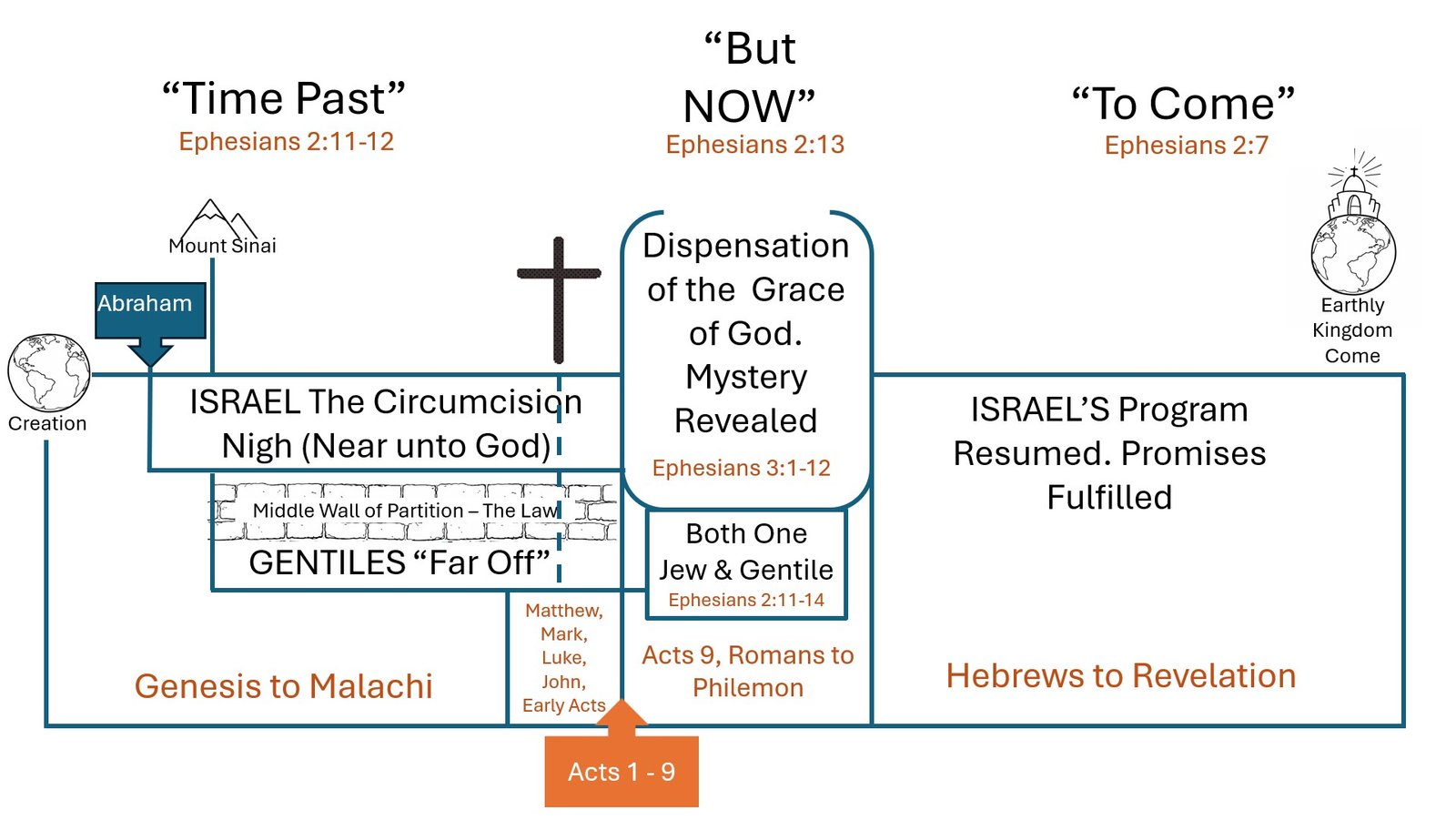
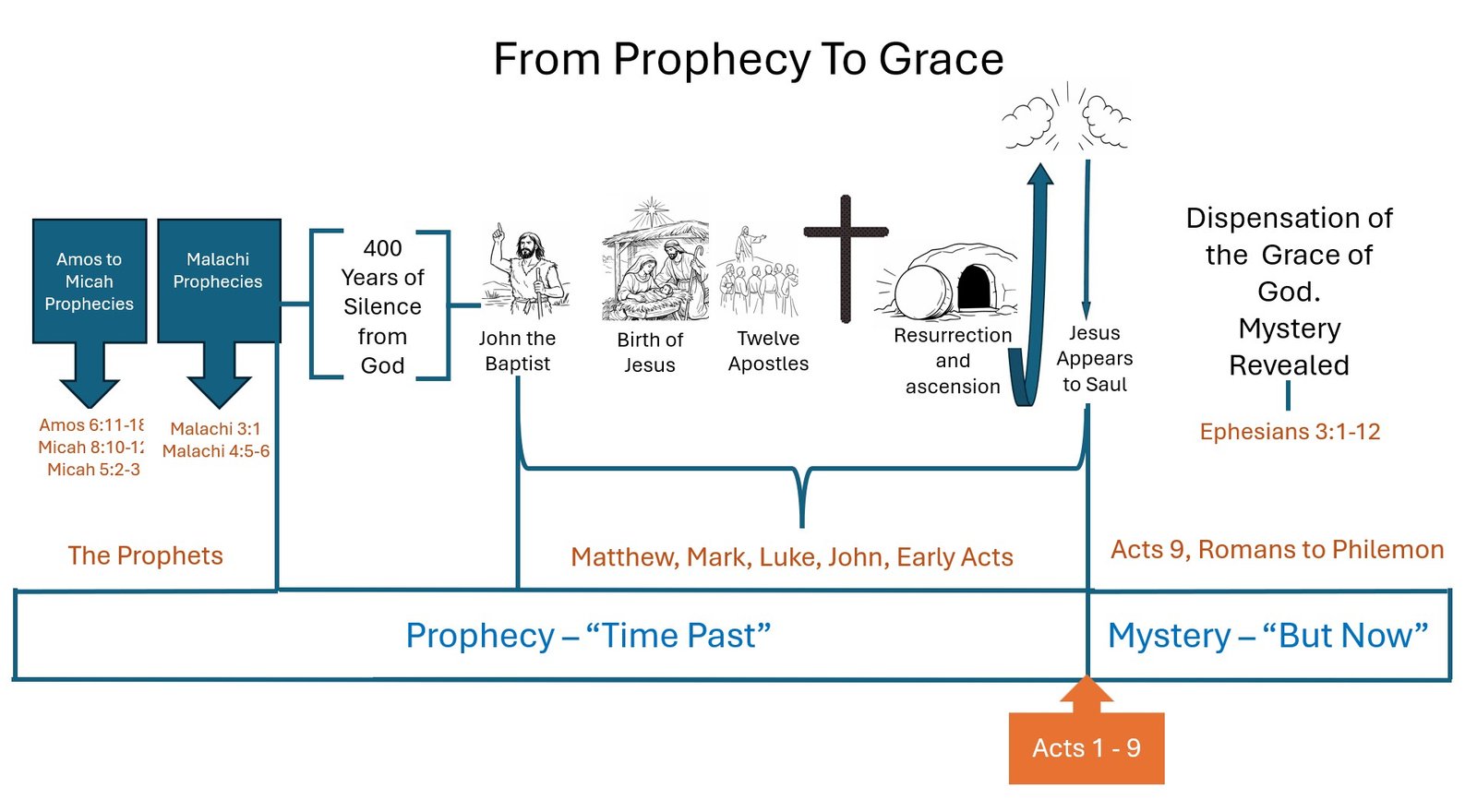
The charts we’ve made to help explain these time periods that are crucial to understanding the bible are still included below this recording. On the charts, we can see this parenthesis or bracketed chunk on the timeline, which is the dispensation of grace, the “but now” interruption in God’s plan that up till then was primarily for His nation, Israel, with us Gentiles being blessed through that nation.

In this episode, we return to our program for today, the dispensation of grace. Again, everything we studied in the last several episodes—Matthew, Mark, Luke, John, and Acts 1–7—belongs to the “time past” period, or God’s prophetic dealings with Israel. That whole section is what the prophets spoke about “since the world began.” But what we live in today is something different, something God kept secret “since the world began,” until He raised up Paul, our apostle to the Gentiles.

Rightly dividing the word of truth, as we’re told to by Paul in 2 Timothy 2:15, is not dividing the Old Testament from the New Testament. It’s dividing prophecy (Israel’s program) and mystery, our program for today, for both Jew and Gentile.

Time past = Genesis through Malachi, the gospel accounts, and Acts 1–7. But now = Romans through Philemon, the revelation of the mystery given to Paul. Ages to come = Hebrews to Revelation, when God resumes and finishes His program with Israel after this dispensation ends.

So, to summarise once again, God has two programs that can be clearly seen when we divide the bible rightly:

  1. Prophecy – Israel, spoken by the prophets since the world began.
  2. Mystery – the Body of Christ, kept secret since the world began.

Israel’s program is not cancelled. It’s temporarily suspended. The prophets are not being fulfilled today. God will resume Israel’s program after the dispensation of grace ends with the rapture, the mystery coming of Christ that only Paul speaks about.

This’s why we can’t take our doctrine, promises, or instructions from Matthew, Mark, Luke, John, or early Acts. Those books deal with the climactic stage of Israel’s program—the earthly ministry of Christ, the ministry of the twelve, and the offer of the kingdom. None of that is addressed to the Body of Christ. Our doctrine comes from Paul, the apostle to the Gentiles, the one God raised up to reveal the mystery.

Paul and Moses are the only two men in Scripture whose offices God magnifies. Paul says in Romans 15 that he magnifies his office because God gave him a unique apostleship. That’s what we’re focusing on now—the uniqueness and specialness of Paul’s apostleship. This is basic material, milk of the Word, yet most Christians never learn it because there’s a satanic policy of evil that works hardest against the revelation of that mystery.

The gospel accounts, and Acts 1–7, are not the beginning of the church, the Body of Christ. They’re the continuation of Israel’s prophetic program. The Body of Christ begins only when God interrupts that program and raises up Paul in Acts 9.

So, as we move into this episode and the next and final one, keep the timeline chart below in mind:

Time Past – Israel’s program (Genesis–Malachi, Gospels, Acts 1–7), But Now – Mystery program (Romans–Philemon),  Ages to Come – Israel’s program resumed after the rapture

Our instructions, promises, and identity are found only in Paul’s epistles. That’s where God speaks to you and me today.

By now, we see a lot about Paul’s unique apostleship just from what we’ve studied. There are many more differences in Scripture between Paul’s apostleship and the twelve, but even the basic things we’ve covered show how separate and special Paul’s calling is. Most Christians never see this because they’ve never been taught to let the Bible speak to them for itself.

One of the most misunderstood issues is Acts chapter 1 and the replacement of Judas. The common idea today is that Peter made a mistake, or that he “ran ahead of God,” and that Paul should have been Judas’s replacement. That is not only quite wrong, it’s also quite silly. The Bible says the exact opposite.

If people would simply read Acts 1 in light of what the Lord already taught the twelve in Matthew, Mark, Luke, and John, they would see there’s no mistake here. Peter and the others knew exactly what they were doing. They knew Scripture had to be fulfilled. They knew Judas’s office had to be taken by another. And they knew God had already chosen the man.

They were not gambling when they cast lots. Casting lots was the God‑given method for determining His will in Israel’s program, used by the high priest himself. They prayed, they quoted Scripture, they followed the Lord’s instructions, and they acted with full authority. To say otherwise is simply a result of not studying the Bible. Now don’t work yourself over about it, we’ve all been there, let’s just correct ourselves and get on with it!

Here’s the biggest proof:

In Acts 2, when the day of Pentecost was fully come, the twelve were filled with the Holy Ghost. Matthias was one of those twelve. If he were not God’s chosen replacement, he would not have been filled with the Spirit, because the promise of the Spirit was given only to the apostles to carry out their kingdom ministry in the Lord’s absence. The fact that Matthias stands there as one of the Spirit‑filled Galileans proves everything was done properly.

Now let’s look at the details in Acts 1. Peter stands up among the 120 and says Scripture, quote, “must needs be fulfilled” concerning Judas, and that’s Acts 1:16. He quotes the Psalms:

Psalm 69:25. – “Let his habitation be desolate…” and  Psalm 109:8.

“Let his days be few; and let another take his office.”

Then Peter lays out the qualifications. Judas’s replacement had to be someone who had been with them from John’s baptism all the way to the Lord’s ascension. Paul doesn’t even come close to meeting that requirement. He wasn’t even a believer then—he was persecuting the church. He even looked on as Stephen was stoned to death.

So the idea that Paul should have been Judas’s replacement is impossible.

Two men fit the qualifications: Joseph called Barsabbas and Matthias. They prayed, asking the Lord to show which man He had chosen. Then they cast lots, and the lot fell on Matthias. And the Scripture says plainly in Acts 1:26:

“He was numbered with the eleven apostles.”

Everything was done decently, in order, and according to God’s will.

Paul was never meant to be the twelfth apostle. He was meant to be something far greater—the apostle of the Gentiles, the steward of the mystery, the man through whom God revealed the dispensation of grace. His apostleship is separate, distinct, and unique.

Understanding this is part of rightly dividing the Word of truth. It keeps Israel’s program where it belongs, and it keeps our program, for the Body of Christ, where God put it, in Romans through to Philemon.

We’ll build on this more in the next and last episode.

Before we look again at Acts 1, we should remember that in the first seven chapters of Acts, the Lord had already spent forty days with the eleven after His resurrection, teaching them through the Holy Ghost. Acts 1:1–3 says He gave them commandments through the Spirit and taught them things pertaining to the kingdom of God. They weren’t guessing. They were trained for what they had to do in His absence during that extension of mercy and forbearance before the day of wrath that we showed last time.

To understand this, let’s go back to John 16. Before the cross, Jesus told the eleven He had “many things” to say, but they could not bear them yet. When the Spirit of truth came, He would guide them into all truth and show them things to come. That refers to the Spirit’s coming at Pentecost, not the forty‑day period in Acts 1.

But the Lord also had things they needed to know before Pentecost, so they could function as soon as He ascended to heaven. For that, He gave them the Spirit in a special, temporary way. In John 20:21–23, we see that He breathed on them and said, “Receive ye the Holy Ghost.”

This was not the full baptism with the Spirit—that would come at Pentecost—but a special enabling so they could understand His commandments and carry them out before the Spirit was poured out.

One of those commandments that had to be done before Pentecost was the restoration of the full number of twelve apostles.

Remember, the twelve apostles correspond to the twelve tribes of Israel of Matthew 19:28, where we read,

And Jesus said unto them, Verily I say unto you, That ye which have followed me, in the regeneration when the Son of man shall sit in the throne of his glory, ye also shall sit upon twelve thrones, judging the twelve tribes of Israel.

Eleven won’t do. Thirteen won’t do. The kingdom program requires twelve.

Judas was prophesied to fall, as we see in Psalm 69 and Psalm 109.

His office, or his “bishopric” as Peter called it, had to be taken by another. The Lord had already prepared the apostles for this. That’s why Peter stands up in Acts 1 with full confidence and authority. He isn’t guessing. He isn’t being “impulsive Peter.” He’s obeying the commandments the Lord gave them during those forty days.

Peter quotes Scripture and says in Acts 1:16,

“This scripture must needs be fulfilled.”

He lays out the qualifications: the replacement must be someone who’s been with them from John’s baptism to the ascension.

And, as we’ve already said, that alone proves Paul could never have been Judas’s replacement. He didn’t meet a single qualification.

Two men fit the requirements: Barsabbas and Matthias. They prayed, asking the Lord to show which man He‘d chosen. Then they cast lots—not gambling, but the God‑given method for determining His will in Israel’s program. The lot fell on Matthias, and Scripture says plainly in Acts 1:26,

“He was numbered with the eleven apostles.”

Everything was done properly and in order according to God’s will.

The final proof is in Acts 2:1-4.

When the day of Pentecost was fully come, the twelve, note twelve, were filled with the Holy Ghost. This was before the quote, “Devout Jews of every nation who were dwelling in Jerusalem had come together there to see what was going on.”

Matthias was one of the Spirit‑filled Galileans speaking in tongues.

If he were not God’s chosen apostle, he wouldn’t have been filled with the Spirit, because the Spirit was only given to the apostles at that stage. Again, Saul/Paul was nowhere on the scene.

Peter understood the Scriptures better than most Christians today because the Lord had given him commandments through the Holy Ghost during those forty days after the resurrection in Acts 1:1–3. He wasn’t guessing. He wasn’t acting in the flesh. He had the Spirit in a special, temporary way so he could understand what needed to be done before Pentecost.

Acts 1:15 shows Peter standing up among the 120. He recognises that the first of the two prophecies he quotes from Psalms—Judas’s habitation becoming desolate—was already fulfilled by Judas’s own actions as we see in Acts 1:18–19. But the second part—“his office being taken by another”- was still unfulfilled. And that part was their responsibility, not the nation’s. The rulers who betrayed Christ couldn’t replace Judas. Only the remaining apostles, filled with the Spirit, could do that.

Peter knew that Psalm 109 said Satan stood at Judas’s right hand, and at the right hand of the rulers who helped betray Christ. So the replacement had to come from within the faithful remnant, not the apostate, unbelieving nation. That’s why Peter says in Acts 1:21–22 that the replacement must be someone who had been with them from John’s baptism to the ascension. That is the Lord’s own qualification, not Peter’s idea.

Paul could never meet that requirement. He wasn’t with them from John’s baptism. He wasn’t with them during the Lord’s earthly ministry. He wasn’t even a believer. Only two men in the entire group of 120 met the qualifications: Joseph Barsabbas and Matthias, as Acts 1:23 tells us. That alone proves Paul was never intended to be Judas’s replacement.

We point out again, because of its importance, that Peter also knew the Lord had already taught them about the twelve thrones in the kingdom. In Matthew 19:28, Jesus said the twelve apostles would sit on twelve thrones, judging the twelve tribes of Israel. That’s why there must be twelve, not eleven or thirteen. The number is tied to Israel’s kingdom program.

So Acts 1 shows no mistake, or confusion, or human guessing. It shows the apostles obeying the Lord’s commandments, operating under the Spirit’s guidance, and preparing for the next stage of Israel’s prophetic program.

All of this sets the scene for this great contrast of Paul’s apostleship.

Now that this issue’s settled, we can look more at the details of Paul’s unique apostleship and why God magnified his office for us today.

God knew the tactics of the satanic policy of evil against you and me and how the message of this dispensation of grace was going to be bombarded in order to get Christians to be biblical and scriptural, but not dispensational, not rightly dividing the Word of Truth. God’s already provided the key to counter all that. It just requires us to pay attention to his word and go by exactly what He says, regardless of what others say or what’s popular.

Now look at Romans 15:15-16. Paul says he writes “more boldly” because of the grace given to him by God, that he should be the minister of Jesus Christ to the Gentiles, ministering the gospel of God, that the offering up of the Gentiles might be acceptable, being sanctified by the Holy Ghost.

He won’t boast in himself, but he will boast in what Christ has wrought by him in Romans 15:18. God magnified Paul’s office—just like He magnified Moses’—so that we’d stick with Paul, because our program comes through him.

Romans 15 shows the two programs side by side:

-Prophecy: Christ’s earthly ministry to Israel in verses 8–12, and

– Mystery: Paul’s ministry to the Gentiles in verses 15–21.

Paul says in verse 16 that the offering up of the Gentiles is “sanctified by the Holy Ghost.” It’s acceptable to God. He writes boldly, so it becomes acceptable to you and me, so we fully understand what God’s doing today.

Colossians 2:1–3 shows Paul fighting a spiritual battle so that believers, you and me,  come to “the full assurance of understanding to the acknowledgement of the mystery.” Satan fights hardest against this truth.

If we don’t stand firm in Paul’s message, we’re playing into the adversary’s hands.

In Romans 15, Paul talks about fully preaching the gospel of Christ “from Jerusalem and round about.” That sounds strange for the apostle of the Gentiles—until we read Galatians 2, where Paul explains why he went to Jerusalem, how God sent him there by revelation to explain the change of programs to the Jerusalem apostles and saints.

Their program—Israel’s prophetic program—was now in postponement, and they needed to be updated.

In Galatians 2:1–2, Paul says he went up “by revelation” and communicated to them quote, “that gospel which I preach among the Gentiles.” He didn’t go to compare notes with the other apostles, Peter and the like, or to check if they were preaching the same thing. He went to teach them, because they knew nothing about the mystery. He communicated that to them.

Communicated here means to lay out, to explain, and to educate. God used Paul to educate the former leaders of Israel’s program about what He was doing now.

Paul took precautions because the message was radically different—no circumcision, not under the law, Jew and Gentile in one body. Titus, a Greek who Paul took with him, wasn’t compelled to be circumcised, as we see in verse 3. False brethren tried to bring them into bondage in verse 4, but Paul says he didn’t give in, “no, not for an hour,” as he puts it, so the truth of the gospel would continue.

Then Paul says something powerful in verse 6 (Galatians 2:6) and we’ll read that,

But of these who seemed to be somewhat, (whatsoever they were, it maketh no matter to me: God accepteth no man’s person:) for they who seemed to be somewhat in conference added nothing to me:

Peter, James, and John—once the pillars of Israel’s program—added nothing to Paul. Instead, Paul added to them. He taught them what God had revealed to him.

Then Galatians 2:7-9 is critical. It says:

But contrariwise, when they saw that the gospel of the uncircumcision was committed unto me, as the gospel of the circumcision was unto Peter;

(For he that wrought effectually in Peter to the apostleship of the circumcision, the same was mighty in me toward the Gentiles:)

We clearly see here two distinct gospels, not one gospel to two groups, but the gospel of the uncircumcision, and the gospel of the circumcision. Two different messages for two different programs. Many modern translations change this verse to fit their theology, but that’s man’s change, not God’s.

Peter’s gospel—the gospel of the circumcision—belongs to Israel’s prophetic program spoken of since the world began. Paul’s gospel—the gospel of the uncircumcision—is the mystery, kept secret since the world began and revealed first to Paul. That’s why God sent Paul to Jerusalem fourteen years later—to reveal it to them, those of the circumcision.

Galatians 2:8, which we just read, says the same God who worked effectually in Peter for the circumcision worked mightily in Paul toward the Gentiles. Two apostleships. Two messages. Two programs.

The Jerusalem apostles recognised the difference.

Galatians 2: 9–10 reads,

And when James, Cephas, and John, who seemed to be pillars, perceived the grace that was given unto me, they gave to me and Barnabas the right hands of fellowship; that we should go unto the heathen, and they unto the circumcision.

Only they would that we should remember the poor; the same which I also was forward to do.

The great Jewish apostles of the circumcision gave Paul and Barnabas the right hand of fellowship, acknowledging the change. They agreed Paul would go to the Gentiles and they to the circumcision. They understood God had shifted programs.

Paul’s ministry is unique.

Romans 15 shows God magnified his office so we would stick with Paul, just as Israel had to stick with Moses. Paul’s message—the mystery—is the only place where God’s program for today is revealed, and we’ve just seen in Colosians 2 Paul fighting a spiritual battle so believers come to “the full assurance of understanding” and “the acknowledgement of the mystery.”

Many Christians treat the Bible as one big block and assume that everything in it is written directly to them. But God gave different instructions to different people at different times. All Scripture is profitable, but it must be rightly divided because it contains different contexts, operations, instructions, and audiences.

Our basis throughout this series has been Paul’s command to you and me today in 2 Timothy 2:15. Also in 2 Corinthians 2,3 and 4, he warns against those who handle the word of God deceitfully, which means with the intention to deceive, to falsify, to corrupt, to adulterate or to bait or trap.

He’s warning against using Scripture in a way that misleads, manipulates, or corrupts the truth, and this all starts with a failure to divide the word into its correct divisions and contexts.

If we ignore this, contradictions appear, confusion grows, and believers adopt promises and commands never given to them.

Most churches do not rightly divide the Word of Truth. They look similar on the outside with their buildings, their programs and their preaching—but the harm’s inside the people. Wrong division produces confusion, instability, and bad doctrine. More teaching is not better if the teaching’s wrong.

Timothy was facing this problem in Ephesus. He taught what Paul taught him, but some taught other doctrines.

Paul warned Timothy in 1 Timothy 1:3 to “charge some that they teach no other doctrine.” Paul didn’t stand for a mixed bag when it came to doctrine.

That means some doctrines shouldn’t be taught. It’s not enough to be “biblical.” You must teach the right doctrine for this dispensation. Some teachings in the Bible are not for us, even though they’re profitable and necessary for us to learn.

Paul told Timothy to stop wrong doctrine because wrong doctrine harms the church.

Paul warns Timothy in 1 Timothy 1:4 not to give heed to fables and endless genealogies. These things, such as Jewish traditions, religious stories, and Christian legends, are outside Scripture—

This is why we never put our faith in any Christian testimony or stories of healings or anything else that they say God may have done with them.

They may be touching, but they’re not doctrine. They “minister questions rather than godly edifying,” Paul says. Wrong doctrine creates confusion.

Many church speakers today speak passionately and emotionally, labouring on motivating the people to have a better life with more stuff, but people leave the room with no growth in their understanding of God, even though they may be temporarily motivated.

They’re taught to ignore their confusion by “Just having faith,” as if blind faith covers ignorance. But faith comes by hearing the Word, as we see in Romans 10:17, hearing correct doctrine from the truth that only God’s Word provides. Faith must be based on the hearing of the truth in order to do what it’s supposed to, the truth about Christ and the gospel.

In 1 Timothy 1:6, Paul says some have “swerved” from this and turned aside to “vain jangling.” Their heart, their conscience, and their faith are corrupted, so their charity’s corrupted too. What caused the swerving? Wrong doctrine, especially misusing the law.

Moses told Israel in Deuteronomy 32:46–47 that the law was “not a vain thing,” because it was their life. But Paul says in this dispensation that some desire to be teachers of the law and calls that vain jangling. Paul’s talking about law and grace. Grace has been given to him. We’re not under the law today. The law kills; grace gives life. If people leave the results of grace and try to teach the law as the rule of life, Paul says they “understand neither what they say, nor whereof they affirm.”

Paul warns in 2 Corinthians 11 that Satan’s ministers appear as “ministers of righteousness.” They preach righteousness by the law. They preach Sabbath‑keeping, tithing, and self‑made rules as the way to becoming a better, more successful Christian. That’s law, and that’s bondage. Walking by grace means our hearts are changed from the inside out. The law just cannot do that.

In the next and final episode in this series, we’ll look at this satanic policy of evil that works actively against the right division of God’s Word.

Until then, may God bless you and keep you.

Understanding The Bible – Episode 10

Let’s get into episode 10 of our Understanding the Bible series.
As per usual, we’ve included our two timeline charts below this recording to help us see more clearly the workings of God’s timeline.
The purpose of this series is to stir up in you a hunger to really know God’s Word, so you’re never satisfied just staying where you are, but you want to “increase in the knowledge of God”.
That’s God’s desire for you and me in this dispensation of grace, as Paul says in 1 Timothy 2:4,
Who (that’s God) will have all men to be saved, and to come unto the knowledge of the truth.

“Speed Slider”
Episode 9 ChartPress Image To Enlarge

Prophecy To Grace - 9

Press Image to Enlarge

Prophecy To Grace - 9

Press Image to Enlarge

Understanding The Bible – Episode 10 – Transcript

Okay, folks, let’s get into episode 10 of our Understanding the Bible series.

As per usual, we’ve included our two timeline charts below this recording to help us see more clearly the workings of God’s timeline.

The purpose of this series is to stir up in you a hunger to really know God’s Word, so you’re never satisfied just staying where you are, but you want to “increase in the knowledge of God”.

That’s God’s desire for you and me in this dispensation of grace, as Paul says in 1 Timothy 2:4,

Who (that’s God) will have all men to be saved, and to come unto the knowledge of the truth.

We want you to share in that “mutual faith” Paul talks about in Romans 1, especially about what God’s doing now in this dispensation of grace and how we walk in line with His program today.

Bible study is serious business because there’s a Satanic policy of evil that never ceases trying to confuse and rob us of what God’s so clearly given us. Only through studying the Word rightly divided can we understand God’s plan and rejoice in it to His glory.

Grab your Bibles and turn to Acts chapter 2.

We suggested last time to read verses 1–21. So you’d get used to the words the Bible uses to describe what’s happening at Pentecost, and how Peter explains it.

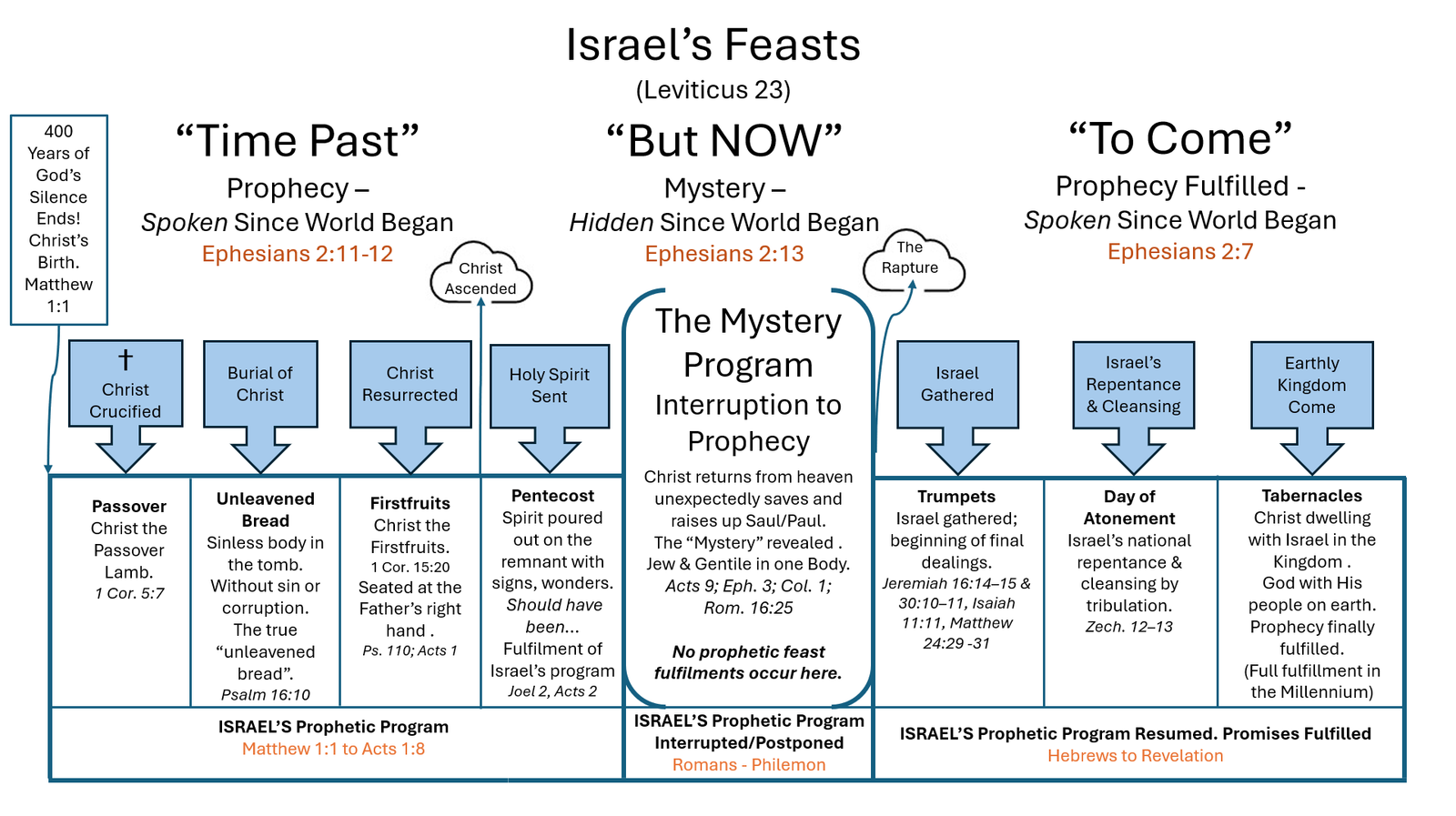
We’ve included a third timeline chart in this episode, and you’ll see it below this recording.

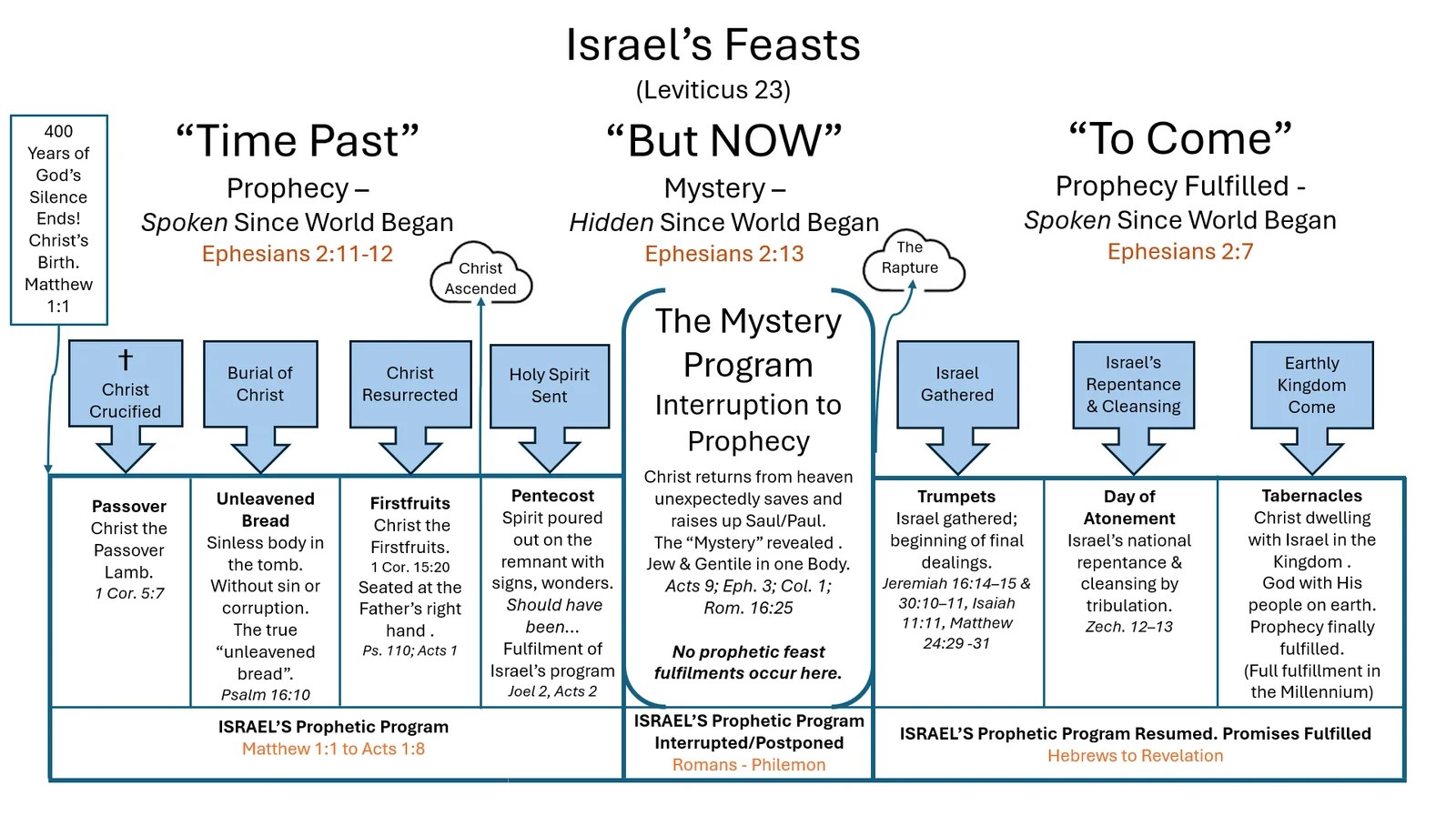
This third chart shows how Israel’s program follows the feast calendar from Leviticus 23, and we see that in the “Times Past” era, we have the feasts of:

PASSOVER (Lamb slain, fulfilled in Christ on the Cross)

UNLEAVENED BREAD  (Without sin, fulfilled in Christ’s sinless body, buried without seeing corruption)

FIRSTFRUITS (First sheaves of the harvest, fulfilled in Christ, the Firstfruits as explained in 1 Corinthians 15:20)

PENTECOST (Spirit poured out on the remnant  with signs and wonders, Joel 2, fulfilled in Acts 2)

Then we see that in the “Ages To Come” era, we have the feasts of:

TRUMPETS – Israel gathered; beginning of final dealings

DAY OF ATONEMENT  –  Israel’s national repentance & cleansing from Zechariah 12–13

TABERNACLES

  • Christ dwelling with Israel in the Kingdom
  • Full fulfilment in the Millennium
  • God with His people on earth

We notice there’s no feast covering the dispensation of grace

in that calendar. We, today, the Body of Christ, are not under those feast days. Colossians 2:17-17 says not to let anyone judge us in “meat, or drink, or… holyday… new moon… sabbath days,” which were shadows of things to come, but the body is of Christ.

For Israel, those feasts mapped out the days of their Messiah. When Acts 2:1 says, “when the day of Pentecost was fully come,” it means the shadow (the feast) and the substance (the real event) met.

Something big happened—the outpouring of the Holy Spirit, just like the Lord said in Acts 1, and like God promised in Ezekiel 36, that He would put His Spirit within them and cause them to walk in His ways.

This was for the believing remnant of Israel, to empower them and intensify the sign ministry confirming:

– the gospel of the kingdom, and

– that Jesus of Nazareth is Israel’s Messiah.

For about a year, in Acts 1–7, God was giving Israel a final chance to repent before the day of wrath, with signs, wonders, and miracles by the Holy Ghost as per the prophecies from Jeremiah 31, Zechariah 12:10, Hebrews 8 and 10, Ezekiel 37, Joel 2 and other places.

In Acts 2, the twelve Galileans speak in other tongues as the Spirit gives them utterance. Jews from many nations hear them and understand what’s being spoken of in their own languages, and they’re confused. Some mock and say they’re drunk. Then Peter, who has the keys of the kingdom, as per Matthew 16, stands up with the eleven and explains.

He says, “Ye men of Judaea, and all ye that dwell at Jerusalem…” he’s talking to Israel, not the Body of Christ. He denies they’re drunk and then gives the real explanation. Acts 2:16,

“But this is that which was spoken by the prophet Joel”.

That’s the key line.

We directly connect Joel 2 to Acts 2. Peter doesn’t say, “This is something new, never spoken before.” He says, “This is that” which the prophet Joel prophesied. That’s Israel’s program, not the beginning of the dispensation of grace.

My friends, the words here couldn’t be any plainer. Peter and the others are filled with the Holy Ghost, and God the Holy Spirit is speaking through Peter to tell us exactly what’s happening on that day of Pentecost.

Peter doesn’t say, “this is something never spoken since the world began,” or “this is the mystery of Christ,” or “this was hidden in God.” Those are Paul’s words, later explaining the dispensation of grace and the mystery given to him.

Here, Peter says:

“This is that which was spoken by the prophet Joel”.

He does not say, “this is like that,” but “this is that.” So if Joel spoke it, it’s not the mystery of Christ, not the Body of Christ, not the dispensation of grace that was kept secret since the world began. Just that one verse, before we even read Joel, tells us:

Pentecost is Israel’s program, not the birthday of the church, the Body of Christ.

Then, in Acts 2:17, Peter quotes Joel:

“And it shall come to pass in the last days, saith God…”

So this is not the start of something new; it’s the beginning of the end—the last days of Israel’s prophetic time schedule.

Remember: God gave Israel a time schedule in Daniel. Daniel sits like the hub of a wheel, and the other prophets (Isaiah to Malachi) are like the rim. Their “latter days,” “last days,” “many days” all plug back into Daniel’s time chart like spokes, joining the hub to the rim. Joel fits into that same schedule.

Those last days are the last seven years of Daniel’s time schedule. But the Lord told Peter, James, and John that He was extending that schedule, adding a short extension of mercy and forbearance at the front. So some things from the beginning of those last days get pulled forward to start right after the Lord goes back to heaven, but before the full seven years click in.

In Joel 2:28-29, which is the first and early days of the last days, Joel lays out what happens, which is early in the last days, including that extension of mercy:

And it shall come to pass afterward, that I will pour out my spirit upon all flesh; and your sons and your daughters shall prophesy, your old men shall dream dreams, your young men shall see visions:

And also upon the servants and upon the handmaids in those days will I pour out my spirit.

That’s what’s starting at Pentecost—the Spirit poured out on the remnant of Israel, with prophecy, visions, and dreams.

Then, in the later part (deeper into the last seven years):

Joel 2:30-32,

And I will shew wonders in the heavens and in the earth, blood, and fire, and pillars of smoke.

The sun shall be turned into darkness, and the moon into blood, before the great and the terrible day of the LORD come.

And it shall come to pass, that whosoever shall call on the name of the LORD shall be delivered: for in mount Zion and in Jerusalem shall be deliverance, as the LORD hath said, and in the remnant whom the LORD shall call.   

Those are the intensified signs in the latter half—the last three and a half years of the tribulation—leading right up to the second coming of Christ, the “great and notable day of the Lord,” that Acts 2:20 states and that Jesus spoke of in Matthew 24.

So, the early last days are where the Spirit is poured out, resulting in prophesying, visions, and dreams.

Then in the later last days we have blood, fire, smoke, sun darkened, and the moon turned to blood.

All of it together is under the heading of the “last days” (plural).

Some people say that because all those things didn’t happen on the day of Pentecost, Peter couldn’t mean that Joel is being fulfilled. But the text says “last days”—plural. Joel never said all of it would happen on one day. He gave an outline of what would happen across those last days, in order and growing more intense.

Peter’s point is simple and powerful:

On Pentecost, it has begun.

Peter says, “This is that”. The “That” is what Joel spoke about—Israel’s last days starting, not the mystery Body of Christ, not our dispensation of grace.

What they were seeing on the day of Pentecost was exactly what Joel said would happen in Israel’s last days.

God was pouring out His Spirit on the sons and daughters of the people who lived in Joel’s time—their descendants now living in Peter’s day. They would prophesy, the young men would see visions, the old men would dream dreams, and God’s servants and handmaids in Israel would speak by the Spirit.

These things were beginning right there, at Pentecost, and they’d intensify through that short extension of mercy and forbearance, and then continue into the first part of Daniel’s final seven years.

After that would come the judgment signs, and then the terrifying cosmic signs right before the Lord returns to set up His kingdom. Joel 2 lays out Israel’s last days sign‑by‑sign, and Peter says plainly, “This is that.”

God knew exactly what He was doing at Pentecost. Sadly, many Christians today don’t, and they say things about Pentecost that God never said. They even try to follow Pentecost as if it were our program.

Look again at Acts 2:21,

…whosoever shall call on the name of the Lord shall be saved.

To see who that “whosoever” is, go back to Joel 2:32. It says,

And it shall come to pass, that whosoever shall call on the name of the LORD shall be delivered: for in mount Zion and in Jerusalem shall be deliverance, as the LORD hath said, and in the remnant whom the LORD shall call.

That’s the kingdom church, the remnant Jesus spoke of in Matthew 16, the group Peter, James, and John were gathering.

Now come back to Acts 2:37-40.

After Peter quotes Joel and accuses Israel of rejecting their Messiah, the people are “pricked in their heart” and ask, “What shall we do?” Peter answers with Israel’s gospel: “Repent, and be baptized… for the remission of sins, and ye shall receive the gift of the Holy Ghost.”

That’s the same message John the Baptist preached. It’s the same program, the same kingdom gospel. And Peter says the promise is “to you and your children, and to all that are afar off”, the scattered Israelites, just like Daniel and Joel said. God is calling out a remnant, just like Joel 2:32.

Peter then warns them: “Save yourselves from this untoward generation.”

That salvation is not the salvation Paul later preaches. It’s deliverance from the coming wrath on that generation of Israel. God promised deliverance in Jerusalem and Zion, and He’s offering it now through the twelve.

Notice something important: Peter never tells them to trust in Christ’s finished work for salvation. That’s not the message here. This is Israel’s program, not the Body of Christ. Pentecost is the next “fully come” feast on Israel’s calendar in Leviticus 23, not the beginning of the dispensation of grace.

Acts 2:41–47 shows the remnant living exactly as God said they would when He put His Spirit within them—having all things common, and selling possessions, just like Jesus told them in Luke 12. They were preparing for the tribulation that was soon coming at that time.

In Acts 3:6, Peter and John heal the lame man. Peter says, “Silver and gold have I none”. They’d been obedient and sold all. But they had the kingdom signs: healing and power. Again, this is Israel’s program moving forward.

Peter then accuses Israel again of killing the Prince of Life. He doesn’t preach that as good news. He says they did it in ignorance, just like Jesus prayed in Luke 23:34, and just like God had blinded them so the cross would happen.

They didn’t know what they were doing. It’s one of the reasons why God told them from Matthew 16:20 not to tell any man He is the Christ.

All of this shows the same truth:

Acts 2–3 is Israel’s prophetic program continuing, not the Body of Christ beginning.

God knew exactly what He was doing when Israel crucified Christ in ignorance. That ignorance allowed God to extend this short season of mercy and forbearance before the day of His wrath. The issue now is simple: will Israel believe what God says, or cling to what their teachers told them?

Peter says in Acts 3:17 that Israel and their rulers killed Christ “through ignorance.” But in verse 18, he explains that the prophets had already spoken of Christ’s sufferings, and those things were now fulfilled. Not everything the prophets said—just the suffering part. Now the next “fully come” events on Israel’s prophetic calendar were beginning, starting with Pentecost.

Because more prophetic events were coming, Peter urges Israel in verse 19 (Acts 3:19):

“Repent… and be converted, that your sins may be blotted out when the times of refreshing shall come from the presence of the Lord.”

On the chart, the “times of refreshing” is the kingdom, when Christ returns and restores all things. If their sins aren’t blotted out when that comes, they won’t enter it.

Peter says heaven must receive Christ until the “times of restitution of all things,” which God spoke by all His prophets since the world began, as Acts 3:21 states. The Holy Spirit uses that wording on purpose, because later He’ll have Paul speak of the mystery as something kept secret since the world began. What was “spoken since the world began” cannot be the same as what was “kept secret since the world began.” Two different programs.

Peter’s preaching the same program God gave to Abraham, Isaac, Jacob, Moses, David, Samuel, Isaiah, John the Baptist, and the Lord Himself. They all looked for the kingdom—the restitution of all things, restoring the creation to what it was before Adam sinned.

Peter quotes Deuteronomy 18, where God would raise up a Prophet like Moses, and every soul that would not hear Him would be destroyed. That’s the wrath coming on Israel’s unbelieving generation. Peter is gathering the remnant church Jesus spoke of in Matthew 16, not the Body of Christ. If they refuse, they will be cut off when the kingdom arrives.

Acts 3:24 says,

Yea, and all the prophets from Samuel and those that follow after, as many as have spoken, have likewise foretold of these days.

That alone proves this is not the dispensation of grace, the church, the body of Christ today. Samuel and the prophets knew nothing of the mystery. They ministered to Israel, not the Gentiles. Peter says plainly that the people he’s speaking to are the children of the prophets and of the covenant God made with Abraham. That’s Israel—not us.

Then Acts 3:26 sums it up:

Unto you first God, having raised up his Son Jesus, sent him to bless you, in turning away every one of you from his iniquities. That’s the extension of mercy before wrath falls.

This whole section—Acts 1 through to Acts 7—is Israel’s prophetic program moving forward exactly as God said. It only gets misunderstood when Christians won’t let God tell them what He’s doing but persist in repeating what they’re taught by pastors, seminaries, religious systems and social media. The same blindness that crippled Israel’s leaders—the scribes, the Pharisees, and doctors of the law—now works against the Body of Christ through a satanic policy of evil.

Finally, in Acts 5:30, Peter again accuses Israel:

Whom You slew and hanged Him on a tree. 

Peter says the Lord’s waiting in heaven because something’s happening down here. Acts 5:31 tells us plainly what it is:

Him hath God exalted with his right hand to be a Prince and a Saviour, for to give repentance to Israel, and forgiveness of sins.

There it is—five words that summarise Acts 1–7:

“To give repentance to Israel.” 

That’s the whole purpose of this extension of mercy and forbearance before the day of wrath. God’s giving His nation a chance to repent, to change their mind, about Jesus of Nazareth before He rises from the Father’s right hand and judges them.

All of this is prophecy, not mystery. All of its Israel’s program, not ours.

From Acts 1 to Acts 7, God gives Israel’s rulers three opportunities to repent. Each one is tied to their response to the Spirit‑filled ministry of Peter, James, and John. The last and final opportunity comes through Stephen in Acts 7.

In Acts 6:8-15, Stephen is full of faith and power, doing wonders and miracles. The religious leaders can’t resist the wisdom and Spirit he speaks with—just like Jesus said in Matthew 10. So they bring in false witnesses, accusing him of speaking against Moses and the law. But notice: the only people saying the law was no longer in effect were liars. Peter, James, John, and Stephen never said that. The law was still in force because Israel’s program was still operating. It’s only in the dispensation of grace that God says, “You’re not under the law, but under grace.”

We can’t drag Acts 1–7 into today without disobeying God.

Stephen is God’s divine messenger to Israel’s rulers. God even changes Stephen’s face so it shines “as the face of an angel” in Acts 6:15, so the Sanhedrin knows exactly who stands before them. This is their third and final chance. The Sanhedrin was the supreme Jewish legislative council and the highest court of justice in ancient Israel.

In Acts 7, Stephen doesn’t defend himself—he defends God’s dealings with Israel. He walks them through their whole history, showing how their fathers always resisted the Holy Ghost. He shows that rejecting the Messiah was the high point of their rebellion, and that the nation now stood on the very edge of falling into the Lord’s hands in the day of His wrath.

Then he brings it to a head in Acts 7:51:

Ye stiffnecked and uncircumcised in heart and ears… ye do always resist the Holy Ghost; as your fathers did, so do ye. 

He accuses them of persecuting the prophets and betraying and murdering the Just One. They received the law by angels but did not keep it.

This is the moment of decision. A divine messenger stands before them, shining like an angel, filled with the Holy Ghost, giving them their last chance to repent. Do they change their mind?

Acts 7:54 tells us:

They were cut to the heart, and gnashed on him with their teeth.

No repentance. No change of mind. They respond with rage, and in that fury they,

ran upon him with one accord, And cast him out of the city, and stoned him:

This rejection closes the extension of mercy and forbearance. Israel’s rulers have now rejected all three Spirit‑given opportunities: Peter and the twelve, the apostles again in Acts 3–5, then Stephen before the Sanhedrin.

The nation stands guilty, and the prophetic program is ready to move to the next step—judgment—until God interrupts everything in Acts 9 by raising up Paul with the revelation of the mystery.

Everything in Acts 1–7 is Israel’s prophetic program, not the Body of Christ. The Bible makes it plain if we’d just let the words say what they say.

After Stephen’s message exposes Israel’s long history of resisting the Holy Ghost, something remarkable happens. Verse 55 says Stephen, full of the Holy Ghost, looked up into heaven and saw the glory of God, and Jesus standing at the right hand of God. He says, “Behold, I see the heavens opened, and the Son of Man standing on the right hand of God.”

Why is that important?

If we go back to Acts 2, when Peter explained Pentecost, he said Jesus had ascended to the Father’s right hand to sit there “till I make thy foes thy footstool” as prophesied in Psalm 110:1.

That “sitting” marks the beginning of the extension of mercy and forbearance. Christ sits while Israel is given a chance to repent.

Peter also said in Acts 2:17 that visions would be given to Israel’s young men in these last days. Stephen is a young man, and he receives one of those visions. And what does he see? Not Christ sitting, but standing.

That means the time has come for the Father to say, “The extension is over. Rise and make Your enemies Your footstool.”

This is Israel’s third and final chance to repent.

But, there’s no repentance. No change of mind. The rulers reject God’s final offer.

Do you see what’s been happening?

God’s kept giving and giving and giving every possible opportunity for Israel to repent, accept their Messiah and get ready for the setting up of the kingdom. Stephen’s vision shows the end of the mercy period and the readiness for the day of the Lord’s wrath.

The prophets spoke of this. In Isaiah 2–3, the Lord rises to shake the earth terribly. Isaiah says men will hide in the rocks and quote, “for fear of the Lord, and for the glory of His majesty, when He ariseth to shake the earth.”

That’s the same standing Stephen sees. The prophetic program is moving exactly as foretold.

This closes the extension of mercy and forbearance. Israel’s prophetic program is now ready for judgment—until God interrupts everything in Acts 9 by raising up Paul with the revelation of the mystery, the dispensation of grace.

Acts 1–7 is Israel’s program, not ours, and the Bible makes it plain.

We can’t understand the gospel accounts or Acts 1–7 unless we understand Isaiah, Joel, Daniel, and the rest of the prophets. Every word Jesus spoke, and every act of the twelve, relates back to what the prophets said. Understanding that makes the whole picture clear.

Acts 7 is the backdrop, if you like, to the dispensation of grace. Israel’s ready for wrath. Pentecost shows Christ sitting. Stephen shows Him standing. Israel rejects their final chance. If God had no mystery to reveal, Israel’s program would have continued, the day of the Lord’s wrath would have begun, and the kingdom would already be here.

But God had something kept secret since the world began—a mystery He planned before Israel ever rejected Him. So instead of wrath falling in Acts 8, something totally unexpected happens.

Acts 9 happens!

Saul of Tarsus—Israel’s chief enemy—is on the road to Damascus, breathing out slaughter. Suddenly, a light from heaven shines, and he hears a voice:

“Saul, Saul, why persecutest thou me?” 

He asks, “Who art thou, Lord?”

The answer: “I am Jesus.”

Right there, the risen Christ does something never prophesied. He comes back from heaven, not to judge, as prophecy spoke of for millennia, but to save His worst enemy and make him a brand‑new apostle. Through Paul, God reveals the mystery of Christ, the dispensation of grace offered to the Gentiles. It’s something that’s been hidden since the world began.

From Acts 9 through to Philemon, we’re in the dispensation of grace. That’s where our doctrine, our promises, and our instructions for the body of Christ today are found, and we’re still living in that dispensation today.

So we can see clearly that the dispensation of grace did not begin at Pentecost.  We can see that Acts 1–7 is Israel’s prophetic program, moving exactly as the prophets said.

We can see Christ sitting during the mercy extension, then standing when Israel rejected Stephen.

But, instead of the wrath that was maybe minutes away from coming to fulfil prophecy, God interrupted everything with the mystery revealed to Paul.

In the next episode, we’ll look more closely at the dispensation of grace itself. It’ll still be basic, but on top of the foundation that’s been laid, so we can appreciate why it’s completely different from Israel’s program.

Until then my God bless you in the knowledge of Him.