Tag Archive for: understanding the Bible

Understanding The Bible – Episode 12

This is episode 12 and our final episode in this Understanding the Bible series. The whole purpose has been to help us obey 2 Timothy 2:15,
Study to shew thyself approved unto God, a workman that needeth not to be ashamed, rightly dividing the word of truth.
We’re trying to show why that’s absolutely necessary. In this last episode, we look at something most Christians never even think about: Satan’s policy of evil against the Body of Christ in this dispensation of grace.

“Speed Slider”
Episode 9 ChartPress Image To Enlarge

Prophecy To Grace - 9

Press Image to Enlarge

Prophecy To Grace - 9

Press Image to Enlarge

Understanding The Bible – Episode 12 – Transcript

Alright, this is episode 12 and our final episode in this Understanding the Bible series. The whole purpose has been to help us obey 2 Timothy 2:15,

Study to shew thyself approved unto God, a workman that needeth not to be ashamed, rightly dividing the word of truth.

We’re trying to show why that’s absolutely necessary. In this last episode, we look at something most Christians never even think about: Satan’s policy of evil against the Body of Christ in this dispensation of grace.

To rightly divide the Word of Truth means that we not only know what God’s doing today, but also what the adversary’s doing. Satan doesn’t run the same script in every age. What he did in time past against Israel is not what he’s doing today.

When God suspended Israel’s program and brought in the mystery, Satan instantly adjusted. He understands the Body of Christ better than most believers. He understands the mystery better than most believers. And he hates it.

His goal today is simple: keep the mystery a mystery. Keep us ignorant of who we are in Christ, what God’s doing today, and why God brought in this dispensation at all. The revelation of the mystery is an embarrassment to Satan and his principalities and powers in heavenly places.

To grasp this, let’s turn to 1 Corinthians 2:7-8, where we read,

But we speak the wisdom of God in a mystery, even the hidden wisdom, which God ordained before the world unto our glory: Which none of the princes of this world knew: for had they known it, they would not have crucified the Lord of glory.

God kept the mystery secret so Satan would help accomplish the very thing that destroys his entire plan—both on earth and in the heavens.

We need to understand why God brought in the dispensation of grace. It wasn’t because He was frustrated with Israel. Romans 11 makes that clear. God set Israel aside temporarily because He had a secret purpose, “the mystery of His will” as Ephesians 1:9 labels it, planned before the world began. The mystery is about forming a new creation, the one new man, the Body of Christ, made of Jew and Gentile with no difference between them.

Why?

Because God’s reclaiming not only the earth, through Israel’s program, but also the heavenly places, through our program.

Genesis 1:1 says God created the heaven and the earth. Prophecy deals with the earth. But Satan also seized the heavenly governmental realm when he fell. Prophecy said nothing about how God would reclaim the heavens. That’s what the mystery’s for.

Ephesians 1:9-10 says this,

Having made known unto us the mystery of his will, according to his good pleasure which he hath purposed in himself:

That in the dispensation of the fulness of times he might gather together in one all things in Christ, both which are in heaven, and which are on earth; even in him:

God will place all things—heaven and earth—under the headship of Christ.

Israel will reign on earth. The Body of Christ will reign in the heavenly places. That’s why we’re given spiritual bodies, as 1 Corinthians 15 talks about, especially 1 Corinthians 15:44.

That’s why we are “seated with Christ in heavenly places” in Ephesians 2:6. That’s why the rapture, the great catching up of the Body of Christ, takes us into the air—the very realm where Satan is “prince of the power of the air.”

Satan didn’t know or even foresee this, but he knows it all now. He knows the Body of Christ is God’s instrument to replace his fallen principalities. That’s why he fights the mystery harder than anything else. If he can keep us confused—mixing Israel’s program with ours, living in Matthew to Acts 2, then in Hebrews to Revelation, instead of Romans through Philemon—then he keeps us spiritually useless.

So the adversary’s policy today is not demon possession, not signs and wonders, not attacking Israel’s kingdom program. His policy today is the confusing of doctrine—to keep Christians “biblical but not dispensational,” to keep them mishandling Scripture, to keep them blind to the mystery.

That’s why rightly dividing the Word of Truth is not optional. It’s our protection. It’s our stability, and it’s our clarity. It’s the only way to stand against Satan’s policy of evil in this dispensation of grace.

God took the wise in their own craftiness by doing one simple thing: keeping a secret. That’s why Paul calls the mystery “the hidden wisdom” in 1 Corinthians 2:7. God ordained this mystery before the world, long before Israel ever existed, long before Satan ever rebelled. So we mustn’t think God brought in the dispensation of grace because Israel failed or because He had to fix something. The mystery was already planned. He simply kept it hidden.

Ephesians 1:4 says we were chosen in Christ before the foundation of the world. That’s the mystery of God’s will—His secret purpose in Christ, laid out before creation. Keeping it secret was a masterstroke of God’s wisdom.

Satan’s fall in Isaiah 14 and Ezekiel 28 shows he challenged God on the issue of wisdom. He was created “full of wisdom” and “perfect in beauty,” but pride corrupted him. He built his plan of evil on the belief that his wisdom could outsmart God.

But God kept the mystery hidden, and by doing so, He let Satan perform the very act that destroyed his entire plan, crucifying the Lord of glory.

Satan thought the cross was his victory. Instead, it exposed him as a fool. God took the crown that Satan had claimed for himself and replaced it with a dunce cap. That’s what the mystery’s all about.

Because of that, Satan’s infuriated at the revelation and the proclaiming of the mystery. His policy of evil today is aimed at keeping the mystery unknown, as if God never revealed it. He wants the Body of Christ ignorant of who we are, what God’s doing, and why this dispensation exists. Satan’s policy is motivated by pure, blind hatred, both of God and those who are his.

Look at Colossians 2, where Paul shows the embarrassment the mystery brings to Satan and his principalities. Colossians 2:15 says, And having spoiled principalities and powers, he (Christ) made a shew of them openly, triumphing over them in it.

Those three words—spoiled, shew, triumph—tell us exactly how the mystery affected the heavenly rulers.

They were spoiled: Their entire plan of evil collapsed. They’d pledged themselves to Satan’s “superior wisdom,” believing he could avoid the lake of fire and take God’s place. The cross proved their confidence was foolish.

They were made a shew of: God publicly exposed them as fools. The heavenly realm saw that Satan’s wisdom was nothing compared to God’s hidden wisdom.

He triumphed over them: Christ won. Satan lost, and the cross sealed the doom of every principality aligned with him.

This is why Satan hates the mystery. This is why he hates us understanding Paul’s epistles. And this is why Paul warned the Corinthians not to be ignorant of Satan’s devices in 2 Corinthians 2.

Sadly, most Christians today are ignorant of those devices. They only know Satan’s tactics from Israel’s program—signs, wonders, demon possession—but they don’t know what he’s doing now. The mockery and foolishness of today’s “demon hunters” in the church is overwhelming. I’ve had first-hand exposure to this throughout my years of attending church, with many people professing to have been given a ministry directly by God to cast out demonic activity and, as a result, causing immense damage to both individuals directly and the Body of Christ in general, scarring them emotionally and destroying their truthful understanding of scripture.

Today Satan’s attack is doctrinal, and its primary tool is confusion, mixing Israel’s program with ours and keeping believers out of Romans through to Philemon. Keeping the mystery hidden in plain sight.

Those principalities and powers hate the revelation of the mystery because it spoiled them, exposed them, and triumphed over them. But there’s another reason why they hate it so fiercely. Look at Ephesians 3:9–11 which says.

And to make all men see what is the fellowship of the mystery, which from the beginning of the world hath been hid in God, who created all things by Jesus Christ:

To the intent that now unto the principalities and powers in heavenly places might be known by the church the manifold wisdom of God,

According to the eternal purpose which he purposed in Christ Jesus our Lord:

Paul says God wants the mystery preached, taught, rejoiced in, and fellowshipped around, because every time the Body of Christ talks about it, it echoes through the heavenly realm and reminds those fallen rulers that God is infinitely wiser than they are. It reminds them their doom is sealed. It reminds them they were fooled by a secret, and it lays the boot in with the fact that it’s the church, the new man, the Body of Christ, mere humans that keep them reminded of it.

That’s why Satan hates this message with a hatred you can’t measure. If he could undo the cross, he would. But he can’t. So he wages war against the mystery. That’s why Paul’s epistles constantly use warfare terms like fight the good fight, war a good warfare, wrestle not against flesh and blood, taken captive. The battle’s real, my friends, and it takes place in the mind where either understanding and peace reign or ignorance and confusion.

Satan’s will is ignorance and confusion; it’s all he has left!

He uses it to block Ephesians 3:9-11, by keeping believers from seeing “the fellowship of the mystery.” If he can corrupt our understanding of what God’s doing today, we won’t fellowship around the mystery, we won’t talk about it, and the impact in the heavenly places will be either weak or won’t be made at all.

So Satan’s front line, primary attack is the corruption of the doctrine God has given to us. He wants us to handle the Bible, but not handle it accurately. He wants us to mix Israel’s program with ours. He wants us to be confused about Paul’s apostleship. He wants us to think there’s no difference between Paul and the twelve, or that Paul should have been Judas’s replacement. All of that fits perfectly into his policy of evil. If we accept and believe those things, we’ve swallowed his plan. If we communicate them to others, we’re helping it along.

Satan well knows that if he can corrupt our understanding of Ephesians 3:1–8, Paul’s unique apostleship and the difference between time past, but now, and ages to come, then we won’t see the fellowship of the mystery. And if we don’t see it, we won’t talk about it. And if we don’t talk about it, the heavenly rulers don’t have to listen to the message that humiliates them. Their wounded pride gets comforted.

Not only that—Satan can then turn the tables and act as the devil, the diabolos, the slanderer. He can use misguided Christians as examples of confusion, speaking accusingly on their behalf. He can carry out “spiritual wickedness in high places” at their expense. And he gloats on it. It’s all he has!

We need at least a basic grasp of what’s at stake if we don’t rightly divide the Word. Satan understands the importance of it far more than most Christians. He’s devoted the entire machinery of his heavenly kingdom to stopping its impact.

So let’s look at some passages that show his first-line attack—corrupting doctrine so the mystery is not understood, not fellowshipped around, and not proclaimed.

That attack always begins with undermining the uniqueness of Paul’s apostleship, because if Paul’s distinct message is blurred, the mystery’s blurred, and Ephesians 3:10 is never fulfilled.

Let’s go to Ephesians 4, where Paul shows how the Lord provided everything needed for the sound edification of the Body of Christ in this dispensation of grace.

Ephesians 4:11 says that after His ascension,

…he gave some, apostles; and some, prophets; and some, evangelists; and some, pastors and teachers;

These are not the twelve. The twelve were made apostles back in Matthew 10, long before the cross. The apostles and prophets in Ephesians 4 are gifts for the Body of Christ after Christ’s ascension, not Israel’s program. That’s why Paul can call Timothy, Titus, and Epaphroditus apostles—they belong to this category.

Why did Christ give these gifts?

Next verse, Ephesians 4:12,

For the perfecting of the saints, for the work of the ministry, for the edifying of the body of Christ:

They’re educational terms. These are communication gifts. God designed the local assembly to be “the pillar and ground of the truth” (1 Timothy 3:15). A classroom for sound doctrine. If a church doesn’t teach sound doctrine, it isn’t functioning as a church—no matter what the sign says.

God wants His saints edified, or built up and educated in the truth of this dispensation. Colossians 1:27 says God wants His saints to know “the riches of the glory of this mystery… Christ in you, the hope of glory.” That requires education. Everything we covered in the earlier episodes—Paul’s apostleship, time past / but now / to come, Israel’s program vs. the Body of Christ—is basic milk doctrine. But God wants us to go on to maturity.

Ephesians 4:13 gives this doctrinal goal of doctrine:

Till we all come in the unity of the faith, and of the knowledge of the Son of God, unto a perfect man, unto the measure of the stature of the fulness of Christ:

Full knowledge of the Son of God is not just knowing His earthly ministry. We don’t even know half of what’s to know about Christ if all we know is Matthew, Mark, Luke, and John. Full knowledge demands understanding the mystery of Christ, God’s secret purpose in His Son.

A “perfect man” is a fully educated member of the Body of Christ, much like the idea of a student who’s finished all the stages of their schooling. God wants fully trained saints who can function properly in their vocation to make the impact of Ephesians 3:10, declaring God’s manifold wisdom to the heavenly powers.

That’s why Ephesians chapter 4 begins with Paul saying :

I…beseech you that ye walk worthy of the vocation wherewith ye are called,

A vocation is a true “calling” or lifework rather than just a way to make money.

Our vocation has two parts:

  1. What we do now, on earth, before the rapture.
  2. What we’ll do then, in the heavenly places with our glorified body.

Now, our vocation includes making that heavenly impact by understanding and fellowshipping around the mystery. Talking about it. Standing for it. Not clamming up when opposition comes.

And this is exactly where Satan attacks.

Ephesians 4:13-14 has this,

Till we all come in the unity of the faith, and of the knowledge of the Son of God, unto a perfect man, unto the measure of the stature of the fulness of Christ:

That we henceforth be no more children, tossed to and fro, and carried about with every wind of doctrine, by the sleight of men, and cunning craftiness, whereby they lie in wait to deceive;

This shows Satan’s goal. He wants children, children in understanding, saints who never learn what they should’ve learned. Saints who can’t fellowship around the mystery because they don’t understand it.

This is Phase One of Satan’s policy of evil:  Doctrinal corruption.

Get believers confused. Get them mixing Israel’s program with ours. Get them thinking Paul isn’t unique. Get them tossed around by every wind of doctrine. Because if he can stop us from understanding the mystery, he can stop us from making the impact of Ephesians 3:10.

That’s what’s at stake. And that’s why right division matters so much.

The sad truth is that when a believer doesn’t grow up in sound doctrine, he stays a child in understanding. And worse than that, the little he does know is usually a pile of corrupted doctrine, misapplied verses, and teachings that don’t belong to this dispensation of grace. That’s exactly what Ephesians 4:14 warns about—being “tossed to and fro, and carried about with every wind of doctrine,” blown around by teachings that look and sound biblical but are not rightly dividing the Word of Truth.

Those winds of doctrine don’t come out of nowhere. Paul says they come by the sleight of men and cunning craftiness, men who “lie in wait to deceive.”

Behind that lies the adversary himself. His goal is simple: keep us confused so we never understand the fellowship of the mystery, and therefore never make the impact of Ephesians 3:10, declaring God’s manifold wisdom to the heavenly powers.

If you ever wonder why you’ve never heard the mystery taught before, that’s the reason. Satan works hard to keep it hidden.

Now look at Colossians 2:1-4. Paul’s carrying on talking about his prayer for the Colossians from the previous chapter. He explains part of that prayer in verses 2 & 3, which reads,

That their (that’s the saints in Laodicea, as many as have not seen him in the flesh – you and me). That their hearts might be comforted, being knit together in love, and unto all riches of the full assurance of understanding, to the acknowledgement of the mystery of God, and of the Father, and of Christ; In whom are hid all the treasures of wisdom and knowledge.

Then, in the next part of that prayer, in verse 4, he gives a reason for that prayer request,

And this I say, lest any man should beguile you with enticing words.

These beguiling and enticing words are messages that come from pulpits, and through the media and are spoken by people who look and sound like Christian ministers. But 2 Corinthians 11:14-15 says Satan himself is “transformed into an angel of light”, and his ministers transform themselves into “ministers of righteousness.”

They don’t show up wearing horns and red suits. They quote Scripture. They talk about Jesus. But they preach another Jesus, another spirit, and another gospel, and it’s all from the Bible, but not according to Paul’s message given by Christ himself directly for us in this present “But Now” age, today.

Jesus can be preached from Matthew, Mark, Luke, and John and still be preached in error if the person preaching doesn’t understand the difference between Israel’s program and the dispensation of grace. “Receiving the Spirit” from Acts 2 can be preached, but if it’s not preached with an understanding of Israel’s Pentecostal program, that preaching will be of “another spirit”. If “The gospel of the Kingdom” from the prophets and the four gospels is preached without the full understanding of our gospel today, as defined in 1 Corinthians 15:1-4, it’s another gospel, because there’s clearly more than one gospel in the Bible. Satan uses all of that to corrupt the minds of believers from “the simplicity that is in Christ,” as 2 Corinthians 11:3-4 says.

In Corinth, false apostles were operating right in their assembly. They didn’t say, “We’re false apostles.” They said they were Christ’s ministers. They even had signs and wonders, real miracles. That’s why Paul never argued, “I did miracles, and they didn’t.” They did miracles. But they were “deceitful workers,” using signs to seduce the saints so the doctrines of devils could be accepted, as Paul teaches Timothy in 1 Timothy 4:1.

This is Phase One of Satan’s policy of evil:  Corruption of our doctrine through enticing words, false apostles, and misused Scripture.

Its goal is to keep you and me from understanding the mystery, so we never fellowship around it, never speak it, never stand for it, and never make the heavenly impact God purposed us to make.

If Satan can keep us doctrinally confused by wrong doctrine—mixing Israel’s program with ours, ignoring Paul’s apostleship, chasing signs, following emotional preaching—then he’s succeeded. We become children tossed by every wind of doctrine, unable to stand firm, unable to walk worthy of our vocation, unable to make the impact of Ephesians 3:10.

This’s why rightly dividing the Word of truth really matters. This is why Paul fought so hard. And this is why you and I must stand firm in the truth of the mystery, no matter who opposes it.

We should always keep in mind that the corrupt doctrines that toss believers “to and fro” don’t come from atheists or people throwing the Bible away. They come from Bible‑using teachers who mishandle Scripture. That’s the sleight of men and cunning craftiness Paul warns about in Ephesians 4:14. These doctrines look biblical, they sound spiritual, and they often come with “power”—but it’s not God’s power. It’s backed by seducing spirits, producing spiritual experiences that deceive Christians who don’t rightly divide the Word.

God gave us an unquestionable standard against which all other things are measured:  “The glorious gospel of the blessed God, which was committed to my (Paul’s) trust.” (1 Timothy 1:11)

If a minister does not teach the distinctiveness, the easy-to-recognise difference of the dispensation of grace, the uniqueness of Paul’s apostleship, and the truth of the mystery, then no matter how sincere he is, his doctrine is corrupted.

In Colossians 2:8, Paul warns us to,

Beware lest any man spoil you through philosophy and vain deceit, after the tradition of men, after the rudiments of the world, and not after Christ.

These are human ideas imposed on Scripture. The traditions of men he talks of are religious practices carried over from Israel’s program into today. The rudiments of the world are earthly ordinances and laws taken from time past and forced into the Body of Christ. All these can be “found in the Bible,” but they don’t belong to this dispensation today.

Satan’s not trying to make Christians unbiblical. He wants them misbiblical, you could say, using the Bible wrongly, mixing programs, misapplying and using out-of-context verses, but never understanding the mystery. That is his first and most successful tactic.

Paul also warns in Colossians 2:18–19 about people claiming extra‑biblical revelations such as “God told me,” or “the Spirit spoke to me,” or “I saw an angel.” Paul says such people are “vainly puffed up” and not holding the Head. “Not holding the Head” means disregarding the fact that Christ is the Head of the Body of Christ.

This describes the spiritual arrogance of these false teachers and those who believed what they teach. There’re few things more dangerous among Christians than spiritual pride and arrogance.

Anyone claiming a new revelation today is lying. God has completed His Word, especially concerning this dispensation of grace.

All of this is part of Satan’s policy of evil.

Now come to 2 Timothy 2:15, where we began. I pray that this series, if nothing else, has shown the absolute necessity of rightly dividing the word of truth and to recognise the difference between time past, but now, and ages to come.

I also pray you recognise that Romans through Philemon is God’s Word to you today and that Genesis through to Acts 9 is Israel’s program, and Hebrews through to Revelation is Israel’s future program, and that you know not to claim Israel’s promises or instructions for yourself.

I hope you see why God wants us to put special focus on Paul’s epistles, from the milk of Romans to the solid meat of Philemon, over and over for the rest of our lives until the rapture. That’s how we learn our instructions, our promises, our doctrines, and our walk for today.

That’s what 2 Timothy 2:15-16 commands:

Study to shew thyself approved unto God, a workman that needeth not to be ashamed, rightly dividing the word of truth. But shun profane and vain babblings: for they will increase unto more ungodliness.

If we rightly divide the Word of truth, we won’t be ashamed now or at the Judgment Seat of Christ. If we don’t, especially after looking at all these scriptures, and we try to justify our life by quoting Matthew or Acts 2, or trying to fit into Israel’s Old Testament, we should be prepared for the Lord to simply say, “Didn’t you know that wasn’t written to you?” And we’ll be ashamed—not because He didn’t tell us, but because we didn’t listen.

This concludes our Understanding the Bible series. We’ve only scratched the surface, but hopefully we’ve shown why rightly dividing the Word is not optional and how it protects us from the adversary’s policy of evil that lies in every corner, waiting to corrupt our knowledge of God in this dispensation of grace today.

Thank you for letting me share this series with you. From here, stand fast in the mystery. Stay grounded in Paul’s gospel and keep rightly dividing the Word of truth, and don’t let the adversary keep God’s revealed secret from you.

Understanding The Bible – Episode 11

We’re in episode 11 of this Understanding the Bible series and we return to our program for today, the dispensation of grace. Again, everything we studied in the last several episodes—Matthew, Mark, Luke, John, and Acts 1–7—belongs to the “time past” period, or God’s prophetic dealings with Israel. That whole section is what the prophets spoke about “since the world began.” But what we live in today is something different, something God kept secret “since the world began,” until He raised up Paul, our apostle to the Gentiles.

“Speed Slider”
Episode 9 ChartPress Image To Enlarge

Prophecy To Grace - 9

Press Image to Enlarge

Prophecy To Grace - 9

Press Image to Enlarge

Understanding The Bible – Episode 11 – Transcript

Okay, folks, we’re in episode 11 of this Understanding the bible series, and let’s get it off the ground by opening our Bibles at Acts chapter 1.

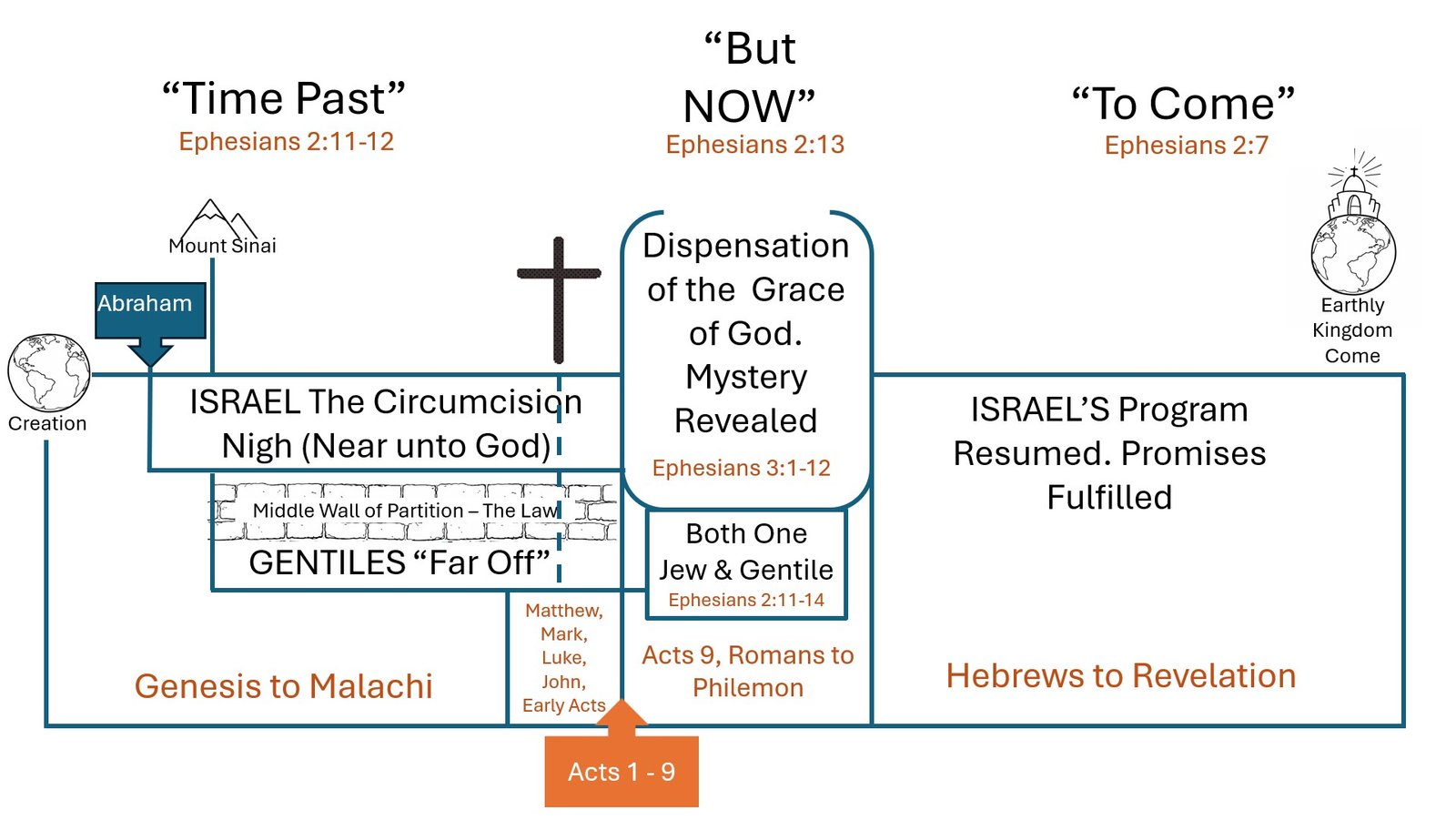
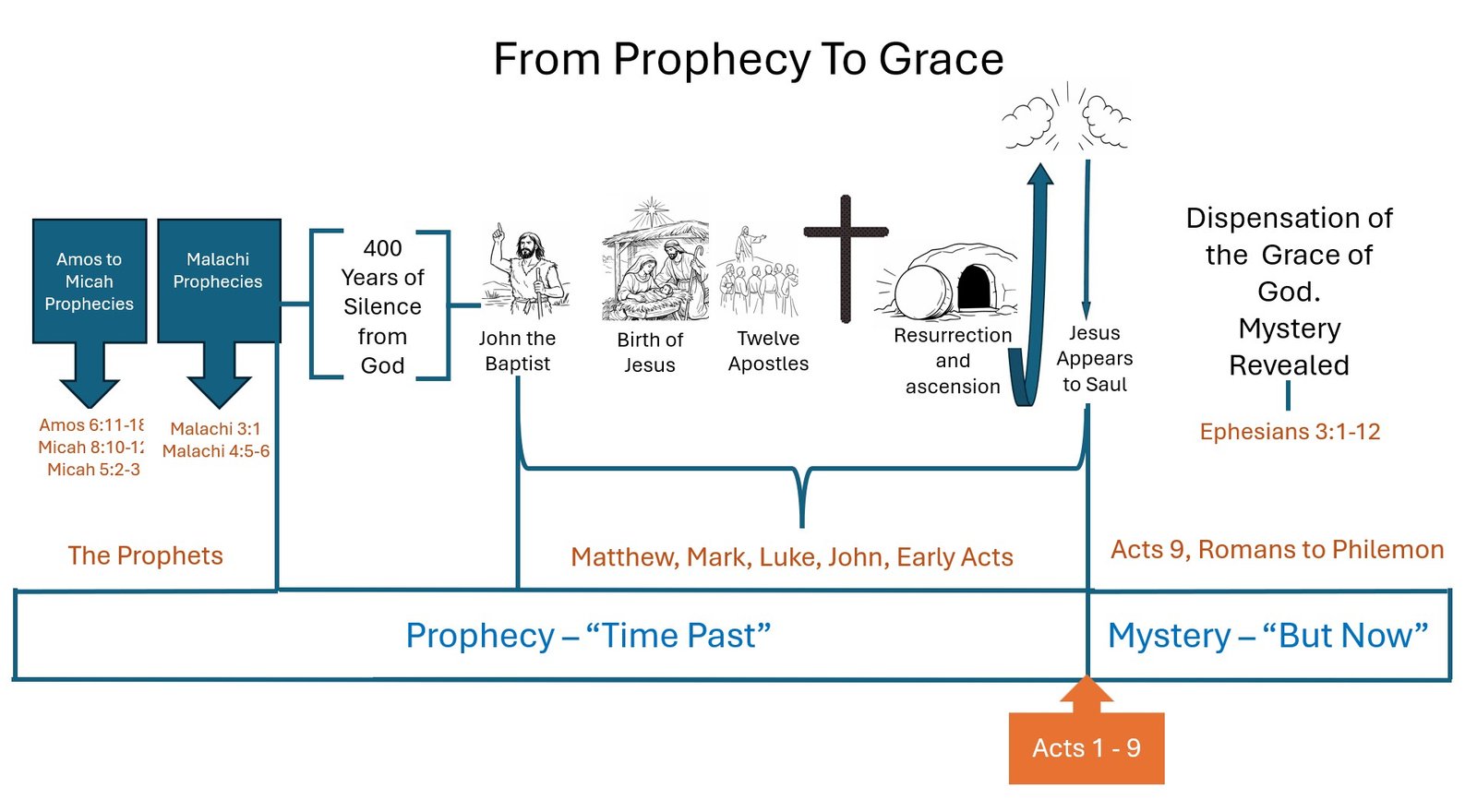
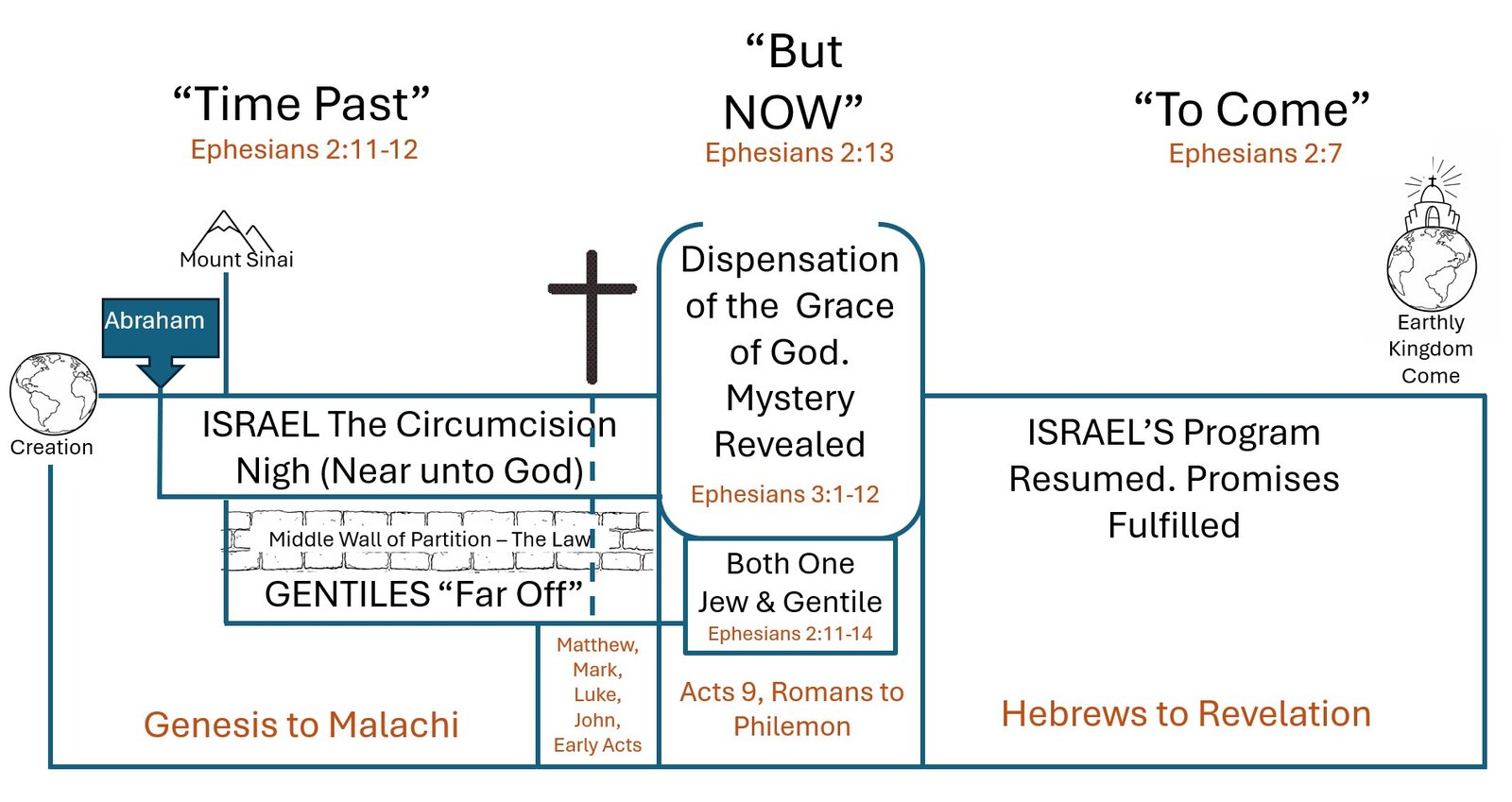
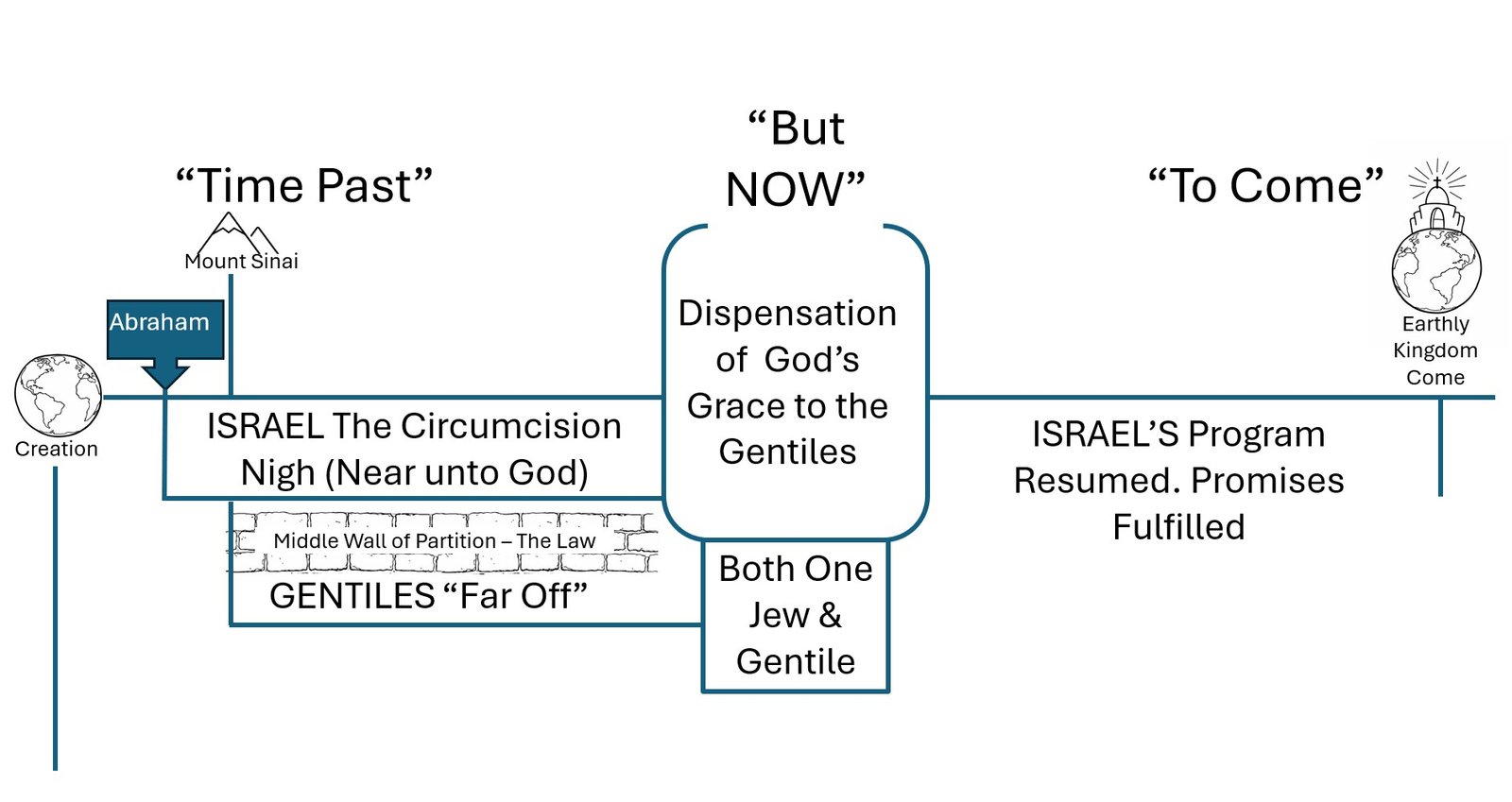
The charts we’ve made to help explain these time periods that are crucial to understanding the bible are still included below this recording. On the charts, we can see this parenthesis or bracketed chunk on the timeline, which is the dispensation of grace, the “but now” interruption in God’s plan that up till then was primarily for His nation, Israel, with us Gentiles being blessed through that nation.

In this episode, we return to our program for today, the dispensation of grace. Again, everything we studied in the last several episodes—Matthew, Mark, Luke, John, and Acts 1–7—belongs to the “time past” period, or God’s prophetic dealings with Israel. That whole section is what the prophets spoke about “since the world began.” But what we live in today is something different, something God kept secret “since the world began,” until He raised up Paul, our apostle to the Gentiles.

Rightly dividing the word of truth, as we’re told to by Paul in 2 Timothy 2:15, is not dividing the Old Testament from the New Testament. It’s dividing prophecy (Israel’s program) and mystery, our program for today, for both Jew and Gentile.

Time past = Genesis through Malachi, the gospel accounts, and Acts 1–7. But now = Romans through Philemon, the revelation of the mystery given to Paul. Ages to come = Hebrews to Revelation, when God resumes and finishes His program with Israel after this dispensation ends.

So, to summarise once again, God has two programs that can be clearly seen when we divide the bible rightly:

  1. Prophecy – Israel, spoken by the prophets since the world began.
  2. Mystery – the Body of Christ, kept secret since the world began.

Israel’s program is not cancelled. It’s temporarily suspended. The prophets are not being fulfilled today. God will resume Israel’s program after the dispensation of grace ends with the rapture, the mystery coming of Christ that only Paul speaks about.

This’s why we can’t take our doctrine, promises, or instructions from Matthew, Mark, Luke, John, or early Acts. Those books deal with the climactic stage of Israel’s program—the earthly ministry of Christ, the ministry of the twelve, and the offer of the kingdom. None of that is addressed to the Body of Christ. Our doctrine comes from Paul, the apostle to the Gentiles, the one God raised up to reveal the mystery.

Paul and Moses are the only two men in Scripture whose offices God magnifies. Paul says in Romans 15 that he magnifies his office because God gave him a unique apostleship. That’s what we’re focusing on now—the uniqueness and specialness of Paul’s apostleship. This is basic material, milk of the Word, yet most Christians never learn it because there’s a satanic policy of evil that works hardest against the revelation of that mystery.

The gospel accounts, and Acts 1–7, are not the beginning of the church, the Body of Christ. They’re the continuation of Israel’s prophetic program. The Body of Christ begins only when God interrupts that program and raises up Paul in Acts 9.

So, as we move into this episode and the next and final one, keep the timeline chart below in mind:

Time Past – Israel’s program (Genesis–Malachi, Gospels, Acts 1–7), But Now – Mystery program (Romans–Philemon),  Ages to Come – Israel’s program resumed after the rapture

Our instructions, promises, and identity are found only in Paul’s epistles. That’s where God speaks to you and me today.

By now, we see a lot about Paul’s unique apostleship just from what we’ve studied. There are many more differences in Scripture between Paul’s apostleship and the twelve, but even the basic things we’ve covered show how separate and special Paul’s calling is. Most Christians never see this because they’ve never been taught to let the Bible speak to them for itself.

One of the most misunderstood issues is Acts chapter 1 and the replacement of Judas. The common idea today is that Peter made a mistake, or that he “ran ahead of God,” and that Paul should have been Judas’s replacement. That is not only quite wrong, it’s also quite silly. The Bible says the exact opposite.

If people would simply read Acts 1 in light of what the Lord already taught the twelve in Matthew, Mark, Luke, and John, they would see there’s no mistake here. Peter and the others knew exactly what they were doing. They knew Scripture had to be fulfilled. They knew Judas’s office had to be taken by another. And they knew God had already chosen the man.

They were not gambling when they cast lots. Casting lots was the God‑given method for determining His will in Israel’s program, used by the high priest himself. They prayed, they quoted Scripture, they followed the Lord’s instructions, and they acted with full authority. To say otherwise is simply a result of not studying the Bible. Now don’t work yourself over about it, we’ve all been there, let’s just correct ourselves and get on with it!

Here’s the biggest proof:

In Acts 2, when the day of Pentecost was fully come, the twelve were filled with the Holy Ghost. Matthias was one of those twelve. If he were not God’s chosen replacement, he would not have been filled with the Spirit, because the promise of the Spirit was given only to the apostles to carry out their kingdom ministry in the Lord’s absence. The fact that Matthias stands there as one of the Spirit‑filled Galileans proves everything was done properly.

Now let’s look at the details in Acts 1. Peter stands up among the 120 and says Scripture, quote, “must needs be fulfilled” concerning Judas, and that’s Acts 1:16. He quotes the Psalms:

Psalm 69:25. – “Let his habitation be desolate…” and  Psalm 109:8.

“Let his days be few; and let another take his office.”

Then Peter lays out the qualifications. Judas’s replacement had to be someone who had been with them from John’s baptism all the way to the Lord’s ascension. Paul doesn’t even come close to meeting that requirement. He wasn’t even a believer then—he was persecuting the church. He even looked on as Stephen was stoned to death.

So the idea that Paul should have been Judas’s replacement is impossible.

Two men fit the qualifications: Joseph called Barsabbas and Matthias. They prayed, asking the Lord to show which man He had chosen. Then they cast lots, and the lot fell on Matthias. And the Scripture says plainly in Acts 1:26:

“He was numbered with the eleven apostles.”

Everything was done decently, in order, and according to God’s will.

Paul was never meant to be the twelfth apostle. He was meant to be something far greater—the apostle of the Gentiles, the steward of the mystery, the man through whom God revealed the dispensation of grace. His apostleship is separate, distinct, and unique.

Understanding this is part of rightly dividing the Word of truth. It keeps Israel’s program where it belongs, and it keeps our program, for the Body of Christ, where God put it, in Romans through to Philemon.

We’ll build on this more in the next and last episode.

Before we look again at Acts 1, we should remember that in the first seven chapters of Acts, the Lord had already spent forty days with the eleven after His resurrection, teaching them through the Holy Ghost. Acts 1:1–3 says He gave them commandments through the Spirit and taught them things pertaining to the kingdom of God. They weren’t guessing. They were trained for what they had to do in His absence during that extension of mercy and forbearance before the day of wrath that we showed last time.

To understand this, let’s go back to John 16. Before the cross, Jesus told the eleven He had “many things” to say, but they could not bear them yet. When the Spirit of truth came, He would guide them into all truth and show them things to come. That refers to the Spirit’s coming at Pentecost, not the forty‑day period in Acts 1.

But the Lord also had things they needed to know before Pentecost, so they could function as soon as He ascended to heaven. For that, He gave them the Spirit in a special, temporary way. In John 20:21–23, we see that He breathed on them and said, “Receive ye the Holy Ghost.”

This was not the full baptism with the Spirit—that would come at Pentecost—but a special enabling so they could understand His commandments and carry them out before the Spirit was poured out.

One of those commandments that had to be done before Pentecost was the restoration of the full number of twelve apostles.

Remember, the twelve apostles correspond to the twelve tribes of Israel of Matthew 19:28, where we read,

And Jesus said unto them, Verily I say unto you, That ye which have followed me, in the regeneration when the Son of man shall sit in the throne of his glory, ye also shall sit upon twelve thrones, judging the twelve tribes of Israel.

Eleven won’t do. Thirteen won’t do. The kingdom program requires twelve.

Judas was prophesied to fall, as we see in Psalm 69 and Psalm 109.

His office, or his “bishopric” as Peter called it, had to be taken by another. The Lord had already prepared the apostles for this. That’s why Peter stands up in Acts 1 with full confidence and authority. He isn’t guessing. He isn’t being “impulsive Peter.” He’s obeying the commandments the Lord gave them during those forty days.

Peter quotes Scripture and says in Acts 1:16,

“This scripture must needs be fulfilled.”

He lays out the qualifications: the replacement must be someone who’s been with them from John’s baptism to the ascension.

And, as we’ve already said, that alone proves Paul could never have been Judas’s replacement. He didn’t meet a single qualification.

Two men fit the requirements: Barsabbas and Matthias. They prayed, asking the Lord to show which man He‘d chosen. Then they cast lots—not gambling, but the God‑given method for determining His will in Israel’s program. The lot fell on Matthias, and Scripture says plainly in Acts 1:26,

“He was numbered with the eleven apostles.”

Everything was done properly and in order according to God’s will.

The final proof is in Acts 2:1-4.

When the day of Pentecost was fully come, the twelve, note twelve, were filled with the Holy Ghost. This was before the quote, “Devout Jews of every nation who were dwelling in Jerusalem had come together there to see what was going on.”

Matthias was one of the Spirit‑filled Galileans speaking in tongues.

If he were not God’s chosen apostle, he wouldn’t have been filled with the Spirit, because the Spirit was only given to the apostles at that stage. Again, Saul/Paul was nowhere on the scene.

Peter understood the Scriptures better than most Christians today because the Lord had given him commandments through the Holy Ghost during those forty days after the resurrection in Acts 1:1–3. He wasn’t guessing. He wasn’t acting in the flesh. He had the Spirit in a special, temporary way so he could understand what needed to be done before Pentecost.

Acts 1:15 shows Peter standing up among the 120. He recognises that the first of the two prophecies he quotes from Psalms—Judas’s habitation becoming desolate—was already fulfilled by Judas’s own actions as we see in Acts 1:18–19. But the second part—“his office being taken by another”- was still unfulfilled. And that part was their responsibility, not the nation’s. The rulers who betrayed Christ couldn’t replace Judas. Only the remaining apostles, filled with the Spirit, could do that.

Peter knew that Psalm 109 said Satan stood at Judas’s right hand, and at the right hand of the rulers who helped betray Christ. So the replacement had to come from within the faithful remnant, not the apostate, unbelieving nation. That’s why Peter says in Acts 1:21–22 that the replacement must be someone who had been with them from John’s baptism to the ascension. That is the Lord’s own qualification, not Peter’s idea.

Paul could never meet that requirement. He wasn’t with them from John’s baptism. He wasn’t with them during the Lord’s earthly ministry. He wasn’t even a believer. Only two men in the entire group of 120 met the qualifications: Joseph Barsabbas and Matthias, as Acts 1:23 tells us. That alone proves Paul was never intended to be Judas’s replacement.

We point out again, because of its importance, that Peter also knew the Lord had already taught them about the twelve thrones in the kingdom. In Matthew 19:28, Jesus said the twelve apostles would sit on twelve thrones, judging the twelve tribes of Israel. That’s why there must be twelve, not eleven or thirteen. The number is tied to Israel’s kingdom program.

So Acts 1 shows no mistake, or confusion, or human guessing. It shows the apostles obeying the Lord’s commandments, operating under the Spirit’s guidance, and preparing for the next stage of Israel’s prophetic program.

All of this sets the scene for this great contrast of Paul’s apostleship.

Now that this issue’s settled, we can look more at the details of Paul’s unique apostleship and why God magnified his office for us today.

God knew the tactics of the satanic policy of evil against you and me and how the message of this dispensation of grace was going to be bombarded in order to get Christians to be biblical and scriptural, but not dispensational, not rightly dividing the Word of Truth. God’s already provided the key to counter all that. It just requires us to pay attention to his word and go by exactly what He says, regardless of what others say or what’s popular.

Now look at Romans 15:15-16. Paul says he writes “more boldly” because of the grace given to him by God, that he should be the minister of Jesus Christ to the Gentiles, ministering the gospel of God, that the offering up of the Gentiles might be acceptable, being sanctified by the Holy Ghost.

He won’t boast in himself, but he will boast in what Christ has wrought by him in Romans 15:18. God magnified Paul’s office—just like He magnified Moses’—so that we’d stick with Paul, because our program comes through him.

Romans 15 shows the two programs side by side:

-Prophecy: Christ’s earthly ministry to Israel in verses 8–12, and

– Mystery: Paul’s ministry to the Gentiles in verses 15–21.

Paul says in verse 16 that the offering up of the Gentiles is “sanctified by the Holy Ghost.” It’s acceptable to God. He writes boldly, so it becomes acceptable to you and me, so we fully understand what God’s doing today.

Colossians 2:1–3 shows Paul fighting a spiritual battle so that believers, you and me,  come to “the full assurance of understanding to the acknowledgement of the mystery.” Satan fights hardest against this truth.

If we don’t stand firm in Paul’s message, we’re playing into the adversary’s hands.

In Romans 15, Paul talks about fully preaching the gospel of Christ “from Jerusalem and round about.” That sounds strange for the apostle of the Gentiles—until we read Galatians 2, where Paul explains why he went to Jerusalem, how God sent him there by revelation to explain the change of programs to the Jerusalem apostles and saints.

Their program—Israel’s prophetic program—was now in postponement, and they needed to be updated.

In Galatians 2:1–2, Paul says he went up “by revelation” and communicated to them quote, “that gospel which I preach among the Gentiles.” He didn’t go to compare notes with the other apostles, Peter and the like, or to check if they were preaching the same thing. He went to teach them, because they knew nothing about the mystery. He communicated that to them.

Communicated here means to lay out, to explain, and to educate. God used Paul to educate the former leaders of Israel’s program about what He was doing now.

Paul took precautions because the message was radically different—no circumcision, not under the law, Jew and Gentile in one body. Titus, a Greek who Paul took with him, wasn’t compelled to be circumcised, as we see in verse 3. False brethren tried to bring them into bondage in verse 4, but Paul says he didn’t give in, “no, not for an hour,” as he puts it, so the truth of the gospel would continue.

Then Paul says something powerful in verse 6 (Galatians 2:6) and we’ll read that,

But of these who seemed to be somewhat, (whatsoever they were, it maketh no matter to me: God accepteth no man’s person:) for they who seemed to be somewhat in conference added nothing to me:

Peter, James, and John—once the pillars of Israel’s program—added nothing to Paul. Instead, Paul added to them. He taught them what God had revealed to him.

Then Galatians 2:7-9 is critical. It says:

But contrariwise, when they saw that the gospel of the uncircumcision was committed unto me, as the gospel of the circumcision was unto Peter;

(For he that wrought effectually in Peter to the apostleship of the circumcision, the same was mighty in me toward the Gentiles:)

We clearly see here two distinct gospels, not one gospel to two groups, but the gospel of the uncircumcision, and the gospel of the circumcision. Two different messages for two different programs. Many modern translations change this verse to fit their theology, but that’s man’s change, not God’s.

Peter’s gospel—the gospel of the circumcision—belongs to Israel’s prophetic program spoken of since the world began. Paul’s gospel—the gospel of the uncircumcision—is the mystery, kept secret since the world began and revealed first to Paul. That’s why God sent Paul to Jerusalem fourteen years later—to reveal it to them, those of the circumcision.

Galatians 2:8, which we just read, says the same God who worked effectually in Peter for the circumcision worked mightily in Paul toward the Gentiles. Two apostleships. Two messages. Two programs.

The Jerusalem apostles recognised the difference.

Galatians 2: 9–10 reads,

And when James, Cephas, and John, who seemed to be pillars, perceived the grace that was given unto me, they gave to me and Barnabas the right hands of fellowship; that we should go unto the heathen, and they unto the circumcision.

Only they would that we should remember the poor; the same which I also was forward to do.

The great Jewish apostles of the circumcision gave Paul and Barnabas the right hand of fellowship, acknowledging the change. They agreed Paul would go to the Gentiles and they to the circumcision. They understood God had shifted programs.

Paul’s ministry is unique.

Romans 15 shows God magnified his office so we would stick with Paul, just as Israel had to stick with Moses. Paul’s message—the mystery—is the only place where God’s program for today is revealed, and we’ve just seen in Colosians 2 Paul fighting a spiritual battle so believers come to “the full assurance of understanding” and “the acknowledgement of the mystery.”

Many Christians treat the Bible as one big block and assume that everything in it is written directly to them. But God gave different instructions to different people at different times. All Scripture is profitable, but it must be rightly divided because it contains different contexts, operations, instructions, and audiences.

Our basis throughout this series has been Paul’s command to you and me today in 2 Timothy 2:15. Also in 2 Corinthians 2,3 and 4, he warns against those who handle the word of God deceitfully, which means with the intention to deceive, to falsify, to corrupt, to adulterate or to bait or trap.

He’s warning against using Scripture in a way that misleads, manipulates, or corrupts the truth, and this all starts with a failure to divide the word into its correct divisions and contexts.

If we ignore this, contradictions appear, confusion grows, and believers adopt promises and commands never given to them.

Most churches do not rightly divide the Word of Truth. They look similar on the outside with their buildings, their programs and their preaching—but the harm’s inside the people. Wrong division produces confusion, instability, and bad doctrine. More teaching is not better if the teaching’s wrong.

Timothy was facing this problem in Ephesus. He taught what Paul taught him, but some taught other doctrines.

Paul warned Timothy in 1 Timothy 1:3 to “charge some that they teach no other doctrine.” Paul didn’t stand for a mixed bag when it came to doctrine.

That means some doctrines shouldn’t be taught. It’s not enough to be “biblical.” You must teach the right doctrine for this dispensation. Some teachings in the Bible are not for us, even though they’re profitable and necessary for us to learn.

Paul told Timothy to stop wrong doctrine because wrong doctrine harms the church.

Paul warns Timothy in 1 Timothy 1:4 not to give heed to fables and endless genealogies. These things, such as Jewish traditions, religious stories, and Christian legends, are outside Scripture—

This is why we never put our faith in any Christian testimony or stories of healings or anything else that they say God may have done with them.

They may be touching, but they’re not doctrine. They “minister questions rather than godly edifying,” Paul says. Wrong doctrine creates confusion.

Many church speakers today speak passionately and emotionally, labouring on motivating the people to have a better life with more stuff, but people leave the room with no growth in their understanding of God, even though they may be temporarily motivated.

They’re taught to ignore their confusion by “Just having faith,” as if blind faith covers ignorance. But faith comes by hearing the Word, as we see in Romans 10:17, hearing correct doctrine from the truth that only God’s Word provides. Faith must be based on the hearing of the truth in order to do what it’s supposed to, the truth about Christ and the gospel.

In 1 Timothy 1:6, Paul says some have “swerved” from this and turned aside to “vain jangling.” Their heart, their conscience, and their faith are corrupted, so their charity’s corrupted too. What caused the swerving? Wrong doctrine, especially misusing the law.

Moses told Israel in Deuteronomy 32:46–47 that the law was “not a vain thing,” because it was their life. But Paul says in this dispensation that some desire to be teachers of the law and calls that vain jangling. Paul’s talking about law and grace. Grace has been given to him. We’re not under the law today. The law kills; grace gives life. If people leave the results of grace and try to teach the law as the rule of life, Paul says they “understand neither what they say, nor whereof they affirm.”

Paul warns in 2 Corinthians 11 that Satan’s ministers appear as “ministers of righteousness.” They preach righteousness by the law. They preach Sabbath‑keeping, tithing, and self‑made rules as the way to becoming a better, more successful Christian. That’s law, and that’s bondage. Walking by grace means our hearts are changed from the inside out. The law just cannot do that.

In the next and final episode in this series, we’ll look at this satanic policy of evil that works actively against the right division of God’s Word.

Until then, may God bless you and keep you.

Understanding The Bible – Episode 10

Let’s get into episode 10 of our Understanding the Bible series.
As per usual, we’ve included our two timeline charts below this recording to help us see more clearly the workings of God’s timeline.
The purpose of this series is to stir up in you a hunger to really know God’s Word, so you’re never satisfied just staying where you are, but you want to “increase in the knowledge of God”.
That’s God’s desire for you and me in this dispensation of grace, as Paul says in 1 Timothy 2:4,
Who (that’s God) will have all men to be saved, and to come unto the knowledge of the truth.

“Speed Slider”
Episode 9 ChartPress Image To Enlarge

Prophecy To Grace - 9

Press Image to Enlarge

Prophecy To Grace - 9

Press Image to Enlarge

Understanding The Bible – Episode 10 – Transcript

Okay, folks, let’s get into episode 10 of our Understanding the Bible series.

As per usual, we’ve included our two timeline charts below this recording to help us see more clearly the workings of God’s timeline.

The purpose of this series is to stir up in you a hunger to really know God’s Word, so you’re never satisfied just staying where you are, but you want to “increase in the knowledge of God”.

That’s God’s desire for you and me in this dispensation of grace, as Paul says in 1 Timothy 2:4,

Who (that’s God) will have all men to be saved, and to come unto the knowledge of the truth.

We want you to share in that “mutual faith” Paul talks about in Romans 1, especially about what God’s doing now in this dispensation of grace and how we walk in line with His program today.

Bible study is serious business because there’s a Satanic policy of evil that never ceases trying to confuse and rob us of what God’s so clearly given us. Only through studying the Word rightly divided can we understand God’s plan and rejoice in it to His glory.

Grab your Bibles and turn to Acts chapter 2.

We suggested last time to read verses 1–21. So you’d get used to the words the Bible uses to describe what’s happening at Pentecost, and how Peter explains it.

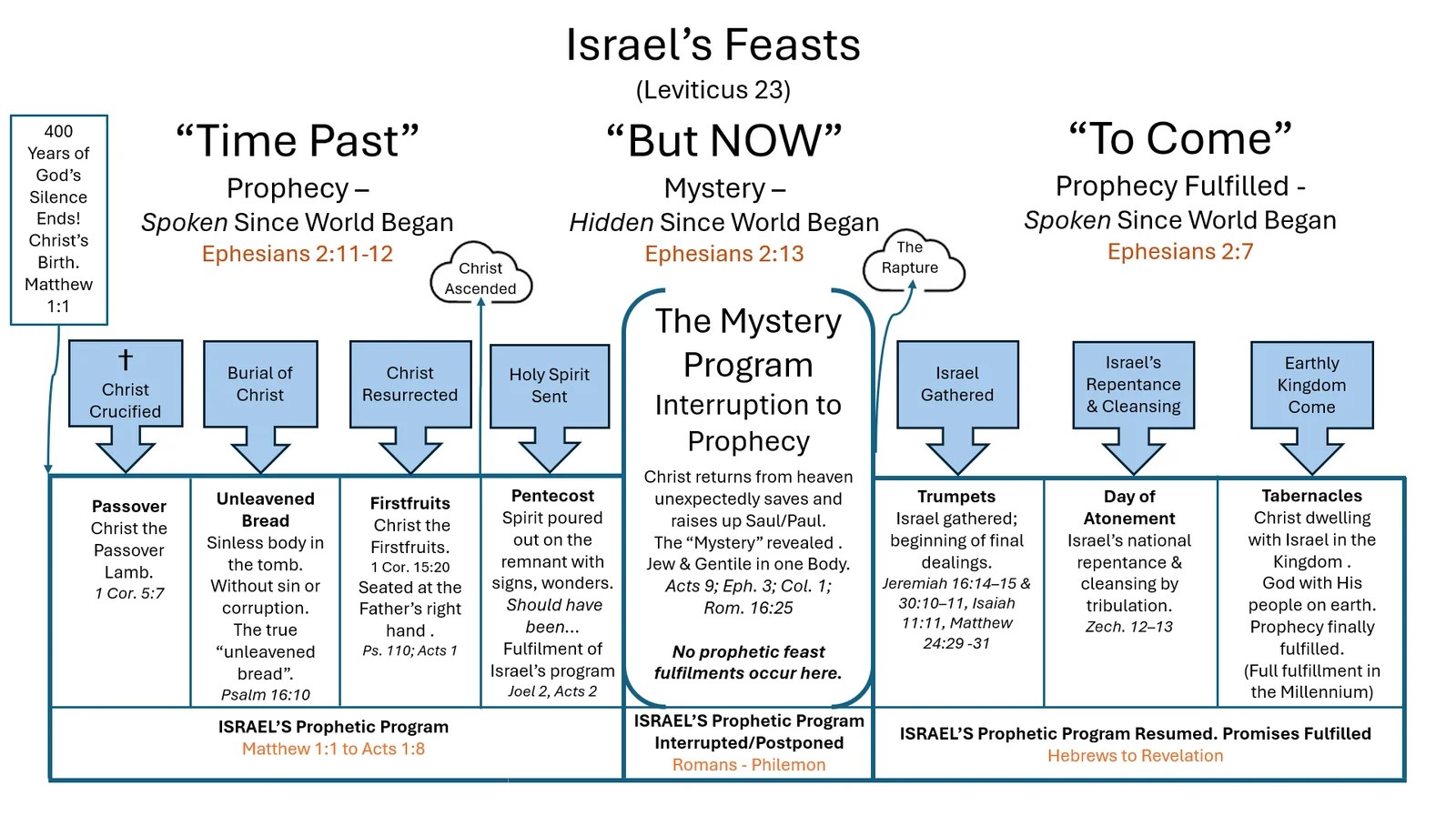
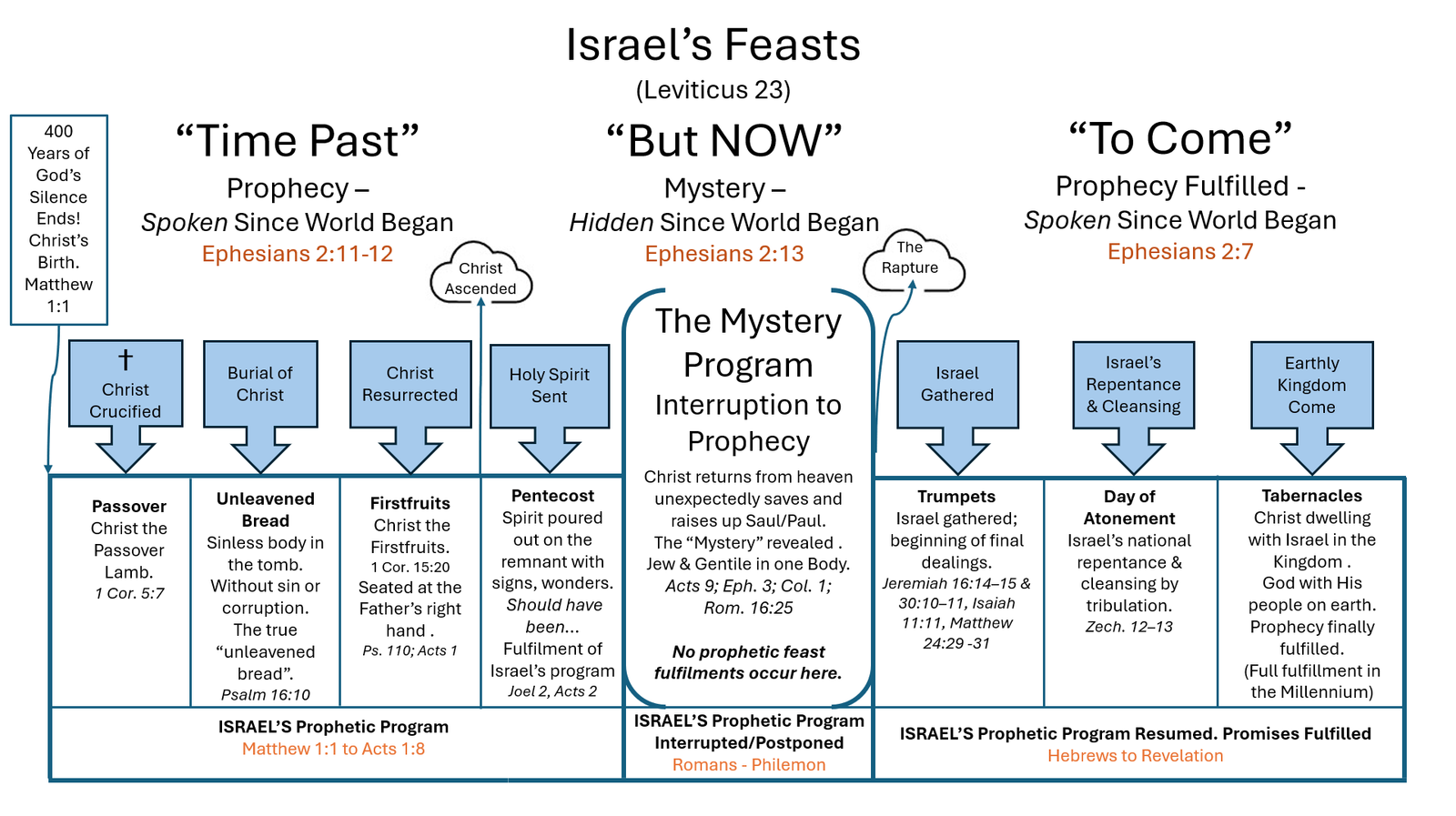
We’ve included a third timeline chart in this episode, and you’ll see it below this recording.

This third chart shows how Israel’s program follows the feast calendar from Leviticus 23, and we see that in the “Times Past” era, we have the feasts of:

PASSOVER (Lamb slain, fulfilled in Christ on the Cross)

UNLEAVENED BREAD  (Without sin, fulfilled in Christ’s sinless body, buried without seeing corruption)

FIRSTFRUITS (First sheaves of the harvest, fulfilled in Christ, the Firstfruits as explained in 1 Corinthians 15:20)

PENTECOST (Spirit poured out on the remnant  with signs and wonders, Joel 2, fulfilled in Acts 2)

Then we see that in the “Ages To Come” era, we have the feasts of:

TRUMPETS – Israel gathered; beginning of final dealings

DAY OF ATONEMENT  –  Israel’s national repentance & cleansing from Zechariah 12–13

TABERNACLES

  • Christ dwelling with Israel in the Kingdom
  • Full fulfilment in the Millennium
  • God with His people on earth

We notice there’s no feast covering the dispensation of grace

in that calendar. We, today, the Body of Christ, are not under those feast days. Colossians 2:17-17 says not to let anyone judge us in “meat, or drink, or… holyday… new moon… sabbath days,” which were shadows of things to come, but the body is of Christ.

For Israel, those feasts mapped out the days of their Messiah. When Acts 2:1 says, “when the day of Pentecost was fully come,” it means the shadow (the feast) and the substance (the real event) met.

Something big happened—the outpouring of the Holy Spirit, just like the Lord said in Acts 1, and like God promised in Ezekiel 36, that He would put His Spirit within them and cause them to walk in His ways.

This was for the believing remnant of Israel, to empower them and intensify the sign ministry confirming:

– the gospel of the kingdom, and

– that Jesus of Nazareth is Israel’s Messiah.

For about a year, in Acts 1–7, God was giving Israel a final chance to repent before the day of wrath, with signs, wonders, and miracles by the Holy Ghost as per the prophecies from Jeremiah 31, Zechariah 12:10, Hebrews 8 and 10, Ezekiel 37, Joel 2 and other places.

In Acts 2, the twelve Galileans speak in other tongues as the Spirit gives them utterance. Jews from many nations hear them and understand what’s being spoken of in their own languages, and they’re confused. Some mock and say they’re drunk. Then Peter, who has the keys of the kingdom, as per Matthew 16, stands up with the eleven and explains.

He says, “Ye men of Judaea, and all ye that dwell at Jerusalem…” he’s talking to Israel, not the Body of Christ. He denies they’re drunk and then gives the real explanation. Acts 2:16,

“But this is that which was spoken by the prophet Joel”.

That’s the key line.

We directly connect Joel 2 to Acts 2. Peter doesn’t say, “This is something new, never spoken before.” He says, “This is that” which the prophet Joel prophesied. That’s Israel’s program, not the beginning of the dispensation of grace.

My friends, the words here couldn’t be any plainer. Peter and the others are filled with the Holy Ghost, and God the Holy Spirit is speaking through Peter to tell us exactly what’s happening on that day of Pentecost.

Peter doesn’t say, “this is something never spoken since the world began,” or “this is the mystery of Christ,” or “this was hidden in God.” Those are Paul’s words, later explaining the dispensation of grace and the mystery given to him.

Here, Peter says:

“This is that which was spoken by the prophet Joel”.

He does not say, “this is like that,” but “this is that.” So if Joel spoke it, it’s not the mystery of Christ, not the Body of Christ, not the dispensation of grace that was kept secret since the world began. Just that one verse, before we even read Joel, tells us:

Pentecost is Israel’s program, not the birthday of the church, the Body of Christ.

Then, in Acts 2:17, Peter quotes Joel:

“And it shall come to pass in the last days, saith God…”

So this is not the start of something new; it’s the beginning of the end—the last days of Israel’s prophetic time schedule.

Remember: God gave Israel a time schedule in Daniel. Daniel sits like the hub of a wheel, and the other prophets (Isaiah to Malachi) are like the rim. Their “latter days,” “last days,” “many days” all plug back into Daniel’s time chart like spokes, joining the hub to the rim. Joel fits into that same schedule.

Those last days are the last seven years of Daniel’s time schedule. But the Lord told Peter, James, and John that He was extending that schedule, adding a short extension of mercy and forbearance at the front. So some things from the beginning of those last days get pulled forward to start right after the Lord goes back to heaven, but before the full seven years click in.

In Joel 2:28-29, which is the first and early days of the last days, Joel lays out what happens, which is early in the last days, including that extension of mercy:

And it shall come to pass afterward, that I will pour out my spirit upon all flesh; and your sons and your daughters shall prophesy, your old men shall dream dreams, your young men shall see visions:

And also upon the servants and upon the handmaids in those days will I pour out my spirit.

That’s what’s starting at Pentecost—the Spirit poured out on the remnant of Israel, with prophecy, visions, and dreams.

Then, in the later part (deeper into the last seven years):

Joel 2:30-32,

And I will shew wonders in the heavens and in the earth, blood, and fire, and pillars of smoke.

The sun shall be turned into darkness, and the moon into blood, before the great and the terrible day of the LORD come.

And it shall come to pass, that whosoever shall call on the name of the LORD shall be delivered: for in mount Zion and in Jerusalem shall be deliverance, as the LORD hath said, and in the remnant whom the LORD shall call.   

Those are the intensified signs in the latter half—the last three and a half years of the tribulation—leading right up to the second coming of Christ, the “great and notable day of the Lord,” that Acts 2:20 states and that Jesus spoke of in Matthew 24.

So, the early last days are where the Spirit is poured out, resulting in prophesying, visions, and dreams.

Then in the later last days we have blood, fire, smoke, sun darkened, and the moon turned to blood.

All of it together is under the heading of the “last days” (plural).

Some people say that because all those things didn’t happen on the day of Pentecost, Peter couldn’t mean that Joel is being fulfilled. But the text says “last days”—plural. Joel never said all of it would happen on one day. He gave an outline of what would happen across those last days, in order and growing more intense.

Peter’s point is simple and powerful:

On Pentecost, it has begun.

Peter says, “This is that”. The “That” is what Joel spoke about—Israel’s last days starting, not the mystery Body of Christ, not our dispensation of grace.

What they were seeing on the day of Pentecost was exactly what Joel said would happen in Israel’s last days.

God was pouring out His Spirit on the sons and daughters of the people who lived in Joel’s time—their descendants now living in Peter’s day. They would prophesy, the young men would see visions, the old men would dream dreams, and God’s servants and handmaids in Israel would speak by the Spirit.

These things were beginning right there, at Pentecost, and they’d intensify through that short extension of mercy and forbearance, and then continue into the first part of Daniel’s final seven years.

After that would come the judgment signs, and then the terrifying cosmic signs right before the Lord returns to set up His kingdom. Joel 2 lays out Israel’s last days sign‑by‑sign, and Peter says plainly, “This is that.”

God knew exactly what He was doing at Pentecost. Sadly, many Christians today don’t, and they say things about Pentecost that God never said. They even try to follow Pentecost as if it were our program.

Look again at Acts 2:21,

…whosoever shall call on the name of the Lord shall be saved.

To see who that “whosoever” is, go back to Joel 2:32. It says,

And it shall come to pass, that whosoever shall call on the name of the LORD shall be delivered: for in mount Zion and in Jerusalem shall be deliverance, as the LORD hath said, and in the remnant whom the LORD shall call.

That’s the kingdom church, the remnant Jesus spoke of in Matthew 16, the group Peter, James, and John were gathering.

Now come back to Acts 2:37-40.

After Peter quotes Joel and accuses Israel of rejecting their Messiah, the people are “pricked in their heart” and ask, “What shall we do?” Peter answers with Israel’s gospel: “Repent, and be baptized… for the remission of sins, and ye shall receive the gift of the Holy Ghost.”

That’s the same message John the Baptist preached. It’s the same program, the same kingdom gospel. And Peter says the promise is “to you and your children, and to all that are afar off”, the scattered Israelites, just like Daniel and Joel said. God is calling out a remnant, just like Joel 2:32.

Peter then warns them: “Save yourselves from this untoward generation.”

That salvation is not the salvation Paul later preaches. It’s deliverance from the coming wrath on that generation of Israel. God promised deliverance in Jerusalem and Zion, and He’s offering it now through the twelve.

Notice something important: Peter never tells them to trust in Christ’s finished work for salvation. That’s not the message here. This is Israel’s program, not the Body of Christ. Pentecost is the next “fully come” feast on Israel’s calendar in Leviticus 23, not the beginning of the dispensation of grace.

Acts 2:41–47 shows the remnant living exactly as God said they would when He put His Spirit within them—having all things common, and selling possessions, just like Jesus told them in Luke 12. They were preparing for the tribulation that was soon coming at that time.

In Acts 3:6, Peter and John heal the lame man. Peter says, “Silver and gold have I none”. They’d been obedient and sold all. But they had the kingdom signs: healing and power. Again, this is Israel’s program moving forward.

Peter then accuses Israel again of killing the Prince of Life. He doesn’t preach that as good news. He says they did it in ignorance, just like Jesus prayed in Luke 23:34, and just like God had blinded them so the cross would happen.

They didn’t know what they were doing. It’s one of the reasons why God told them from Matthew 16:20 not to tell any man He is the Christ.

All of this shows the same truth:

Acts 2–3 is Israel’s prophetic program continuing, not the Body of Christ beginning.

God knew exactly what He was doing when Israel crucified Christ in ignorance. That ignorance allowed God to extend this short season of mercy and forbearance before the day of His wrath. The issue now is simple: will Israel believe what God says, or cling to what their teachers told them?

Peter says in Acts 3:17 that Israel and their rulers killed Christ “through ignorance.” But in verse 18, he explains that the prophets had already spoken of Christ’s sufferings, and those things were now fulfilled. Not everything the prophets said—just the suffering part. Now the next “fully come” events on Israel’s prophetic calendar were beginning, starting with Pentecost.

Because more prophetic events were coming, Peter urges Israel in verse 19 (Acts 3:19):

“Repent… and be converted, that your sins may be blotted out when the times of refreshing shall come from the presence of the Lord.”

On the chart, the “times of refreshing” is the kingdom, when Christ returns and restores all things. If their sins aren’t blotted out when that comes, they won’t enter it.

Peter says heaven must receive Christ until the “times of restitution of all things,” which God spoke by all His prophets since the world began, as Acts 3:21 states. The Holy Spirit uses that wording on purpose, because later He’ll have Paul speak of the mystery as something kept secret since the world began. What was “spoken since the world began” cannot be the same as what was “kept secret since the world began.” Two different programs.

Peter’s preaching the same program God gave to Abraham, Isaac, Jacob, Moses, David, Samuel, Isaiah, John the Baptist, and the Lord Himself. They all looked for the kingdom—the restitution of all things, restoring the creation to what it was before Adam sinned.

Peter quotes Deuteronomy 18, where God would raise up a Prophet like Moses, and every soul that would not hear Him would be destroyed. That’s the wrath coming on Israel’s unbelieving generation. Peter is gathering the remnant church Jesus spoke of in Matthew 16, not the Body of Christ. If they refuse, they will be cut off when the kingdom arrives.

Acts 3:24 says,

Yea, and all the prophets from Samuel and those that follow after, as many as have spoken, have likewise foretold of these days.

That alone proves this is not the dispensation of grace, the church, the body of Christ today. Samuel and the prophets knew nothing of the mystery. They ministered to Israel, not the Gentiles. Peter says plainly that the people he’s speaking to are the children of the prophets and of the covenant God made with Abraham. That’s Israel—not us.

Then Acts 3:26 sums it up:

Unto you first God, having raised up his Son Jesus, sent him to bless you, in turning away every one of you from his iniquities. That’s the extension of mercy before wrath falls.

This whole section—Acts 1 through to Acts 7—is Israel’s prophetic program moving forward exactly as God said. It only gets misunderstood when Christians won’t let God tell them what He’s doing but persist in repeating what they’re taught by pastors, seminaries, religious systems and social media. The same blindness that crippled Israel’s leaders—the scribes, the Pharisees, and doctors of the law—now works against the Body of Christ through a satanic policy of evil.

Finally, in Acts 5:30, Peter again accuses Israel:

Whom You slew and hanged Him on a tree. 

Peter says the Lord’s waiting in heaven because something’s happening down here. Acts 5:31 tells us plainly what it is:

Him hath God exalted with his right hand to be a Prince and a Saviour, for to give repentance to Israel, and forgiveness of sins.

There it is—five words that summarise Acts 1–7:

“To give repentance to Israel.” 

That’s the whole purpose of this extension of mercy and forbearance before the day of wrath. God’s giving His nation a chance to repent, to change their mind, about Jesus of Nazareth before He rises from the Father’s right hand and judges them.

All of this is prophecy, not mystery. All of its Israel’s program, not ours.

From Acts 1 to Acts 7, God gives Israel’s rulers three opportunities to repent. Each one is tied to their response to the Spirit‑filled ministry of Peter, James, and John. The last and final opportunity comes through Stephen in Acts 7.

In Acts 6:8-15, Stephen is full of faith and power, doing wonders and miracles. The religious leaders can’t resist the wisdom and Spirit he speaks with—just like Jesus said in Matthew 10. So they bring in false witnesses, accusing him of speaking against Moses and the law. But notice: the only people saying the law was no longer in effect were liars. Peter, James, John, and Stephen never said that. The law was still in force because Israel’s program was still operating. It’s only in the dispensation of grace that God says, “You’re not under the law, but under grace.”

We can’t drag Acts 1–7 into today without disobeying God.

Stephen is God’s divine messenger to Israel’s rulers. God even changes Stephen’s face so it shines “as the face of an angel” in Acts 6:15, so the Sanhedrin knows exactly who stands before them. This is their third and final chance. The Sanhedrin was the supreme Jewish legislative council and the highest court of justice in ancient Israel.

In Acts 7, Stephen doesn’t defend himself—he defends God’s dealings with Israel. He walks them through their whole history, showing how their fathers always resisted the Holy Ghost. He shows that rejecting the Messiah was the high point of their rebellion, and that the nation now stood on the very edge of falling into the Lord’s hands in the day of His wrath.

Then he brings it to a head in Acts 7:51:

Ye stiffnecked and uncircumcised in heart and ears… ye do always resist the Holy Ghost; as your fathers did, so do ye. 

He accuses them of persecuting the prophets and betraying and murdering the Just One. They received the law by angels but did not keep it.

This is the moment of decision. A divine messenger stands before them, shining like an angel, filled with the Holy Ghost, giving them their last chance to repent. Do they change their mind?

Acts 7:54 tells us:

They were cut to the heart, and gnashed on him with their teeth.

No repentance. No change of mind. They respond with rage, and in that fury they,

ran upon him with one accord, And cast him out of the city, and stoned him:

This rejection closes the extension of mercy and forbearance. Israel’s rulers have now rejected all three Spirit‑given opportunities: Peter and the twelve, the apostles again in Acts 3–5, then Stephen before the Sanhedrin.

The nation stands guilty, and the prophetic program is ready to move to the next step—judgment—until God interrupts everything in Acts 9 by raising up Paul with the revelation of the mystery.

Everything in Acts 1–7 is Israel’s prophetic program, not the Body of Christ. The Bible makes it plain if we’d just let the words say what they say.

After Stephen’s message exposes Israel’s long history of resisting the Holy Ghost, something remarkable happens. Verse 55 says Stephen, full of the Holy Ghost, looked up into heaven and saw the glory of God, and Jesus standing at the right hand of God. He says, “Behold, I see the heavens opened, and the Son of Man standing on the right hand of God.”

Why is that important?

If we go back to Acts 2, when Peter explained Pentecost, he said Jesus had ascended to the Father’s right hand to sit there “till I make thy foes thy footstool” as prophesied in Psalm 110:1.

That “sitting” marks the beginning of the extension of mercy and forbearance. Christ sits while Israel is given a chance to repent.

Peter also said in Acts 2:17 that visions would be given to Israel’s young men in these last days. Stephen is a young man, and he receives one of those visions. And what does he see? Not Christ sitting, but standing.

That means the time has come for the Father to say, “The extension is over. Rise and make Your enemies Your footstool.”

This is Israel’s third and final chance to repent.

But, there’s no repentance. No change of mind. The rulers reject God’s final offer.

Do you see what’s been happening?

God’s kept giving and giving and giving every possible opportunity for Israel to repent, accept their Messiah and get ready for the setting up of the kingdom. Stephen’s vision shows the end of the mercy period and the readiness for the day of the Lord’s wrath.

The prophets spoke of this. In Isaiah 2–3, the Lord rises to shake the earth terribly. Isaiah says men will hide in the rocks and quote, “for fear of the Lord, and for the glory of His majesty, when He ariseth to shake the earth.”

That’s the same standing Stephen sees. The prophetic program is moving exactly as foretold.

This closes the extension of mercy and forbearance. Israel’s prophetic program is now ready for judgment—until God interrupts everything in Acts 9 by raising up Paul with the revelation of the mystery, the dispensation of grace.

Acts 1–7 is Israel’s program, not ours, and the Bible makes it plain.

We can’t understand the gospel accounts or Acts 1–7 unless we understand Isaiah, Joel, Daniel, and the rest of the prophets. Every word Jesus spoke, and every act of the twelve, relates back to what the prophets said. Understanding that makes the whole picture clear.

Acts 7 is the backdrop, if you like, to the dispensation of grace. Israel’s ready for wrath. Pentecost shows Christ sitting. Stephen shows Him standing. Israel rejects their final chance. If God had no mystery to reveal, Israel’s program would have continued, the day of the Lord’s wrath would have begun, and the kingdom would already be here.

But God had something kept secret since the world began—a mystery He planned before Israel ever rejected Him. So instead of wrath falling in Acts 8, something totally unexpected happens.

Acts 9 happens!

Saul of Tarsus—Israel’s chief enemy—is on the road to Damascus, breathing out slaughter. Suddenly, a light from heaven shines, and he hears a voice:

“Saul, Saul, why persecutest thou me?” 

He asks, “Who art thou, Lord?”

The answer: “I am Jesus.”

Right there, the risen Christ does something never prophesied. He comes back from heaven, not to judge, as prophecy spoke of for millennia, but to save His worst enemy and make him a brand‑new apostle. Through Paul, God reveals the mystery of Christ, the dispensation of grace offered to the Gentiles. It’s something that’s been hidden since the world began.

From Acts 9 through to Philemon, we’re in the dispensation of grace. That’s where our doctrine, our promises, and our instructions for the body of Christ today are found, and we’re still living in that dispensation today.

So we can see clearly that the dispensation of grace did not begin at Pentecost.  We can see that Acts 1–7 is Israel’s prophetic program, moving exactly as the prophets said.

We can see Christ sitting during the mercy extension, then standing when Israel rejected Stephen.

But, instead of the wrath that was maybe minutes away from coming to fulfil prophecy, God interrupted everything with the mystery revealed to Paul.

In the next episode, we’ll look more closely at the dispensation of grace itself. It’ll still be basic, but on top of the foundation that’s been laid, so we can appreciate why it’s completely different from Israel’s program.

Until then my God bless you in the knowledge of Him.

Understanding The Bible – Episode 9

Well, here we are in Episode Nine of our Understanding the Bible series.
As we said in the last episode, we’re now going to look at what happened in that crucial time period between Acts Chapter 1 and Acts Chapter 9.
Many Christians say Peter and the others “ran ahead of God” when they replaced Judas with Matthias in Acts chapter 1. But that idea only comes from not reading the text. Acts 1 shows they followed Scripture exactly. And Paul himself never says he was supposed to replace Judas. In fact, Paul makes it clear in Galatians 2 that his apostleship is distinct from Peter’s. Paul is not the 13th apostle to Israel. He’s the apostle of the Gentiles, with the gospel of the uncircumcision, not the gospel of the circumcision.

“Speed Slider”
Episode 9 ChartPress Image To Enlarge

Prophecy To Grace - 9

Press Image to Enlarge

Understanding The Bible – Episode 9 – Transcript

Well, here we are in Episode Nine of our Understanding the Bible series.

As we said in the last episode, we’re now going to look at what happened in that crucial time period between Acts Chapter 1 and Acts Chapter 9.

This is a good point to take stock and define exactly why we’re undertaking this series. It’s called Understanding the Bible, and as we said in the first episode, it’s not for the person who hasn’t yet come to the realisation that the 66 books that go to make up our Bible are the infallible word of God. Nor is it about the stories of the Bible. It’s about a secret key to understanding the Bible that’s hidden in plain view! We find that key in 2 Timothy 2:15-16, which reads,

Study to shew thyself approved unto God, a workman that needeth not to be ashamed, rightly dividing the word of truth.

But shun profane and vain babblings: for they will increase unto more ungodliness.

Failure to see that God works with mankind in different ways through different ages, as Hebrews 1:1-2 states, is the number one reason people get confused about the Bible and fail to get the message that God’s plainly written for all men to see.

God Himself, His Character and Who He is never changes, He’s the same yesterday, today and forever, but the way in which He has and will deal with man through the ages most definitely has and will change.

God Himself, His Character and Who He is never changes, He’s the same yesterday, today and forever, but the way in which He has and will deal with man through the ages most definitely has and will change.

In our two timeline charts below, we’ve added an orange marker to show this very small but highly important place these verses occupy, the little space in the line between the Cross and the dispensation of grace NOT begun yet until in Acts chapter 9. That whole section up until that line is still Israel’s program and still time past on our timeline.

These opening chapters of Acts are critical to our understanding of the Bible. Many Christians think our program today started here, and that one of the main events taking place in these passages, the feast of Pentecost, is “the birthday of the church.” But that’s not what the Bible says.

The dispensation of grace did not begin in the gospel accounts, and it did not begin at Pentecost, and with that statement, I will lose many listeners who have stayed with the series so far.

God did not reveal this new dispensation until He raised up Paul as a brand‑new and different apostle in Acts chapter 9. Paul was not one of the twelve. He was not chosen during Christ’s earthly ministry. His apostleship is separate, unique, and tied to the revelation of the mystery of Ephesians 3.

Many Christians say Peter and the others “ran ahead of God” when they replaced Judas with Matthias in Acts chapter 1. But that idea only comes from not reading the text. Acts 1 shows they followed Scripture exactly. And Paul himself never says he was supposed to replace Judas. In fact, Paul makes it clear in Galatians 2 that his apostleship is distinct from Peter’s. Paul is not the 13th apostle to Israel. He’s the apostle of the Gentiles, with the gospel of the uncircumcision, not the gospel of the circumcision.

So, at this point on our timeline charts, everything from Matthew to John, to Acts 1–9, is still in Israel’s prophetic program. There’s nothing about the mystery, nothing about the body of Christ and nothing about our dispensation as yet. Israel’s being offered her kingdom. The Lord has gone back to heaven by this point, and Israel is entering her last days, as shown in Acts 2. That’s why these chapters matter so much.

But Christians often mix these different time periods together, thinking that the gospel accounts and Pentecost are the start of the church today. They claim the promises, the signs, the commands, and the kingdom instructions, and try to make them fit our dispensation. That confusion keeps people from seeing what God is actually doing today. Satan delights in that.

Acts 1–9 is not the beginning of the church, the body of Christ. It’s the continuation of Israel’s program, moving toward the kingdom, until God interrupts it by saving Saul and revealing the mystery.

In the next episode, we’ll look more closely at Paul’s unique apostleship and why it proves that the dispensation of grace did not begin until Acts 9.

If we’re honest with the Scripture, we’ll clearly see that Pentecost is not when the Body of Christ, the Church and the dispensation of grace began, and Paul’s epistles open our eyes to that. People seldom study details, so they see this big event of Acts 2 and assume it must be the start of our program. But if we let the text tell us what’s going on, it’s clear: Israel’s program is still running in Acts 1–9.

In our last episode, we looked at the gospel accounts—Matthew, Mark, Luke, John—and we’d need to be willingly blind to miss the fact that the kingdom program’s in effect.

The Lord’s rejection, His death, His resurrection, and His return to the Father did not end Israel’s program. All of that was expected and prophesied. Jesus told Peter, James, and John in Mark 10:34 that the Christ must suffer before entering His glory. The cross was a necessary step toward the kingdom, not the beginning of something new.

In Matthew 24, the Lord prepared them for what they would be doing after He left, all according to the prophetic time schedule in Daniel chapters 11–12. He said nothing about the mystery, nothing about Jew and Gentile being made one, nothing about forming the church, the body of Christ or the dispensation of grace to the Gentiles. He did not teach them what Paul later teaches in Romans 11 about Israel falling, God turning to the Gentiles, and Israel’s fullness being delayed until the fullness of the Gentiles comes in. He kept the mystery hidden.

So when Christ ascends, Peter, James, John, and the rest continue right on in Israel’s kingdom program. And that’s exactly what we see in the opening chapters of Acts. The great dispensational change does not happen in Matthew 1, Acts 1, Acts 2, or anywhere before Acts 9, when God raises up Paul as this brand‑new apostle with a brand‑new message.

Failing to see this is a dangerous mistake, and it causes endless confusion in the church.

Now, let’s look at Acts 1:1–3, where Luke, the writer of Acts, continues the story from his gospel. He says,

The former treatise have I made, O Theophilus, of all that Jesus began both to do and teach, 

Until the day in which he was taken up, after that he through the Holy Ghost had given commandments unto the apostles whom he had chosen: 

To whom also he shewed himself alive after his passion by many infallible proofs, being seen of them forty days, and speaking of the things pertaining to the kingdom of God: 

Notice, it was what Jesus “began”. This was the climactic stage of Israel’s program—confirming the promises made to the fathers as Romans 15:8 depicts. And He handed the finishing of that work to the twelve apostles and keep in mind, Paul’s nowhere in the story yet.

Turn to Matthew 16 and Hebrews 2. In Matthew 16, about two years into His ministry, Jesus begins to show the apostles that He must go to Jerusalem, suffer, be rejected, and rise again. Before that, He never told them about the cross. They didn’t understand it, didn’t preach it, and didn’t include it in their gospel. They preached the gospel of the kingdom, not the gospel of the grace of God. Luke 18 says God even hid the meaning of the cross from them.

So how could they be preaching the same gospel Paul later preached? They couldn’t. It’s impossible. Two different messages for two different programs.

So, in Matthew 16, the Lord also prepares them to carry on the kingdom program after His departure. The cross would not stop Israel’s program. Jesus going back to the Father would not start the body of Christ. All of that fits the prophets.

So, as we’ve said so often, and we’ll keep saying, when we step onto our timeline charts below, everything from Matthew → John → Acts 1–9 is still Israel’s prophetic program, still time past, still moving toward the kingdom—until God interrupts it by saving Saul in Acts 9 and revealing the mystery.

In Matthew 16:13, Jesus asks,

…Whom say ye that I am?

Peter answers in Matthew 16:16,

 Thou art the Christ, the Son of the living God.

In Matthew 16:17, Jesus says this was revealed by the Father, not by flesh and blood. Then He says,

Thou art Peter, and upon this rock I will build my church.

The “rock” is the revelation Peter just confessed—not Peter himself.

Most people today hear the word church and think only of the body of Christ, but the Bible uses the word many times for Israel’s assemblies. There was a church long before Paul. Psalm 22 speaks of it. Isaiah 65 speaks of it. It is the remnant, the little flock of Ezekiel 34, the believing group inside Israel who would receive the kingdom. That’s a prophesied church, not the mystery church, the Body of Christ, revealed to Paul.

Stephen, in Acts 7, even talks about “the church in the wilderness” under Moses. Hosea 2 says God would call Israel again into the wilderness. Jesus in Matthew 24 tells the remnant to flee into the wilderness when the abomination of desolation appears. All of that is Israel’s prophetic church—not the body of Christ.

So when Jesus says, “I will build my church,” He’s talking about that remnant church, believing Israel, who’ll inherit the kingdom. This is the group Peter, James, and John will lead once Christ returns to the Father. That’s why Jesus gives Peter the keys of the kingdom of heaven in Matthew 16:19. The message has not changed, and the program has not changed. Peter will use those keys in the opening chapters of Acts, and he expected to use them all the way through Israel’s last days, because nothing about a Gentile dispensation had been revealed yet.

Then comes the surprising command in Matthew 16:20,

Then charged he his disciples that they should tell no man that he was Jesus the Christ. 

That sounds strange to us today, because in our dispensation, we’re told to preach Christ openly. But back then, during the Lord’s earthly ministry, the remnant church was not to be built until after He left. So for that last stretch of time, the twelve were ordered not to announce Him as the Christ. If they had preached it anyway, they would have been disobeying Him. That alone shows the message back then is not our message today.

Everything Jesus “began to do and teach” as we saw in Acts 1:1, belonged to Israel’s kingdom program. Luke understood that. Anyone studying the Bible God’s way—not hopping around into random verses all over the place—would see that before reaching Acts 1.

The Lord prepared the twelve to carry on the kingdom message in His absence. He gave them authority to bind and loose. He gave Peter the keys. He prepared them for the last days of Israel’s prophetic timeline.

None of this is the dispensation of grace.

By the time we reach Acts 1, Luke expects that we’ve already read Matthew, Mark, Luke, and John. We’ve already seen the Lord prepare Peter, James, and John to carry on Israel’s program after He returns to the Father. Acts simply records the history of the continuation of that same program and the apostles doing exactly what Jesus trained them to do.

Now look at Hebrews, because that book shows how God resumes Israel’s program after the interruption of the dispensation of grace. Hebrews sits after Paul’s epistles on purpose. God designed it to be exactly where it is. It belongs to the last division of the Bible, dealing with Israel’s resumption and fulfilment of their prophetic program. Revelation then shows the Day of the Lord’s wrath, the kingdom, and the new heavens and new earth—none of which describe us in this dispensation.

Hebrews is a reorientation of the Hebrew people as to where their program stood before God interrupted it with the mystery. It reminds them what the Lord taught when He was here, and what the apostles confirmed. That’s why Hebrews begins simply with “God…”, no human author named. When God resumes Israel’s program, He speaks to them again, just like the silence of Amos 8 was broken by John the Baptist.

Hebrews 1 points them back to time past, to the prophets, the covenants, the Messiah seated at the Father’s right hand, ready to bring the kingdom. None of this describes the mystery of Christ. It describes the situation in Acts 1, right before the program was interrupted.

Now open Hebrews 2:3–5, and this is a key. We’ll paraphrase those verses here.

How shall we escape if we neglect so great salvation, which at the first began to be spoken by the Lord… 

That salvation is the kingdom salvation promised to Israel—the same salvation Luke 1 speaks of: deliverance from their enemies and entrance into the kingdom.

It quote “began to be spoken by the Lord” in His earthly ministry. Then it was confirmed by “them that heard Him”—that’s the twelve apostles. Their ministry in Acts 1–7 is a confirming ministry, not a new dispensation. God bore them witness with signs, wonders, miracles, and gifts of the Holy Ghost—the very things we see at Pentecost. Those signs validated the gospel of the kingdom, not the gospel of the grace of God.

Verse 5, Hebrews 2:5, says this message concerns “the world to come.” That’s the kingdom age—the same “world to come” Paul mentions in Ephesians 1, which arrives after this dispensation ends.

Hebrews quotes Psalm 8 about the Son of Man having all things put under His feet. But then Hebrews 2:5 says, “We see not yet all things put under him.” Why? Because the dispensation of grace interrupted Israel’s program.

So, Hebrews helps us understand the ministry of the twelve and what’s happening in the opening chapters of Acts.

Matthew, Mark, Luke, and John prepare us for Acts. Hebrews confirms what Acts is doing. And all of it shows the same truth on our chart, that Israel’s program continues from the gospels into Acts 1–8, until God interrupts it in Acts 9 by raising up Paul and revealing the mystery.

When this dispensation of grace ends, God’ll turn Israel’s program back on, and the Hebrew people will look again at the gospel accounts and the opening chapters of Acts. That’s why we must understand Acts 1 as the continuation of Israel’s program, not the start of ours.

Come back to Acts 1. Acts 1:2 says Jesus continued what He began to do and teach until the day He was taken up, after giving commandments through the Holy Ghost to the apostles He had chosen. Those commandments included replacing Judas. Peter wasn’t running ahead of God. He was obeying what the Lord had taught them during the forty days after the resurrection. The Holy Spirit had already been given to them in a special way so they could understand the Scriptures—things that were hidden from them earlier. Peter understood Psalm 69 and the other passages perfectly. Anyone saying Peter made a mistake simply doesn’t believe the text.

Acts 1:3 says Jesus spent forty days speaking to the apostles of the kingdom of God. He didn’t change the program. He didn’t tell them the kingdom was postponed or that a new heavenly body was about to begin. He didn’t reveal anything that Paul later teaches. He kept speaking the same kingdom truths that He always spoke.

In Acts 1:4, He commands them to stay in Jerusalem and wait for “the promise of the Father.” This fits the order He already gave them—Jerusalem, Judea, Samaria, then the rest of Israel. He’d told them in Matthew 10 that they’d not finish going through the cities of Israel before the Son of Man returned. They knew their order. They knew their territory. They knew the kingdom program was still moving forward.

Then, in Acts 1:5, Jesus reminds them of what they already heard:

“John truly baptised with water, but ye shall be baptised with the Holy Ghost not many days hence.” 

They had heard this from Jesus, and even earlier from John the Baptist in Matthew 3:11–12. John said the Messiah would baptise Israel with the Holy Ghost and with fire, gather the wheat, and burn the chaff. John outlined the whole prophetic program. He knew nothing of the dispensation of grace.

Acts 1 shows that the same program is still in effect. The coming of the Holy Ghost was not a mystery event. It was prophesied. To see that, go to Ezekiel 36. God lays out Israel’s cleansing process, and we see:

  1. Clean water — John’s baptism, Ezekiel 36:25
  2. A new heart and new spirit — Christ’s atoning work, Ezekiel 36:26
  3. The Spirit within them — the Pentecost outpouring, Ezekiel 36:27
  4. Entrance into the land and kingdom, Ezekiel 36:28

That’s the exact order. Pentecost is step three in Israel’s prophetic cleansing—not the beginning of the body of Christ.

Everything in Acts 1–9 fits the timeline chart of Israel’s program continuing from the gospels. Nothing here belongs to the mystery. Nothing here belongs to the church, the body of Christ. All of it is prophecy being fulfilled, right up until God interrupts it in Acts 9 by raising up Paul.

When the dispensation of grace ends, God will turn Israel’s program back on, and the Hebrew people will look again at the gospel accounts and the opening chapters of Acts. That’s why Acts 1 is so important—it shows Israel’s program continuing, not changing.

Back in Acts 1, the first verses already tell us the program’s still Israel’s. Jesus continued what He began to do and teach until He was taken up, after giving commandments through the Holy Ghost to the apostles. One of those commandments was to replace Judas, and we can see this when we read Acts 1:12-26, closely paying attention to the details.

Peter wasn’t acting in the flesh. He was obeying what the Lord taught them during the forty days after the resurrection. The Spirit had already opened their understanding so they could grasp the Scriptures—things hidden from them earlier, as in Luke 18. Peter understood Psalm 69 better than any theologian today.

Acts 1:3 says Jesus spent forty days speaking of the kingdom of God. He didn’t change the message. He didn’t tell them the kingdom was cancelled or postponed. He didn’t reveal anything about the body of Christ. He kept teaching the same kingdom program that He taught in the gospels.

In Acts 1:4, He commands them to stay in Jerusalem and wait for “the promise of the Father.” This fits the order He already gave them—Jerusalem, Judea, Samaria, then the rest of Israel. In Matthew 10, He told them they would not finish going through the cities of Israel before the Son of Man returned. They knew their territory. They knew the kingdom program was still moving forward.

Now look at Acts 1:6. The apostles ask,

Lord, wilt thou at this time restore again the kingdom to Israel?

People mock them for this, but they understood the program perfectly. The only thing they didn’t know was the timing, so they asked.

Jesus doesn’t correct their doctrine. He doesn’t say, “No more kingdom.” He simply says in Acts 1:7 that the timing is in the Father’s hands. The kingdom itself is still the program.

In Acts 1:9–12, Jesus ascends from the Mount of Olives, and two angels tell the apostles He’ll return in the same manner. That points straight back to Zechariah 14, where the Lord returns at the end of the tribulation, His feet standing again on the Mount of Olives and with the mountain splitting to protect the remnant. That prophecy has never been fulfilled. The Roman, Titus, didn’t fulfil it when he and his legion destroyed Jerusalem in 70 AD. It’ll happen after this dispensation ends.

Those angels are not announcing a rapture here. They’re confirming the prophetic second coming, the kingdom return. The rapture is part of the mystery revealed only to Paul that Paul speaks of in 1 Corinthians 15, 1 Thessalonians 4–5 and 2 Thessalonians 2.

Peter, James, and John knew nothing about it. They expected to go through Israel’s last days, just as the prophets said.

Now look at Acts 2, which we’ll look at more next time. The day of Pentecost arrives. It’s one of Israel’s feast days that we saw in previous episodes. Acts 2:1 says,

When the day of Pentecost was fully come

That means Israel’s prophetic calendar was moving forward exactly as God laid it out. The feasts in the Law were shadows of things to come or prophetic pictures of the days of the Messiah. Passover pictured His death. Unleavened Bread pictured His burial. Firstfruits pictured His resurrection. Pentecost pictured the Spirit poured out on the remnant, just as the prophets said.

Acts 2:1–4 shows the Spirit coming with wind and fire, and the apostles speaking in other tongues. This is not the start of the body of Christ. This is the third step in Israel’s cleansing program. Remember the steps?

  1. Water — John’s baptism
  2. Blood — Christ’s atoning work applied to the remnant
  3. Spirit — Pentecost
  4. Kingdom — preservation through the tribulation into the land

You can see this whole order perfectly prophesied in Ezekiel 36:25–28. Pentecost fits perfectly. Nothing here is mystery truth. Nothing here belongs to the church, the body of Christ. Everything is prophecy.

That’s why in Acts 2:44-45 they had all things in common, sold their possessions and goods and distributed to every person according to their need and walked in perfect unity. God’s causing them to walk in His statutes. This is how they’ll survive the tribulation to come. That’s definitely not how God deals with us today in the dispensation of grace.

When you follow the timeline chart, Acts 1–7 flow straight on from Matthew, Mark, Luke, and John. There’s no hint of a new program. The shock comes in Acts 9, when Christ suddenly returns from heaven and raises up Paul. That’s the true dispensational change.

In the prophecy-filling days of the Messiah, Israel’s feast days weren’t just shadows—they were fulfilment of prophecy.

When Christ died, the Passover feast had fully come. In Acts 2, when Pentecost was “fully come,” the event it pictured in Israel’s program had arrived, perfectly fulfilling God’s calendar from Leviticus 23.

God expects us to read His book from the beginning, not just jump into the middle somewhere randomly. You wouldn’t open any other book halfway through and expect to know the characters it writes about. It’s the same when we get to Acts 2. Before we ever reach Pentecost, God expects that we’ve read Genesis through to Acts 1, and that we already understand Israel’s program, the feast calendar, and how those shadows become fulfilled in the days of the Messiah. Now, if we haven’t done that, how is it possible to know God’s program? However, that doesn’t stop the multitude of teachers and preachers from passing on what they don’t fully know and understand and the millions who suck it in.

So, Acts 2:1 shows that the day of Pentecost was another prophetic event on Israel’s calendar taking place, not the start of the body of Christ. Peter will explain this in Acts 2:16 and following. Peter never says that Pentecost is the birthday of the church, the body of Christ.

In the next episode, we’ll see :

– the day of Pentecost in detail

– the opening seven chapters of Acts

– why God brought in the dispensation of grace

– Paul’s unique apostleship

– who you are in the body of Christ

– and the satanic policy of evil designed to keep Christians “biblical but not dispensational.”

How about reading Acts 2:1-21, slowly and methodically, in preparation for the next episode.

Until then, may God bless you in the knowledge of Him.

Understanding The Bible – Episode 8

We’re now in episode eight of our Understanding the Bible series, and we’re picking up where we left off in the last episode.
We’re dealing with the second big issue that proves the gospel accounts and the early chapters of Acts belong to God’s program with Israel and not the dispensation of grace that we live in today.
When we’re in Matthew, Mark, Luke, John, and early Acts, we’re in the time past section of our charts, not in the mystery program Christ revealed to us through Paul.

“Speed Slider”
Episode 5 ChartPress Image To Enlarge

From Prophecy to GracePress Image to Enlarge

Understanding The Bible – Episode 8 – Transcript

As a reminder of where we are on the timeline charts that we’ve included again below the audio.

We’ve been looking at the gospel of the Gospels, the message preached when Israel’s prophetic clock had reached its climactic stage, and we’ve only scratched the surface, but enough to show us what to look for as we study further.

Let’s turn to Matthew 24.

Last episode, we said we’d look at a few more things about that kingdom gospel. As the Lord’s earthly ministry moved toward the cross, He prepared Peter, James, John, and the remnant for what would happen after He returned to the Father, and, on that timeline, there’s no dispensation of grace in view. That’s our present age, and it hasn’t been revealed yet, at that point in the timeline. What they saw coming at that time was “the wrath to come”, which was right on their doorstep.

A few days before the cross, the Lord taught them how to go through that time. They did not expect a rapture or a deliverance out of the tribulation; there’s no rapture in the gospel accounts. That’s why so many Christians get confused because they mix Israel’s program with Paul’s. The only place the rapture, the catching away of the body of Christ, is revealed is in Paul’s epistles. Paul calls it part of the mystery in 1 Corinthians 15, especially 1 Corinthians 15:12.

Since the mystery wasn’t revealed until Paul, we won’t find the rapture in Matthew 24 or anywhere in the gospel records.

Rightly dividing the Word of truth is the only way to see it. If we try to make Matthew 24 and 1 Thessalonians 4 talk about the same event, we’ll stay confused, always looking at jigsaw puzzle pieces but never connecting them to the completed picture.

Now look at Matthew 24 again. The disciples only knew of one coming, the one Jesus said would happen immediately after the tribulation. That’s when He returns in power and great glory to set up the kingdom. He was preparing them to go through the day of His wrath. He told them they’d see the abomination of desolation spoken of by Daniel, and when did they were to flee into the mountains where God would provide for them. This is all Israel’s program.

The wars and rumours of wars in Matthew 24 are not what we read or hear about in the media today. These are specific prophesied events from Daniel 11, Isaiah 19, and other passages, which are the exact forerunners to the day of the Lord.

In the Olivet Discourse, in Matthew 24, our Lord actually lays out Daniel 11–12, and adds details that fulfil the “increased knowledge” Daniel spoke about there in Daniel 12:4.

Look at Matthew 24:15,

When ye therefore shall see the abomination of desolation, spoken of by Daniel the prophet, stand in the holy place, (whoso readeth, let him understand:) 

Then let them which be in Judaea flee into the mountains: 

“When ye therefore shall see the abomination of desolation…”

Only people in Judea will see that, not people here in Australia, or America or Europe. It’ll be set up in Israel’s temple, and they’re told to run. The law’s still in effect, and the Sabbath’s still operating. This is Israel’s last days, not the body of Christ.

Then Matthew 24:21-22:

For then shall be great tribulation, such as was not since the beginning of the world to this time, no, nor ever shall be. And except those days should be shortened, there should no flesh be saved: but for the elect’s sake those days shall be shortened.  

That runs until Christ returns and destroys Israel’s enemies and establishes the kingdom. The elect here are Israel’s elect, the remnant, not the church.

Then Matthew 24:29:

Immediately after the tribulation of those days shall the sun be darkened, and the moon shall not give her light, and the stars shall fall from heaven, and the powers of the heavens shall be shaken:

That’s the coming they were looking for.

In Matthew 24:30, the Lord tells Peter, James, and John exactly what’ll happen after He goes away. He says,

And then shall appear the sign of the Son of man in heaven: and then shall all the tribes of the earth mourn, and they shall see the Son of man coming in the clouds of heaven with power and great glory. 

And he shall send his angels with a great sound of a trumpet, and they shall gather together his elect from the four winds, from one end of heaven to the other. 

That’s the only “coming” these men knew about. No rapture or secret catching away, or meeting Christ in the air. They expected Him back after the tribulation of those days, just as He said.

Acts 1 confirms it. As the Lord ascends from the Mount of Olives, two angels say He will return in like manner. And where does prophecy say He returns? Zechariah 14:4,

His feet stand on the Mount of Olives at the end of the tribulation to deliver Israel.

That’s “the coming” they were taught, and it’s the only “coming” they had any knowledge of.

People talk about the “second coming,” but there’re actually four comings. They are:

  1. His birth.
  2. His unexpected return from heaven to raise up Saul, who’d become Paul.
  3. The rapture, or the great catching away, as revealed only to Paul.
  4. His return after the tribulation to set up the kingdom.

But the apostles only knew about that last one.

Now, before we look at the message Jesus told the 12 apostles to preach, we need to see the context. After the Lord’s rejected, crucified, raised, and ascends to the Father, the message does not change. The program is still Israel’s program. The message is still the gospel of the kingdom. Look at Matthew 24:14,

This gospel of the kingdom shall be preached in all the world… and then shall the end come.

That’s the same message John the Baptist preached, the same message Jesus preached for three years and the same message the Twelve preached with Him. After He leaves, they keep preaching the same gospel of the kingdom, fully expecting they’ll go through the soon expected day of the Lord’s wrath.

The cross didn’t change the message. The Lord never told Israel that the cross cancelled the kingdom. He said it was necessary!

Luke 24:26.

Ought not Christ to have suffered these things, and to enter into his glory? 

The program remains the same.

Now look at Mark 16:15,

And he (Jesus) said unto them (the disciples), Go ye into all the world, and preach the gospel to every creature. 

People quote that as if it’s our commission today. But the gospel there is the gospel of the kingdom. Jesus had just told them in Matthew 24 that this same gospel would be preached among all nations during the tribulation. Five days later, in Mark 16, He hadn’t changed it. He’d just risen from the dead, and this is the first time He sees them again since His crucifixion, but the message is the same.

Mark 16:16 proves it,

He that believeth (beliveth what? The gospel of the Kingdom from verse 15). He that believeth and is baptized shall be saved; but he that believeth not shall be damned.

That’s kingdom‑gospel salvation is the same message John preached – water baptism for the remission of sins.

Luke 7 says the Pharisees rejected the counsel of God by not being baptised of John. You couldn’t believe that message without water baptism. But Paul says in 1 Corinthians 1:17 that he was not sent to baptise, and that again shows the difference between Israel’s program and the dispensation of grace.

So the point’s simple: after the cross, the apostles still preach the gospel of the kingdom, because the program’s still Israel’s. The mystery program and Paul’s gospel had not yet been revealed.

Those opening chapters of Acts are still Israel’s program as well. Nothing changes until Acts chapter 9, when the risen Lord unexpectedly appears to Saul, the great persecutor of those who believed that the kingdom was at hand and that Jesus was the Christ.

He becomes Paul, the apostle of the Gentiles. That change was not prophesied and not looked for. It was the revelation of the mystery truth that God had kept secret since the world began. That alone shows the gospel of the kingdom and the gospel of the grace of God are not the same message.

Everything we’ve looked at so far should make it clear that the dispensation of grace was not operating in the gospel accounts. We just don’t find our instructions, our promises, or our marching orders in Matthew, Mark, Luke, and John. Those books record Christ’s ministry under Israel’s covenants, fulfilling what was spoken by the prophets since the world began.

Rightly dividing the word of truth is not dividing between Malachi and Matthew, it’s recognising the difference between:

Israel’s program — spoken since the world began, and the mystery — kept secret since the world began, then revealed to Paul.

Romans through to Philemon is our mail in this dispensation of grace. Genesis through to Acts and Hebrews through to Revelation belong to Israel’s program, both time past and the ages to come.

Now we move to the third issue in the gospel accounts:  the signs of the kingdom.

Turn to Matthew 4: 17, where Jesus begins to preach. It reads:

From that time Jesus began to preach, and to say, Repent: for the kingdom of heaven is at hand.

This is the gospel of the kingdom, the same message John the Baptist preached. Even the location of His ministry was prophesied. Matthew 4:13–16 quotes Isaiah 9:1, the light would shine first in Zebulun and Naphtali, in Galilee of the Gentiles. Every word Jesus spoke, and every step He took, could be traced somewhere back to the prophets. He told them in  John 5:39,

Search the scriptures; for in them ye think ye have eternal life: and they are they which testify of me. 

Now look at Matthew 4:23,

And Jesus went about all Galilee, teaching in their synagogues, and preaching the gospel of the kingdom, and healing all manner of sickness and all manner of disease among the people. 

His fame spreads because He heals the sick, casts out devils, cures the tormented, the lunatic and the palsied. All of it. Why? Because the healing ministry was part of the kingdom program. It was prophesied. The signs weren’t side‑shows. They were signs of the kingdom, absolute proofs that the kingdom was truly “at hand.”

A sign validates something, and these miracles validated the message. They proved beyond doubt that Jesus was indeed the promised Messiah and the kingdom was at hand.

By the way, in relation to healing today, look at Matthew 8:16. When the even was come, they brought unto him many that were possessed with devils: and he cast out the spirits with his word, and healed all that were sick:

Notice that Jesus healed ALL that were sick! What a contrast to today’s so-called healing ministries.

Luke 8:1 says,

And it came to pass afterward (that’s after the incident of the woman wiping Jesus’ feet with tears), that he went throughout every city and village, preaching and shewing the glad tidings of the kingdom of God: and the twelve were with him, 

Note that! The preaching and showing! The message and the signs go together, and that’s the point. The healings, miracles, and casting out of devils were kingdom signs, proving Israel’s promised kingdom was near. They belong to Israel’s program, not the dispensation of grace.

Jesus’s preaching came from His mouth; the showing came through healings and casting out evil spirits. Those two categories, healing physical infirmities and casting out unclean spirits, were the hallmark signs of the kingdom. They weren’t random miracles to impress people; they were prophesied signs, proving the kingdom of heaven was truly at hand and that the message being preached was from God!

These miracles validated the message because the prophets said that when Israel’s Messiah came, and the kingdom drew near, two things would happen in the land. Israel’s physical infirmities would be healed, and unclean spirits would be driven out.

Isaiah chapters 34 and 35 look ahead to the time when God judges Israel’s enemies and brings joy and restoration to the land. The desert blossoms, the curse is lifted, and Israel sees “the glory of the Lord.” This is kingdom glory, not Israel’s modern irrigation projects. Then Isaiah 35:4 says, “Your God will come… He will come and save you.”

When He does, verse 5 says, “the eyes of the blind shall be opened… the lame man shall leap… the tongue of the dumb shall sing.” That’s kingdom life. No sickness, no lameness, no dumbness. All healed!

So what did the Lord do in His earthly ministry? He gave Israel a foretaste of that kingdom. Hebrews 6:5 calls it “tasting the powers of the world to come.”

That’s exactly what happened. He healed the blind, made the lame walk, cleansed lepers, cast out devils, all signs of the kingdom, signs of the times, proofs that the promised kingdom was near.

That’s why in Matthew 11:2-7, when John the Baptist sends two disciples asking, “Are you the one, or do we look for another?”, Jesus doesn’t just say “Yes.” He points to the signs: the blind see, the lame walk, the lepers are cleansed, the dead are raised, and the gospel’s preached to the poor. Why? Because that’s exactly what Isaiah 35 said would happen when the Messiah came, and Jesus was, in effect, saying, tell John you know I’m He by the signs.

These signs tell us what program we’re in when we read the gospel accounts. We’re in Israel’s program, in the climactic stage of prophecy. The dispensation of grace is not operating there. Israel’s receiving her prophesied signs.

Now look at Zechariah 13:2.

It speaks of the unclean spirit being removed from the land. That’s why the Lord cast out devils everywhere He went. It’s another sign of the kingdom — the land being cleansed, just as the prophets said.

Come back to Isaiah 8:16, which speaks of binding up the testimony and sealing the law among His disciples. Those disciples in the gospel accounts — Peter, James, John, and the rest — are prophesied people, functioning under the law, in Israel’s program, receiving and performing the signs God said would accompany the Messiah’s days.

So the point’s simple:

The miracles in the gospel accounts are not church‑age miracles. They’re kingdom signs, proving Israel’s promised kingdom was at hand.

Isaiah 8:18 explains the whole sign‑ministry of the Lord, and we read:

Behold, I and the children whom the LORD hath given me are for signs and for wonders in Israel from the LORD of hosts, which dwelleth in mount Zion. 

The “I” here is the Messiah. The “children” are His disciples, Jewish disciples. That’s why the Lord performed signs and wonders in Israel, and why He gave Peter, James, John, and the rest of the Twelve power in Matthew 10 to heal the sick and cast out devils — the two hallmark signs of the kingdom. They were fulfilling Isaiah 8:18.

Hebrews quotes that same verse because Hebrews 1–2 re‑orients Israel to the program that was operating before it was cut off. It reminds them that the Lord, and those who heard Him, confirmed the message with signs and wonders, just as Isaiah said.

So when you see the Twelve — and later the Seventy — performing miracles, we’re watching the increasing signs of the kingdom.

And the Lord said in John 14:12,

Greater works than these shall ye do, because I go unto my Father.

That’s not talking about us today. That’s talking about them, in Israel’s program, with the sign‑ministry intensifying after His ascension. Those signs in Mark 16 — tongues, healings, casting out devils — are Israel’s signs, not the body of Christ’s. None of that belongs to the dispensation of grace today because that period of time was interrupted, and God brought in a new, temporary dispensation.

This’ll cause a lot of Christians to scoff at this series because it’s so contrary to what most modern pastors and teachers have taught. And that’s really the sad fact, that it’s from those pastors and teachers that most people get their understanding and knowledge of God, not through actually immersing themselves into the scripture on their own.

That intensified sign‑ministry in early Acts was prophesied in Joel 2, which is why Peter quotes it on Pentecost. We’ll see that when we study Acts 1–7.

But for now, the point is simple: the signs and wonders in the gospel accounts prove that Israel’s program is operating at that time, not ours.

The two hallmark signs are: Physical healings and casting out demons.

Now look at Zechariah 13.

When the kingdom is established, God opens a fountain for cleansing, destroys idols, and removes the unclean spirits from the land. No demonic activity, no false prophets. Satan’s bound, and his demons are imprisoned. That’s kingdom life. So a sign that the kingdom is at hand would naturally be the casting out of devils, and that’s why the Lord did it constantly.

Now go to Matthew 12:22, where they bring Jesus a man possessed with a devil and blind and dumb. Jesus heals him so that he both speaks and sees. The people say, “Is not this the Son of David?” See, they recognise the kingdom signs. But the Pharisees, the religious hierarchy, the pastors and teachers of the day, accuse Him of working by Beelzebub, the name given to Satan. The Lord exposes their foolishness, then gives the key statement:

If I cast out devils by the Spirit of God, then the kingdom of God is come unto you.

Why? Because Zechariah 13 said the kingdom would have the unclean spirits cast out of the land. His miracles were the proof.

Luke 11:20 says the same:

If I with the finger of God cast out devils, no doubt the kingdom of God is come upon you.

Jesus is saying here what these signs should mean when we read the gospel accounts. They validate the gospel of the kingdom. They show the kingdom was truly at hand. And they show that no such signs are being carried out today, because the kingdom’s not at hand in the dispensation of grace. These are Israel’s signs, not ours.

In Luke 10:1-24, the Lord sends the seventy out with the same kingdom signs He gave the Twelve. He tells them in verse 9,

Heal the sick… and say unto them, The kingdom of God is come nigh unto you.

The healing wasn’t just kindness. It was a sign proving the truth of the gospel of the kingdom. The miracle validated the message. If they believed it, they became part of the little flock, the children of the kingdom who’d be provided for through the coming day of wrath and enter the kingdom when the King returned.

These ones who the Lord sent out were a “sign” themselves, from Isaiah 8:18. They themselves were living demonstrations of the coming tribulation period when God would miraculously provide for the believing remnant. But in Luke 10:10, Jesus tells them if a city rejected the message of the kingdom, they were to shake off the dust, which was a gesture of disassociation, but to still declare to those cities,

Be sure of this: the kingdom of God is come nigh unto you.

Their rejection didn’t change the truth. The signs proved the kingdom was at hand.

These instructions were not for us today. They were for the lost sheep of the house of Israel as we see in Luke 10:1 and Matthew 10:5–6.

Now look at Matthew 16. The Pharisees and Sadducees demand a sign from heaven, but the Lord rebukes them by pointing out,

You can discern the sky, but you cannot discern the signs of the times.

They’d already seen two years of kingdom signs, the healings, devils cast out, and miracles performed – all signs – fulfilling Isaiah 35, Isaiah 61, and Zechariah 13. If they’d searched the Scriptures as He told them to in John 5:39, they would’ve recognised the clear and plain signs. The prophetic clock was at 98%, with only the final 2% — the tribulation — left before the kingdom.

These signs validated the message of Isaiah 40 — the comforting news that Israel’s God was coming to reign, fulfilling the Abrahamic covenant.

Now come to Luke 18:31-33, which really seals the issue. After nearly three years of preaching the gospel of the kingdom, the Lord takes the Twelve aside and tells them plainly what’s about to happen in Jerusalem, and we read,

Then he took unto him the twelve, and said unto them, Behold, we go up to Jerusalem, and all things that are written by the prophets concerning the Son of man shall be accomplished. 

For he shall be delivered unto the Gentiles, and shall be mocked, and spitefully entreated, and spitted on: 

And they shall scourge him, and put him to death: and the third day he shall rise again. 

But look what verse 34 (Luke 18:34) says:

And they understood none of these things: and this saying was hid from them, neither knew they the things which were spoken. 

They’d been preaching the gospel of the kingdom for almost three years with Jesus, and they knew nothing about the death, burial, and resurrection. That proves the gospel they preached was not Paul’s gospel. How could it be? You can’t preach what you don’t know.

The common idea in Christianity is that the apostles were preaching the cross all along, but the Scripture says the opposite. They didn’t understand it. It was “hid from them”. The gospel of the kingdom contained no reference to the cross because the cross wasn’t yet revealed as good news. It was still a mystery.

So the evidence is overwhelming, the signs were kingdom signs,  the message was the gospel of the kingdom, the apostles knew nothing of the cross, and Paul’s gospel was revealed later, by the risen Christ. The gospel in the gospel accounts is not the gospel for today.

One of the saddest things I know is that God, in His infinite wisdom, has made all this infinitely clear, but because most professing Christians, pastors and teachers included, would rather base their knowledge on what a man says. So often, that man tries to convince others that He’s being spoken to by God in a special and different way than everyone else in the body of Christ and that God somehow picked him out and gave him a ministry.

They’d rather listen to that man for 30 minutes one day a week and fool themselves they’re coming into the knowledge of God, than search the scriptures themselves and rightly divide God’s incredible Word. I know because I was that person for more years than I care to remember.

So, to really push home this vital point about the times, and the signs, and  the gospel being preached in the four gospels, look again carefully at Luke 18:34. God tells us three times in that one sentence that the Twelve did not understand the Lord’s words about His death, burial, and resurrection:

The first time was when He said, “They understood none of these things.”  Not some. None.

The second time was when He said, “This saying was hid from them.”  God Himself didn’t allow them to grasp it. The third time was when He said, “Neither knew they the things which were spoken.”  Even as they thought on it, they couldn’t figure it out.

That means for almost three years, while they preached the gospel of the kingdom, they knew nothing about the cross. They weren’t expecting it, they weren’t looking for it, and they certainly weren’t preaching it. And yet the cross, the Messiah’s death, burial and resurrection is crucial to salvation by grace to all, Jew and Gentile. That’s the gospel of salvation by grace, as Paul later points out in 1 Corinthians 15:4.

Now go to Matthew 16:21-22 again. This is at about the two‑and‑a‑half‑year mark of Jesus’s earthly ministry. Jesus begins to tell the apostles for the first time that He must go to Jerusalem, suffer, be killed, and rise again. But what does Peter do in verse 22?  He rebukes the Lord!

Then Peter took him, and began to rebuke him, saying, Be it far from thee, Lord: this shall not be unto thee.

That’s not a man who understands the cross. That’s a man trying to stop it. He saw no value in it, and he didn’t even know it was necessary. Luke 18 says God hid it from them.

So, let’s think about that. If they’d been preaching the same gospel we preach today — the gospel of Christ’s death, burial, and resurrection — how did they preach what they had no idea of? How did they preach what God had not only not yet revealed to them but actually purposely hid from them? How could they preach what they actively opposed?

You just can’t preach what you don’t understand.

This is why the gospel of the kingdom is not the gospel of the grace of God that Paul preached later, after Christ had risen. The gospel of the kingdom said nothing about the cross. It was the good news that the kingdom was at hand, the King was present, and Israel’s long‑promised deliverance was near.

But today, in the dispensation of grace, the whole message is the preaching of the cross as in 1 Corinthians chapter 1.

That message was revealed later, to Paul, by the risen Christ. It’s part of the mystery truth kept secret since the world began.

So when the Word of God confronts us with this, we don’t brush it aside. We believe what God says! We don’t listen to what tradition says. At the judgment seat of Christ, we stand alone. God will hold us accountable for what He said in His Book, not what someone told us to think.

In the next episode, we move into Acts 1–7 to watch Israel’s program continue right up to the point where God interrupts it and brings in the dispensation of grace through Paul. Then we’ll look at Paul’s unique apostleship and why Satan attacks it so fiercely.

Understanding The Bible – Episode 7

We’re moving on now in our Understanding the Bible series, and we’re on episode seven.
We’re using the charts below this recording as a visual tool to help us see the timeline we’re talking about.
As with the last episode, we’re looking at what was happening in God’s program with Israel just before He brought in the dispensation of grace.

“Speed Slider”
Episode 5 ChartPress Image To Enlarge

From Prophecy to GracePress Image to Enlarge

Understanding The Bible – Episode 7 – Transcript

As with the last episode, we’re looking at what was happening in God’s program with Israel just before He brought in the dispensation of grace. This was right before God suspended His dealings with Israel and raised up Saul and changed his name to Paul. Paul was a brand‑new apostle, revealing the mystery that had been kept secret since the world began, none of which was spoken about by the prophets. Paul says that over and over again.
Before God interrupted Israel’s program, Israel had entered the climactic time that the prophets spoke of — the days of the Messiah. The prophets showed two stages:

  1. The meek and lowly first coming, where Christ confirmed the promises made to the fathers.

2. The Day of the Lord, still future, when He returns in wrath and glory, purges Israel, judges the nations, and establishes the kingdom promised in the Abrahamic and Davidic covenants.

That’s what we’re reading when we open the Gospel accounts, and this is where so many Christians get confused. Most believers today open Matthew, Mark, Luke, and John to find their instructions for Christian living — but that’s out of line with what God’s doing today. The Gospel records, and Acts 1–7, belong to Israel’s program, not the present dispensation of grace.

Paul says plainly in Romans 15:8 that Jesus Christ was “a minister of the circumcision for the truth of God, to confirm the promises made unto the fathers.”

We’ve seen that in Ephesians 2, and we’ve seen the Gospel accounts themselves showing the same thing.

The first stage that we looked at was Christ’s first coming, where He confirmed the promises made to the fathers.

The people Jesus dealt with then were Israel. He said Himself that He was sent only to the lost sheep of the house of Israel. He told the Twelve apostles not to go to the Gentiles. We saw that the Gentiles were called dogs, and we saw that the middle wall of partition, separating the circumcision and the uncircumcision, was still fully in effect.

No change to that was expected, and no change to that was happening. The Bible’s perfectly clear on this, and the only way Christians can miss it is if we don’t pay attention to what God actually says. Today, we tend to listen to too many so-called authorities on the Word of God teaching from their own positions of misunderstanding instead of understanding the whole counsel of God themselves before turning their listeners to confusion and error.

I’ve been the subject of that myself for many years, but I don’t blame the teachers. It was me who was either too lazy or too busy to properly check out what I was being taught using the entire Bible, even though looking back now, the timings of God’s overall plan and purpose were in full view all the time.

Also, I absolutely understand how living in this world can consume us, demanding our full attention, and even though we believe in God, the pressure of the “now” drags us away from studying the Bible properly and understanding our eternal destiny and the truth relating to our lives that’s at stake.

Now we’re on the second stage of the message being preached in the Gospel records.

Turn to Luke 1:31–33, and it’s where the Angel, Gabriel, tells Mary why the Messiah is coming. Let’s read,

And, behold, thou shalt conceive in thy womb, and bring forth a son, and shalt call his name JESUS. 

He shall be great, and shall be called the Son of the Highest: and the Lord God shall give unto him the throne of his father David: 

And he shall reign over the house of Jacob for ever; and of his kingdom there shall be no end.

That’s the Davidic covenant, the promise that God made to David, which was itself built on the Abrahamic covenant, the covenant God made with Abraham. That’s why Christ came — to bring in that long-promised and prophesied kingdom.

He, Jesus, will be “great” because God promised to make Israel a great nation, not by fleshly greatness but by Jehovah’s working in them and through them. That’s what the kingdom of heaven, the kingdom of God, is in the Gospel accounts — God establishing His covenant kingdom in and through Israel.

Nothing here is about forming the church, the body of Christ, where Jew and Gentile are equal. That truth was still hidden in God. The message preached by John the Baptist, and then by the Lord Himself, and then by the twelve apostles and the “seventy”, and then by the twelve again after the resurrection and His ascension to heaven, was all the gospel of the kingdom, the good news that the promised kingdom for Israel was at hand.

That kingdom of heaven on earth, ruling and reigning through the seed of Abraham and Jacob.

Look again at Luke 1:33,

And he shall reign over the house of Jacob for ever; and of his kingdom there shall be no end.

God the Father will give Christ “the throne of His father David.” That’s a literal, physical throne, not a spiritual kingdom in men’s hearts, not heaven itself, but the actual kingdom on this earth that was promised in the covenants.

Christ will reign over the house of Jacob forever. That’s His house, a real nation, in a real land, with real borders. And “of His kingdom there shall be no end.” It’ll be here, on earth, forever! That’s the Abrahamic covenant being fulfilled.

This is the same kingdom Jesus teaches the apostles to pray for in Matthew 6:5-13. “Thy kingdom come, Thy will be done on earth.” God’s will is destined to be done on earth, with Christ reigning as Jehovah in human flesh, the Son of David, Jesus, the Christ, fulfilling the Abrahamic and Davidic covenants. Gabriel knows this. He isn’t speaking his own ideas — he’s sent from the Father, who wrote the plan.

We see it confirmed again before the public message even begins. Luke 1:67, John the Baptist is born, and his father Zacharias is filled with the Holy Ghost and prophesies.

He says, “Blessed be the Lord God of Israel, for He hath visited and redeemed His people.”

His people are Israel, not the world, not Gentiles. God has raised up a horn of salvation for Israel in the house of David. This is all fulfilling prophecy, not revealing a mystery.

Zacharias says it plainly: “As He spake by the mouth of His holy prophets, which have been since the world began.”

Nothing secret here. Nothing new. This is the climactic stage of God’s program with Israel.

Zacharias explains the salvation he has in mind: Israel saved from their enemies in verse 71. Those enemies are Gentiles, friends. In time past, the Gentiles were the nations Satan used against Israel. Joel 3:9 even records God’s message to the Gentiles in the Day of the Lord. It reads,

Proclaim ye this among the Gentiles; Prepare war, wake up the mighty men, let all the men of war draw near; let them come up: 

That’s what we would have heard if God had not brought in the dispensation of grace. Without the mystery of Christ, God’s message to us would have been, “Get ready — I’m coming to fight you.”

Here in Luke 1, the salvation is God delivering Israel from their enemies to perform the mercy promised to the fathers and remember His holy covenant (verses 72–73).

God staked His holiness on that covenant. Paul says in Romans 11 that the gifts and calling of God to Israel are without repentance. God swore to Abraham that Israel would be delivered and would serve Him without fear, in holiness and righteousness all their days (verses 74–75).

That’s what the Holy Spirit was declaring through Zacharias. That’s what was happening in the Gospel accounts. And notice how there’s nothing at all there about the mystery of Christ. Nothing about Jew and Gentile being made one, nothing about the body of Christ and nothing about a dispensation of grace given to the Gentiles. None of that is in Luke 1 because none of that was the issue. This is still Israel’s program.

And what was our status as Gentiles at that time? Enemies of God, not only as sinners but on the basis of just being Gentiles. Paul says in Colossians 2:13 that before God saved us in this dispensation of grace, we Gentiles were dead twice. Dead in sins as Adam’s children, and dead in the uncircumcision of our flesh. One of those deaths was simply being a Gentile.

Gentiles were Israel’s enemies, and Luke 1 shows that clearly. God promised Israel deliverance from those enemies in the Day of the Lord’s wrath.

In Luke 1:76, Zacharias tells his son John what his ministry will be:

And thou, child, shalt be called the prophet of the Highest: for thou shalt go before the face of the Lord to prepare his ways; 

John will give knowledge of salvation to Israel — not salvation from hell, but salvation from their enemies, performed by the Horn of Salvation, the Messiah. That’s why John preaches the wrath to come and why he speaks of the Lord purging His floor, burning the chaff, and gathering the wheat as we see in Matthew 3. That’s the salvation he’s talking about.

Luke 1:77 says He gives this knowledge “by the remission of sins,” which is where his water baptism fits. John’s baptism identified the believing remnant of Israel who would escape the coming wrath. This is tied to the Dayspring from on high that Luke 1:78 mentions.

This is a Davidic‑covenant title, visiting Israel to give light to those sitting in darkness. It’s Israel under Gentile oppression, as in Isaiah 9:2 says,

The people that walked in darkness have seen a great light: they that dwell in the land of the shadow of death, upon them hath the light shined.

This is the program in the Gospel accounts: Israel entering the climactic stage of prophecy, the kingdom being offered, the wrath approaching, and the Messiah ready to deliver the nation and bring in the promised kingdom. The message is about national deliverance, kingdom blessing, and Jehovah’s reign on earth through the Son of David.

This is not the message God’s preaching today. You can’t go out and preach John the Baptist’s message, or the Lord’s kingdom gospel, or the Twelve apostles’ message, and be doing God’s will today. That would be preaching something God’s not doing in this dispensation of grace. It would make the Word of God of none effect by ignoring the timeline.

Now turn to Matthew 3. John the Baptist breaks the 400‑year silence. Luke 3 says the Word of God came to John in the wilderness. John 1 says he was a man sent from God, and Matthew 3:1-3 says,

In those days came John the Baptist, preaching in the wilderness of Judaea, 

And saying, Repent ye: for the kingdom of heaven is at hand. 

For this is he that was spoken of by the prophet Esaias, saying, The voice of one crying in the wilderness, Prepare ye the way of the Lord, make his paths straight.

Matthew 3:3 quotes Isaiah 40:3, the voice crying in the wilderness, preparing the way of the Lord.

Malachi 3 also foretold him. Jesus later quotes both passages and applies them to John in Matthew 11 and Mark 1.

This proves something important for our timeline:

John is a prophesied messenger with a prophesied message.

He’s not preaching anything new, secret, or hidden. He’s preaching exactly what the prophets said would come. That means he’s not preaching the mystery of Christ, not the body of Christ, not Jew and Gentile made one, not the dispensation of grace. His message belongs to Israel’s prophetic program, not ours.

Look at Isaiah 40. The whole context shows the message John would preach:

“Comfort ye my people… speak comfortably to Jerusalem… her warfare is accomplished… her iniquity is pardoned.”

This is comforting news to Israel, just like Zacharias said: “Blessed be the Lord God of Israel, for He hath visited and redeemed His people.”

This is what was happening in the Gospel accounts, Israel’s kingdom program, not the mystery program revealed later to Paul.

The Messiah is Israel’s deliverance, the means by which everything in Isaiah 40:1 will happen — Israel comforted, no longer oppressed, delivered from all who hate her, and finally receiving her kingdom. John will proclaim this publicly. None of this is a mystery. It all sits in the Abrahamic covenant, the mercy promised to the fathers, and the words spoken by the prophets since the world began.

John’s message is simple: Everything God promised is now at hand. He begins the comforting news. The end of that comfort will be Israel’s warfare finished, her iniquity pardoned, and her kingdom given. John prepares the people for the Lord in a very specific way. He is in the wilderness because God said in Hosea that He would bring Israel back there and speak to her heart again.

John matches Elijah in 1 Kings 17 and 2 Kings 1:8, where prophecy is about Elijah coming before the Messiah.

These fine details show Israel’s program is in full operation, and the climactic stage has arrived.

In Isaiah 40, the voice asks, “What shall I cry?” The answer begins with a personal indictment: all flesh is grass. Israel must face her condition. Then comes the good news to Zion, “Behold your God”.

The Messiah is here. He will come with a strong arm, ruling in power and glory. He will also feed His flock like a shepherd.

John announces both stages of the Messiah — the meek and lowly One now present, and the powerful One who will come in judgment and glory.

This is a prophesied message, not a mystery. John could never say he was preaching something “kept secret since the world began.” Everything he says was spoken by the prophets. Jesus Himself said in Matthew 11 and Luke 16, “The law and the prophets were until John.”

That doesn’t mean the law ended with John — it means the law and prophets kept saying, “It’s coming, it’s coming,” until John arrived and said, “It’s here. It’s at hand.”

Daniel even put the kingdom on a time schedule. When the schedule reached its point, the kingdom would be declared “at hand”. That is exactly what John does in Matthew 3:2:  “Repent ye, for the kingdom of heaven is at hand.”*

That marks this climactic stage of Israel’s program on our timeline.

When something is “at hand,” it’s within reach — ready to be established. And we know what that kingdom is: the literal, physical kingdom of God on this earth, promised in the Abrahamic and Davidic covenants, confirmed by Gabriel in Luke 1, and tied to Daniel’s prophecy in Daniel 2:44, which says:

“In the days of these kings shall the God of heaven set up a kingdom…”

The kingdom of heaven is not heaven itself, and it’s not a spiritual reign in men’s hearts, but God ruling on earth through Israel in an actual, physical kingdom. That’s the good news of the Gospels — the gospel of the kingdom — because the issue in the Gospel accounts is God’s program with Israel, not the mystery program revealed later to Paul.

In Mark 1:14, we read,

Now after that John was put in prison, Jesus came into Galilee, preaching the gospel of the kingdom of God, 

See? The same message John preached. The Kingdom of God and the Kingdom of heaven are the same thing — God’s kingdom, set up by the God of heaven on this earth. Moses, in Deuteronomy 11:21, spoke of the days of heaven upon the earth, because God Himself will come down and reign here. Jacob saw the same thing in his ladder vision in Genesis 28:10–22, heaven’s business carried out from the land God promised to him. That’s why he called it Bethel, the house of God.

Moses said in Exodus 15 that Israel would be brought to God’s sanctuary, His habitation, and that the Lord would reign forever and ever from that land. This’s been God’s plan for the earth since the world began, carried out through the seed of Abraham. In the Gospel accounts, the time schedule has reached the point where this kingdom can be declared at hand.

So Jesus says in Mark 1:15,

…The time is fulfilled, and the kingdom of God is at hand: repent ye, and believe the gospel. 

See how the “at hand” message is tied directly to time. John, Jesus, and later the Twelve all say the same thing because the time schedule given to Daniel was almost complete.

Daniel, in his incredible prophecy relating to the fulfilment of God’s plan, in Daniel 9, laid out a 490‑year program for Israel and Jerusalem. After 483 years, Messiah would be “cut off.” The Lord’s earthly ministry lasted about 3 years, placing His preaching at roughly the 480‑year mark, which makes about 98% of the prophetic clock completed. That’s why Jesus could honestly say, “The time is fulfilled.” They couldn’t say that in Daniel’s day, nor during the 400‑year silence. But once John and Jesus appear, the prophetic clock is near its end.

This answers an important question on our timeline chart below:

Why did the kingdom not get established, even though it was truly “at hand”?

The only honest answer is that God interrupted the program. When Israel rejected their Messiah, and the last seven years of Daniel’s prophecy, which we know as Daniel’s 70th week, were ready to begin, God brought in the dispensation of grace. He stopped the prophetic clock, and it hasn’t started ticking again since! And it won’t start again until after this dispensation ends.

That’s why Paul says in 1 Thessalonians 5:1,

But of the times and the seasons, brethren, ye have no need that I write unto you. 

Times and seasons belong to Israel’s program, not ours. In Matthew 24, Daniel 11–12, and the Lord’s own teaching, Israel is given detailed timing for the last seven years. But in the dispensation of grace, we’re not on a time schedule, at least not one that God’s revealed to man in any way.

So when Jesus and John preached, “The kingdom of heaven is at hand,” they were speaking truth because the prophetic time schedule was nearly complete. The kingdom they preached was the literal, physical kingdom promised in the Abrahamic and Davidic covenants, confirmed by Gabriel in Luke 1, and tied to Daniel 2:44, which says,

And in the days of these kings shall the God of heaven set up a kingdom, which shall never be destroyed:

That’s the gospel of the kingdom — the good news in the Gospel accounts of God’s program with Israel. It’s not the mystery program revealed later to Paul.

The time schedule God gave Daniel lets us know exactly whose program is operating in the Gospel accounts. That prophetic clock is still ticking in Matthew, Mark, Luke, and John. Nothing mysterious is happening there. It is all prophesied, and even scheduled. That’s why the kingdom can finally be called “at hand.”

The kingdom wasn’t at hand in Abraham’s day, or Moses’, or David’s, or Isaiah’s, or even Daniel’s days. It becomes “at hand” only when the prophetic clock reaches its final years. So when Jesus says, “The time is fulfilled, and the kingdom of God is at hand: repent and believe the gospel,” He means exactly that — the timeline is almost complete.

Back to Matthew 3. This could be called the “gospel of the Gospels” — the good news that the time for God to fulfil His program with Israel has arrived. The message is preached to Israel, the lost sheep of the house of Israel. It’s their kingdom, their covenants and their promises.

John the Baptist shows the rest of Isaiah 40 being fulfilled. In Matthew 3:7, he warns the Pharisees and Sadducees:

But when he saw many of the Pharisees and Sadducees come to his baptism, he said unto them, O generation of vipers, who hath warned you to flee from the wrath to come? 

That wrath is the final seven years of Daniel’s timeline — the Day of the Lord, the time of Jacob’s trouble. After 483 years, Messiah would be cut off. Only seven years remain. John’s announcing the urgency of that moment.

In Matthew 3:10, John says,

And now also the axe is laid unto the root of the trees:

God is ready to cut down the unfruitful trees in Israel. The axe is already in place during Christ’s meek and lowly ministry. In the Day of His wrath, He’ll swing it. Every tree not bearing good fruit will be cast into the fire — the purging fire of the tribulation spoken of in depth in Malachi 4.

John says he baptises with water, but the One coming after him will baptise with the Holy Ghost (Acts 2) and with fire (the Day of the Lord).

Pentecost is not the beginning of the dispensation of grace. It is a prophesied event, spoken of in Isaiah 40, Isaiah 42, Joel 2, and many other places. Nothing about Pentecost was a mystery. John knew it was coming because the prophets said it.

In Matthew 3:12, John says of the Messiah,

Whose fan is in his hand, and he will throughly purge his floor, and gather his wheat into the garner; but he will burn up the chaff with unquenchable fire. 

The wheat is the believing remnant — the little flock. The chaff is the rebellious part of Israel.

This is the message of the Gospels — the gospel of the kingdom. It may sound severe to us today, but to Israel back then, it was good news: repent, escape the wrath, be part of the remnant, and receive the kingdom.

Now look at Luke 12:32. Jesus speaks to that believing remnant — Peter, James, John, and the others who believed the gospel of the kingdom:

Fear not, little flock; for it is your Father’s good pleasure to give you the kingdom. 

They’ll go through the Day of the Lord, but God will provide for them. Their treasure will be in heaven, but they’re not going to heaven — the kingdom will be brought back to earth when Christ returns, just as Gabriel told Mary in Luke 1.

The Father will give the kingdom to that generation — the generation that goes from being a “generation of vipers” to His generation, fulfilling Psalm 22.

These believing Israelites are counted as His generation, and they’ll enter and inherit the kingdom with Him, which the terrifying but glorious Isaiah 65 prophesied.

Because of that, Jesus tells them in Luke 12:33 to Sell that ye have, and give alms.

In that coming time, they’ll not need earthly possessions — God will miraculously provide for them. That command is not for us today. It’s not a test of our dedication, and it’s not some sort of spiritual symbol or image. It was a real instruction for the remnant of Israel in their program.

Peter and John understood this.

In Acts 3, they say, *“Silver and gold have I none.”* They weren’t lying. They had obeyed the Lord’s instruction. They didn’t twist the passage or spiritualise it like preachers do today when they fail to rightly divide the word of truth.

For those who believed the gospel of the kingdom, their hope was the earthly kingdom, not heaven. They were not looking for a rapture, not looking for a heavenly citizenship like we have today. Their promise was the kingdom on earth, brought by the Messiah.

Come down to Luke 12:49. Jesus says,

I am come to send fire on the earth…

There’s no dispensation of grace in view here. John the Baptist had already said the Messiah would baptise with the Holy Ghost and with fire, and that His fan was in His hand to purge His floor. Now Jesus Himself says the fire is already kindled. The wrath is ready to break out according to the prophetic timeline.

Paul later calls this present age the longsuffering of God — God holding back wrath, but in Luke 12, Jesus is not talking about longsuffering. He’s talking about wrath that’s ready to fall as soon as His baptism (which is the cross) is accomplished.

Then He says in Luke 12:51,

Suppose ye that I am come to give peace on earth? I tell you, Nay; but rather division: 

Peace comes only when the kingdom’s established. Until then, there’ll be division — exactly what Micah 7 foretold, families divided, households split, because God’s separating the believing remnant from the rebellious nation. This also fulfils the powerful Ezekiel 34, where God separates “cattle and cattle,” gathering His flock and judging the rebellious.

That is why Jesus calls the believing remnant His little flock in Luke 12:32. That is why He calls Himself the Good Shepherd in John 10. He’s fulfilling Ezekiel 34 and Psalm 23 — passages about Israel, not you and me today and the body of Christ.

John the Baptist is the porter, water baptism is the door into the sheepfold, and the believing remnant becomes His generation.

This is the gospel of the Gospels — the gospel of the kingdom. It’s the good news that the long‑promised kingdom is at hand, the prophetic clock is almost complete, the wrath is near, and the remnant who believe will escape the fire and inherit the kingdom.

We’ll say a few more things about this at the start of the next episode, then we’ll move into the third and final point that makes the Gospel accounts clear on the timeline.

Understanding The Bible – Episode 6

We don’t follow Paul, we follow Jesus, but we recognise that following Jesus in this day and age means following Him through what he has revealed to us, to you and me, through Paul.
What we’re studying are Christ’s words, not Paul’s opinions. When we make a big issue of Paul, we’re not exalting the man. Paul always put himself far below Christ, and even us. He refers to himself in Ephesians as “least of all saints.”
What we magnify is the office Paul held as our apostle, the apostle to the Gentiles, and we magnify it because God magnifies it.

“Speed Slider”
Episode 5 ChartPress Image To Enlarge

From Prophecy to GracePress Image to Enlarge

Understanding The Bible – Episode 6 – Transcript

Here we are at Episode 6 in our Understanding the Bible series.
Turn again to Romans 15 in your Bibles, and we’re picking up where we left off last episode.
As with all episodes so far, we have our timeline chart, in fact, two timeline charts below this recording. Very often, a visual representation of what we’re saying is extremely helpful in placing events in their correct sequence.
Last time we looked at two verses where the Apostle Paul, speaking from the standpoint of the dispensation of grace, looks back to time past and reminds us again of God’s program with Israel.
He also reminds us of his unique apostleship and how God raised him up for this present dispensation. But our focus today is especially on the earthly ministry of the Lord Jesus Christ and the early Acts period before Paul was raised up.
We should always keep in mind that whenever I say “Paul says,” I mean Christ speaking through Paul.

We don’t follow Paul, we follow Jesus, but we recognise that following Jesus in this day and age means following Him through what he has revealed to us, to you and me, through Paul.

What we’re studying are Christ’s words, not Paul’s opinions. When we make a big issue of Paul, we’re not exalting the man. Paul always put himself far below Christ, and even us. He refers to himself in Ephesians as “least of all saints.”

What we magnify is the office Paul held as our apostle, the apostle to the Gentiles, and we magnify it because God magnifies it.

God only had two men in the whole Bible magnify their office because they stand at the centre of His twofold plan: Moses and Paul.

Many men wrote Scripture, but only these two were told to magnify their office so strongly that God even spoke of His Word as their word. That’s why Scripture calls it “the Law of Moses.” Moses didn’t invent it—God spoke it through him—but God wanted Israel to understand Moses’ office.

Jesus Himself said, “Moses gave you the law… and Moses said…” It wasn’t exalting Moses above God; it was honouring the office that God magnified.

The only other man God did that with is Paul.

Now look again at Romans 15:15–19, Paul speaking,

That I should be the minister of Jesus Christ to the Gentiles, ministering the gospel of God, that the offering up of the Gentiles might be acceptable, being sanctified by the Holy Ghost. 

I have therefore whereof I may glory through Jesus Christ in those things which pertain to God. 

For I will not dare to speak of any of those things which Christ hath not wrought by me, to make the Gentiles obedient, by word and deed, Through mighty signs and wonders, by the power of the Spirit of God; so that from Jerusalem, and round about unto Illyricum, I have fully preached the gospel of Christ. 

Illyricum is north of Macedonia, on the Adriatic Sea.

Paul says he wrote “more boldly” to put them in mind because of the grace given to him—that special apostleship with the mystery of Christ.

He says he is the minister of Jesus Christ to the Gentiles, and that Christ worked through him “to make the Gentiles obedient.” To make us obedient to what God’s telling us today, through Paul. He fully preached the gospel from Jerusalem outward by the power of the Spirit.

Paul speaks boldly here because what he’s teaching will be attacked by the satanic policy of evil.

In Romans 16, he warns that men will come speaking contrary doctrines, especially denying Paul’s apostleship and denying the true nature of Christ’s earthly ministry.

In fact, we should read that in Rom 16:17-20.

Now I beseech you, brethren, mark them which cause divisions and offences contrary to the doctrine which ye have learned; and avoid them. 

For they that are such serve not our Lord Jesus Christ, but their own belly; and by good words and fair speeches deceive the hearts of the simple. 

For your obedience is come abroad unto all men. I am glad therefore on your behalf: but yet I would have you wise unto that which is good, and simple concerning evil. 

And the God of peace shall bruise Satan under your feet shortly. The grace of our Lord Jesus Christ be with you. Amen. 

They’ll say Jesus was ministering to Gentiles the same way He was in His earthly ministry. But Romans 15:8 says plainly: “Jesus Christ was a minister of the circumcision.”

His earthly ministry had the world in view only through Israel’s kingdom—not through the dispensation of grace.

Today God deals with Gentiles in spite of Israel, not through Israel’s rise.

The why of that is as simple as it is powerful, and we’ll see it as we go on.

So when we make a big issue of Paul, we’re doing exactly what God does here in Romans 15. Just as God made Moses the spokesman for Israel, He made Paul the spokesman for you and me, the Body of Christ.

If you want confirmation of what “the grace given to me” means, hold your place in Romans 15 and look at Ephesians 3:1-4, where Paul says,

For this cause I Paul, the prisoner of Jesus Christ for you Gentiles, 

If ye have heard of the dispensation of the grace of God which is given me to you-ward: 

How that by revelation he made known unto me the mystery; (as I wrote afore in few words, 

Whereby, when ye read, ye may understand my knowledge in the mystery of Christ) 

That’s the same grace he’s talking about in Romans 15.

Now let’s go to Ephesians 3:7–8, where Paul says,

Whereof (and the “whereof” is the gospel), Whereof I was made a minister, according to the gift of the grace of God given unto me by the effectual working of his power. 

Unto me, who am less than the least of all saints, is this grace given, that I should preach among the Gentiles the unsearchable riches of Christ; 

When Paul talks about “the grace given unto me,” he means that special apostleship God gave him—the mystery of Christ kept secret since the world began, now revealed to him for us in this dispensation of grace. That’s the same thing he means in Romans 15, where he wants us always to remember “the grace given to me of God.”

Romans 15:16 defines it clearly:

That ye may with one mind and one mouth glorify God, even the Father of our Lord Jesus Christ. 

That’s Paul’s God‑given role. He’s our minister, appointed by Christ to preach the gospel of God so the “offering up of the Gentiles” might be acceptable, sanctified by the Holy Ghost. That offering wasn’t happening in time past—as our charts below show—but it is happening now.

Because of this new Gentile program, Paul says in Romans 15:17 he has reason to “glory through Jesus Christ.”

He’s not boasting in himself—he already said he’s the least of all saints—but he is magnifying the office God gave him, so we know exactly where to go in the Bible to find God’s instructions for us today: Romans through to Philemon, Paul’s 13 epistles.

This is why Scripture contrasts Christ’s earthly ministry with His ministry from heaven through Paul. Those two ministries match God’s twofold plan.

Now back to Romans 15:8, where we read,

Now I say that Jesus Christ was a minister of the circumcision for the truth of God, to confirm the promises made unto the fathers: 

Before Christ came back from heaven and raised up Paul, His earthly ministry was “a minister of the circumcision for the truth of God, to confirm the promises made unto the fathers.”

He was that minister—past tense. Now He ministers to Gentiles from heaven through Paul.

Then Paul quotes four prophetic passages from Old Testament prophecy in Romans 15:9-12, and we need to read them,

And that the Gentiles might glorify God for his mercy; as it is written, For this cause I will confess to thee among the Gentiles, and sing unto thy name. (Quoted from Psalm 18:49) 

And again he saith, Rejoice, ye Gentiles, with his people. (Quoted from Deuteronomy 32:43)

And again, Praise the Lord, all ye Gentiles; and laud him, all ye people.  (Quoted from Psalm 117:1)

And again, Esaias saith, There shall be a root of Jesse, and he that shall rise to reign over the Gentiles; in him shall the Gentiles trust. (Quoted from Psalm 11:1-10). 

These prophecies show that God always planned to bless Gentiles, but through Israel’s rise, not through Israel’s fall.

The Abrahamic covenant promised, “In thee shall all families of the earth be blessed.”

That blessing comes when Israel becomes that great nation with Jehovah dwelling in their midst, and then they bless the world in the Davidic kingdom. Every passage Paul quotes here points to Gentiles glorifying God in Israel’s kingdom, not in the dispensation of grace.

So we don’t ever think that the dispensation of grace means God never spoke of the Gentiles before that. The issue is how He deals with them. Today, He deals with Gentiles in spite of Israel, with Israel’s program paused. That’s the “offering up of the Gentiles” Paul speaks of.

But when Christ was on earth, He was confirming the promises made to Abraham, Isaac, Jacob, Moses, David, and the prophets. He wasn’t fulfilling them yet—that comes in the last stage of Israel’s program—but He was confirming them in the stage just before the kingdom.

So Romans 15 teaches two things clearly seen on our charts:

  1. Christ’s earthly ministry belonged to Israel’s program.
  2. Christ now ministers to Gentiles from heaven through Paul, in a program never spoken of before.

You and I need to let the Bible tell us what’s going on, friends. Not theologians, not teachers, and most important of all, not me. You check the verses yourself and be honest with what’s written. Understanding the Bible and God’s plan and purpose for mankind, and each one of us personally, will never be achieved by simply listening to short sermons by a preacher in a church building or on video, who’s more often than not speaking about some sort of lifestyle message of his own and using a scripture here and there to somehow “prove” that what he’s saying is from God.

Look, if we can’t deal honestly with the plain statements of Scripture, then clinging to tradition is just dishonesty of heart and leads to a terrible condition that many Christians suffer from, self-deception.  2 Timothy 3:13 warns,

But evil men and seducers shall wax worse and worse, deceiving, and being deceived.

Zeal without knowledge doesn’t impress God—Romans 10:2, in fact, the whole of Romans 10 shows that clearly.

Bible study is serious business. God expects precision, not a loose “verse‑here, verse‑there” approach.

Some people might say we’re splitting hairs. Well, God is the greatest hair‑splitter in the Bible. Look at Israel’s program—how exact the sacrifices had to be, how exact the instructions were. If they weren’t precise, people died. God says what He means ans means what He says. Every word matters.

That’s why the Lord told Satan in Matthew 4:4,

…It is written, Man shall not live by bread alone, but by every word that proceedeth out of the mouth of God. 

Every word.

That’s also why paraphrased Bibles and loose translations won’t work for real study. They’re not dealing with every word—just some man’s idea of the words.

Now, with that seriousness in mind, we must face what the Bible says about the gospel accounts.

When Jesus said, “Go not into the way of the Gentiles,” in Matthew 10:5, He meant it. To go to a Gentile was disobedience. That tells us plainly that during Christ’s earthly ministry, a dispensation of grace was NOT in effect. If you and I had lived then, Jesus would not have been sent to us as Gentiles. We would have had to come through Israel, blessing Israel first, before He’d even listen.

There are only two times in Jesus’ earthly ministry that He dealt with Gentiles—one woman, one man—and both came through Israel’s mediation. Let’s look at one of them.

Matthew 15:21–28. Jesus enters the coasts of Tyre and Sidon, and a Canaanite woman—a Gentile—comes crying to Him, and we’ll read the passage,

Then Jesus went thence, and departed into the coasts of Tyre and Sidon. 

And, behold, a woman of Canaan came out of the same coasts, and cried unto him, saying, Have mercy on me, O Lord, thou Son of David; my daughter is grievously vexed with a devil. 

But he answered her not a word. And his disciples came and besought him, saying, Send her away; for she crieth after us. 

But he answered and said, I am not sent but unto the lost sheep of the house of Israel. 

Then came she and worshipped him, saying, Lord, help me. 

But he answered and said, It is not meet to take the children’s bread, and to cast it to dogs. 

And she said, Truth, Lord: yet the dogs eat of the crumbs which fall from their masters’ table. 

Then Jesus answered and said unto her, O woman, great is thy faith: be it unto thee even as thou wilt. And her daughter was made whole from that very hour. 

This is almost the exact opposite of the picture most Christians paint of Jesus—arms open to everyone, helping everyone. But here, a desperate woman cries for mercy, and He ignores her. Why? Because He was following the program God sent Him to fulfil.

Even the disciples tell Him to send her away. They weren’t being cruel—they were obeying Matthew 10. They were doing exactly what He told them: don’t go to Gentiles.

Jesus explains it Himself in verse 24 of that passage.  Matthew 15:24,

But he answered and said, I am not sent but unto the lost sheep of the house of Israel. 

Who was He sent to? Israel.

Does a Gentile woman qualify? No.

Would we have qualified back then? No.

Now, our religious traditions may cause us to reject that. We may not like how it sounds, but – that’s – what – the – Bible – says.

And we’ve got to decide whether we’ll go by Scripture or by how we think things should be according to the popularly held views.

This passage forces us to face the truth we see on our charts:

That in the gospel accounts, the dispensation of grace is NOT operating.

Christ’s earthly ministry belongs to Israel’s program, not ours.

And if we set aside what the Word actually says, or try to change and mix it all together, it’ll cut us to pieces—because it’s alive, powerful, and sharper than any two‑edged sword as Hebrews 4:12 points out to us.

Now look at Matthew 15:25 and 26 in the passage we just read.

Then came she and worshipped him, saying, Lord, help me. But he answered and said, It is not meet to take the children’s bread, and to cast it to dogs. 

Jesus is not using some sort of random slogan here. He’s speaking directly to the situation. In His mind, there are two groups:

children being Israel, and dogs being Gentiles.

That’s not new language. The Old Testament uses it. David called Goliath an “uncircumcised” dog in 1 Samuel 17:26 and 1 Samuel 17:43. Gentiles were outside the covenant. This woman was not a child of Israel. She was a Gentile dog—just like we were in time past, as Ephesians 2:11–12 points out.

Jesus says it’s not right to give Israel’s bread to Gentiles. That bread was the spiritual food Israel needed in this crucial stage of their program, as it was climaxing to prepare them for the kingdom. At this point in time, the Gentiles’ blessing would come later, through Israel, after Israel’s program is fulfilled.

But here’s where this woman shows real understanding. She doesn’t argue with Jesus. She submits. In Verse 27, she says.

“Truth, Lord.”

She accepts her “Gentile dog” status and asks only for a crumb—not the bread.

She knows the kingdom blessings are future, but she also knows crumbs are falling now because Israel’s not receiving what God’s giving them.

Her faith is not vague. Faith is based on one thing only—the Word of God.

She believes exactly what God said about Israel, about Gentiles, and about the Abrahamic covenant. She believes in the truth of her place in Israel’s program.

And then Jesus says to her, “Oh woman, great is thy faith.” Her daughter is healed—not because a dispensation of grace was in effect, but because the Law made provision for a Gentile who blessed Israel and came through Israel.

Mark 7 gives the same account. There, Jesus adds, “Let the children first be filled.” That’s the order in Israel’s program. Gentiles are blessed after Israel is filled, not before. That’s why in the Great Commissions they must finish with Israel first. That’s why He told them they would not cover all the cities of Israel before He returned.

The only other Gentile Jesus dealt with was the centurion, and even he came through Israel’s mediation.

The Jews said he was worthy because he had built them a synagogue. Again, he came through Israel, not apart from them.

All of this shows plainly on our charts that during Christ’s earthly ministry, the dispensation of Gentile grace was NOT operating. Jesus was functioning exactly as Romans 15:8 says:

“A minister of the circumcision for the truth of God, to confirm the promises made unto the fathers.”

Even in John’s Gospel, when two Greeks wanted to see Jesus, He didn’t deal with them.

Here’s what happens there. John 12:20–21,

And there were certain Greeks among them that came up to worship at the feast: 

The same came therefore to Philip, which was of Bethsaida of Galilee, and desired him, saying, Sir, we would see Jesus.

In John 12:22–24, Philip and Andrew tell Jesus, but instead of meeting them, He speaks of His coming death:

The hour is come, that the Son of man should be glorified… Except a corn of wheat fall into the ground and die, it abideth alone.

So Jesus doesn’t deal directly with the Greeks — He turns the moment into a prophecy of His death and resurrection, showing that access to Him would soon come through the cross, not a personal audience.

He reminded the disciples that the time for Gentiles had not come yet.

So in the gospel accounts, circumcision vs. uncircumcision still stands. Israel are the children. Gentiles are the dogs. And Jesus tells His apostles plainly: “Go not to the Gentiles.”

This all testifies clearly that Christ’s earthly ministry belonged to Israel’s program, not the dispensation of grace.

When we’re back in the 4 gospels, Matthew, Mark, Luke and John, there’s still a big difference between Jew and Gentile. Anyone can and should see that. And whenever that difference exists, we know we’re not in the dispensation of grace, because in this dispensation “circumcision availeth nothing, nor uncircumcision,” and there is no difference between Jew and Greek as Galatians 3:28 and Ephesians 2 explained, which we’ve already seen. In those gospel records, the middle wall of partition is still standing. That alone tells us where we are on our timeline chart.

Now, let’s bring in the second issue in the gospel accounts, and that’s the actual gospel message being preached.

The message preached by John the Baptist, by the Lord, and by the twelve apostles is not the gospel of the grace of God, and it was not the mystery revealed to Paul.

Now that statement’s going to rock some traditional boats, for sure! But stick with it and remember this is not personal opinion, personal “insight” or personal interpretation of the Word. What we’re saying is actually written clearly and plainly in God’s Word for all to see, at least by those who’re desperate for fact over fiction.

Paul said that the gospel was “committed to my trust” in 1 Timothy 1:11.

The message in the gospel accounts is the gospel of the kingdom—the good news that the prophesied kingdom of heaven for Israel was at hand. It is the gospel of the circumcision, as Galatians 2:7 labels it. God’s program with His circumcised nation, Israel, was ready to move into its next stage.

To see this clearly, turn to Luke 1:31-33 and see what the angel Gabriel tells Mary,

And, behold, thou shalt conceive in thy womb, and bring forth a son, and shalt call his name JESUS. 

He shall be great, and shall be called the Son of the Highest: and the Lord God shall give unto him the throne of his father David: 

And he shall reign over the house of Jacob for ever; and of his kingdom there shall be no end.

Not only will Mary bear the long-prophesied Messiah, fulfilling Isaiah 7:14, which said,

Therefore the Lord himself shall give you a sign; Behold, a virgin shall conceive, and bear a son, and shall call his name Immanuel (which means God with us)

This passage also tells us why this is happening in God’s program.

That’s the goal. Not a dispensation of grace. Not the Body of Christ. Not a new program for Gentiles. The goal is the Davidic kingdom promised in the Abrahamic and Davidic covenants. The Angel Gabriel says He “shall be great”—not just great in the sense of being God in the flesh, but great because Israel’s greatness promised in the covenants is vested in Him.

Israel’s greatness was never going to come from their own flesh; the law proved that. Their greatness comes from Jehovah dwelling among them, and the Messiah is the One who brings that to pass.

So the whole purpose of Christ’s coming in the gospel accounts is tied to Israel’s kingdom program, not the dispensation of grace as we see on our charts.

The message He and the twelve preach—“the kingdom of heaven is at hand”—fits perfectly with that. You can’t preach that message today and tell the truth, because in the dispensation of grace, Israel’s program is set aside, and the kingdom’s not at hand.

Many churches today try to claim that kingdom program for themselves, but that’s not correct. Only Israel will fulfil that program. It belongs to them alone.

In our next episode, we’ll look more closely at this passage and then examine the gospel message in the gospel records. Read on in Luke 1 and look at what John the Baptist’s father says. We’ll pick it up there next time.

May God bless you in the knowledge of Him.

Understanding The Bible – Episode 5

Paul makes it clear in Ephesians chapters 2–3 that The mystery—the revelation of this present dispensation of grace—was not revealed before Paul. God raised up Paul as the other apostle, the one who came later, the one not found in the gospel accounts, because his apostleship is unique. He’s the apostle of the Gentiles, and the doctrine for this dispensation was committed to him alone.

“Speed Slider”
Episode 5 ChartPress Image To Enlarge

From Prophecy to GracePress Image to Enlarge

Understanding The Bible – Episode 5 – Transcript

We’re now in Episode Five of our Understanding the Bible series.

Turn to Matthew 1—or to Malachi 4.

I just want you to see that blank page between those two books. Most Bibles have “The New Testament” printed on that page, making it seem like God’s program changed right there in Matthew 1.

We’ve already touched on this, but we need to emphasize because it matters a lot for rightly dividing the word of truth. Most people think the Bible is divided into “Old Testament” (Genesis–Malachi) and “New Testament” (Matthew–Revelation), and that rightly dividing the Word is simply that editorial break. So they assume time past is Genesis through to Malachi, and that the dispensation of grace begins in Matthew 1. This means that most people naturally think the earthly ministry of Christ in Matthew, Mark, Luke, and John is written directly to us today.

But when we look at the timeline chart below this recording, we can see that’s not true.

The books of Matthew, Mark, Luke and John still sit in time past. The earthly ministry of Christ, John the Baptist, the twelve apostles, and even the early chapters of Acts (up to Acts 9) all belong to God’s program with Israel, not the church, the body of Christ.

Paul makes this clear in Ephesians chapters 2–3. The mystery—the revelation of this present dispensation of grace—was not revealed before Paul. God raised up Paul as the other apostle, the one who came later, the one not found in the gospel accounts, because his apostleship is unique. He’s the apostle of the Gentiles, and the doctrine for this dispensation was committed to him alone.

The marker page, between Malachi and Matthew, is deceiving because it suggests that everything following it, from Matthew 1:1 to Revelation 22:21, is the New Testament, or the New Covenant prophesied in Jeremiah 31:31–34 and Ezekiel 36:24–28 and many other places both directly and indirectly.

But everything after that marker page is not about the New Testament. Jesus Christ came to this earth, God in the form of man, to bring in and fulfil the New Covenant that God had promised to Israel. But as we’ll see in detail through this series, this was not completed.

Because of Israel’s unbelief, their rejection of their prophesied Messiah, the New Covenant was never fulfilled. It was put on hold, temporarily, and a new dispensation was introduced by God, the Dispensation of Grace.

So, if we were going to use marker pages to segregate the sections of the Bible correctly, we’d have one between Acts and Romans chapter 1, printed with “Dispensation of Grace” or “New Dispensation” or something like that.

Then there should be another marker page between Philemon and Hebrews 1 printed with something like “New Testament Resumed” or something.

Everything in Paul’s epistles deals with this dispensation of grace and how God has made Jew and Gentile one new man, and how He deals with us now, today. And as we saw in the last episode, there are huge differences between God’s dealings with Israel in time past and His dealings with us today. The examples we looked at, such as the dietary laws, holy days, and rudiments of the world, were just the most obvious ones.

But the differences go far deeper than that. They reach into things like personal prayer. Prayer in this dispensation works differently than it did for Israel. God expects it to accomplish something different in us today, and He responds to it differently. That’s why rightly dividing the Word of Truth isn’t just a chart; it affects the details of our life, our walk, our expectations, and our ability to honour God.

Sometimes the obvious examples don’t hit home. But when we start seeing how rightly dividing the Word affects something as close to us as prayer, we begin to feel the weight of it.

In this episode and the next, we’re going to look at some clear examples from the gospel accounts that show the dispensation of grace was not in effect during Christ’s earthly ministry. But before we do that, we need to understand that marker page in our Bibles and what it does not mean.

Now we’re at the point we mentioned last episode:  where we take a clear look at the time when the Lord Jesus Christ was on earth, and those opening chapters of Acts.

Most Christians think that Matthew, Mark, Luke, John, and early Acts contain the main instructions for their daily walk on earth today. They don’t ignore Paul on purpose, but when they need help, they almost always turn to the gospel accounts.

Many Bibles encourage this. They load the four gospels and Acts with notes, applications, charts, and advice, such as lists saying, “if you have this problem, read this verse”. And then you have red‑letter editions, which make people think the words in red are more inspired than the rest of Scripture, as if the whole Bible isn’t the Word of Christ.

That kind of thinking damages a new believer. Jesus Christ never told anyone to highlight His earthly ministry above the rest of His word. If anything were to be printed in red, it should be Romans through to Philemon, because that’s where Christ speaks directly to us today through our apostle, Paul.

Paul tells us how to divide God’s word:  Time past – God’s program with Israel, but now – the revelation of the mystery given to Paul, and Ages to come – when God resumes and fulfils Israel’s program.

Rightly dividing the Word of truth is not Old Testament vs. New Testament. It’s prophecy vs. mystery, Israel’s program vs. the body of Christ, earthly kingdom vs. heavenly purpose.

And this shouldn’t surprise us. In Genesis 1:1, the very first verse of the Bible, God shows us that He has two realms: heaven and earth. Two spheres. Two purposes. Two programs. From Genesis onward, the focus is mainly on the earth, because that’s Israel’s realm. But when the mystery’s revealed to Paul, we finally see God’s purpose for the heavenly realm—and that’s where the church, the body of Christ, fits.

So when we come to the gospel accounts, we need to keep in mind that the “New Testament” marker page is not marking the start of the dispensation of grace, and it’s only partially marking the New Testament. The gospel accounts still belong to Israel’s program. The Lord’s earthly ministry is still time past on the timeline. Israel is still under the law. The Kingdom is being preached. The twelve apostles are ministering to Israel. Nothing about the mystery or the body of Christ has been revealed yet.

In Matthew, Mark, Luke, John, and early Acts, Israel’s program is still in view. The dispensation of grace has not yet begun, and it’s plain to see that the Lord Jesus Christ lived under the law.

Paul says in Galatians 4:4,

But when the fulness of the time was come, God sent forth his Son, made of a woman, made under the law, 

Everything in Christ’s earthly ministry shows that. He taught His disciples that they were under the law. In Matthew 23:1-3, we read,

Then spake Jesus to the multitude, and to his disciples, 

Saying, The scribes and the Pharisees sit in Moses’ seat: 

All therefore whatsoever they bid you observe, that observe and do; but do not ye after their works: for they say, and do not.

The people were to obey what Moses said.

In Matthew 5:17, Jesus said,

Think not that I am come to destroy the law, or the prophets: I am not come to destroy, but to fulfil. 

In Matthew 5:19, He said,

Whosoever therefore shall break one of these least commandments, and shall teach men so, he shall be called the least in the kingdom of heaven: but whosoever shall do and teach them, the same shall be called great in the kingdom of heaven. 

Jesus came not to destroy the law, but to fulfil it.

But He did not fulfil the whole law at the cross!

He fulfilled the sacrificial part, the shadow of His once‑and-for‑all offering, but the law also includes the prophets, and the prophets pointed to things still future in Israel’s program.

The kingdom, the judgments, the rewards, the last stage of Israel’s dealings with God, those things were still ahead. So during Christ’s earthly ministry, the Old Covenant was still in force.

The sacrifice for sin that was critical to the New Covenant was provided for at the cross, but that New Covenant does not become active for Israel until their program resumes, as Hebrews explains, and Israel finally accepts their Messiah.


Even in early Acts, the law is still operating. WE see priests believing the gospel of the kingdom, yet still serving in the temple. That wasn’t disobedience. That was exactly where Israel’s program was at that time. Nothing in Matthew, Mark, Luke, John, or early Acts is the dispensation of grace given to the Gentiles. So, again, when we open Matthew 1, we’re in time past on the timeline.

Just because “New Testament” is printed there on that marker page before Matthew 1, we mustn’t assume God’s program changes at that point. As we said in the last episode, the Old Covenant didn’t even begin until Exodus 19, and it wasn’t confirmed until a few chapters later. Genesis isn’t “Old Testament ground” in the covenant sense at all. The break between Malachi and Matthew is mostly because the language changes from Hebrew to Greek.

The page marked “New Testament” does belong there, just not for the reason most people think. It represents the so-called 400 years of silence between Malachi and John the Baptist. God had warned through the prophets that a time was coming when He would “give them up” and there would be a famine of hearing the word of the Lord. Amos 8:11-12,

Behold, the days come, saith the Lord GOD, that I will send a famine in the land, not a famine of bread, nor a thirst for water, but of hearing the words of the LORD: 

And they shall wander from sea to sea, and from the north even to the east, they shall run to and fro to seek the word of the LORD, and shall not find it. 

No prophets. No fresh revelation. That silence lasted until John the Baptist appeared.

On our timeline chart below, Amos and Micah stand back there in Israel’s history, speaking of things that would come in the earthly ministry of Christ and the final stages of Israel’s program. Their prophecies look forward to John the Baptist, the birth of Christ, the twelve apostles, the cross, and the early chapters of Acts, all still part of Israel’s program.

So when we hit Matthew 1, were not entering the New Covenant, and we’re not entering the body of Christ, and the dispensation of grace. We’re stepping into the next phase of Israel’s prophetic program after 400 years of silence, exactly as the prophets said.

In Micah 5, God gives one of the clearest prophecies about the coming Messiah. Remember, this is 700 years before Matthew chapter 1.

He names Bethlehem as the birthplace of Christ, and He looks ahead to the days when the Messiah will finally begin Israel’s redemption, comfort, and deliverance.

Micah—and Amos with him—are looking forward to the Kingdom, the literal kingdom God will set up on this earth through the nation of Israel.

None of these prophets sees anything about the dispensation of grace. That program was still a secret, kept hidden until God raised up Paul in Acts 9.

That famine of the word spoken of in Amos chapter 8 that we just saw didn’t happen in Amos’ day. Nor did it happen in the days of Haggai, Zechariah, or Malachi either. And it didn’t happen during Christ’s earthly ministry.

John the Baptist, Christ Himself, the twelve apostles, and even the seventy, because, quite plainly, were all speaking God’s word.

It didn’t happen in early Acts either, because the apostles were still preaching with the Spirit.

So when did that famine happen?

Between Malachi and John the Baptist. It lasted for about 400 years where God said nothing to Israel.

That’s what the marker page in our Bible really stands for. It’s not the start of the New Testament church and the beginning of the dispensation of grace, but the silence of God before the Messiah came.

Micah confirms this in Micah 5:2, he names Bethlehem as the Messiah’s birthplace, then in Micah 5:3 he says,

Therefore will He give them up, until the time that she which travaileth hath brought forth.

God would give Israel up, let them go on without His voice, until the birth of Christ. That’s the silence. That’s the famine. That’s the blank page.

Then comes Malachi, the final prophet.

In Malachi 3:1, God says,

Behold, I will send my messenger, and he shall prepare the way before me: and the Lord, whom ye seek, shall suddenly come to his temple, even the messenger of the covenant, whom ye delight in: behold, he shall come, saith the LORD of hosts.

That messenger is John the Baptist, as all four gospels confirm. Malachi ends his prophecy, and God goes silent, and the next voice Israel hears is John the Baptist crying in the wilderness.

We’ve included a second chart below to show the sequence of events so far. Amos and Micah prophesy, Malachi closes the Old Testament prophets, 400 years of silence, John the Baptist appears, Christ is born in Bethlehem, the twelve apostles minister, then the cross, then early Acts, then, unexpectedly, Christ returns from heaven and raises up Saul of Tarsus, the apostle Paul, and the dispensation of grace begins.

So again, when we open Matthew 1, we’re not stepping into the New Covenant as God promised Israel through the prophets, and we’re not stepping into the body of Christ, and the dispensation of grace. We’re stepping into the resumption of Israel’s prophetic program after 400 years of silence, exactly as Amos, Micah, and Malachi said.

When we study the prophets and the natural timeline that God’s blended into His Word, we can see exactly why there is this 400‑year gap before Matthew 1. It’s that period God called a famine of hearing the word of the Lord in Amos 8. During these 400 years, there were no prophets and no fresh revelation. God went silent toward Israel. That’s why that blank, separating page is there between Malachi 4 and Matthew 1, belongs there. It marks the silence, not the start of a new program, not the beginning of the New Testament church, and not the dispensation of grace.

If we understand Israel’s history up to Malachi, we would never expect something new to begin in Matthew 1. What we’d expect is exactly what God said: a long silence, then a messenger, then the Messiah, and then the continuation of Israel’s prophetic program. And that is exactly what we see when we open the gospel accounts.

John the Baptist appears preaching a prophesied message, not the mystery revealed later to Paul. Everything in Matthew, Mark, Luke, John, and early Acts fits perfectly with what the prophets said would happen when God resumed speaking to Israel.

Understanding that blank page also helps us avoid another major mistake. Some people—and some Bible publishers—include the Apocrypha as if those books were Scripture. But every one of those books was written during the time when God said He would be silent. If God said He would not speak, then anything written in that period cannot be His word. Books like Tobit, Judith, 1–2 Maccabees, Bel and the Dragon, and the Song of Susanna may have historical interest, but they are not Scripture. Amos 8, Micah 5, Malachi 3, Daniel 9, Hosea 5—all these passages show God Himself set the boundaries of His word. That protects us from thinking we’re missing something or that God’s word is incomplete.

So the blank page is important—but not for rightly dividing the Word of truth as Paul instructs. It marks the 400 years of silence before God spoke again through John the Baptist. And once we see that, we also see that what follows in the gospel accounts is the resumption of Israel’s program. God begins to act again through the Messiah to bring Israel the salvation, deliverance, and kingdom He promised.

On our chart below, the gospel accounts and early Acts mark the second‑to‑last stage of Israel’s program. The last stage—the day of the Lord’s wrath—was ready to begin. Everything Christ said and did was prophesied. Every word He spoke can be traced back to the prophets. The gospel accounts are not mystery ground. They’re prophecy ground.

And it was right at that moment, when Israel’s final stage was ready to unfold, that the Lord Jesus Christ unexpectedly returned from heaven, raised up Saul of Tarsus, and suspended Israel’s program, and that’s when the dispensation of grace began.

So the gospel accounts are not the beginning of something new for us today. They’re the continuation of something old for Israel—the climactic stage of their prophetic program. And the only thing left to be fulfilled after this dispensation ends is the last stage, the “to come” era that the prophets spoke of.

This is why the Lord told the Pharisees, “Search the scriptures.”

Everything He said and did was already written in Genesis through to Malachi. The prophets testified of Him—not only of His coming, but of His words, His works, His miracles and His judgments. Israel could check the Scriptures and see that Jesus of Nazareth was the Messiah.

And once we understand that, we also understand something else:

If everything Christ said and did was prophesied, then He could not have been revealing the mystery of Christ, because the prophets knew nothing about it. The mystery was still hidden in God until He revealed it to Paul. That’s why Christ’s earthly ministry cannot be the beginning of the dispensation of grace.

I know we’ve spent a lot of time laying groundwork, but this prep work matters. Without it, the details of the gospel accounts get twisted, and people start pulling instructions for the body of Christ out of passages that were never written to us.

Now we’re ready to look at the details—the things in the gospel accounts and early Acts that show plainly that God’s program with Israel was still operating, and that the dispensation of grace was not in effect.

Our instructions as members of the church, the body of Christ, are not found in Matthew, Mark, Luke, John, or Acts 1–7.

Pentecost is not the birthday of the church.

The body of Christ was not formed in Acts chapter 2.

Pentecost is part of Israel’s program, prophesied in Joel 2, and Peter says so directly in his famous sermon in Acts 2:14:41.

Everything happening in early Acts is prophecy being fulfilled—not mystery being revealed.

Now, that doesn’t mean Christ’s earthly ministry has no value to us. It absolutely does. But we must understand who He was talking to, what He was talking about, and what program was in effect. The instructions for us today are the words the resurrected Christ spoke from heaven through Paul, our apostle.

In the next episodes, we’re going to look at three major proofs—three out of about forty—that show the gospel accounts and early Acts belong to Israel’s program. Here’s an early summary of those three proofs.

  1. Who Christ said He came to.

He states plainly, He was sent to Israel, not to Gentiles. That alone settles the issue.

  1. The message being preached.

John the Baptist, Jesus, and the twelve preached the gospel of the kingdom, also called the gospel of the circumcision, in Galatians chapter 2. That message is about Israel’s covenants, Israel’s promises, and Israel’s kingdom—not the gospel of the grace of God given to Paul.

  1. The sign ministry.

The miracles, healings, and casting out of devils were signs to Israel, proving that the prophesied last days of their program had arrived, because the prophesied Messiah had arrived. Joel 2 foretold the intensifying of signs in Israel’s final stage, and Peter quotes that very passage at Pentecost.

All of this is prophecy ground, not mystery ground.

Once we finish those three proofs, we’ll take a full episode to walk through Pentecost itself so we can see exactly what the apostles understood was happening—and what they were not saying.

By now, it should be very clear from our two charts below that there was no dispensation of grace in effect during the earthly ministry of Christ or the early chapters of Acts. What was running then was God’s program with Israel, not the program we live in today.

Let’s step back for a moment and appreciate this dispensation of grace—its background, its uniqueness, and our place in it as members of the church, the body of Christ. We need to know who we are in God’s plan, why this dispensation exists, and why Paul’s apostleship is so special.

Later we’ll also look at Satan’s policy of evil against the body of Christ, and how confusion about dispensations is one of his favourite tricks. He loves it when Christians mix Israel’s program with ours. It produces confusion in our doctrine and produces messed‑up Christian living, even in sincere people.

Our adversary will happily keep us comfortable in the wrong program, surrounded by friends, doing things “the popular way” instead of God’s way.

For now, let’s meditate on two key passages where Paul looks back at time past and at Christ’s earthly ministry:

Ephesians 2:11–12 and Romans 15:8.

In Ephesians 2:11–12, which we’ve already studied in this series, Paul tells us this:

Wherefore remember, that ye being in time past Gentiles in the flesh, who are called Uncircumcision by that which is called the Circumcision in the flesh made by hands; 

That at that time ye were without Christ, being aliens from the commonwealth of Israel, and strangers from the covenants of promise, having no hope, and without God in the world: 

Paul’s not just saying, “remember before we were saved.” He’s saying, “Remember before this dispensation of grace began.” Back then, God’s program was with the circumcision—Israel—and we Gentiles were afar off. When Christ was on earth as the seed of David, we Gentiles were without Christ. He did not come to us. He said Himself in Matthew 15:24,

I am not sent but unto the lost sheep of the house of Israel.

That’s His own words about His earthly mission.

Later in the chapter in Ephesians 2:17, Paul says Christ “came and preached peace to you which were afar off, and to them that were nigh.”

But that coming to us happened after Christ’s earthly ministry, through the preaching of Paul, once the mystery was revealed.

Then in Romans 15:8, Paul sums it up saying:

Now I say that Jesus Christ was a minister of the circumcision for the truth of God, to confirm the promises made unto the fathers: 

Notice the word “was.” That was His, Jesus Christ’s role in time past. He was a minister of the circumcision, confirming promises to Israel’s fathers. He was not a minister to you and me as Gentiles. Whenever circumcision vs. uncircumcision is an issue in Scripture, we’re on time‑past ground, not in the dispensation of grace.

My friends, how much more clearly can God spell it out before we get it? Do you see how critical it is to understand the whole counsel of God as one fully integrated message? We’ll never understand the Bible while the only exposure we get to it is cherry-picked verses. Some here and there from the gospels, one ot two from Paul’s epistles. maybe a couple from the Psalms, especially at funerals, and a hand-picked few from Revelation.

So on our timeline charts below, Christ’s earthly ministry sits firmly in Israel’s program, not ours. We Gentiles were without Christ then. He comes to us later—unexpectedly, unprophesied—through the raising up of Paul, and that’s when this dispensation of grace begins.

Before the next episode, why not read Ephesians 2:11–12 and Romans 15:8 slowly and deliberately, letting the weight of those words sink in. They tell us exactly who Christ came to then—and who He comes to now.

God bless you all.

Understanding The Bible – Episode 4

We’re now in Episode Four of ourUnderstanding the Bible series.
On the chart below this recording, we’re looking at the plain differences between what God told Israel in time past and what He tells us today in this dispensation of Gentile grace, or the era the Apostle Paul calls “But Now”. As we saw in the previous episodes, this chart is a visual representation of how we should rightly divide the Word of Truth as we’re told to by Paul in 2 Timothy 2:15.

“Speed Slider”
Episode 4 ChartClick Image To Enlarge

Understanding The Bible – Episode 4 – Transcript

We’re now in Episode Four of our Basic Bible Understanding series.

On the chart below this recording, we’re looking at the plain differences between what God told Israel in time past and what He tells us today in this dispensation of Gentile grace, or the era the Apostle Paul calls “But Now”. As we saw in the previous episodes, this chart is a visual representation of how we should rightly divide the Word of Truth as we’re told to by Paul in 2 Timothy 2:15.

This matters because if we don’t rightly divide the word of truth, you can be scriptural and still disobey the Lord. We can quote the Bible and yet grieve the Holy Spirit if we take something God said to Israel and try to make it fit us today. God made a great dispensational change when He set Israel aside and began forming the new creation, the church, the body of Christ.

So we see these three sections on the timeline:

Genesis through to the early chapters of Acts is “time past” or God’s dealings with Israel.

From the later chapters of Acts and Romans through to Philemon, we have the “but now ” era, God, dealing with us today through Paul.

Hebrews through to Revelation are the “ages to come”, when God resumes Israel’s program.

Right division simply means we don’t mix these programs. We don’t take Israel’s laws, promises, or instructions and lay them on the church. And we don’t take church doctrine and push it back into Israel’s program. God didn’t design His book to work that way.

A very obvious example is the one we started last time with the dietary laws.

In Leviticus 11, God told Moses and Aaron to command Israel not to eat certain meats. Those laws had force. If an Israelite ate unclean food, he became unclean and had to go outside the camp. That was God’s program with Israel.

But when we come to 1 Timothy 4, God says the exact opposite to us today.

Through Paul, the Spirit warns that in the latter times some will depart from the faith by listening to seducing spirits and doctrines of devils. And what will these false teachers say? They’ll forbid meats or take Israel’s old dietary laws and try to put them on the church today.

Paul says that kind of teaching is not from God — it is from devils.

So if a Christian today tries to follow Leviticus 11 as if it were written to us, he’s not being obedient. He’s mixing programs. He’s ignoring the dispensational change God made.

This is why Bible critics love to point out “contradictions.” They see Leviticus say one thing and Paul say the opposite. But the problem isn’t the Bible; the problem is not rightly dividing it. When Christians don’t understand this, they get confused, and scoffers use that confusion to attack the Scriptures.

Right division clears it up.

Leviticus 11 belongs to Israel’s “time past” program.

1 Timothy 4 belongs to our program today.

Both are Scripture. Both are true. But they’re not written to the same people or for the same dispensation.

This is why we must handle God’s Word the way God tells us to — by rightly dividing it.

Now look here in 1 Timothy 4. Paul says these false teachers will stand with a Bible in their hand, quote chapter and verse, and still lead God’s people away from the truth.

Take the example we’re dealing with: commanding to abstain from meats. It’s in the Bible, and Leviticus 11 is full of it. God told Israel, “Don’t eat this, don’t touch that.” Those meats were unclean to them. But that was Israel’s program, back in time past on our timeline.

Now look at what Paul says about this in 1 Timothy 4:3–5,

Forbidding to marry, and commanding to abstain from meats, which God hath created to be received with thanksgiving of them which believe and know the truth.

For every creature of God is good, and nothing to be refused, if it be received with thanksgiving:

For it is sanctified by the word of God and prayer.

He says these meats are created by God to be received with thanksgiving. He says every creature of God is good, and nothing is to be refused if received with thanksgiving, because it’s sanctified by the word of God and prayer.

So in Leviticus 11, God said, “Refuse it.”

In 1 Timothy 4, God says, “Don’t refuse it.”

How can both be true?

Because God changed the program. Leviticus 11 was never spoken to the church, the body of Christ. Paul’s epistles, Romans through to Philemon, are the portion of God’s Word written to us and about us today.

This is why right division is not optional. A Christian today cannot follow Leviticus 11 and please God. The only ones pleased by that are the flesh and the devils who promote it, and the Holy Spirit expressly warns us not to do it.

Satan doesn’t want Christians to throw their Bibles away. He wants them to use the Bible wrongly. He wants members of the church, the body of Christ, to live as if they were back in “time past” under Israel’s law, or out in the “ages to come”, instead of living in the dispensation of grace God has given us today.

So Satan puts his ministers right where the Bible is taught—churches, seminaries, Bible colleges, and home studies. They quote Scripture, but they don’t divide it correctly. They take things God said to Israel and lay them on us, and Paul says that kind of teaching is not from God at all.

Why? Because Satan knows that when we go back to trying to do the law, we will fail dismally every time, just like Israel did. That will succeed in bringing condemnation, a sense of defeat and hopelessness to the Christian. It will rob him of the great treasures he has now under the dispensation of grace, and it will cause him to live a totally defeated life, always feeling worthless and separated from God. Satan rejoices at this!

Zeal and sincerity are no excuse. Paul said in Romans 10 that Israel had a zeal for God, but not according to knowledge, and God still held them accountable.

The same is true today. If we ignore the knowledge God’s given us through Paul, we’ll end up disobeying God while thinking we’re serving Him.

This is one of Satan’s main goals in this age: to get Christians to be biblical but not dispensational. And when we look around, we can see how successful he’s been. Many Christians try to live under Israel’s program and don’t even know the mystery of Christ exists.

Now let’s look at another obvious example.

We’re going to look now at John 7 and Galatians 5 and keep our timeline in mind as we compare them.

Now, when we’re in John’s Gospel, you’re back in time past on our timeline, and we’re dealing with Israel’s program, not the church, the body of Christ.

Here in John 7, the Lord Jesus Christ is speaking to unbelieving Israel about something that was a huge issue for them — physical circumcision.

Look at John 7:21–22 where,

Jesus answered and said unto them, I have done one work, and ye all marvel.

Moses therefore gave unto you circumcision; (not because it is of Moses, but of the fathers;) and ye on the sabbath day circumcise a man.

Jesus says Moses gave them circumcision, though it really began with the fathers, back in Genesis 17, when God gave Abraham the sign of the covenant. Circumcision marked Israel as God’s people. The uncircumcised were “cut off.” This wasn’t optional. Moses himself almost died for failing to circumcise his sons in Exodus 4:24 -26. That shows how serious it was under Israel’s law.

Jesus even says they would circumcise a child on the Sabbath day because the command was that important.

And in Luke 2:21, we read,

And when eight days were accomplished for the circumcising of the child, his name was called JESUS, which was so named of the angel before he was conceived in the womb.

Even the Lord Jesus Christ Himself — born of a woman, made under the law — was circumcised on the eighth day. Under Israel’s program, no man could afford to ignore circumcision.

Now move forward on the timeline to Galatians 5:1-2, where Paul speaks to the new creation, the church, the body of Christ, in this dispensation of grace. Paul says,

STAND fast therefore in the liberty wherewith Christ hath made us free, and be not entangled again with the yoke of bondage.

Behold, I Paul say unto you, that if ye be circumcised, Christ shall profit you nothing.

That’s something Moses could never say! It’s the exact opposite of what Israel was told. Under the law, circumcision was required. Under grace, Paul says if you get circumcised for religious reasons, you lose the profit of Christ.

That’s why he says, Behold, I Paul say unto you…”

We’d better know who this man is, because he’s saying something totally different from Moses, Abraham, and even Jesus in His earthly ministry.

Why?

Because we’re in a different program! Circumcision has no place in the dispensation of grace. Look at Galatians 5:6,

For in Jesus Christ neither circumcision availeth any thing, nor uncircumcision; but faith which worketh by love.

And again in Galatians 6:15,

For in Christ Jesus neither circumcision availeth any thing, nor uncircumcision, but a new creature.

That’s the issue today. The one new man, the new creation God’s forming. In this body, there’s no Jew or Gentile, no male or female, no bond or free. The old distinctions of Israel’s program simply don’t apply.

This is simple, but that’s the point. When we can see the simple differences, we can handle the harder ones. And this shows yet again why we must rightly divide the word of truth.

If a Christian today tries to follow Israel’s circumcision law, he’s not pleasing God. He’s pleasing his flesh and the devils who push that confusion. The Holy Spirit expressly warns us not to go back under that bondage.

Now let’s look at another clear comparison.

Turn to Leviticus 23 and Galatians 4, while keeping our timeline chart in mind as we compare Israel’s holy days with what God says to us today.

Here, in Leviticus chapter 23, the Lord gives Israel a whole calendar of holy days, Sabbaths, feast days, new moons, Passover, Unleavened Bread, Firstfruits, Pentecost, Trumpets, Day of Atonement, and Tabernacles. These were not optional. God calls them “My feasts.” They were holy convocations, sacred assemblies set apart to honour God. Israel could not worship God properly without keeping this calendar. These holy days were part of the outward ceremonies God gave Israel under the law.

Now move forward on the timeline to Galatians 4, where Paul’s writing to the church, the body of Christ, in the dispensation of grace. The Galatians had been tricked by the very thing Paul warns about in 1 Timothy 4—seducing spirits and doctrines of devils. False teachers came in with Bibles in their hands, so to speak, and bewitched them.

Paul says in Galatians 3:1,

“O FOOLISH Galatians, who hath bewitched you, that ye should not obey the truth, …

They didn’t even know it happened.

In Galatians 1:6, Paul says,

I marvel that ye are so soon removed from him that called you into the grace of Christ unto another gospel:

They were removed from the grace of Christ to “another gospel.” That’s how powerful Satan’s policy of evil is when Christians don’t rightly divide the word of truth.

Now, by the way, Paul’s not saying they lost their salvation, but the power of the true gospel and all the treasures they had under that gospel were no longer the foundation of their daily walk.

What were these Galatians doing? They were opening their Bibles, the scriptures, to Leviticus 23 and had started keeping Israel’s feast days.

They were being scriptural, but they were not remembering the new dispensation Paul had taught them.

They brought Israel’s program into the dispensation of grace, and Paul says that’s disobedience.

Look at Galatians 4:3–7.

Even so we, when we were children, were in bondage under the elements of the world:

But when the fulness of the time was come, God sent forth his Son, made of a woman, made under the law,

To redeem them that were under the law, that we might receive the adoption of sons.

And because ye are sons, God hath sent forth the Spirit of his Son into your hearts, crying, Abba, Father.

Wherefore thou art no more a servant, but a son; and if a son, then an heir of God through Christ.

Paul explains that in time past, Israel was under the elements of the world, the law, the holy days, and the ceremonies. But now, in the fullness of time, God sent His Son to redeem those under the law so that we might receive the adoption of sons. That’s a different standing.

Under the law, Israel was treated as children under tutors and governors. But in grace, God deals with us as adult sons, not servants. We have the Spirit of His Son in our hearts crying, “Abba, Father.” Paul says plainly, “Thou art no more a servant, but a son.”

Two different positions.

Two different ways God deals with His heirs.

Two different programs on the timeline.

Israel’s heirs in time past lived under the law, the Sabbaths, the feasts, and the new moons. But the heirs in this dispensation of grace are not under those things. God’s dealing with us differently.

But the Galatians didn’t walk in that truth. They were persuaded—Paul says in Galatians 5:8,

This persuasion cometh not of him that calleth you.

They were persuaded by Satan’s policy of evil to go back under Israel’s program. They thought they were honouring God by keeping feast days, but they were actually disobeying Him.

This is why Paul warns them in Galatians 4:9–11

But now, after that ye have known God, or rather are known of God, how turn ye again to the weak and beggarly elements, whereunto ye desire again to be in bondage?

Ye observe days, and months, and times, and years.

I am afraid of you, lest I have bestowed upon you labour in vain.

He says he’s afraid for them. They were scriptural, but not orrect and that’s where the trouble always comes in.

Rightly dividing the Word protects us from this. It keeps us from dragging Israel’s holy days into the dispensation of grace and calling it obedience. It keeps us walking in the liberty God’s given us as sons, not servants.

Here’s another clear example of how Satan works. He doesn’t tell Christians to throw the Bible away. He wants believers to be scriptural, but following the wrong program. On our chart below, he wants the church, the body of Christ, to live as if we were still in the time past era, under Israel’s law, instead of living as sons in the dispensation of grace.

We just read Paul saying in Galatians 4:7–9 that we are no more servants, but sons. God isn’t treating us like children under the law. Yet the Galatians turned back to the, quote, weak and beggarly elements, the very things God gave Israel when He was treating them as children.

Paul asks, “How turn ye again… to be in bondage?” They were observing days, months, times, and years. Where did they get that? From Leviticus 23, where God told Israel to keep Sabbaths, feast days, and holy convocations.

Those things were right for Israel. They were part of their worship. God called them “My feasts”, but they were never given to the church. And Paul says plainly that for us, those things are now weak and beggarly. Moses could never have said that, because Israel was supposed to live under those elements. But we’re not Israel, and we’re not under that program.

It’s impossible to obey Leviticus 23 and Galatians 4 at the same time. If a Christian today observes holy days to please God, he’s not pleasing God at all. He’s pleasing his flesh and the devils who push that confusion.

Paul warns again in Colossians 2:8,

Beware lest any man spoil you through philosophy and vain deceit, after the tradition of men, after the rudiments of the world, and not after Christ.

These rudiments are the same outward ceremonies Israel had: meats, drinks, holy days, new moons, Sabbaths. In Colossians 2:16–17, Paul says, “Let no man therefore judge you” in these things. Why? Because they’re a shadow of things to come, not the things we do today. They belong to Israel’s future kingdom program, in the “times to come” era, not the body of Christ.

There’s no such thing as a “Christian Sabbath.” That’s just a clever way to drag the law into grace. The only Sabbath God ever gave was the one He gave to Israel. All those Sabbaths and feast days in Leviticus 23 are shadows, pictures of what God will do when He finishes His program with us. They’re not for the church today.

When a believer follows those shadows, he’s acting as if he belongs to Israel’s program, or even to Israel’s future kingdom, and that’s way out of line with what God’s doing now in the dispensation of grace.

Now look again at John 7 and Romans 6. In John 7, Jesus tells Israel that Moses gave them the law, and they were under it. The law was the whole structure of God’s dealings with Israel. Jesus Himself was born under the law and told Israel to obey those who sat in Moses’ seat.

But in Romans 6, Paul tells us something completely different. We are not under the law, but under grace. God’s not dealing with us by the Ten Commandments or the law system. That belonged to Israel’s program in time past and will belong to them again in the future. But not now.

This is why we must rightly divide the word of truth. If we don’t, we will end up scriptural—but disobedient.

Now let’s look at one more major issue on our timeline — the law itself. In John 7, Jesus tells Israel plainly, “Did not Moses give you the law?” Israel was under the law, and God dealt with them by that law.

Jesus Himself lived under it. He was circumcised, Mary offered the purification sacrifice, He kept the feasts, and He told Israel that whoever broke even the least commandment would be least in the kingdom. The law was the tenor, or the voice of God’s dealings with Israel — the whole structure of their program.

But when you move forward on the timeline into Paul’s epistles, you find the exact opposite.

In Romans 6:14, Paul says this,

For sin shall not have dominion over you: for ye are not under the law, but under grace. 

Moses could never say that. Jesus never said that to Israel. The twelve apostles never said it. Yet Paul says it with full authority because God has made a dispensational change. In this dispensation of grace, God deals with us under grace, not under the law.

Grace is the key word of this whole program — from why it began to how God works in us today. And if a believer doesn’t understand what it means to live under grace, he has no capacity to please the Lord. Trying to live under the law today doesn’t honour God. It grieves the Holy Spirit and pleases the adversary.

Now look at 1 Timothy 1. Paul warns Timothy about people in this age who “desire to be teachers of the law.”

The false teachers were Judaizers, who tried to mix Judaism and Christianity, law and grace. They taught that faith in Christ was not sufficient for salvation. They insisted that a man must be circumcised and must keep the Law of Moses.

This false teaching has been present in every century of church history, and it is the plague that has been most successful in corrupting Christianity. It states that although faith in Christ is necessary for salvation, a person must also be baptised, or join the church, or keep the law, or do penance, or tithe, or perform some other type of “good works.” Those who teach this fail to realise that salvation is by faith in Christ without the deeds of the law. They don’t realise that good works are the result of salvation and not the cause. They don’t see that Christ, and not the law, is the believer’s rule of life. They fail to understand that a man cannot be under the law without being under the curse. The law condemns to death all who fail to keep every letter of it. Since no man can obey the law perfectly, all are condemned to death. But Christ has redeemed believers from the curse of the law because He was made a curse for us.

The apostle says that these false teachers did not understand what they were saying. They couldn’t speak intelligently about the law because they didn’t understand the purpose for which the law was given or the relationship of the believer to the law.

That could never be said in Moses’ day, because Israel was supposed to live under the law. But today, in grace, that kind of teaching is, as Paul describes, vain jangling, empty noise.

Paul left Timothy in Ephesus to charge certain men to teach no other doctrine. Once a person stops rightly dividing the Word, they end up with fables, genealogies, and confusion. Godly edifying today is in faith, not in the law system. Paul says the law is good if a man uses it lawfully, and the lawful use is to show up the sin in a person and how hopeless a person’s position is without a redeemer.

1Timothy 1:9 says,

The law is not made for a righteous man…

Every believer in this dispensation is righteous by justification. The law was made for the lawless, not for the saints.

So any attempt to put Christians under the Ten Commandments as a rule of life is false doctrine. It denies the very nature of this dispensation. God is dealing with us in a totally different way than He dealt with Israel in time past.

All these examples — circumcision, feast days, meats and drinks, Sabbaths, and now the law itself — show the absolute need to rightly divide the word of truth. This dispensation of grace is a new program with new instructions, and if we mix it with Israel’s program, our Christian life becomes confused and displeasing to God, no matter how sincere we are.

In the next episode, we’ll pull these threads together and then step into that critical section of the four gospels, Matthew, Mark, Luke and John, where so many Christians think the dispensation of grace is operating. We’ll see clearly what’s really happening there and how God is dealing with us today under grace.

Understanding The Bible – Episode 3

Here we are at Episode 3 in our Understanding the Bible series.
We’re looking at the different ways in which God’s dealing with us, you and me, today in this dispensation of grace.
To do that, we’ve got to what Paul says in 2 Timothy 2:15,
Study to shew thyself approved unto God, a workman that needeth not to be ashamed, rightly dividing the word of truth.

“Speed Slider”
Episode 3 ChartClick Image To Enlarge

Understanding The Bible – Episode 3 – Transcript

This present dispensation of grace is a new program in God’s overall purpose, and it was a mystery, something that wasn’t expected, prophesied about, or looked for in generations past.

God kept it a secret, as we see in many places in the Bible, like Ephesians 3:3-5.

God’s dealing with us in an entirely different manner than He dealt with his people Israel, back there in time past, and in a different manner than when God resumes His program with the nation of Israel, after this dispensation of grace is over.

So, we must understand the vast differences in the things going on in this dispensation of grace, now, from what was going on before and from what’s going to go on in the ages to come and to do that, we must rightly divide the Word of Truth.

So many Christians fail to do that. They take portions of God’s Word, especially dealing with time past, and especially that portion of God’s Word called the gospel accounts and the earthly ministry of the Lord Jesus Christ, and they try to apply those things to their lives today.

They claim promises that the Lord gave to Peter, James and John and the remnant of Israel, before He brought in the dispensation of grace. But they fail to appreciate the glorious and wonderful things freely given to us in this dispensation of grace.

They don’t see God’s dealings with us as the one new man, the new creation, the church, the body of Christ, and the vast differences in the way in which God deals with us and treats us today as opposed to what He did do and will do with Israel.

The result is a lot of heartache, discontent and dissatisfaction and a lot of deceit as Christians try to make things fit in this dispensation of grace that don’t.

So in this episode, we’re going to look at how God’s Word

is laid out in the order of the outworking of His plan and purpose. It naturally divides itself into “time past”, “but now” and “to come”.

The books of the Bible were, of course, written at different times, and this often matters a lot when we’re studying. For example, 1 Thessalonians was Paul’s first letter, then 2 Thessalonians and then Galatians, but that’s not the order they appear in the Word.

So when Paul refers to a letter he wrote earlier than the one we’re currently reading, it helps to know which was written before.

However, when they were written has little effect on how they’re placed in the Bible. God’s placed them perfectly to outline His plan and purpose.

In the timeline chart below, we see the creation of the world on the far left. God’s Word opens up with the book of Genesis, the Book of Beginnings, where God begins to describe the outworking of His plan and purpose with the creation of the heavens and the earth.

In the book of Genesis, we eventually come to chapter twelve, where God separates the man Abraham, and we get the beginning of the nation, Israel, and the beginning of God’s program with Israel, the circumcised people.

Then we go to the book of Exodus, and the bringing in of that law contract and the setting up of that middle wall of partition that we’ve seen Paul talking about. We commonly call the books from Genesis to Malachi the Old Testament.

Everything from Genesis through to Malachi falls into this “time passed” era. But that’s not all the books in “time past”.

When we come to the cross of the Lord Jesus Christ, we’re in the gospel accounts of Matthew, Mark, Luke, and John. The “Gospels” as they’re known, deal with the earthly ministry of the Lord Jesus Christ, His birth as the seed of David, of the Virgin Mary, there in Bethlehem, and the details of John the Baptist’s ministry.

Most Christians don’t understand that we’re still in “time past” at that time. More on that as we go.

The Bible, from Genesis through to the book of Revelation, is laid out in accordance with God’s plan and purpose.

God hasn’t put His word together in a haphazard manner where the books that make up the Bible are just jumbled together randomly.

God’s the one who wrote it. He utilised certain men to put the words down on paper, but God’s the author of the book. It’s His Word. It’s His book.

God Himself oversaw every aspect of it, its construction and preservation. What we hold in our hand when we pick up the Bible, either as a physical book or as software, is the preserved word of God translated into the English language for you and me today.

God’s Word is put together in the order in which God wants it put together.

Sometimes people don’t understand that. There are so-called scholars and theologians out there who tell us that the best way to study the Bible is to find out the chronological order in which the books were written, and then study them that way, and that’s a bunch of tripe. God’s smarter than any theologian, and He’s smarter than me and you.

He’s put His word together in the order in which he designed us to study it.

And He’s put it together in the order in which He’s working out His plan and purpose. He had the books written at particular times for particular purposes, but he’s put the word together so it corresponds with the outworking of His plan and purpose.

As we study the Bible from Genesis to the Revelation, we go through in perfect order, time passed, then, now and then the things to come, the details of God’s timing.

We go through past dealings with His nation, Israel, and then we come to a break in Israel’s program, and deal with a portion of God’s word that’s focusing on now and this dispensation of grace. Then we come to a portion that ends the Bible, which focuses on the resumption and the fulfilment of God’s program with Israel. God’s word is laid out in the order of time past, but now and to come.

In 2 Timothy 2:15, which we continue to refer to time and time again, we see,

Study to show thyself approved unto God, a workman that needeth not to be ashamed, rightly dividing the word of truth,

Timothy understood what Paul was saying. He had followed up on his education with Paul, and he understood the things we’ve briefly gone over in Romans nine, ten and eleven, and in Ephesians two and three, regarding time past, now, and to come.

Timothy wasn’t puzzled or confused by what the Apostle Paul meant when he said, rightly dividing the word of truth.

He knew that God’s Word records things in connection with God’s time, past dealings with Israel, his present dealings with us in Paul’s epistles in this dispensation of grace, and the things yet to come when God resumes and fulfils his program with Israel.

Timothy knew what it meant. And you and I can know what it means, because the one who said it explained it all in his earlier epistles.

Because of that, we understand the need to rightly divide the word of truth.

There’s a portion written in God’s Word that looks towards the resuming of, and the fulfilment of, God’s program with Israel. It follows after the collection of the thirteen epistles of the Apostle Paul, after the dispensation of grace is over.

If, at that time, a member of the remnant of Israel out there in the future, after God resumes His program with Israel, tries to walk after Paul’s epistles about this dispensation of grace, and thinks he’s a member of the church, the body of Christ, he’s going to be mishandling God’s word.

He’ll be mishandling it just as much as if a member of the church, the body of Christ today, goes back into the Old Testament scriptures and thinks that they’re talking about him, today, and so starts applying things in connection with God’s program with Israel.

God’s Word contains the record of all His dealings with mankind, and they’re not designed to be all blended. Sure, they’re all part of God’s overall plan and purpose, but that plan and purpose is made up of different parts, each with its own purpose within the main purpose.

The reason why Paul tells Timothy of the necessity to rightly divide the Word of Truth is that God’s word was being mishandled there in Ephesus, and Christians were acting as if the dispensation of grace either didn’t exist or wasn’t any different from God’s program with Israel. These folk were preachers, pastors of churches, who were desiring to be teachers of the law, not understanding what they were saying.

Paul says they were teaching things that were out of line with the revelation that was committed to him about and for this dispensation of grace.

They weren’t able to see the separation between the mystery revelation for today and the prophecy program that God’s had since the world began in connection with his nation, Israel.

How common that is today.

God’s Word lays itself out in accordance with that right division into time past, but now and to come, and we need to see that.

Let’s take a look at the layout of the books of the Bible and appreciate the natural breakdown into those 3 time spans.

The circle to the left on our chart below represents the creation of the world. We’re first and foremost in the things recorded in the opening chapters of the book of Genesis.

The book of Genesis is the Book of Beginnings. That’s what the name stands for. And there’s a number of beginnings that’re recorded there in the book of Genesis.

One particular beginning is in Genesis chapter twelve. It’s the beginning of the nation, Israel.

It’s here where we find out about that separation of this man, Abraham. God set him apart from the rest of the world, called him out to make of him a great nation, setting the rest of the nations of the world aside.

As we go through the book of Genesis, we read about the process that established that great nation.

We read about it being multiplied in the land of Egypt and, in later chapters, God’s dealings with Jacob, who was later named Israel, and his sons, who would become the foundation of the twelve tribes of Israel.

After the book of Genesis, we come to the book of Exodus, and we see this great nation now greatly increased in numbers.

God prepares to bring them out of the slavery they had fallen into in Egypt to fulfil one of his promises to Abraham there in Genesis fifteen.

As we go through the book of Exodus, which follows the book of Genesis, we eventually come to a point where God brings the law in connection with the nation, Israel, and, as we know from Ephesians chapter two, that law contract functioned as a middle wall of partition between Israel and the Gentiles, the other nations of the world.

The law established Israel’s being nigh, near, to God, while the Gentiles, the rest of the nations of the world, were not nigh unto God; they were afar off.

As you go through the rest of what we call the Old Testament scriptures, we’ve got this time past period being established. That is, of course, time passed in relation to us today.

The record goes on in the Old Testament scriptures through the books of Leviticus, Numbers, Deuteronomy, and all the way through the book of Malachi.

We’re in time past ground while we’re in Genesis, through to Malachi. The dispensation of grace isn’t in view anywhere there. God’s still keeping that a secret at that time. It’s still hidden in Himself.

But that’s not all. It’s a secret beyond that, too. We’re not only in time past, in Genesis, through Malachi. The gospel accounts follow on after Malachi.

Matthew, Mark, Luke and John are shown on our chart where the cross of the Lord Jesus Christ depicts their space in time. The gospel accounts record Israel’s rejection of the Lord Jesus Christ as their Messiah. The Lord’s earthly ministry went on for three and a half years and is testified to in Matthew, Mark, Luke and John. That period is a very critical yet very confusing portion of God’s Word, and we’ll see why in a few episodes up the track.

These things may not sit well with you, because you’ve never heard them from your pulpit. But stick with me, and we’ll go over those things in detail and always from the Word of God.

But at the moment, I just want to alert you to the fact that when you’re in Matthew, Mark, Luke, and John, the gospel accounts, you’re still in time past.

The Apostle Paul once again makes it plain and clear there in his epistles that the revelation of the mystery and this dispensation of Gentile grace was first revealed to him, and wasn’t known in ages and generations past until him. That so called gospels accounts were before him.

No one before Paul knew anything about it.

That means that the dispensation of grace begins with God’s raising up of Paul as that brand new apostle. And he is that, a brand new apostle, to the Gentiles!

He didn’t replace Judas as so many teach that he did, and he’s not aligned with the twelve. He’s a brand new and different apostle. We’ll clarify those things later in their correct context, but it’s plain and clear that Matthew, Mark, Luke and John are still in the time passed period. In fact, those Gospels are also Old Testament scriptures.

The editors of the Bible stuck a blank page between Malachi and Matthew, and then on one side of that blank page, they printed the words “the New Testament”; however, the truth is that Scripture shows plainly and clearly that the earthly ministry of the Lord Jesus Christ was under the law under that old covenant.

In fact, the New Covenant wasn’t even established for the nation of Israel, because it was impossible to do so until Christ died upon the cross. Hebrews 9:16-17 proves this saying,

For where a testament is, there must also of necessity be the death of the testator.

For a testament is of force after men are dead: otherwise it is of no strength at all while the testator liveth.

Paul states in Galatians chapter four, that Christ was born of a woman, made under the law, and the things that He did in his earthly ministry acknowledged the law’s existence and its authority, and, in effect, that it’s still in force while Christ was alive.

When we talk about the New Testament, it’s a misapplied and inappropriate, there where it is in our Bibles. We understand why it’s done, but human publishers put that label there, not God.

So, the misunderstanding that widely exists regarding the Lord’s earthly ministry and record of it in Matthew, Mark, Luke and John starts with the placement of those books. They’re not in the wrong place in the Bible. We must be absolutely clear on that, but they’re misplaced in people’s minds because of the publisher’s placing them in the “New Testament” section.

That New Testament publishers’ division leads people to think that the new program, the dispensation of Grace, began between the end of Malachi chapter 4 and the beginning of Matthew chapter 1.

When most people think about rightly dividing the word of truth, they usually think of the artificial division that men have created between the Old Testament and New Testament sections of the book. That just confuses things all that much more, and that’s not what Paul’s talking about there.

When we rightly divide the Word, we’re not relying on man’s division but on the way God has plainly and clearly divided His program with Israel from His program with us Gentiles.

We understand God began His program with Israel back in the book of Genesis, and when we come to Matthew 1:1, nothing has changed in that program. The Lord’s coming to earth and His earthly ministry are part of that program with Israel.

The gospel accounts are still in time past. When the Lord Jesus Christ was born here, He was made of a woman made under the law. Born of the seed of David, to save his people, Israel, from their sins in perfect accordance with prophecy going back to Genesis.

He’s the horn of salvation for us in the house of His servant David, as Luke 1:69 tells us.

Zacharias, John the Baptist’s father, being filled with the Holy Spirit, makes that plain and clear in Luke 1:67-68, and we read,

And his father Zacharias was filled with the Holy Ghost, and prophesied, saying,

Blessed be the Lord God of Israel; for he hath visited and redeemed his people

And Paul, in Romans 15:8, says this,

Now I say that Jesus Christ was a minister of the circumcision for the truth of God, to confirm the promises made unto the fathers:

Paul’s writing that from the perspective of the dispensation of grace. He looks back at the earthly ministry of the Lord Jesus Christ, and he says Jesus Christ was a minister of the circumcision when He was here.

We’ll look at that more as we go on in our series, but for now, we see that the earthly ministry of the Lord Jesus Christ is in time passed.

We’re in God’s time past dealings with man when we’re in the gospel accounts, but that’s not what He’s doing today.

That’s why we hear the Lord say in Matthew 15:24 when He was on earth,

… I am not sent but unto the lost sheep of the house of Israel.

He didn’t say He was sent to the Gentiles. In fact, in Matthew 10:5-7, He told the disciples this,

These twelve Jesus sent forth, and commanded them, saying, Go not into the way of the Gentiles, and into any city of the Samaritans enter ye not:

But go rather to the lost sheep of the house of Israel.

And as ye go, preach, saying, The kingdom of heaven is at hand.

How in the world could a dispensation of grace be in effect to the Gentiles when he told them not to even go to the Gentiles?

All this should begin to make us realise that if we’ve been thinking of the gospel accounts as describing what God’s doing today, we haven’t been understanding the way we need to. We haven’t been rightly dividing the word of truth.

Back in Ephesians 2:12, now where Paul says,

That at that time ye were without Christ, being aliens from the commonwealth of Israel, and strangers from the covenants of promise, having no hope, and without God in the world:

Which “at that time” is Paul referring to?

The time recorded in the gospel accounts was Christ’s earthly ministry. And yet Paul says, “That’s time passed”.

And at that time, we were without Christ. He didn’t come to us Gentiles because we were aliens from the Commonwealth of Israel. His problem was with Israel at that time, and when we’re in Matthew, Mark, Luke and John, we’re still in time past.

John the Baptist’s ministry and the ministry of the twelve apostles are all “time passed” ministry.

Even in the first eight chapters of the book of Acts, with the Day of Pentecost in Acts chapter two, it’s still time passed. No wonder there’s so much confusion in Christianity, around Charismatics, Pentecostals and the gifts and things. Those things don’t pertain to the dispensation of grace.

Those things were going on before the dispensation of grace was even revealed. They all pertain to God’s program with Israel, and it’s very clear when we go back and read it and just let the text tell us what’s going on instead of assuming that it must be for us today.

This is hard to see for a person who’s had a long term involvment with modern teaching and preaching where there’s often a lot to “unlearn”.

Genesis, through to Malachi, Matthew, Mark, Luke and John and the opening chapters of the Book of Acts, is all “time passed”.

Everything that’s going on in most of that portion of God’s Word pertains to God’s program and dealings with the nation, Israel.

All the individuals involved in that period of time knew nothing about the dispensation of grace and the mystery of Christ, because, as we’ve said repeatedly, God kept it secret.

He didn’t reveal it until the Lord Jesus Christ came back from heaven, as recorded in Acts chapter nine and raised up Saul of Tarsus, later called Paul, and revealed the mystery of Christ to him. He gave him the dispensation of grace for us today and taught him how He was interrupting His program with Israel because of their unbelief.

Christ revealed to Paul this big dispensational change, how He was now making both Jew and Gentile one and forming the new creation, the one new man, the church, the body of Christ.

It was all kept hidden until He revealed it to the Apostle Paul.

So the main point we’re trying to establish is that this “time past” period is from Genesis through to those opening chapters of the book of Acts.

It’s not until we come to the apostle Paul’s epistles that we come to the time period of “now”.

We should appreciate how God’s Word naturally falls into parts or divisions that, although dealing with mankind differently, are all part of the outworking of God’s plan and purpose.

This dispensation of grace has been just like the parentheses, the brackets, on our chart below. And, just like Paul teaches in Romans nine ten and eleven, a divine interruption in God’s program with Israel.

God has put Paul’s epistles right in there, following the book of Acts. Three-quarters of the book of Acts is dedicated to the history and the activities of this brand new apostle from chapter nine on.

And it’s all done in perfect harmony with the interruption of His program with Israel.

So on our chart, it’s Romans through to Philemon that we’re dealing with now. That’s the portion of the Word of God and the time period that’s talking to you and me today. Those books contain the instructions, the promises, the doctrines and so forth that we need to understand. It’s in them that we learn what we should be doing.

Now, again, we need to understand the whole book. The whole counsel of God, all God’s Word, is for us.

2 Timothy 3:16 tells us that all Scripture is profitable. God desires us to get profit from it. But not all Scripture is designed for our obedience, because not everything in Scripture is said to you and me today.

But when we’re in Romans through to Philemon, those things are said to us today because Paul’s writing as our apostle, the apostle to the Gentiles, to us as who and where we are in God’s plan and purpose, and we’re not members of the nation of Israel.

Since the moment we trusted Jesus Christ as our Saviour, we’re members of the new creation, and God’s dealing with us in a very special way.

Every one of Paul’s epistles, from Romans to Philemon, opens with Paul saying grace to you, and peace from God the Father and from the Lord Jesus Christ.

That’s what God’s extending to us today: grace and peace. And those words are from God the Father and from the Lord Jesus Christ to us through the Apostle Paul.

That’s our mail, yours and mine.

All the Bible is a collection of all the mail that God’s written to His people in all His dealings, but not all that mail has our name on it. Paul’s letters do.

Every one of those letters is written to the members of the church, the body of Christ. And that’s the mail we’re supposed to read and understand.

Romans through to Philemon naturally follow God’s program with Israel, just as the dispensation of grace does. But the Bible doesn’t end with Philemon.

God’s program with Israel isn’t over with, and He’s had a portion of His Word written by the very individuals, the very apostles, who were ministering at the time the program was interrupted.

That portion of his word, Hebrews to Revelation, was written by them, in advance, looking to the resuming and the fulfilment of Israel’s program.

God’s put it in His word, and His word is complete. It’s not only set for the duration of this dispensation of grace for you and me. It’s also set out for the resumption of His program with Israel, after the dispensation of grace ends by the rapture of the church.

The books that follow Philemon immediately put us back into Israel’s program.

The book that follows Philemon is addressed to those very people. Hebrews.

Hebrews through to the book of Revelation focus upon and deal with the things connected with the resumption of Israel’s program and its fulfilment.

As we said, God’s Word is laid out in an order that makes sense of the outworking of God’s plan and purpose.

On our chart, we see the present time, the time past and the future, the time to come, and that’s how God expects us to look at His Word, rightly dividing it.

It’s not just dividing the Bible publisher’s Old Testament and New Testament.

Do you know that there was a time in God’s dealings with men in which there wasn’t even an Old Testament?

Just think about it for a few minutes. When did that law contract, that Old Testament, come into effect? Was it given to Adam? No. Was that given to Noah? No. Was it even given to Abraham? No. We don’t come across it until Exodus chapter nineteen. We’re not even on Old Testament ground, much less the New Testament. It’s no testament ground.

Now we realise that there’s a testament connection with Abraham, and a covenant in connection with Noah, but we should realise that the right division of God’s Word isn’t about Old Testament verses New Testament.

The right division of God’s Word is acknowledging God’s two programs: His program with the nation of Israel and His program with the new creation, the church, the body of Christ.

Israel is something He’s spoken about since the world began.

Let’s look at Luke chapter one and Romans chapter sixteen.

Luke chapter one is the time of the beginning of the gospel period, and we’re still in time past.

The Lord Jesus Christ has been conceived and will soon be born of the Virgin Mary. John the Baptist has just been born, and his father is filled with the Holy Ghost and prophesies about this critical time in God’s dealings with Israel. What he talks about is that everything’s coming to a head at this time in God’s program with Israel. At this point, there’s no knowledge whatsoever of a dispensation of grace, even to this man whose filled with the Holy Ghost.

He says that what’s coming to a head is what God’s been speaking about by the mouth of his holy prophets since the world began.

Look at it here, in Luke 1:67-73,

And his (John the Baptist’s) father Zacharias was filled with the Holy Ghost, and prophesied, saying,

Blessed be the Lord God of Israel; for he hath visited and redeemed his people,

And hath raised up an horn of salvation for us in the house of his servant David;

As he spake by the mouth of his holy prophets, which have been since the world began: That we should be saved from our enemies, and from the hand of all that hate us;

To perform the mercy promised to our fathers, and to remember his holy covenant;

The oath which he sware to our father Abraham,

And he goes on to amplify that. Zecharias is prophesying, filled with the Holy Ghost. This is not just his misguided opinion. It’s God’s testimony to the nation.

What’s going on?

At that time, when John the Baptist was born, and the Messiah was conceived and ready to be born in the land, the issue is the salvation that God has promised to his people Israel, by the mouth of all his holy prophets since the world began.

Zacharias is confirming here that God had a plan and a purpose of which the nation, Israel, was the focal point, and it’s been that way since the world began. He’s also confirming that the time for the fulfilment of that program had actually arrived. But that’s getting a bit ahead.

Now, we talk about the nation, Israel, beginning with God separating Abraham in Genesis chapter twelve. And historically, that is where the nation began. But in God’s mind, He was beginning a new aspect of a program that’s already been in effect since the world began. It’s just that the nation, Israel, is the means by which he’s going to fulfil that program.

He spoke about that program to Adam, but Israel is the means by which it’s going to be fulfilled.

That’s why Zacharias can talk here about the horn of salvation being raised up for them, the nation Israel, and this being that spoken about by the mouth of all his holy prophets since the world began.

We want to appreciate that that’s what Zacharias recognised. There’s a message that’s recorded in the Word of God through the mouth and pen of His holy prophets. And it’s been the issue since the world began. And it’s the only message that anybody knew of up until that time.

But now open Romans 16:25. And when we come to Paul’s epistles, we see that same terminology about “being spoken about since the world began”, but Paul spins it.

Let’s read,

Now to him that is of power to stablish you according to my gospel, and the preaching of Jesus Christ, according to the revelation of the mystery, which was kept secret since the world began,

But now is made manifest, and by the scriptures of the prophets, according to the commandment of the everlasting God, made known to all nations for the obedience of faith:


See something that’s been kept secret since the world began. It can’t be the same thing that was spoken about since the world began, can it?

They aren’t the same thing. They’re two separate and distinct messages. And it’s on that basis that God expects us to rightly divide the word of truth.

The right division of God’s Word is dividing the prophetic message, which was spoken of since the world began, from the mystery message that was hidden since before the world began.

The prophetic message spoken of since the world began is God’s program with Israel.

The mystery message hidden since the world began is God’s program with the Gentiles.

Rightly dividing the word of truth is understanding that the two don’t go on at the same time, and they aren’t the same thing.

Trying to blend these two messages together only makes for confusion and error.

We need to let the God-inspired text do the talking, even when that means chucking out our denominational baggage that’s been there through our exposure to wrong teaching. Many of us also need to put aside the pride that makes us think we know something in ourselves and realise that only in God’s Word, His entire Word, do we come to the knowledge of Him.

If we, today, try to follow in the footsteps of Jesus in his earthly ministry, it dishonours the Lord, and that’s the plague in Christianity today.

Now we can say, “The Bible says this, and that’s what I’m doing, and I’ve got chapter and verse to back it up.”

We can be one hundred per cent scriptural and be dead wrong in God’s sight.

We can be one hundred per cent scriptural and dishonour the Lord. We can be one hundred per cent scriptural and disobey God. Now, if I said that to you before you had an appreciation for rightly dividing the word of truth, you’d have called me a heretic. But even with the basic things that we’ve gone over so far, maybe you’d look at it a little differently.

In Leviticus chapter eleven, God gives a long and complex list of dietary commands relating to eating certain foods.

If I say, “Since God said not to eat those things, I’m going to ban them from my diet.” I’d be dishonouring God.

Why? Because this is not the program for the dispensation of grace, and it’s not a commandment to me as a member of the church, the body of Christ today.

In fact, our own apostle, the Apostle Paul, explicitly warns against returning to the commandments and to Israel’s dietary ordinances in Romans 14:2–3, 1 Timothy 4:3–5, and Colossians 2:16–17. Those ordinances belonged to the law, and not in the body of Christ. They were given to Israel.

We’d be disobeying God by trying to fulfil Leviticus eleven, because that’s not part of this dispensation of grace. That’s God’s program with Israel. That’s time past.

Now, let’s go to 1 Timothy 4:1–5.

NOW the Spirit speaketh expressly, that in the latter times some shall depart from the faith, giving heed to seducing spirits, and doctrines of devils;

Speaking lies in hypocrisy; having their conscience seared with a hot iron;

Forbidding to marry, and commanding to abstain from meats, which God hath created to be received with thanksgiving of them which believe and know the truth.

For every creature of God is good, and nothing to be refused, if it be received with thanksgiving:

For it is sanctified by the word of God and prayer.

Here, the Holy Spirit speaks expressly to us, telling us that in the latter times some shall depart from the faith, giving heed to seducing spirits and doctrines of devils.

Sound doctrine is going to be ripped apart by a Satanic policy of evil.

Ministers are going to come into local churches and into Christian ministries speaking lies in hypocrisy, having their conscience seared with a hot iron. What does that mean?

When skin is seared with a hot iron, it becomes numb, insensitive, unable to feel pain, and scarred and hardened.

The conscience that warns, convicts, and restrains can end up in the same condition.

A seared conscience no longer responds to truth. It’s no longer troubled by error or pricked by guilt, and it’s no longer able to discern right from wrong.

It’s not that the person never had a conscience; it’s that they destroyed its sensitivness through repeated rejection of truth.

Paul’s just told us here some of the things they’ll preach.

But didn’t we just see in Leviticus chapter eleven that there were some things to be refused? Sure, we did, and that was the Word of God!

But Paul comes along now and says that the Word of God sanctified them all. Who’s right?

Well, they’re both right. They’re two different programs. It’s that simple, and that’s what we need right now, and that’s what this whole series is all about. Simplicity. A simple approach to basic Bible understanding.

The key is proper handling of God’s Word of truth by rightly dividing it and understanding that God has said different things to you and me for obedience in this dispensation of grace from what he said to Israel. In fact, some of those things are so different, they’re the exact opposite.

And for us to follow things back in Israel’s program will cause us to be out of line with this dispensation of grace, and in many cases, we’ll be doing the exact opposite of what God wants us to do.

Next episode, we’ll look at the gospel accounts and the opening chapters of the Book of Acts. Until then may God richly bless you.