Hosea 1:1-5 – The Unfaithful Wife
Hosea 1:1 begins the verse‑by‑verse study of the book:
THE word of the LORD that came unto Hosea, the son of Beeri, in the days of Uzziah, Jotham, Ahaz, and Hezekiah, kings of Judah, and in the days of Jeroboam the son of Joash, king of Israel.
Before studying the verses, let’s get a basic background of when Hosea lived and why God sent him. The opening verse lists kings of Judah, the Southern kingdom, as Uzziah, Jotham, Ahaz, Hezekiah, then one king of Israel, the Northern kingdom, Jeroboam the son of Joash.
These names show the time in Israel’s history when Hosea prophesied.
“Speed Slider”

Press or Click to Open Larger Image
Israel and Judah During Jeroboam 2nd and Uzziah

Kings of Israel and Judah Showing Hosea’s Ministry

Map of the Jezreel Valley

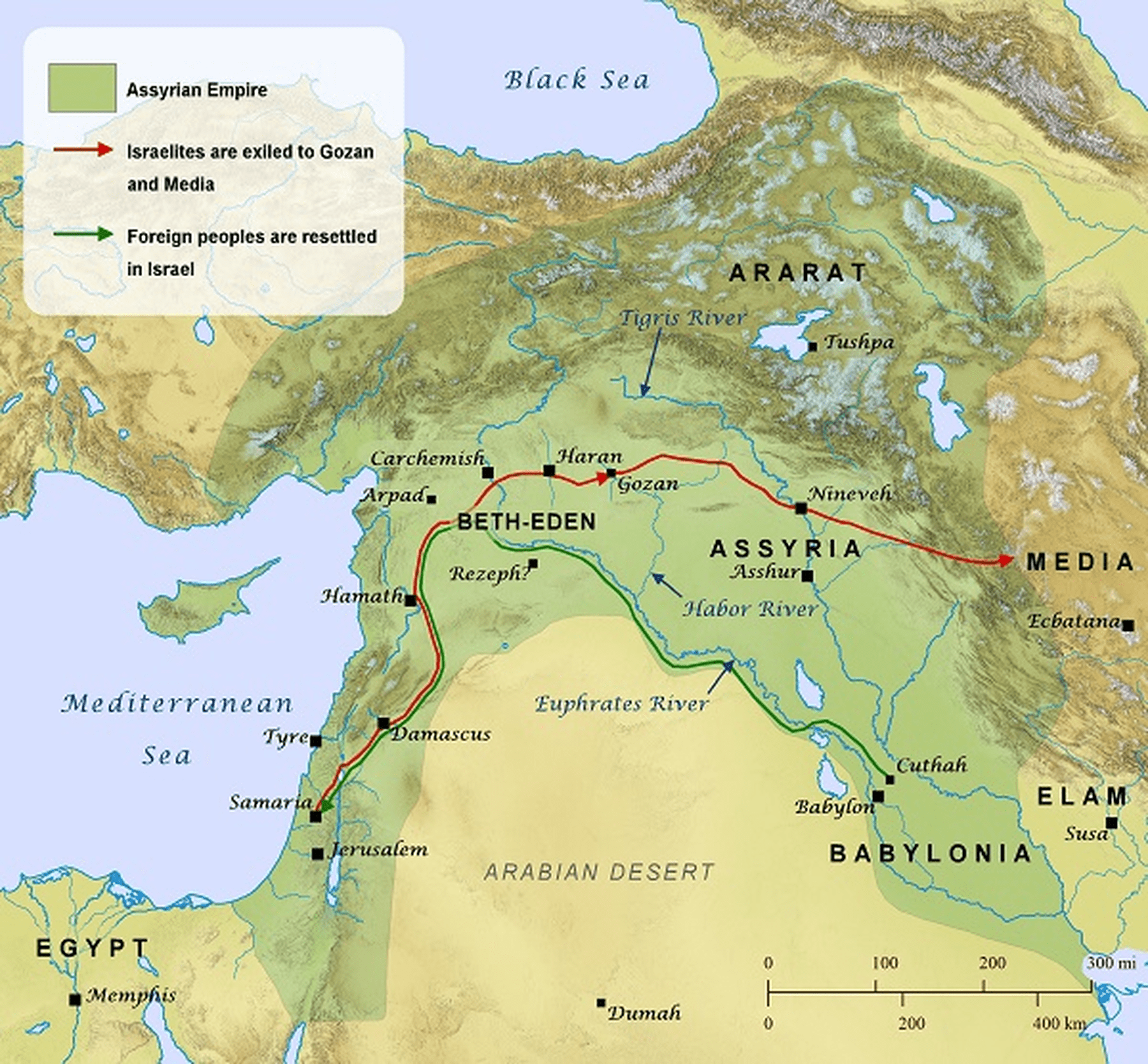
Map of the Assyrian Empire and the Northern Kingdom
Hosea 1:1-5 – Transcript
The prophets often begin their books this way so readers know the setting of their message. Prophets usually warn the nation of sin and call for repentance, but each prophet speaks to specific events in his own day, and this’s why the historical books of the Bible and the prophetic books should be read together.
The historical books are: Joshua, Judges. Ruth, 1 Samuel, 2 Samuel, 1 Kings, 2 Kings, 1 Chronicles, 2 Chronicles, Ezra, Nehemiah and Esther.
They cover about 800–1000 years of Israel’s history, including the conquest of Canaan, the era of the judges, the united monarchy, the divided kingdoms, the Assyrian and Babylonian exiles, and the restoration under Persian rule.
Israel’s history explains Hosea’s ministry.
The first kings over the whole nation were Saul, David, and Solomon, but because Solomon disobeyed God—turning to many wives and idol worship—God said the kingdom would be torn from him, and 1 Kings 11:11 tells us this.
God told Solomon, as 1 Kings 11:31 records, that ten tribes would be taken away and given to Jeroboam, who led the revolt against Solomon’s son and heir to the throne. Jeroboam’s revolt was an armed insurrection against Rehoboam, Solomon’s son, which resulted in the breakaway of the northern tribes and the formation of the Northern Kingdom of Israel. The rebellion began when Jeroboam and the northern tribes rejected Rehoboam’s harsh policies, withdrawing their allegiance to the House of David and proclaiming Jeroboam king.
One tribe, Judah, would remain for David’s sake, because God had promised David an everlasting house and a throne in Jerusalem, as we see in 1 Kings 11:32.
So, the nation split into ten northern tribes, the Northern Kingdom, called the House of Israel and the Southern Kingdom around Jerusalem, called the House of David, or the House of Judah.
The northern tribes quickly followed Jeroboam into idolatry. They worshipped false gods such as Ashtoreth, Chemosh, and Milcom (1 Kings 11:33). Judah in the south kept a more faithful form of worship, though many of Judah’s kings also fell into sin.
Israel’s kings were almost all wicked, while Judah had a mixture of good and bad rulers. Some kings of Judah began well and ended badly; others began badly and later repented. But the kings of the northern kingdom, Israel, remained mostly corrupt for centuries.
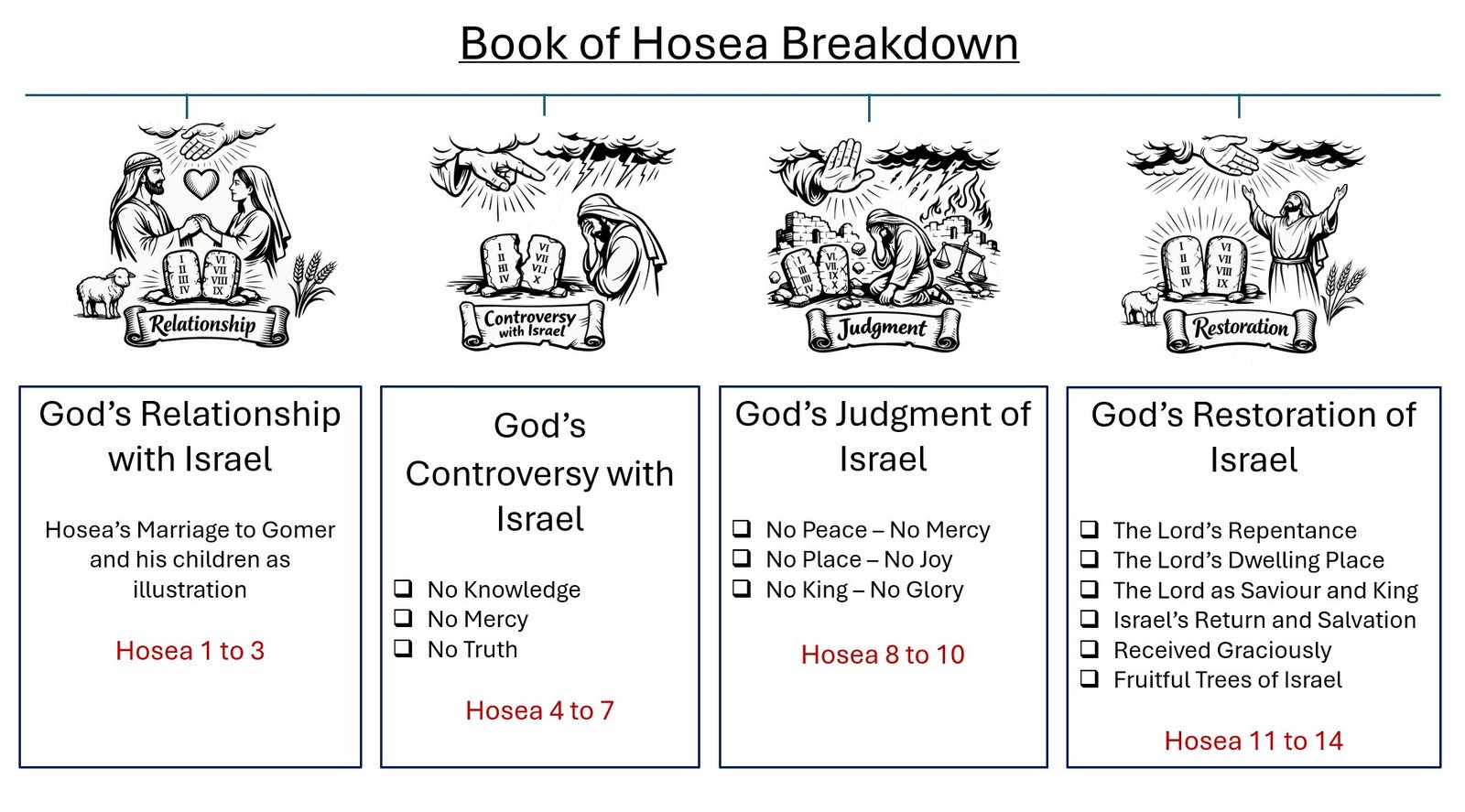
Hosea was sent to speak against the sin and apostasy of this northern kingdom.
His message came after long years of idolatry, injustice, and false religion.
Hosea ministered during the reigns of Judah’s kings Uzziah, Jotham, Ahaz, and Hezekiah, and during the reign of Jeroboam II in Israel. This Jeroboam is not the first Jeroboam after Solomon, but a later king from the house of Jehu. We have a chart of the kings of Judah and Israel in the graphics selections below this recording, and the chart shows the time Hosea prophesied in relation to the reigns of the kings.
Hosea’s prophecies warn that Israel’s long rebellion will bring judgment from God. He foretells that the northern tribes will be destroyed as a kingdom and carried away into captivity by Assyria.
This is the background of the book of Hosea: a divided nation, a long history of sin in the north, and a prophet sent by God to announce both judgment and future hope.
When Hosea began his ministry, it was a time of prosperity and expansion, but not a time of true righteousness. Both the northern and southern kingdoms were gaining land and wealth, winning wars, and even working together at times, but this success didn’t come from trusting God.
The people trusted their own strength and were willing to compromise sound doctrine to keep their prosperity. Sound familiar?
This is the setting in which Hosea starts to preach judgment. His message is that God will destroy the nation that thinks it’s secure and blessed, but is spiritually corrupt.
In Hosea 1:2, we read:
The beginning of the word of the LORD by Hosea. And the LORD said to Hosea, Go, take unto thee a wife of whoredoms and children of whoredoms: for the land hath committed great whoredom, departing from the LORD.
This is the first message God gives Hosea, and Hosea is the first of the twelve so-called minor prophets, so it’s also the beginning of God’s word through these prophets.
God’s first command to Hosea is shocking:
“Go, take unto thee a wife of whoredoms and children of whoredoms…”
We don’t have the word “whoredom” in our vocabulary today, but it means a woman known for sexual sin. Hosea’s told to marry a woman like this and to have children with her.
Most of the book, however, is not about Hosea’s marriage, but about Israel’s adultery and idolatry. Hosea’s strange marriage is a picture of the nation’s unfaithfulness to God, but it also shows Hosea’s faithfulness.
He obeys even when God’s instruction seems strange and hard. Prophets were often told to do unusual things to act as a sort of mirror to the nation, so people could see how bad their own behaviour was. These actions weren’t random; they were signs to Israel.
Some people struggle with Hosea 1:2 because they think God is telling Hosea to sin. But God does not tempt people to sin and doesn’t command sin.
So, did God tell Hosea to do something wrong, as some people think? Scripture shows this’s not the case. Hosea was not a priest, so the laws restricting priests from marrying certain women didn’t apply to him.
James 2:25 mentions Rahab, a harlot, as an example of someone “justified by works” when she helped Israel. Her past sin did not prevent God from using her. Israel’s law did, however, forbid priests from marrying a whore or a divorced woman (Leviticus 21:7), but Hosea was not under that restriction because he was not a priest, and neither are we today.
Marrying a sinful woman is not itself a sin; marriage is good. It may be an unwise choice by normal standards, but when God commands it, obedience is right. The problem’s not that Hosea becomes ungodly; the problem is that people often judge godliness by outward respectability instead of by obedience to God.
This passage also teaches that our circumstances whether it’s poverty, low status, sickness, or being tied to someone with a bad past—don’t automatically make a person ungodly. Hosea’s wife being a whore doesn’t make Hosea a wicked man. God can use hard, messy situations to show His truth.
God also speaks of “children of whoredoms.”
These children are not born yet, but they’ll be marked by their mother’s reputation.
This follows a pattern seen in other places in Scripture. When an Israelite married a Gentile woman—against God’s law—the children were counted with the mother’s status.
In Genesis 38:24, Tamar is called a harlot, and her child is said to be “with child by whoredom.” The child carries the label of the mother’s sin.
The prophets and their families often became signs to Israel. Their words, their actions, and even their children’s names were used by God to teach the nation.
Isaiah’s family also shows this clearly.
In Isaiah 8:18, he says,
Behold, I and the children whom the LORD hath given me are for signs and for wonders in Israel from the LORD of hosts, which dwelleth in mount Zion.
God even chose the names of Isaiah’s children to warn the nation. This idea may feel strange to modern Christian thinking, where parents want their children honoured and successful, but Scripture teaches that our lives and our children belong to God, and there’s nothing more worthy than being used for His purpose, even in a sinful world.
In Hosea, this language shows how deeply Israel’s unfaithfulness has affected the nation, even down to the next generation.
So, Hosea’s marriage and children become a living picture of Israel’s spiritual adultery, given at a time when the nation feels strong and prosperous but is, in reality, far from God.
The Bible defines whoredom as lewdness or fornication—sexual relations outside God’s design for marriage. Leviticus 19:29 warns against prostituting a daughter, because it leads the whole land into whoredom. God’s concern was not only for individuals but for the health of the nation. When marriage is ignored, society becomes unstable, immoral, and spiritually careless. Israel’s laws protected marriage because it was critical for a righteous society.
Deuteronomy 23:17 says there must be no whore among Israel’s daughters and no sodomite among Israel’s sons. These laws show that Hosea’s wife was breaking God’s commands.
Her father had failed, and she herself had sinned, yet God told Hosea to marry her, not to approve her sin, but to create a living picture of Israel’s unfaithfulness.
Hosea’s marriage would show the nation what they’d become: a people who’d left God for idols, just like the wife who leaves her husband for other lovers.
This is the meaning of Hosea’s “wife of whoredoms” and “children of whoredoms.”
It’s not about Hosea sinning, nor about the children doing wrong. It’s about God using Hosea’s family as a sign to reveal Israel’s spiritual condition.
In Hosea 1:1–5, the only person doing right is Hosea.
God told him to take this “wife of whoredoms,” and he obeyed. If Hosea were doing wrong, it would imply God was wrong to keep pursuing His unfaithful people. Scripture shows the opposite: Hosea obeys, and God uses his obedience to reveal His heart.
Exodus 34:14 explains why God uses the language of whoredom.
For thou shalt worship no other god: for the LORD, whose name is Jealous, is a jealous God:
God commands Israel to worship no other god.
His name is “Jealous,” meaning He rightly protects what belongs to Him. Jealousy is not envy; it’s the righteous desire to guard what’s yours.
A husband feels this when his spouse is unfaithful. God feels this when Israel goes after idols.
In Exodus 34:15–16, God warns that if Israel makes covenants with pagan nations, they will “go a whoring after their gods,” and their children will follow them.
This shows that whoredom in Scripture includes spiritual adultery, turning from the true God to false gods.
So when God tells Hosea to take a “wife of whoredoms,” He means a woman who has been unfaithful—physically, spiritually, or both. She represents Israel, who’ve broken covenant with God. Hosea is not told to find a pure, devout woman like Mary, but someone more like a Jezebel‑type, openly unfaithful. This was not hard to find in Israel at that time.
The nation had already committed “great whoredom” by departing from the Lord.
This spiritual adultery is confirmed in 1 Chronicles 5:25, which says of the northern tribes,
And they transgressed against the God of their fathers, and went a whoring after the gods of the people of the land, whom God destroyed before them.
Because of this, God sent the kings of Assyria to carry them away into captivity, as 1 Chronicles 5:26 records,
And the God of Israel stirred up the spirit of Pul king of Assyria, and the spirit of Tilgath-pilneser king of Assyria, and he carried them away, even the Reubenites, and the Gadites, and the half tribe of Manasseh, and brought them unto Halah, and Habor, and Hara, and to the river Gozan, unto this day.
We have a map of this area in the graphics selections below this recording.
Hosea ministered before this judgment, warning that Assyria would come if Israel did not repent.
Hosea obeyed God’s command. Hosea 1:3 reads,
So he went and took Gomer the daughter of Diblaim; which conceived, and bare him a son.
Gomer’s father had failed to restrain her, and she herself had broken God’s laws, yet Hosea married her because God commanded it. She conceived and bore Hosea’s son. The children were not from another man. They were called “children of whoredoms” because their mother’s reputation was imputed, or accounted to them, just as we saw in Genesis 38:24, where Tamar’s child is called “with child by whoredom.”
Hosea’s marriage became his lifelong ministry.
His wife’s unfaithfulness mirrored Israel’s unfaithfulness. His struggle with her pictured God’s grief over His people. Hosea’s obedience allowed God to use his home as a living message: Israel must return to her true Husband, the Lord.
Hosea’s situation gives an example for believers who find themselves in marriages where their spouse disagrees with them spiritually. Hosea stayed faithful to God while ministering to a wife who was not aligned with God’s will. His life shows that commitment to the Lord comes first, even when marriage is difficult.
The apostle Peter also describes Israel’s spiritual condition in 2 Peter 2. He speaks of people who walk after the flesh, despise authority, and act with uncleanness.
They speak evil of things they don’t understand, and they perish in their own corruption. Peter says they have “eyes full of adultery” and can’t stop sinning.
Jesus taught that adultery begins in the heart when a person looks with lust, so Peter’s description shows deep inward corruption. These people deceive others, follow covetous practices, and become “cursed children”—a phrase that matches Hosea’s picture of children marked by their parents’ sins.
This doesn’t mean God refuses to save these people.
In this dispensation, the dispensation of grace in which we live today, God saves sinners by grace through Christ’s finished work.
No curse from parents or society can block salvation. Yet sin still brings consequences. A man still reaps what he sows, and the people in Hosea’s day were suffering the results of generations of false worship and wicked leadership.
They assumed they were safe because God hadn’t judged their parents, but Hosea shows that God’s patience doesn’t mean approval. God had been longsuffering, waiting for repentance, but judgment would come.
This same principle applies today.
People often justify sin because life seems prosperous and peaceful. But God is patient, long-suffering, giving time to repent before judgment arrives.
The prophets teach that God is both righteous and long-suffering, and Hosea’s marriage shows God reaching out faithfully to sinners who’ve wandered far from Him.
So, in Hosea 1:3–4, Gomer conceived and bore Hosea a son.
Hosea 1:4 says,
And the LORD said unto him, Call his name Jezreel; for yet a little while, and I will avenge the blood of Jezreel upon the house of Jehu, and will cause to cease the kingdom of the house of Israel.
God told Hosea to name the child Jezreel, saying He would avenge the blood of Jezreel on the house of Jehu and bring an end to Israel’s kingdom. God Himself chose the name, making the child also a message to Israel.
Hosea’s first child becomes the first sign of God’s response to Israel’s spiritual adultery. The name Jezreel carries huge historical meaning tied to Israel’s past violence and coming judgment.
Jezreel is the name of the valley in which the valley of Megiddo is situated.
When the Bible speaks of battles at Megiddo (e.g., Ahaziah dying there, Josiah dying there), those events occur in the Jezreel Valley.
This is why Revelation 16:16 uses the term Armageddon (Har‑Megiddo = “mount of Megiddo”), because Megiddo is the famous military choke‑point within the Jezreel Valley.
Hosea’s children are not random; each name is a message. Remember, Hosea’s marriage and his children form a living picture of Israel’s unfaithfulness. Hosea’s obedience allows God to use his home as a prophetic sign: Israel has left her true Husband, and God is calling her to return before judgment falls.
1 Kings 21 tells the sad story of Naboth, who was a righteous man from Jezreel.
Naboth owned a vineyard beside the palace of Ahab, king of Israel. Ahab wanted the vineyard for a garden and offered money or a better vineyard in exchange. Naboth refused, saying it was the inheritance of his fathers. His refusal was lawful and right, but it angered Ahab. Jezebel, Ahab’s wicked wife, encouraged him to take what he wanted; after all, he was the king, wasn’t he?
She arranged false accusations against Naboth, had him stoned, and Ahab seized the vineyard. Because of this evil, God declared He would destroy Ahab’s house. In biblical terms, this house was every living person associated with Ahab!
Just before that story, 1 Kings 19 records how God speaks to Elijah. Elijah is the prophet whose ministry becomes the pattern for John the Baptist in Malachi 4:5 and Matthew 11:14. He’s the prophet who stands alone against Baal worship.
After his victory over the prophets of Baal on Mount Carmel, which is recorded in 1 Kings 18 and is one of the multitude of amazing biblical accounts, Jezebel, the wife of Ahab, threatens his life, and Elijah runs.
Jezebel was fiercely devoted to Baal and Asherah. She supported hundreds of their prophets and fed them in her palace, creating a rival priesthood inside Israel. Under her influence, Ahab built a Baal temple and an Asherah pole in Samaria, directly breaking God’s command to worship Him alone.
She hated the worship of Yahweh and tried to wipe it out. Jezebel ordered God’s prophets to be killed, forcing many to hide. This persecution led to Elijah’s famous showdown with the prophets of Baal on Mount Carmel, where God proved His power, and the Baal prophets were destroyed.
Instead of repenting, Jezebel became even more furious and threatened Elijah’s life, causing him to flee.
Elijah felt alone and believed he was the only person left in Israel who had not forsaken the true God. But as we see in 1 Kings 19:9, God came to him in his sorrow and told him there was still a remnant of 7000 faithful Israelites.
God then commanded Elijah to anoint Hazael king over Syria, Jehu king over Israel, and Elisha as the prophet who would eventually take Elijah’s place.
These three men would carry out God’s judgment on Ahab’s wicked house. God said that whoever escaped Hazael’s sword, Jehu would kill, and whoever escaped Jehu, Elisha would kill. God was not telling Elijah to hide but to appoint leaders who would confront and destroy the evil ruling Israel.
Jehu’s mission is described in 2 Chronicles 22:7–8 and 2 Kings 9.
Jehu was anointed specifically to “cut off the house of Ahab.”
When Jehu began his revolt, he was acting under God’s command to punish Ahab’s house for its wickedness. He killed King Joram of Israel and King Ahaziah of Judah. Both were connected to Ahab’s family and its idolatry.
Jehu kills King Joram at Jezreel, at the very place where Naboth died. God said He would repay the blood of Naboth.
When Ahaziah, king of Judah, sees this, he tries to flee, but Jehu wounds him, and he dies in Megiddo.
Jehu then continued destroying Ahab’s descendants, fulfilling God’s judgment on Ahab’s house.
Even Ahab’s daughter Athaliah was irreversibly evil; she murdered her own grandsons to seize power, becoming the only woman to sit on Israel’s throne. Jehu eventually ended her reign as well.
Jehu kills princes, relatives, and officials connected to Ahab.
Jehu is zealous to purge Ahab’s idolatry, but he goes beyond what God commanded.
He tricks the worshippers of Baal by pretending to be a devoted Baal follower and gathers them for a great Baal ceremony and kills them all.
God told him to cut off Ahab’s house, not to wipe out every Baal worshipper.
2 Kings 10 shows Jehu’s excess.
Ahab had seventy sons. Jehu sends letters to the leaders in Samaria, demanding they hand over the sons. They submit, and Jehu kills all who remained of Ahab’s house. God had commanded judgment on Ahab, and Jehu fulfilled that part but then went beyond what God had specifically told him to do.
Jehu himself did not fully obey God.
2 Kings 10:29 says he continued in the sins of Jeroboam, worshipping the golden calves at Bethel and Dan.
He removed Baal but kept idolatry. Because Jehu did what God commanded regarding Ahab, God promised in 2 Kings 10:30 that four generations of Jehu’s descendants would sit on Israel’s throne, and that’s exactly what happened: Jehu, Jehoahaz, Jehoash, Jeroboam II, and Zechariah. But every one of them was wicked, following the same idolatry Jehu kept.
This is the moment Hosea speaks into. Hosea prophesies during the reign of Jeroboam II, Jehu’s great‑grandson. The nation is prosperous outwardly but spiritually corrupt, worshipping golden calves while claiming loyalty to God.
Zechariah, not the prophet Zechariah, of course, but the fourth-generation king from Jehu, reigned only six months before being killed, fulfilling God’s word.
After him, Jehu’s dynasty ended.
So when God tells Hosea to name his first son Jezreel, He’s announcing judgment on the house of Jehu. Jehu had cut off Ahab, but now God will cut off Jehu. The name Jezreel recalls Naboth’s murder, Ahab’s wickedness, Jehu’s bloody purge, and the long history of idolatry in the northern tribes. It’s God’s message that the time of patience is over. Israel has committed great whoredom by worshipping false gods, and the dynasty that began with Jehu’s zeal is now going to fall under God’s judgment.
Hosea’s first child becomes a living prophecy that the bloodshed in Jezreel will be judged in Jezreel, and that God was announcing that He would again bring judgment on Israel for its spiritual adultery.
Hosea’s ministry shows God’s heart: He’s righteous in judgment, but also longsuffering, reaching out to sinners who have wandered far from Him.
God knows the end from the beginning, and He already knew that the dynasty of Jehu would end and that Israel’s kingdom would fall. Hosea 1:4 says, “Yet a little while,” showing the judgment was near. Hosea prophesied close to the time when Jehu’s line would be cut off, and the Assyrians would begin destroying Israel.
God says He will “cause to cease the kingdom of the house of Israel.” This refers to the political dominion, not the extinction of the people. Scripture distinguishes between the people of Israel and the government ruling them. It separates the individual Israelite from National Israel. It’s national Israel that Paul refers to as being blinded and fallen in Romans. The individual always has a path to salvation.
The northern tribes would lose their kings and be taken captive, but the people themselves would not disappear. Some were carried away, some fled south, and some were preserved by God. Many individuals who belonged to the 10 tribes that rebelled and formed the northern kingdom stayed loyal to the house of David and stayed in Jerusalem rather than join Jeroboam in the rebellion. This is why the belief of some cults that claim the 10 tribes that rebelled were lost is false. There always was and always will be a faithful remnant of Israel from every tribe. Ten tribes were never lost. God knows every one of them and there mebers.
2 Kings 18:9–12 records the fall of Israel. During Hezekiah’s reign, Shalmaneser, king of Assyria, besieged Samaria for three years and captured it. Israel was carried away because they, as it says, “obeyed not the voice of the Lord” and broke His covenant. This fulfilled earlier prophecies. Zechariah, Jehu’s fourth‑generation descendant, was killed after six months, exactly as God foretold. God’s fulfilled prophecies prove His Word is true; He foretold the rise and fall of kings generations in advance.
Hosea 1:5 adds another detail:
And it shall come to pass at that day, that I will break the bow of Israel in the valley of Jezreel.
God will “break the bow of Israel in the valley of Jezreel” means Israel’s military strength would be shattered. The Assyrians later fought and defeated Israel in that very region. Hosea wrote this at the beginning of his ministry, long before the Assyrian invasion, yet history shows it happened exactly as God said.
The phrase “in that day” in this verse often points to both a near and a distant fulfilment. The near fulfilment was Assyria’s judgment on the northern tribes. But Hosea also looks ahead to a future day when God will gather all Israel. Hosea 1:11 says the children of Judah and Israel will be reunited and appoint “one head.” This has not happened yet. After the Babylonian captivity, only Judah returned; the northern tribes never regained a kingdom. Hosea says that in the future, both groups will be gathered under one King, which is Christ.
Hosea calls this future moment “the day of Jezreel.” Jezreel was a place of judgment in Israel’s past, but Hosea says it will also be a place of restoration when God reunites His people under their true King. The Assyrian invasion was only the first stage. The final fulfilment awaits the time when Christ gathers Israel and Judah together, ending their long division and restoring them under His righteous rule.
Hosea is to the northern tribes what Jeremiah is to Judah. Isaiah warned the north near their fall, just as Jeremiah warned the south near theirs. Their messages are similar: repent, or you will be taken away.
Jeremiah 32 describes Judah’s fall. God says He’ll give Jerusalem into the hands of the Babylonians because Judah offered incense to Baal, worshipped other gods, and even caused their children to pass through the fire to Molech (Jeremiah 32:29–35).
When Jeremiah says Israel made their children “pass through the fire unto Molech,” he’s talking about literal child sacrifice. Parents burned their sons and daughters as offerings to the idol Molech.
God had already forbidden this practice many times. But in Jeremiah 32:35, He goes further, saying: it was not commanded, it was not hinted at, it was not even imagined, and it just wasn’t compatible with who God is.
This is God’s way of saying, “This evil is so far from Me that it’s unthinkable.”
Both Israel and Judah had provoked God “from their youth.” Yet even after announcing judgment, God promises restoration. He says He’ll gather them from all countries where He scattered them, bring them back safely and give them a new and everlasting covenant which includes Him putting my law in their inward parts, and writing it in their hearts; and He will be their God, and they shall be His people, and they will not depart from Him again (Jeremiah 32:30–40).
This matches Hosea’s message. Hosea says the land has committed “whoredom” and departed from the Lord. Jeremiah, speaking later, says God will one day bring them back and give them a united heart so they never depart again. God’s covenant love for Israel remains, even after judgment.
People today often claim that modern events—like political movements or national changes—fulfil these prophecies, but Jeremiah’s description is very specific: Israel and Judah will be gathered together, will have one heart, one mind, one King, and will never again depart from the Lord. That simply has not happened yet. God wants Israel saved, but the full restoration is in the future.
Hosea’s opening verses make the picture clear. Israel is the wife of whoredoms, unfaithful to God. Hosea represents the Lord, who takes back the unfaithful wife and her children. God tells Hosea to marry a woman of whoredoms because Israel has acted that way toward Him. The symbolism is simple: Hosea’s marriage is a living prophecy of God’s relationship with His people.
So Hosea’s first five verses already reveal the whole pattern:
– Israel has committed spiritual adultery.
– God will judge them and end their kingdom.
– Yet God will one day restore them, reunite them, and give them one heart under one King.
The prophecy’s not complicated. Hosea’s marriage shows Israel’s sin, and his children’s names show God’s judgment and future restoration.
May God bless you until the next episode, when we look into Hosea 1:6-11.