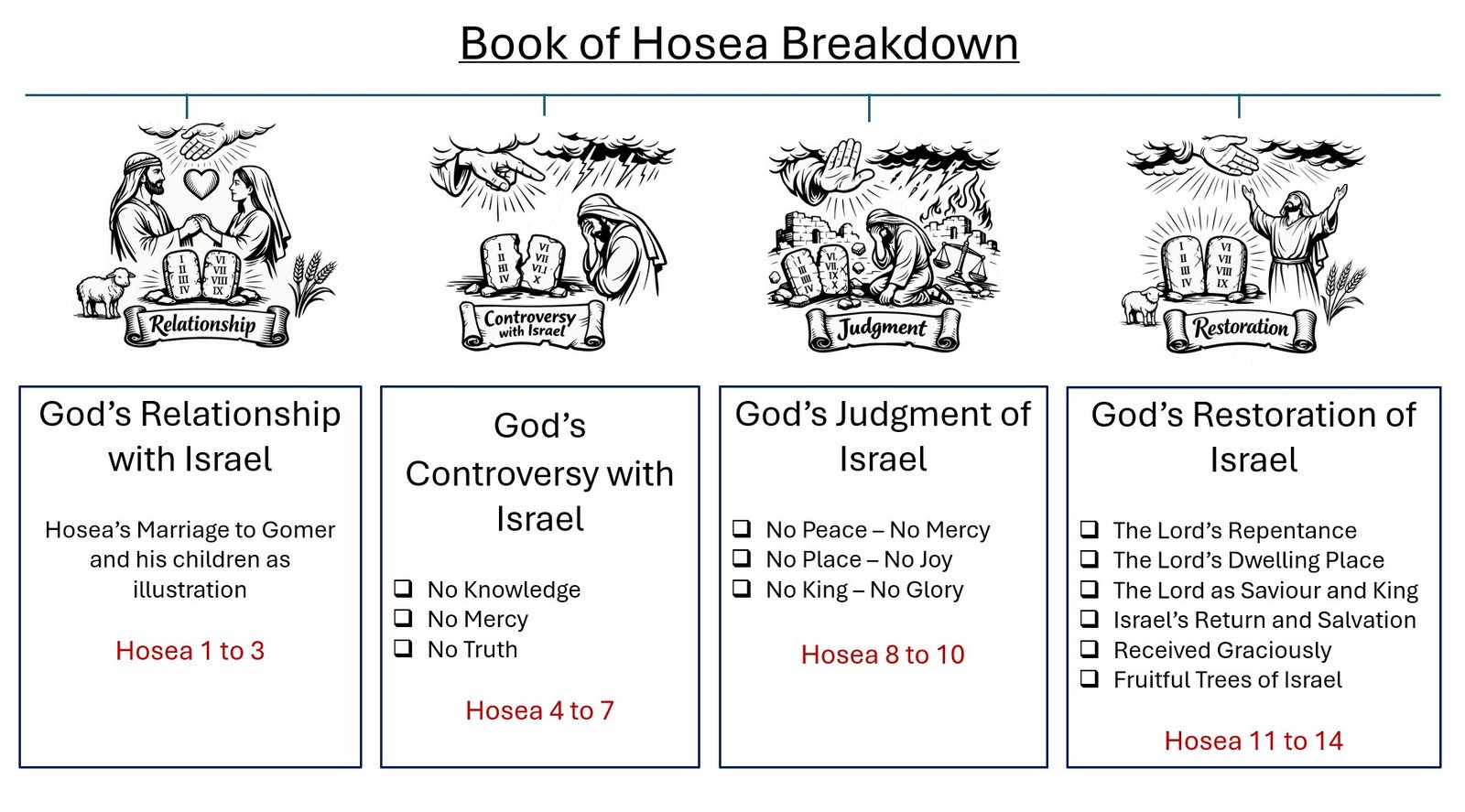
Hosea 2:14-23 – God Allures Israel
In this episode, we’re still in Hosea chapter two, and we’ll look at verses 14 to 23. (Hosea 2:14-23).
Hosea 2 is one of the most vivid descriptions of spiritual adultery in the Bible. God uses Hosea’s marriage to a wife who repeatedly betrays him to illustrate His own relationship with Israel. Israel has gone after other lovers — the pagan god Baal and other nations — believing they provided her food, water, wool, flax, oil, and drink.
But God says, “I gave her these things.” Israel took the gifts and provision that God gave her and thanked Baal for them. She used God’s blessings to worship a false god. She credited an idol with the goodness of the Lord.
“Speed Slider”

Press or Click to Open Larger Image
Hosea 2:14-23 – God Allures Israel – Transcript
This is the heart of idolatry: giving God’s glory to another.
God, through the prophet Hosea, describes Israel as chasing lovers who cannot satisfy her. She thinks Baal will give her everything she wants and needs, but Baal has no power. Israel’s running after emptiness.
So God says He’ll take back His gifts. He’ll expose her false worship. He’ll remove the blessings she misused. He’ll hedge up her way with thorns so she can’t find her lovers, and He’ll let her discover that her idols can’t help her.
This is not cruelty. It’s mercy. God’s removing the things Israel used to run away from Him.
Then comes one of the most beautiful turns in the book.
God says He’ll “allure” Israel, draw her back gently. He’ll speak comfortably to her. He’ll restore her vineyards. He’ll turn the valley of trouble, the valley of Jezreel, into a door of hope.
Israel will call God “my husband” again. The names of Baal will be removed from her mouth. God will betroth her to Himself in righteousness, judgment, lovingkindness, and mercies.
This is all prophesied in Hosea’s children’s names.
The first child’s name is Jezreel, which means that God will avenge the blood of the house of Jehu that Jehu spilled in the valley of Jezreel, and He would bring an end to Israel, the northern kingdom.
His second child is named Lo‑ruhama, meaning “no mercy”, and the third child is named Lo‑ammi, which means “not my people”.
Then in Hosea 1:2 God tells Hosea, SAY ye unto your brethren, Ammi; and to your sisters, Ru-hamah.
Here He removes the “Lo” before the names, changing the meaning from Lo‑ruhama to Ruhama, making “no mercy” into “mercy”, and Lo‑ammi to Ammi, making “not my people” into “my people”.
God’s judgment is real, but His love is relentless, and His mercy is unfathomable.
Hosea 2:14 reads,
Therefore, behold, I will allure her, and bring her into the wilderness, and speak comfortably unto her.
This is God addressing Israel’s spiritual adultery.
Judgment comes first, but it leads to God’s renewed commitment to the nation.
Throughout the Old Testament, whenever God judges Israel, He reaches a point where He could destroy them, yet He pulls back because of His unconditional promises to Abraham, Isaac, and Jacob. He sends Israel into captivity in the nations, removes blessings and protection, but He always returns to the covenant made with the fathers. Israel fails as any nation would, but unlike other nations, Israel has a special promise guaranteeing her future restoration.
The word “behold” means to hold something in view. When the prophets or Jesus Himself say “behold,” they call attention to something that God will visibly perform. Israel will “behold” God’s actions, just as they saw the Red Sea part. Hosea 2:14 uses “behold” to announce something God will do that Israel and the nations will witness.
Another key feature of this chapter is the repeated phrase “I will.” In Hosea 2, especially the second half, God says “I will” more times than in any other chapter except Leviticus 26, the covenant chapter promising blessing for obedience and cursing for disobedience.
Hosea 2 mirrors that pattern: judgment first, then God’s repeated “I will” statements showing He Himself will restore Israel. Israel can’t change her situation; God must act. This’s a one-sided, gracious work rooted in His covenant faithfulness.
Paul later teaches the sufficiency of God, and Hosea shows the same truth: Israel is insufficient, but God is able. When He says “I will,” He accomplishes it. Hosea 2 contains over twenty “I will” statements, and nearly every verse in this section includes one.
The first “I will” is here in verse 14: “I will allure her.” God will draw Israel back like a husband wooing his wife. His purpose is to change her heart, not force her. Earlier in the chapter, Israel says, “I will go after my lovers,” showing her rebellious will. God responds with “I will hedge up thy way,” blocking her from running to idols. Eventually she says, “I will return to my first husband,” but it’s not with full sincerity.
But verse 16 looks ahead to a future day when Israel will call God “Ishi”, meaning my husband. Her will changes from chasing idols to seeking her beloved God. This is the goal of God’s “I will” actions — to win her back.
To “allure” means to attract or draw the desire of another — to woo, not deceive. God chooses to win Israel’s heart, not force obedience. Even after her repeated failures, God says, “I will.” He acts to restore her, showing His covenant love and His commitment to change her heart.
Hosea shows God acting as a faithful husband who refuses to leave Israel desolate. Even when He removes blessings and brings affliction, as we saw last episode, in Hosea 2:13, His judgment is never meant to destroy her. Because of His unconditional promises to Abraham, Isaac, and Jacob, God is obligated by His own word to bring Israel back. The covenant forces Him to show grace after judgment. He disciplines to expose her error, change her heart, and ultimately allure her back.
This pattern resembles Paul’s teaching about delivering someone to Satan for correction. A believer can’t be removed from the Body of Christ, but they can be separated from the assembly so they see their error and return. Grace aims to change the heart, not force obedience, and we understand this more fully now through the revelation of the mystery and the gospel of grace.
So, God says He will allure her and bring her into the wilderness.
The wilderness is where Israel first met Jehovah. It recalls the desert wanderings in Numbers, where Israel had no land, no rivers, and no natural prosperity. God provided water, food, and protection, forming a relationship based on dependence on Him, not on the land or their own works. When Israel later entered the land, they were supposed to remember that prosperity came from God. Instead, they turned to idols and trusted themselves.
Bringing Israel back to the wilderness means returning her to the place where she learned who God was.
This theme appears again when John the Baptist ministers in the wilderness in Matthew 3:1. He calls Israel to repent because Isaiah 40 foretold a voice crying in the wilderness, preparing the way of the Lord. Isaiah 40 also says, “Speak comfortably to Jerusalem”—the same language Hosea uses. Isaiah describes a time when Israel’s warfare is finished and her iniquity pardoned. Hosea follows the same pattern: judgment first, then comfort.
Isaiah 40:3–5 speaks of preparing a straight path for God and of all flesh beholding His glory. John the Baptist fulfilled that, but the kingdom did not come, so verses 4–5 wait for fulfilment in the future. Hosea’s “behold” fits this same idea: Israel will witness God’s actions as He allures her back and restores her.
When God says He’ll speak comfortably to Israel, it’s romantic language—He’ll woo her, not force her. Alluring someone means drawing their will and desire. It requires a change of heart, which is exactly what repentance and faith are. God speaks to her heart so she willingly returns instead of being coerced into returning when she doesn’t really want to. This is love. It’s not compulsion; it’s persuasion.
Grace works the same way today. God doesn’t demand and use the fear of fire and brimstone; He preaches the gospel. He allures us with the beautiful Romans 5:8,
But God commendeth his love toward us, in that, while we were yet sinners, Christ died for us.
Some believe it, and some don’t, but the appeal’s made to the heart. Hosea shows that God restores Israel by grace through faith, the same as our salvation today, drawing her back with comfort, love, and the promise of renewed relationship.
In Hosea, God acts as a faithful husband who refuses to leave Israel desolate. His love is shown by separating her from her mistakes and removing blessings only to correct her, not destroy her.
We keep coming back to it, but it’s the integrity of God’s own Word in His unconditional promises to Abraham, Isaac, and Jacob that binds Him to bringing Israel back. His covenant, His Word, forces Him to show grace after judgment, using discipline to expose error and change her heart so He may allure her again. This is not just a picture of God and Israel but a display of the sheer power of His Word and is more evidence of how you and I can fully trust in what He said.
We continue to Hosea 2:15,
And I will give her her vineyards from thence, and the valley of Achor for a door of hope: and she shall sing there, as in the days of her youth, and as in the day when she came up out of the land of Egypt.
Hosea 2:15 continues the theme of Israel’s future salvation. Israel can’t be saved without believing God. They had to hear John the Baptist and Jesus in His earthly ministry and believe their message to receive the kingdom. Hosea’s promise of comfort assumes their faith.
God says He’ll give Israel “her vineyards from thence” and turn “the valley of Achor” into “a door of hope.”
These are joyful images of restoration, like Israel’s early days when God brought His firstborn son out of Egypt and formed the covenant in the wilderness. Vineyards don’t grow in the wilderness, so God’s promising supernatural restoration after judgment.
Ezekiel 36 explains this pattern.
God says that when He cleanses Israel from all her iniquities, “I will… build the ruined places” and make the desolate land like Eden. This matches Hosea: judgment produces desolation, then God rebuilds. Ezekiel adds that when God restores the land, “the heathen… shall know that I the Lord build the ruined places.”
This shows the restoration is unmistakably God’s work, not human achievement. Modern Israel’s development cannot fulfil this prophecy because the nations don’t acknowledge Jehovah or Jesus Christ in it. Very few people today attribute Israel’s agriculture, technology and brilliance to God, but they certainly will in this future restoration that Hosea and Ezekiel speak of.
Jeremiah 31 also parallels Hosea. It promises the New Covenant and says,
“I will be the God of all the families of Israel, and they shall be my people.”
Hosea had said Israel would become “not my people,” but Jeremiah promises a future reversal. Jeremiah adds that those “left of the sword” — the remnant after judgment — “found grace in the wilderness.” This matches Hosea’s pattern: God allures Israel, brings her to the wilderness, speaks comfortably, and then restores her vineyards. Grace is given to those who trust Him.
These passages show that Israel’s future salvation is by grace through faith, just as salvation is today. The difference is the timing and the terms. Hosea and Jeremiah describe a future national restoration of the nation of Israel tied to her covenants. Today, salvation is offered to all people apart from Israel’s covenant, but still by grace through faith. The mystery revealed through Paul explains how salvation works now, but national Israel’s promised restoration waits for the future kingdom.
Jeremiah continues with God’s declaration in Jeremiah 31:3,
The LORD hath appeared of old unto me, saying, Yea, I have loved thee with an everlasting love: therefore with lovingkindness have I drawn thee.
This also echoes Hosea’s “I will allure her.” God promises to rebuild Israel, adorn her again, and make her rejoice.
He says through Jeremiah 31:5-6 that Israel will plant vines on the mountains of Samaria and Ephraim, the northern tribes, and will one day say, “Let us go up to Zion.” This reunification of Israel and Judah did not happen in Jesus’ day. It could have and should have, but Israel’s rejection postponed their promises yet again through their unbelief. Now that’s all still future.
In all these passages, God’s repeated “I will” shows His one-sided action. Israel can’t restore herself; so God must do it. He judges to correct, allures to draw, and restores to fulfil His promises. The pattern is always the same: judgment, wilderness, grace, faith, and finally restoration.
When Jesus met the Samaritan woman in John 4:22, He told her she did not know what she worshipped.
The Samaritans had their own worship system, separate from Jerusalem. Remember, the Samaritans were the descendants of the Northern Kingdom that were mixed with foreign peoples brought in by Assyria.
They were not purely Israelite, nor purely Gentile, but a hybrid population formed after the fall of Samaria, the Northern Kingdom.
Jeremiah 31:9-12 speaks to this same divided nation. God says, “Sing with gladness for Jacob… O Lord, save thy people, the remnant of Israel.”
He promises, “Behold, I will bring them from the north country… a great company shall return.”
They will come weeping, and God will lead them by rivers of water in a straight way. He declares, “I am a father to Israel, and Ephraim is my firstborn.”
This includes both northern and southern tribes. The split was caused by Solomon’s sin, not God’s plan, so God’s covenant must restore the whole nation, both northern and southern tribes.
Jeremiah 32 continues with Jerusalem about to fall, and Jeremiah imprisoned.
God tells him his uncle will offer land for sale. Even though the Babylonian army is at the gates and the land is worthless, God commands Jeremiah to buy it. Jeremiah purchases it for seventeen pieces of silver and stores the deed in an earthen vessel.
God explains the sign: “Houses and fields and vineyards shall be possessed again in this land.”
Even though judgment’s coming, God will restore Israel. The preserved deed proves the land will one day return to its rightful owners.
This connects directly to God saying through Hosea in Hosea 2:15,
I will give her her vineyards from thence, and the valley of Achor for a door of hope.
The “valley of Achor” recalls the account of Joshua 7.
When the children of Israel entered the Promised Land, three main enemies stood in their way. They were Jericho, Ai, and the Gibeonites. These three enemies of Israel prevented Israel’s possession and enjoyment of the Promised Land. The land was right there, and God had told them that it was theirs. He’d given them the title deed in His promise to Abraham. He said to Joshua in Joshua 1:3,
Every place that the sole of your foot shall tread upon, that have I given unto you, as I said unto Moses.
God was saying to them, “It’s yours; go in, possess, and enjoy that which you take.”
The first enemy was defeated when God miraculously gave the Israelites victory at Jericho, which makes for great reading in Joshua 6.
However, Israel was defeated at Ai.
Ai was an ancient Canaanite city located just east of Bethel, in the central hill country of what’s now the West Bank.
God told Joshua the defeat came because Israel had transgressed. Achan, a man of the tribe of Judah, had taken cursed spoil — a Babylonian garment, silver, and gold — and hid it in his tent. The account of this is in Joshua 7.
Achan’s sin of taking cursed spoil from Jericho brought judgment on all Israel.
The valley where Achan was judged became known as the Valley of Achor, a place of trouble. Hosea uses this history to show that God will turn Israel’s trouble into hope. The valley of judgment becomes the doorway of restoration.
This transgression meant that God was not with Israel at the battle of Ai. Many men died because of one man’s covetousness. Joshua confronted him and asked in Joshua 7:25, “Why hast thou troubled us? The Lord shall trouble thee this day.”
Then Achan, his family, and his possessions were taken to a valley, stoned, burned, and buried under a great heap of stones. That place was named the Valley of Achor — the valley of trouble.
This becomes a prophetic picture.
Joshua himself foreshadows Christ.
His name means “salvation,” the same root as Hosea, Isaiah, and even Jesus.
Joshua led Israel into the land, conquered nations, and declared in Joshua 24:16, “As for me and my house, we will serve the Lord.”
He’s a type of Christ returning to restore Israel and bring them into their promised inheritance.
Jeremiah, Ezekiel, and Hosea all describe the same future: Israel judged, brought to the wilderness, comforted, restored, and reunited. The northern tribes will one day say, “Let us go up to Zion,” something they did not do in Jesus’ day and have not done yet, but God’s everlasting love and covenant promises guarantee that return in the future.
In Joshua, the faithful remnant follows their leader, but a traitor takes cursed wealth and brings destruction. In the future, when Christ returns, anyone who takes the Antichrist’s mark and his “money” will be excluded from the kingdom and cast into fire. Revelation teaches that those who take the mark cannot enter the kingdom. Joshua’s story foreshadows this: cursed treasure, betrayal, judgment, and removal.
Hosea 2 uses this history to show God’s grace.
God says He will allure Israel, speak comfortably to her, and turn the Valley of Achor into a door of hope. The place of judgment becomes the place of restoration.
Jesus is that door. John calls Him the door of the sheep. He’ll lead Israel through the wilderness, back to the land, and into the kingdom. But if they choose the beast instead of the Lord, there’s no hope.
Achor symbolised treason and death, yet God promises to transform it. Ezekiel 37 shows the dry bones rising — another picture of God turning despair into hope. Ezekiel’s valley of dry bones is a prophecy of Israel being “born again” as a nation.
In Ezekiel 37:11, God speaks to Ezekiel, saying,
Son of man, these bones are the whole house of Israel.
This, of course, is not the church, not the Gentiles, and it’s not a metaphor for personal salvation.
The whole house of Israel is the northern tribes and southern tribes together.
Hosea says Israel will sing again “as in the days of her youth, when she came up out of Egypt.”
Exodus 15:1 records that first song:
I will sing unto the Lord, for he hath triumphed gloriously.
Israel praised God because He saved them without their own effort. He said, “I will,” and He did it.
Hosea prophesies that God will once again bring Israel through a wilderness, show His power, and charm their hearts. In the tribulation, many will reject Him even while seeing His works, but the redeemed will rejoice.
Isaiah 51:11 says,
Therefore the redeemed of the LORD shall return, and come with singing unto Zion; and everlasting joy shall be upon their head: they shall obtain gladness and joy; and sorrow and mourning shall flee away.
Redemption requires faith in Christ’s blood; only the redeemed inherit the kingdom.
Revelation shows this same pattern.
The 144,000 — including northern tribes — sing a new song.
Others sing the Song of Moses (Revelation 15), just as Israel sang in Exodus. Even in wrath, the redeemed rejoice because their Redeemer is near. Jesus said, “Look up, for your redemption draweth nigh.”
Micah 7 echoes Hosea: God will repeat the wonders He performed when He first brought Israel out of Egypt. He will feed His flock, gather them, and restore them. The miracles, the covenant, the wooing — all this will happen again. God will allure Israel, comfort her, redeem her, and bring her home.
Micah describes Israel’s future restoration using the pattern of the Exodus.
In Micah 7:15, God says
According to the days of thy coming out of the land of Egypt will I shew unto him marvellous things.
The nations, the Gentile nations, will behold God’s works, be confounded, and humbled. Micah then asks,
Who is a God like unto thee, that pardons iniquity?
Israel sins, is judged, yet God delights in mercy. He promises to turn again, have compassion, subdue their iniquities, and cast their sins into the sea. He’ll perform what He swore to Jacob and the mercy He promised to Abraham. Micah shows that judgment is temporary, but covenant mercy is permanent.
Israel’s history becomes the pattern for her future.
The deliverance from Egypt, the wilderness, and the covenant in Numbers all foreshadow what God will do again.
Amos 9 repeats this theme, and in Amos 9:11-12 we read God saying,
In that day will I raise up the tabernacle of David that is fallen, and close up the breaches thereof; and I will raise up his ruins, and I will build it as in the days of old: That they may possess the remnant of Edom, and of all the heathen, which are called by my name, saith the LORD that doeth this.
Israel will possess the remnant of Edom and the nations called by God’s name.
The “remnant of Edom” refers to the surviving Gentile nations that Israel will rule over in the restored kingdom. This is not the church, of course; we will already be in heaven, and the dispensation of grace has ended by this time.
God promises a time of extraordinary blessing as Amos continues: God says, “I will bring ‘again’ the captivity of my people… they shall build the waste cities… plant vineyards… make gardens… and eat the fruit.”
God will plant Israel in their land, and “they shall no more be pulled up.” This has not happened yet; the northern tribes are still scattered.
Malachi also prophesies Israel’s restoration.
He says the offerings of Judah and Jerusalem will again be pleasant “as in the former years.” This follows the coming of God’s messenger — John the Baptist — who prepares the way. Then the Lord Himself comes suddenly to His temple as a refiner and purifier. Malachi moves from John’s ministry to the tribulation, where Christ purifies Israel before the kingdom. Only then will their worship be restored as in ancient days.
Now to Hosea 2:16, which reads,
And it shall be at that day, saith the LORD, that thou shalt call me Ishi; and shalt call me no more Baali.
Israel will call God Ishi, meaning “my husband” — instead of Baali, which means “my master”. Their heart will change from pursuing other lovers to loving their true Husband.
Song of Solomon pictures Israel as the woman longing for her beloved. In Jeremiah 3:14, God says to the northern tribes, “I am married to you.”
Isaiah 54 expands on this: Israel is the forsaken woman whom God will gather again. He says, “Thy maker is thine husband… for a small moment have I forsaken thee, but with great mercies will I gather thee.” God hid His face for a moment, but with everlasting kindness He will restore her.
All these prophets agree: Israel’s judgment is temporary, but God’s covenant love is everlasting. He will bring her through the wilderness, show her wonders, change her heart, and restore her as in the days of old — singing, redeemed, and reunited with her Husband.
Scripture repeatedly uses the relationship between a husband and wife to describe God’s covenant love for Israel. He committed Himself to her, promised to restore her, and—even after judgment—remains faithful to what He swore to the fathers.
This theme carries into the New Testament.
John the Baptist calls Jesus the Bridegroom. The bride in prophecy is Israel, not the Body of Christ as many people think.
The church is one with Christ by grace, without covenants or land promises. Israel’s marriage imagery is rooted in God’s promise to Abraham, Isaac, and Jacob.
Jesus came as Israel’s Bridegroom in His earthly ministry. He called them to repentance, performed miracles to allure them, and offered the kingdom. Those who believed would receive salvation; those who rejected Him faced judgment. Revelation shows the Bridegroom returning, and John sees New Jerusalem “prepared as a bride,” perfectly fitting these thousands of verses in prophecy depicting God’s relationship with Israel as a marriage.
This bride is Israel restored in the kingdom. The city has twelve tribes and twelve apostles—not the Body of Christ.
Revelation 21 describes a visible tabernacle, a kingdom on earth, and God saying, “They shall be my people”, exactly as Hosea prophesied: Israel, once “not my people,” will again be His people when they’re restored.
Hosea 2:17 says,
For I will take away the names of Baalim out of her mouth, and they shall no more be remembered by their name.
God will remove the names of Baalim, the idols, the pagan masters and the false gods from their mouths.
The people will be cleansed from Baal-worship, even to the degree of forgetting the names of the Baals. They’ll turn from idolatry.
Paul echoes this in Romans 11:26: the Deliverer will come to Zion and remove ungodliness from Jacob.
Zechariah 13 says God will purge idols from the land entirely.
Hosea continues in Hosea 2:18,
And in that day will I make a covenant for them with the beasts of the field, and with the fowls of heaven, and with the creeping things of the ground: and I will break the bow and the sword and the battle out of the earth, and will make them to lie down safely.
This is the New Covenant, preparing Israel for marriage and for that relationship with God that God always intended.
Jeremiah 31 says God will make a new covenant with the house of Israel and the house of Judah, not the Gentiles.
Ezekiel 36 explains how: God will gather Israel from all countries, bring them into their land, sprinkle clean water on them, cleanse them from idols, give them a new heart, and put His Spirit within them. This Spirit will cause them to walk in His statutes—something different from the church’s experience. Ezekiel 36:28 adds,
And ye shall dwell in the land that I gave to your fathers; and ye shall be my people, and I will be your God.
These prophecies show that Israel is not always God’s people. Hosea 1–2 says there is a time when God disowns them, and a future time when He restores them. The New Covenant cleanses Israel, removes idolatry, gives them a new heart, and prepares them for their marriage to the Lord.
Jesus came preaching this New Covenant and promised to send His Spirit. The prophets, Hosea included, show that God’s covenant love will ultimately bring Israel back, cleanse her, and unite her to Himself as a restored bride.
Hosea, Ezekiel, and Jeremiah all teach that God will make a New Covenant with Israel and give them His Spirit. So when Nicodemus questioned Jesus about being “born again,” Jesus expected him to know these prophecies. Nicodemus was a Jewish teacher, and not just any teacher. Jesus calls him “a master of Israel” (John 3:10), meaning: a rabbi, a recognised teacher of the Law, and a member of the Sanhedrin. He should have and would have known these prophecies off by heart.
Israel must be cleansed, given the Spirit, and restored by covenant, or they cannot enter the kingdom or be God’s people.
Hosea 2:18 also includes God saying He will make a covenant “with the beasts of the field, the fowls of heaven, and the creeping things.”
This is because the curse affected the whole creation.
Throughout Scripture, God sometimes uses animals to judge humanity—Egypt’s plagues show this. But in the kingdom, creation will be at peace with Israel.
Isaiah 35 describes the wilderness blossoming, joy and singing, and people beholding the glory of the Lord. A “highway of holiness” will lead the redeemed safely to Zion, with no ravenous beasts harming them. God protects His people as He did in the wilderness under Moses and Joshua.
Isaiah 11 and 65 expand on this: wolves, lambs, lions, and serpents will live harmlessly, with Isaiah 11:8 even saying that “the sucking child shall play on the hole of the asp”.
God makes a covenant with creation so Israel can lie down safely. Isaiah 65 says God will preserve a remnant because “a blessing is in it.”
He will bring forth a seed from Jacob, Israel, and Judah to inherit His mountains. Even the Valley of Achor, once a place of judgment, becomes a peaceful pasture for those who seek Him. God allures Israel back and transforms former places of trouble into places of blessing.
Isaiah 2 shows the kingdom clearly: the Lord’s house exalted, all nations flowing to Zion, God teaching His ways, and the nations beating swords into ploughshares. War ends because God “breaks the bow and the sword,” just as Hosea 2 promises. This is the peace the angels proclaimed at Christ’s birth—peace that will come only when He returns to judge and reign.
Isaiah 65 also describes the new heavens and new earth, Jerusalem rejoicing, vineyards planted, and people enjoying the work of their hands. Before they call, God answers. Creation is transformed: “the wolf and the lamb shall feed together,” and nothing will hurt in God’s holy mountain.
This matches Hosea 2:18—God makes Israel lie down safely like a shepherd with His flock.
All these prophets agree: God will restore Israel, cleanse her, give her His Spirit, remove idolatry, protect her from creation, end war, and bring her into a kingdom of joy and singing. The New Covenant prepares Israel for marriage to her Husband, fulfilling everything He promised to the fathers.
Psalm 23 is perhaps the most well-known Psalm. It’s often used at funerals, but it’s actually a prophetic kingdom psalm. Psalm 22 pictures Christ’s crucifixion, while Psalm 23 pictures Israel being led safely through the tribulation like sheep through the valley of the shadow of death, and Psalm 24 shows the kingdom arriving: “The earth is the Lord’s.” This matches Hosea 2, where God leads Israel through the wilderness, protects them, feeds them, and brings them into vineyards and peace.
Hosea 2:19–20 repeats “I will” three times:
And I will betroth thee unto me for ever; yea, I will betroth thee unto me in righteousness, and in judgment, and in lovingkindness, and in mercies.
I will even betroth thee unto me in faithfulness: and thou shalt know the LORD.
“I will betroth thee unto me.”
After alluring Israel, proving Himself through miracles, and establishing His covenant, God pledges Himself to her forever.
Betrothal is engagement—promising marriage. The word comes from “troth”, meaning fidelity, integrity, loyalty, truthfulness. A person without faithfulness has “no troth” to pledge. But God has perfect troth: He is true, consistent, and faithful even when Israel’s not. So He says, “I will betroth thee unto me forever… in righteousness, judgment, lovingkindness, and mercy.” All those words together describe grace—God doing for Israel what she can’t do for herself.
This betrothal is part of Israel’s covenant program. Their marriage includes land, physical blessing, healing, and the removal of the curse. Today, believers receive salvation by grace without those physical promises. We’re already one with Christ, not waiting for a future marriage. Israel’s marriage is future, tied to the kingdom.
Isaiah 62:4 uses the same marriage language.
Thou shalt no more be termed Forsaken; neither shall thy land any more be termed Desolate: but thou shalt be called Hephzi-bah, and thy land Beulah: for the LORD delighteth in thee, and thy land shall be married.
Hephzibah means “My delight is in her.”
It’s God’s new name for restored Israel in the kingdom, replacing her former name, Forsaken.
The land shall be called “Beulah”. Beulah simply means “married.” Many hymns have been written that apply the name Beulah or Beulah land to Christians, but the prophecy concerns Israel’s restoration.
It describes Israel’s land being married to the Lord. It’s the opposite of “desolate”, and it signals covenant restoration, return, and union with God.
Hosea’s picture of husband and wife is repeated throughout Scripture because Israel broke her covenant, wandered like Hosea’s wife Gomer, and God—faithful to His troth—brings her back.
All of this is Israel’s future salvation: God alluring her, cleansing her, giving her His Spirit, removing idols, protecting her from creation, ending war, restoring her land, and betrothing her to Himself forever. It is the fulfilment of His troth—His faithful covenant love.
Isaiah 62 shows God’s faithfulness to Israel even after speaking of a “bill of divorcement.” He refuses to rest until righteousness and salvation shine out of Jerusalem.
This is all future. Israel today is definitely not the light of salvation. God promises that Gentiles will see Israel’s righteousness, kings will behold her glory, and Israel will receive this new name given by the Lord.
Isaiah 62 continues by showing how Israel’s people will be all righteous and inherit the land forever. God calls them “the branch of my planting,” echoing Hosea’s “I will sow her unto me in the earth.” When God plants Israel, she can’t be uprooted. Human attempts to plant Israel in the land fail, but when God does it, there’ll be no failure.
When Hosea 2:20 says, “I will betroth thee unto me in faithfulness, and thou shalt know the Lord,” it reflects the Jeremiah 31 promises that under the New Covenant, Israel will all know the Lord. Romans 15:8 says Christ came to confirm the promises made to the fathers—this is the faithfulness Hosea describes.
Hosea 2:21-23 reads,
And it shall come to pass in that day, I will hear, saith the LORD, I will hear the heavens, and they shall hear the earth;
And the earth shall hear the corn, and the wine, and the oil; and they shall hear Jezreel. And I will sow her unto me in the earth; and I will have mercy upon her that had not obtained mercy; and I will say to them which were not my people, Thou art my people; and they shall say, Thou art my God.
Hosea 2 ends with God reversing the judgments symbolised by Hosea’s three children’s names. Jezreel, once associated with bloodshed, becomes a place of prosperity as the Lord sows the kingdom “unto Him” and “the earth shall hear the corn, wine, and oil.”
Lo‑ruhamah (“no mercy”) becomes the one who receives mercy: “I will have mercy upon her that had not obtained mercy.”
Lo‑ammi (“not my people”) becomes “my people”: “I will say to them which were not my people, Thou art my people; and they shall say, Thou art my God.”
Isaiah 65 parallels this restoration.
In the kingdom, God answers before His people call. Heaven and earth respond under His rule. Israel hears on earth; God hears from heaven. This is the future kingdom where creation is renewed, vineyards flourish, and the curse is removed.
These prophecies show Israel’s full restoration: mercy given, covenant renewed, idolatry removed, land restored, and relationship healed. Hosea, Isaiah, Jeremiah, and Ezekiel all describe the same future—Israel returning as God’s people, knowing Him, and being planted forever in the land He promised.
Until Hosea chapter 3 in the next episode, may God bless you richly.