Hosea 2:1-13 – Pleading Then Punishment
In this episode, we’re opening Hosea chapter 2.
By now we should be building an appreciation of how important Israel is to us today and why we should understand it’s histrory, its continual falling, and its destiny.
The 2 seperate bodies in God’s plan, Israel and the Body of Christ, are separate, and yet the history and the destiny of each one are inseparably joined.
“Speed Slider”

Press or Click to Open Larger Image
Kings of Israel and Judah Showing Hosea’s Ministry

Hosea 2:1-13 – Pleading Then Punishment – Transcript
God says that “in the same place” where He declared, “You are not my people,” He will one day say, “You are the sons of the living God.” This refers to the northern tribes whom He’s speaking to, not the church, the body of Christ today.
Hosea’s prophecy is about Israel, the northern kingdom, not Judah, the southern kingdom, except for one mention of how the children of Judah and the children of Israel will one day be gathered together. When God said “not my people” in verse 9, Israel was still in their land. They’d not been taken captive yet. People often assume this refers to Gentile lands, but the text clearly says “where it was said,” the geographical location where God declared them not His people before Assyria took them.
God allowed the captivity to take place because He no longer protected them as His nation. That’s a result of God making them, quote, “not my people”.
When Israel returns to their land, God will restore the kingdom and fulfil His promises.
Hosea 1:11 says Judah and Israel will be gathered together, reuniting the divided nation. Jeremiah and Ezekiel also speak of the house of Israel and the house of Judah becoming one again. This reconciliation is not the same as Jew and Gentile becoming one body, as in Ephesians 2:14–16 and many of Paul’s other references to the body of Christ. The subject is Israel’s two houses, the divided nation becoming one.
Many people confuse this with the new covenant that Paul says he’s been made an able minister of in 2 Corinthians 3:6, but Jeremiah 31 clearly states that the New Covenant says the law is written on Israel’s hearts. Similar language doesn’t mean the same covenant. The Body of Christ is not under the law today, and that’s crystal clear throughout Paul’s epistles, from Romans to Philemon, but in the kingdom, when it comes, Israel will still live by the law, but it will be put into their hearts and minds by the Holy Spirit, and they will live by and keep that law as second nature. Then they’ll never depart from it again.
We have a free, downloadable book that deals with the subject of 2 Corinthians 3:6 and the New Covenant in the Resources section of this website.
Hosea speaks of Israel and Judah appointing one head. They appoint their king; we, today, in the body of Christ, didn’t appoint Christ as our Head.
Hosea 1:11 ends with “ for great shall be the day of Jezreel.”
As we saw last time, Jezreel is a place in Israel, connected with king Jehu’s judgment.
The name Jezreel means “God sows.” Hosea 2:22 explains that meaning: God says the earth will hear the corn, wine, and oil, and “they shall hear Jezreel,” meaning God will sow His people again in the land. He’ll have mercy on those who had not obtained mercy and say to those once called “not my people,” “You are my people,” and they will say, “You are my God.”
Jeremiah 31:27–28 confirms this saying: God will sow the house of Israel and Judah with people and animals, repopulating the land. Just as He once plucked up and destroyed, He’ll now build and plant.
Jezreel can mean sowing judgment or sowing blessing. Hosea 1 shows both: first judgment on King Jehu, then blessing when God plants Israel in their land and brings the kingdom.
As we saw in the last episodes. Jehu carried out God’s judgment but then violently shed much blood far beyond what God commanded. He then fell into idolatry himself.
Some sowings bear no fruit, but the final sowing does. God is the sower, and the land must be prepared—sometimes by judgment—before fruit comes, just as Jesus taught in Matthew 13.
Jesus never taught anything that wasn’t already planted in the Old Testament. When He gives the parable of the sower in Matthew 13:18, He’s using a picture that Israel already knew.
People often make the parable of the sower about the condition, or soil, of their own heart, often relating the parable to the church today and making it the method by which they can receive the things they desire.
It’s become a foundational doctrine to the Word of Faith movement that’s so powerful today, which says, “Make sure your heart’s not stony or full of thistles and weeds so the word of prosperity or healing that you plant in your heart can take root and grow.”
But Jeremiah 31 shows God sowing people in the land of Israel. He plucked them up when they were full of thorns and briars, and He will plant them again so they bear fruit. Hosea 1 is the same. Jezreel means “God sows.” God sowed judgment in Jezreel, then, in the future, He’ll sow the whole house of Israel together again.
So when Jesus explains the parable of the sower privately to the disciples, He’s talking about the gospel of the kingdom—the promise that God will reunite Israel and Judah and bring the kingdom. This sowing of the gospel of the kingdom is not a new subject. It’s the kingdom that God’s going to bring Israel and Judah together into one day. That’s what the kingdom is: Israel united with all the tribes together and in their promised land. Hosea 1:11 is the kingdom promised.
Jesus says the seed is “the word of the kingdom.” The “of the kingdom” part’s almost always missed, glossed over or misunderstood in modern Christianity.
If Israel doesn’t believe God’s covenant and promises, the wicked one snatches the seed away. The ground’s not ready, so the kingdom can’t come. Belief, faith, is the key, and it always is with God.
Matthew 13:19 shows the devil catching away what was sown. Israel often turned from the true God to false gods, so they lost the kingdom when they could have, and should have, had it after Jesus was resurrected from the dead.
In Matthew 13:20, the stony ground pictures Israel receiving God’s word with joy but having no root. When persecution or trouble came—like Assyria threatening them—they abandoned God’s commands and sought help from other nations. They couldn’t endure covenant discipline, so they fell away.
Matthew 13:22 speaks of thorns: the cares of the world and deceitfulness of riches. Israel had wealth, especially in Solomon’s day, but they credited their prosperity to idols, so God took their riches away, and they lost the kingdom. They were promised a kingdom, but instead they were taken captive.
God sowing a kingdom in Israel is not new in Matthew 13; it’s everywhere in the Old Testament. Israel repeatedly faced the devil’s corruption, prosperity that choked them, and persecution that made them fall.
Solomon’s riches, his women and his idolatry eventually led to the kingdom being split—showing a classic example of the “thorns” choking the word of the kingdom. Jesus explained the meaning of the parable of the sower in Matthew 13:38-41.
The good ground in Matthew 13:23 is the nation ready to receive God’s word, bear fruit, repent, and endure trouble. That nation gets the kingdom. Jesus identifies who will receive it: the prepared remnant of Israel. The rest reject Him and don’t receive the kingdom.
Jesus is talking to Israel here, not the Body of Christ, which wasn’t even in existence at that time and wasn’t known by anyone other than God. It was a mystery never prophesied.
Isaiah shows the same pattern.
Isaiah 11:10 speaks of the root of Jesse, the Messiah, and it speaks of “in that day”. What day? The day the Lord God returns to set up the kingdom. He’s pictured as a plant bearing fruit and giving rest, and the Gentiles will seek Him.
In Isaiah 11:11, God sets His hand the second time to recover His people. The first recovery was from Babylon; the second hasn’t happened yet. When it does happen, He’ll gather Israel from Assyria, Egypt, Cush, Elam, Shinar, Hamath, and the islands. He’ll assemble the outcasts of Israel and the dispersed of Judah from the four corners of the earth. Ephraim and Judah will no longer envy or vex each other. This is the same reunion Hosea promised: the northern tribes and Judah restored as one nation under their Messiah.
Isaiah 11:16 explains how the root of Jesse—Jesus—will bring back the outcasts of Israel and the dispersed of Judah.
It says there’ll be a highway for the remnant returning from Assyria, just like when Israel came out of Egypt. The remnant of the northern tribes still living in the area where Assyria took them into captivity all those centuries ago will return.
Isaiah describes the path of this return, showing Christ leading His people back into the land the way Joshua once did. In Joshua’s day, the nation was united, and Hosea 1:11 speaks of that same future unity when God sows His people in the land in the great day of Jezreel. This hasn’t happened yet!
Today, under the dispensation of grace, both Jews and Gentiles are saved when they believe and trust in the gospel of Grace: that Jesus was God and that He died according to Scripture, was buried and rose again, according to Scripture. That’s the gospel in 1 Corinthians 15:1-4.
When either a Jew or a Gentile believes that gospel, they’re saved and become a new creature, a member of one body, the Body of Christ. But national Israel and Judah are not yet one nation united in their land, despite the huge number of Christians who believe they are.
We’re talking about different promises.
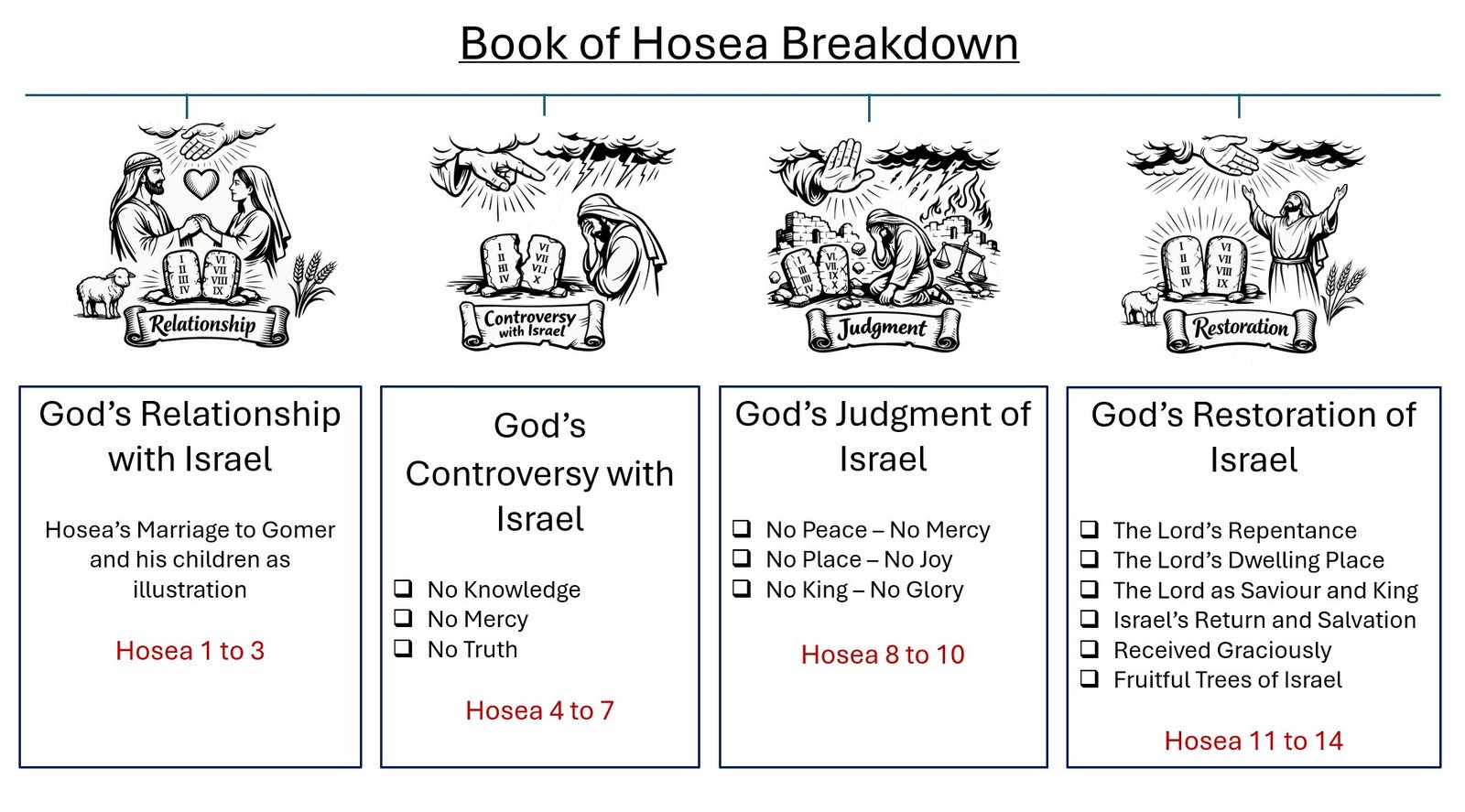
Hosea 2 begins by talking about family, just like chapters 1 and 3. But the book’s not about Hosea’s family drama, even though that’s what commentaries focus on; it’s not all about Hosea and Gomer.
The family’s only an illustration, an example in prophecy, and each chapter quickly turns to the real subject, which is Israel and God’s covenant relationship with them. Hosea’s wife pictures the land of Israel, while the children picture the people of the land.
God takes the private pain of a prophet and turns it into a public picture of His own heart toward Israel.
Israel had left the God who redeemed them and run to other nations and gone after Baal, thanking an idol for the blessings God Himself had provided them. They took God’s rain, God’s grain, God’s wine and God’s protection and attributed those blessings to foreign nations and foreign gods. Then they offered sacrifices and thanks to those false gods. It was spiritual adultery in its ugliest form.
Hosea 1:1 opens with Hosea’s marriage and children, while chapter 2 begins with the children being told something.
SAY ye unto your brethren, Ammi; and to your sisters, Ru-hamah.
In chapter 1, the children were named Lo‑ammi, meaning “not my people”, and Lo‑ruhamah, meaning “no mercy”.
Removing the “lo” reverses the judgment: Ammi means “my people,” and Ruhamah means “mercy.”
Then we go straight to verse 2, Hosea 2:2,
Plead with your mother, plead: for she is not my wife, neither am I her husband: let her therefore put away her whoredoms out of her sight, and her adulteries from between her breasts;
God speaks to those people still in the land. Remember that they’ve not gone into captivity as yet. He tells them to plead with their mother, the land of Israel, to put away her whoredoms. The appeal’s both personal and legal, because Israel’s relationship with God is through a covenant, like a marriage contract.
The mother represents the land, Israel, serving false gods. The children represent the people who must call their nation to repentance. Hosea’s told to make the situation public. In real life, parents hide their problems from children, but here God uses the family to expose Israel’s sin.
Prophets do this: they make hidden sin public, so people have a chance to turn. Israel’s idolatry had been secret and tolerated, so God sends Hosea to reveal it.
This public exposure follows the same pattern Jesus later describes in Matthew 18:15-18 for dealing with sin among Israel’s remnant: first private appeal, then public confrontation if there’s no repentance. Hosea’s already appealed privately; now he speaks to the children, and soon the sin will be exposed to the lovers and to the whole world.
When sin stays hidden, people accept it and are shocked when judgment comes. But Scripture calls sin out, warns of consequences, and then shows that God’s judgment is just.
So when God says in Hosea 2:2,
Plead with your mother, for she is not my wife, neither am I her husband,
He’s telling the people to appeal to their nation to repent.
The names Ammi and Ruhamah show this.
This is quite shocking language, especially for children, but it describes what adultery does to a marriage. Hosea did marry Gomer—chapter 1 makes that clear—but her actions make her “not his wife” in practice.
Adultery destroys the unity of marriage. When one spouse lives as if married to someone else, the real marriage can’t function. This is why adultery was forbidden in the Ten Commandments and why the law allowed severe punishment. When adultery becomes acceptable in a society, families collapse. But in Hosea we have to continually remind ourselves that it’s not a lesson on marriage but an illustration of relationship with God and His people, Israel, even though the example can be applied to marriage today.
Jesus teaches from the law in Matthew 19:9.
He says divorce is not permitted “except for fornication,” and remember Jesus is in His earthly ministry here, under the law, preaching the law.
Even though adultery breaks the marriage covenant, it doesn’t mean reconciliation’s impossible, but it means the marriage is not operating as a marriage while adultery continues. Hosea’s not simply saying he’s done with his wife; he’s saying her adultery is active, still going on, and while she’s living with other men, he can’t act as her husband, and she’s not acting as his wife. So he tells the children to plead with her to put away her whoredoms and adulteries. When we see that Hosea is relating this to Israel and God’s relationship, it makes perfect sense.
Jeremiah 3 helps explain it.
Jeremiah asks whether a man can take back a wife who has gone to another man, again, talking of Israel’s relationship with God, even though the lesson fits perfectly to any marriage.
In Jeremiah 3:6–16, the land is defiled. Yet God says to Israel, “Turn again to me.” He pleads with them to return to Him, even after their spiritual adultery. God also tells Judah to look at what Israel did and learn a lesson from them. Jeremiah 3 says how Israel went up upon every high mountain and under every green tree, and played the harlot and how God called her to return, but she did not. Hosea is in the same situation: God tells the children to plead with their mother, Israel, to come back to God.
This shows God’s mercy.
The strict law demanded death for adultery, but God calls for repentance instead. In John 8, in the account of the woman taken in adultery, Jesus doesn’t deny the law; He says,
He that is without sin among you, let him first cast a stone at her.
He teaches mercy while still acknowledging the seriousness of sin. God had every right to destroy Israel for centuries of adultery, yet He continually called them back. In the wilderness He often threatened to destroy the nation, but Moses interceded, and God showed patience and mercy.
Jeremiah 3:8 says God, speaking of backsliding Israel, said,
I had put her away, and given her a bill of divorce; yet her treacherous sister Judah feared not, but went and played the harlot also.
Human marriages don’t have that same divine promise, which is why divorce among people is different from God’s dealings with Israel, even though the basic truths apply.
They had a contract. It wasn’t a literal marriage. The marriage was symbolic, an illustration of how Israel and God were in union with each other.
Israel broke the contract. God let them break it, but then, after repeated warnings to turn back to Him failed, God gave them the punishment that was due under that contract. But God said, “I still have a promise I have to keep with them, the promise I made to their fathers.”
Israel’s adultery and the consequences of it were a warning to Judah. They could look north and see the tribes gone. If Israel had repented, Judah would have learned from it. But Israel did not return, and Judah followed the same sins.
We see here that the problem was not the original sin itself; the problem was refusing to return when God called. Sin doesn’t prevent salvation—refusing God’s offer does.
God is merciful, but when people repeatedly say “no,” judgment comes. Judah saw Israel’s fall and still played the harlot despite God’s pleading in Hosea 2:2 for her to repent before the consequences arrive.
Hosea 2:3-4 warns of the consequences of failing to heed God’s plea in the previous verse,
Lest I strip her naked, and set her as in the day that she was born, and make her as a wilderness, and set her like a dry land, and slay her with thirst.
And I will not have mercy upon her children; for they be the children of whoredoms.
This is harsh language, but it refers to removing the blessings God gave Israel.
Exodus 21:10 lists a husband’s obligations: food, clothing, and marital rights. God fulfilled these for Israel—He fed them, clothed them, protected them, and blessed them. But if Israel rejects Him, He’ll stop providing these things.
Israel was “born” as a nation in the wilderness. In Exodus 4:22, God is instructing Moses,
And thou shalt say unto Pharaoh, Thus saith the LORD, Israel is my son, even my firstborn:
There they had no land, no food, no water, and no clothing except what God provided miraculously. When God says He’ll “strip her naked” and “slay her with thirst,” He means He’ll remove His blessings and return her to those wilderness conditions. The land’s prosperity came from Him, and without Him it becomes dry and barren.
Hosea 2:4 continues,
And I will not have mercy upon her children, for they be the children of whoredoms.
Before dealing with the fairness of the children suffering for the mother’s sin, we need to understand the phrase “upon the children.” The mother represents the land, and the children represent the people living in it. So the judgment is not only on the land becoming barren; the people themselves will be removed and will suffer the loss of God’s provision. The whole nation experiences the consequences.
People ask, “What about innocent individuals?”
Scripture shows that God knows every person.
Look at the story of Lot. Abraham asked God if He would spare Sodom for even ten righteous people. God is the final judge. Even if someone suffers in national judgment, God rectifies all things in His own judgment. This life is not perfectly fair because sinners rule it, but God’s judgment is always righteous.
Jeremiah suffered during Judah’s fall, yet he trusted God because he knew God was doing exactly what He said He would do. Men of faith don’t accuse God when judgment comes; they understand why it comes.
God tells the children to plead with their mother because repentance could have changed the situation. But they did not respond. So the children suffer as part of the nation’s sin. Hosea says they are “children of whoredoms”, which reflects both the covenant picture and the marriage illustration. In real marriages, adultery harms more than the spouse—it harms the children. When a marriage breaks, children lose the stability God designed for them. They become victims of the parents’ sin.
Adultery also creates confusion about identity.
In a faithful marriage, no one asks, “Who is the father?” But adultery introduces doubt. Hosea’s wife conceived children while running after other men. Without modern tests, the only way to know a child’s father was through marriage. That’s why marriage is so important—it establishes responsibility for the children’s origin, upbringing, teaching, and provision.
When adultery enters, that clarity disappears. Hosea’s children picture Israel’s spiritual confusion: Are they God’s people or Baal’s? God says, “You are not my people,” because their unfaithfulness makes their identity unclear.
Hosea 2:5 explains the mother’s guilt, and we read:
For their mother hath played the harlot: she that conceived them hath done shamefully: for she said, I will go after my lovers, that give me my bread and my water, my wool and my flax, mine oil and my drink.
She’s played the harlot, saying, I’ll go after my lovers. She pursues them for bread, water, wool, flax, oil, and drink—basic provisions and luxuries.
She believes her lovers give her these things, but this is a lie. Later God says, “She did not know that I gave her corn and wine and oil.” She’s deceived, claiming “my bread, my water,” as if her lovers provide them. This pictures Israel chasing false gods and foreign nations for prosperity, thinking they can supply what only God gives. Her hope is false, and her lovers can’t help her. She ends up empty, not realising she abandoned the only One who truly provided for her.
Hosea 2:6–8 shows God speaking to Israel through Hosea,
Therefore, behold, I will hedge up thy way with thorns, and make a wall, that she shall not find her paths.
And she shall follow after her lovers, but she shall not overtake them; and she shall seek them, but shall not find them: then shall she say, I will go and return to my first husband; for then was it better with me than now.
For she did not know that I gave her corn, and wine, and oil, and multiplied her silver and gold, which they prepared for Baal.
We can see that the focus is not Hosea’s marriage but God’s prophecy to the nation. God says He’ll hedge up her way with thorns and make a wall so she cannot find her paths.
Israel will try to follow her lovers—false gods and foreign nations—but she’ll not reach them. She’ll seek them but not find them.
Then she’ll say, “I will return to my first husband, for it was better with me then than now.”
God is describing how He’ll hinder Israel’s idolatry, so she eventually sees her need to return.
This is not God forcing her will.
His first desire was obedience, but Israel repeatedly refused. So He blocks her destructive path, like someone putting safeguards in place to avoid sin. Lamentations 3:7 uses similar language:
He hath hedged me about, that I cannot get out: he hath made my chain heavy.
God becomes a burden only when someone wants to sin. Israel wants adultery; God places thorns in her way so she can’t reach her lovers. The goal is repentance.
Verse 7 to 8 (Hosea 2:7-8) shows her returning home because she can’t find her lovers, but she doesn’t realise that God arranged this. Sinners can’t often see God’s help; they only see their own desires. Israel thinks she’s entitled to what she receives, but fails to recognise that it was God who gave her corn, wine, and oil, and multiplied her silver and gold; but instead of thanking Him and appreciating Him, they offered thanksgiving to an idol, praising a deaf and dumb idol of a false God, Baal, with God’s blessings in their hands. Could there be anything more offensive to the One who gave the provision?
This didn’t just happen once; it had been happening over and over again for a long time.
This sounds exactly like Paul’s description of the state of mankind in Romans chapters 1 and 2.
The powerful Ezekiel 16 describes the same relationship.
God found Israel abandoned like a newborn left in a field. No one pitied her, but God said, “Live,” and raised her. He caused her to grow, clothed her, washed her, adorned her, and entered into a covenant with her. She became His.
He provided everything—food, clothing, protection, and honour. Ezekiel lists the ornaments, linen, silk, jewels, and the crown God gave her. He was a perfect husband according to the covenant, but she turned her back on Him and went to other lovers.
Israel became glorious in the days of David and Solomon because of God’s provision. But verse 15 says she trusted in her own beauty and played the harlot. She forgot who made her beautiful and used her blessings to attract other lovers.
Hosea’s picture matches Ezekiel’s: God birthed Israel, nurtured her, and made her His own. Yet she used His gifts to serve other gods, thinking it was those other gods, her lovers, who provided them.
This is spiritual blindness. Israel chased false hopes, believing idols and other nations could supply what only God gives. Her lovers could not help her; they were not in covenant with her. She ended up empty, not knowing the One who truly provided for her.
God’s hedging, or His withholding of blessings, and His call to return all show His mercy. Though Israel committed adultery, God still sought her repentance because of His covenant promises.
Ezekiel 16 describes Israel’s offerings to Baal in detail. She used God’s garments, jewels, oil, incense, flour, honey, and children in idolatry. Verse 20 says she even sacrificed her sons and daughters in fire—children God said were His. This shows how deep her unfaithfulness ran.
Baal means “lord,” which makes the deception subtle.
People could say “praise the lord” while worshipping a false god. Jesus told the Samaritan woman, “You worship you know not what.” The issue is not the word “lord” but who’s being worshipped. If the god described is not the God of Scripture, it’s Baal.
Ezekiel 16:30–34 shows how extreme Israel’s adultery became.
God calls her an “imperious woman,” harsh and stubborn. She built high places everywhere and acted like a prostitute—but not even a normal one. Prostitutes receive payment; Israel paid her lovers.
She hired foreign nations and false gods to protect her instead of trusting God. She gave gifts to them, and they gave nothing in return. This was spiritual adultery: paying Egypt, Syria, and others for help instead of trusting the Lord.
God says He’ll gather all her lovers—nations and idols—and expose her nakedness to them. They’ll witness her shame. This is exactly what happened to the northern tribes: the nations they trusted turned against them, leaving them exposed and destroyed.
The harsh language in Hosea and Ezekiel is intentional.
God’s not being “impolite”; He’s revealing the seriousness of Israel’s sin. The marriage imagery is meant to shock them awake. Their spiritual adultery—forsaking God’s covenant—is worse than physical adultery. Wrong doctrine and false worship are more destructive than the sins described in the marriage picture. God uses strong language because Israel’s betrayal is deep, persistent, and deadly.
People often judge wrongly.
They boycott worldly companies for their woke stances or for other reasons they disagree with, but fully endorse churches that preach a false gospel.
A statue of Satan is obviously wrong, but a church preaching a distorted Christ is more dangerous. Israel made the same mistake—mixing truth with lies—and God exposes this in Hosea 2.
Hosea 2:9-10 says,
Therefore will I return, and take away my corn in the time thereof, and my wine in the season thereof, and will recover my wool and my flax given to cover her nakedness.
And now will I discover her lewdness in the sight of her lovers, and none shall deliver her out of mine hand.
God will return and take away the provision He gave Israel. She used His gifts to serve Baal, so He removes them.
He’ll later “discover her lewdness in the sight of her lovers”; in other words, He’ll make her sin public.
This is the same picture Ezekiel 16 gives: God exposes Israel’s shame because she refuses to repent. Public exposure’s not cruelty; it’s honest judgment. Marriage is public; adultery hides in darkness. God brings hidden sin into the light so its seriousness is seen.
Israel was birthed, raised, and prospered by God, yet she credited Baal, so God removes His provision and protection.
God calls Assyria the rod of His anger in Isaiah 10:5. God “returns” by sending Assyria to take back what He gave.
Habakkuk struggled with this—God using a wicked nation to judge His people—but God promised He would also judge the wicked nation afterwards. God’s always righteous: He judges Israel, then judges her enemies.
When God becomes Israel’s enemy, she learns that Baal, the chief god of a pagan religion, can’t help her.
Hosea 2:10 says none will deliver her from God’s hand. She brought nothing into the land; she’ll leave with nothing.
This again mirrors Romans 1.
Before Israel existed, the nations knew God but were not thankful. They became vain, darkened, and idolatrous. Now Israel repeats the same decline. They knew God, were not thankful, and changed His glory into images. So God “gave them up” to uncleanness. He gives Israel up to her lovers.
This is why Hosea uses the imagery of marriage and adultery. False gods always allow moral corruption. Only the God of Scripture demands faithfulness. Israel’s spiritual adultery leads to the same moral decay described in Romans 1—unnatural affections, dishonoured bodies, and a reprobate mind. When Israel rejects God, she becomes like the nations God once judged.
Hosea 2:11-12 says,
I will also cause all her mirth to cease, her feast days, her new moons, and her sabbaths, and all her solemn feasts. And I will destroy her vines and her fig trees, whereof she hath said, These are my rewards that my lovers have given me: and I will make them a forest, and the beasts of the field shall eat them.
Israel performed these rituals for a false god. By exposing her shame and removing her celebrations, God severs her relationships with idols and nations. He even causes their mirth, their exultation, joy, and rejoicing to cease. Public judgment destroys the sinful alliances she formed. It’s severe, but it’s righteous, and it’s meant to bring her back to the only true God.
Isaiah 1:10–14 and Amos 5:21–27 show God rejecting Israel’s worship.
He says, “I hate, I despise your feast days… I will not smell in your solemn assemblies,” meaning He won’t accept their incense or burnt offerings. Israel kept the rituals—burnt offerings, music, incense—but God refused them because they were offered to the wrong god and in the wrong spirit.
Amos says God will not hear their songs or accept their offerings because they’re not worshipping Him as He commanded. In Amos 5:24, He wants judgment to run down as waters and righteousness as a mighty stream, not empty ceremonies.
Israel mixed truth with idolatry, carrying the tabernacle of the false god Moloch and the star of their god.
Their worship looked religious, but it was corrupt. So God said He would send them “into captivity beyond Damascus,” Assyria.
Hosea 2 echoes this.
God removes Israel’s feast days, new moons, Sabbaths, and solemn assemblies because they were performed for Baal. If they won’t worship rightly, He stops the worship entirely, then He destroys their vines and fig trees—symbols of joy, prosperity, and religious life—and turns them into a forest for beasts to devour. Israel claimed, “These are my rewards that my lovers gave me,” but God says He will take back what He provided.
Now on to Hosea 2:13, which says,
And I will visit upon her the days of Baalim, wherein she burned incense to them, and she decked herself with her earrings and her jewels, and she went after her lovers, and forgat me, saith the LORD.
God will “visit upon her the days of Baalim,” meaning He’ll judge her as He did in earlier generations. Judges 2 describes those days: Israel did evil, served Baalim, forsook the Lord, and followed the gods of the surrounding nations. They provoked God to anger, and He delivered them into the hands of spoilers. They could no longer stand before their enemies.
This cycle repeats throughout Judges: Israel forgets God, serves idols, suffers judgment, repents, and is delivered—only to fall again.
Judges 3:7 says Israel “forgot the Lord their God and served Baalim and the groves.”
God’s anger burned, and He punished them. Hosea warns that God will do the same now.
Even though Israel has a king, the king is not doing his job, so God Himself will discipline the nation. He’ll bring bondage, remove blessings, expose their shame, and judge them as He did in the days when they forgot Him.
The point is clear: Israel’s worship was corrupt, her alliances were sinful, and her rituals were empty. God removes her prosperity, exposes her idolatry, and brings judgment so she’ll see that Baal can’t save her. Only when righteousness flows like a mighty stream will her worship be accepted again.
All this is so we can get an accurate background knowledge of Israel and God’s dealings with her so that we can properly understand what Paul’s going to teach us in Romans chapters 9 to 11 about Israel falling again after the Lord had come.
He said He would come to bring the kingdom He promised to Israel’s fathers and to make the nation great again, but Israel again rejected Him when He came, just as they always did.
We’ve taken this break after Romans chapter 8 in our verse-by-verse study of Romans to get this incredible background story before moving back to Romans chapter 9.
God bless you all.